You’ll find teeth whitening costs ranging from $5 for basic whitening toothpaste to $1,500 for a clinical laser session. Over-the-counter strips and gels run $20–$100, dentist-supervised kits cost $200–$500, and in-office treatments fall between $300–$1,200. Your location, treatment type, and provider expertise all influence final pricing. Hidden costs like touch-up trays and sensitivity products can add $100–$300 annually. The full breakdown ahead will help you match the right option to your budget.
Key Takeaways
- Teeth whitening costs range from $5 for basic toothpaste to $1,500 for clinical laser procedures, depending on treatment type.
- In-office whitening typically costs $300–$1,200, covering professional-grade materials, clinical oversight, and tailored aftercare instructions.
- Dentist-supervised kits ($200–$500) outperform store-bought options ($20–$100) through custom trays and higher-concentration whitening gels.
- Geographic location significantly impacts pricing; major cities like New York charge $800–$1,200+, while rural areas average $300–$500.
- Hidden costs, including follow-up care and sensitivity products, can add $100–$300 annually beyond the initial treatment price.
What Does Teeth Whitening Cost in 2026?
Teeth whitening costs in 2026 span a wide range depending on the method you choose, from as little as $5 for basic whitening toothpaste to $1,500 or more for clinical laser procedures.
Current Teeth Whitening Trends show three primary tiers: over-the-counter products ($20–$100), dentist-supervised at-home kits ($200–$500), and in-office professional treatments ($300–$1,200).
Teeth whitening options range from affordable over-the-counter products to professional in-office treatments reaching $1,200.
Your location greatly influences pricing—metropolitan areas like New York or Los Angeles consistently exceed $1,000 per session, while suburban and rural practices offer sessions between $350 and $800.
Whitening Safety remains a critical factor when selecting your method, as higher-concentration professional treatments require clinical supervision to minimize sensitivity and enamel risk.
Understanding these cost tiers helps you make a precise, informed decision aligned with your budget and desired results.
In-Office Whitening Prices: What You’re Actually Paying For
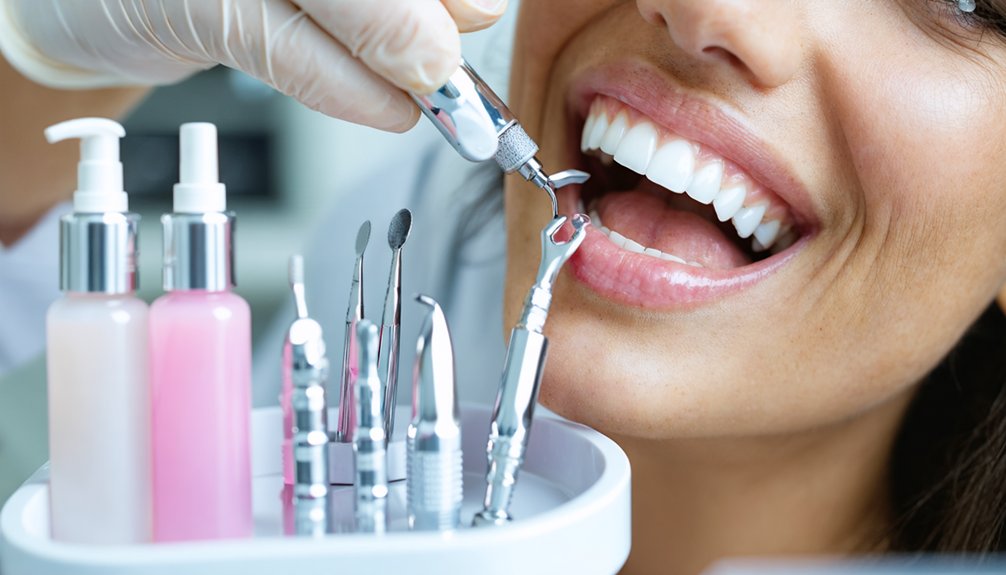
When you choose in-office whitening, you’re paying for more than a brighter smile—you’re investing in clinical oversight, professional-grade materials, and controlled application that OTC products simply can’t replicate. Costs typically range from $300 to $1,200, depending on location and whitening technology used, whether laser, LED, or chemical bleaching.
Your dentist documents treatment duration with before photos, tracks enamel response, and addresses sensitivity issues before they escalate.
You’ll receive precise aftercare instructions tailored to your specific results—something no box kit provides.
Professional recommendations also help you separate whitening myths from clinical fact, ensuring you don’t over-treat or damage enamel chasing unrealistic outcomes.
The patient experience at this level is structured, accountable, and outcome-driven—exactly what you need when you want measurable, lasting results.
Dentist-Supervised At-Home Kits vs. Store-Bought Options
When comparing your whitening options, dentist-supervised at-home kits typically run between $200 and $500, while store-bought strips and gels average just $20 to $70 per kit.
The professional kits justify their higher price through custom-fitted trays and higher-concentration bleaching gels that deliver more consistent, longer-lasting results.
OTC products, however, use lower peroxide concentrations and universal tray designs that limit their contact with tooth surfaces, reducing overall effectiveness.
Cost Comparison Overview
Choosing between dentist-supervised at-home kits and store-bought whitening products comes down to two key factors: cost and effectiveness.
Dentist-supervised kits typically run between $200 and $500, delivering professional-grade gel concentrations that produce measurable, lasting results. Store-bought strips and gels, by contrast, range from $20 to $100, offering convenience at a considerably lower price point.
This cost comparison reveals a clear trade-off: you’re paying more for custom-fitted trays, higher peroxide concentrations, and clinician oversight with dentist-supervised options.
OTC products use weaker formulations, which limits treatment effectiveness and extends the time required to see noticeable changes. If you prioritize controlled, predictable outcomes, the higher upfront investment in dentist-supervised kits delivers stronger whitening performance and a more precise, tailored approach to your specific dental profile.
Professional Kit Effectiveness
Beyond price, the performance gap between dentist-supervised kits and store-bought options is where the real difference becomes apparent.
Professional kit benefits stem primarily from higher-concentration whitening gel types, typically carbamide peroxide ranging from 10% to 22%, compared to OTC products limited to 10% or less by regulation.
Custom-fitted trays guarantee the gel maintains consistent contact with each tooth surface, maximizing penetration and minimizing gum irritation. You’re not guessing with a one-size strip; you’re applying a precisely calibrated treatment.
Store-bought kits use lower-concentration hydrogen peroxide gels that produce surface-level results, often fading within weeks.
Dentist-supervised systems deliver deeper, longer-lasting whitening because you control the application schedule under professional guidance, giving you measurable, sustained outcomes rather than temporary brightness.
OTC Product Limitations
Store-bought whitening kits carry a fundamental constraint: regulatory caps limit over-the-counter hydrogen peroxide concentrations to 10% or less, which restricts how deeply the bleaching agents can penetrate enamel.
When you conduct an ingredient analysis across leading brands, you’ll find significant price variance—ranging from $20 to $100—yet OTC effectiveness remains consistently inferior to professional alternatives.
User testimonials frequently cite uneven application ease, sensitivity flare-ups, and disappointing long-term results.
Brand comparisons reveal that premium-priced strips don’t substantially outperform mid-range options, making high-end OTC purchases questionable investments.
Safety concerns also persist; unsupervised use can cause gum irritation when strips shift during wear.
You’re ultimately trading clinical precision for convenience—a compromise that rarely delivers the controlled, measurable outcomes that dentist-supervised treatments consistently produce.
Whitening Strips, Gels, and Toothpastes: Full OTC Cost Breakdown
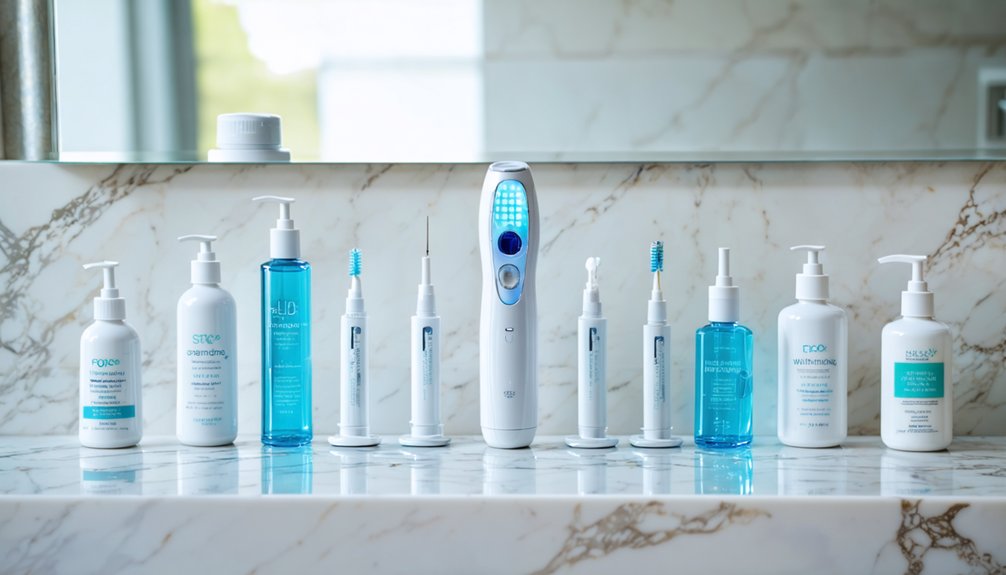
Over-the-counter whitening products fall into three broad categories — strips and gels, pens, and toothpastes — each carrying a distinct price point.
Budget options start as low as $5, while premium kits reach $100. Here’s how the breakdown looks:
- Strips and gels: $20–$70 per kit (mid-range); up to $100 for premium brands
- Whitening pens: $20–$60, offering portability but limited whitening effectiveness
- Whitening toothpastes: $5–$20, the most affordable entry point
When making ingredient comparisons, you’ll notice higher-priced products typically contain stronger peroxide concentrations, directly influencing results.
Low-end options ($5–$25) often rely on abrasives rather than bleaching agents, reducing their clinical value.
Understanding these distinctions lets you allocate your budget toward products that deliver measurable, verifiable outcomes rather than marginal improvements.
Laser and LED Whitening Costs: Is the Premium Worth It?
When you choose laser or LED whitening, you’re paying a significant premium over standard bleaching methods, with laser procedures starting around $600 and reaching up to $1,500 for advanced clinical sessions.
Several factors drive that cost higher, including the technology used, the provider’s location, and whether a take-home tray kit is bundled into the treatment plan.
Understanding what you actually get for that investment helps you determine whether the faster results and professional oversight justify the expense compared to less intensive alternatives.
Laser Versus LED Pricing
How much more does laser whitening actually cost compared to LED—and does the difference justify the price?
Laser techniques typically run $600 to $1,500 per session, while LED effectiveness comes at a lower entry point, often between $300 and $800.
Consumer trends show growing interest in LED options as technology advancements narrow the performance gap. Dentist recommendations increasingly weigh procedure duration, treatment safety, and aesthetic results when advising you on which system fits your goals.
Laser sessions tend to deliver faster oxidation of stains, but patient experiences vary based on sensitivity and enamel condition.
Aftercare tips remain consistent across both methods: avoid staining foods and use desensitizing toothpaste.
Ultimately, you’re paying a premium for speed with laser, not necessarily superior long-term results.
Key Cost Influencing Factors
Several variables directly shape what you’ll pay for laser or LED whitening, and understanding them helps you assess whether the cost reflects genuine clinical value.
Cost factors span multiple dimensions: treatment types differ in protocol complexity, gel concentration, and session duration.
Geographic differences drive significant price gaps—urban clinics in high-cost markets consistently charge premiums over suburban or rural providers.
Material quality and brand influence pricing substantially, as proprietary systems like Zoom command higher fees than generic alternatives.
Professional expertise adds measurable value; board-certified specialists typically charge more than general practitioners.
Patient preferences for accelerated results or combined take-home trays also increase totals.
Staying aware of current market trends helps you benchmark quotes accurately and negotiate from a position of informed confidence.
Value For Your Money
Understanding what drives the cost of laser and LED whitening puts you in a better position to evaluate whether those costs are actually justified. Sessions typically range from $600 to $1,200, commanding a significant premium over OTC alternatives.
Value perception here depends on measurable outcomes: faster results, higher gel concentrations, and clinician oversight reduce risks associated with misuse.
However, you should weigh long term effects carefully. Professional whitening doesn’t permanently alter enamel pigmentation—results typically last one to three years with proper maintenance.
Without dietary adjustments and follow-up care, retreatment costs accumulate. The premium makes sense if you prioritize speed, safety, and clinical precision. It doesn’t if you expect permanent transformation.
Control your expectations, and the investment becomes a calculated, justifiable decision rather than an expensive assumption.
How Your Location Changes Your Teeth Whitening Price
Where you live can greatly affect what you’ll pay for teeth whitening. Regional variations create significant pricing differences across the country, making location impact a critical factor in your budgeting decisions.
- Major metros (New York, Los Angeles, San Francisco): Expect $800–$1,200+ per in-office session.
- Standard urban areas: Mid-range pricing typically falls between $500–$800.
- Suburban markets: Rates generally run $350–$800, offering measurable savings over city clinics.
- Rural areas: Lower overhead costs push prices toward the $300–$500 range.
In the UK, London and the South East command £350–£700, while provincial areas offer £200–£450.
Knowing your regional market lets you negotiate confidently, compare providers accurately, and allocate your whitening budget with precision.
Every Teeth Whitening Method Ranked by Cost
From budget-friendly drugstore strips to high-end laser treatments, teeth whitening methods span a wide cost range—and knowing where each option falls helps you match your goals to your wallet.
Teeth whitening costs vary widely—knowing your options helps you find the right fit for your goals and budget.
Here’s how common teeth whitening techniques rank by cost:
- Whitening toothpaste: $5–$20
- OTC strips and gels: $20–$100
- Dentist-supervised at-home trays: $200–$500
- Zoom or LED in-office whitening: $450–$500
- Standard professional in-office treatment: $500–$800
- Laser whitening: $600–$1,200+
Each tier delivers progressively stronger results, but whitening safety concerns increase with concentration levels.
Higher-grade peroxide formulas require professional oversight to minimize sensitivity and enamel risks.
You’re not just paying for whiter teeth—you’re paying for controlled application, customized trays, and clinical monitoring that OTC products can’t replicate.
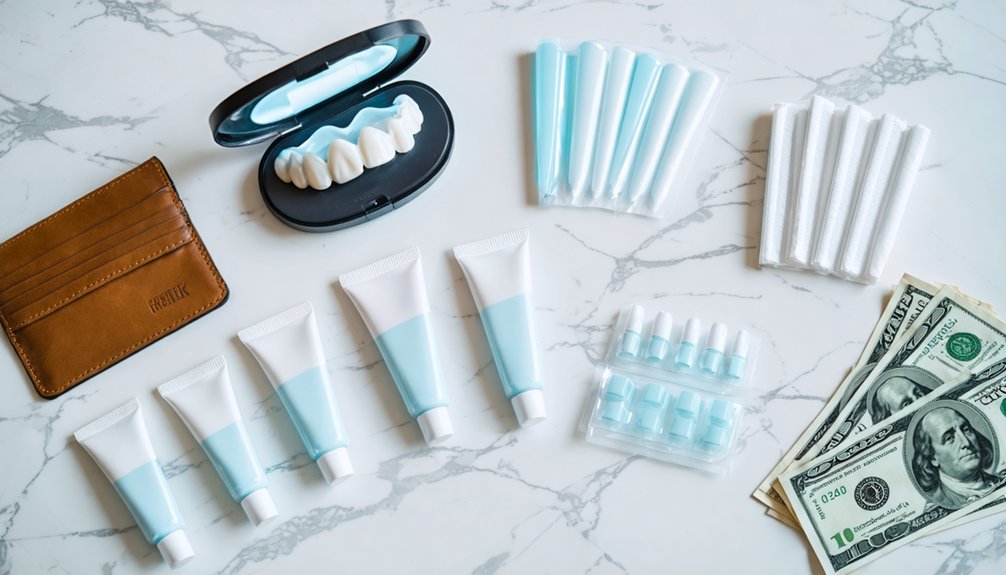
Hidden Teeth Whitening Costs Most Guides Don’t Mention
Most teeth whitening guides focus on the sticker price of a single treatment while glossing over the additional expenses that accumulate before, during, and after your procedure.
Lacking price transparency costs you more than money—it undermines your expected results and long-term planning.
Watch for these hidden fees and overlooked factors:
- Follow-up care: Touch-up trays or gels add $100–$300 annually, directly affecting product longevity and treatment frequency.
- Pre-treatment dental work: Cavities or gum issues must be resolved first, increasing your total spend.
- Insurance coverage: Most plans exclude cosmetic whitening entirely, leaving zero reimbursement.
- Potential side effects: Sensitivity management products—specialized toothpastes or desensitizing gels—carry additional maintenance costs you’ll absorb out-of-pocket.
Factor these into your budget before committing.
Which Teeth Whitening Option Matches Your Budget?
Once you’ve accounted for hidden costs, you can match a whitening method to what you’re actually willing to spend.
If your budget is under $70, OTC strips and gels are your most practical entry point—don’t let whitening myths convince you they’re ineffective; consistent use delivers measurable results.
Between $200 and $500, dentist-supervised at-home trays offer professional-grade gel concentrations with custom-fitted trays.
For budgets exceeding $500, in-office laser or Zoom treatments provide the most controlled, accelerated outcomes, particularly in suburban areas where costs stay closer to $350 to $800. Metropolitan clinics regularly exceed $1,000.
Budget-friendly options exist across every tier, but your final choice should align with both your financial ceiling and your expected shade improvement timeline.
How to Pay Less and Still Get Professional Whitening Results
You can reduce your out-of-pocket costs by negotiating directly with your dentist, asking about payment plans, or requesting bundled pricing that combines in-office treatment with take-home trays.
Timing your appointment around promotional periods—such as new patient specials or seasonal discounts—can further lower the expense.
Pairing a single professional session with maintenance-grade OTC strips lets you extend and preserve results without committing to repeated clinical visits.
Dentist Negotiation Strategies
Although professional teeth whitening carries a premium price tag, several practical negotiation strategies can help you secure substantial discounts without compromising on clinical results.
Using deliberate negotiation tactics and demanding price transparency puts you firmly in control.
- Request itemized cost breakdowns — Ask for line-by-line pricing to identify where reductions are possible.
- Bundle treatments strategically — Combine whitening with scheduled cleanings to negotiate package discounts.
- Leverage competitor quotes — Present lower estimates from rival practices to prompt price matching.
- Inquire about seasonal promotions — Many clinics offer introductory or holiday rates between $300–$500, considerably below standard fees.
Approaching your dentist with documented market rates and clear budget parameters transforms a fixed-price transaction into a negotiable agreement favoring your financial interests.
Timing Discounts Wisely
Timing your whitening appointment strategically can reduce costs by hundreds of dollars while still delivering clinical-grade results.
Dental practices frequently offer discount opportunities during slower booking periods, typically January through February and late summer. You’ll find that new patient promotions, end-of-fiscal-quarter specials, and holiday campaigns can lower in-office sessions from $800 to under $500.
Monitor clinic newsletters and dental membership programs for limited-window pricing. Timing strategies also include scheduling consultations mid-week, when practices are less booked and practitioners are more receptive to negotiating package deals combining in-office treatment with custom take-home trays.
Bundling both services often costs less than purchasing each separately. Controlling when you book directly influences what you pay without compromising the professional-grade outcome you’re targeting.
Combining OTC and Professional
Combining over-the-counter products with professional treatment is one of the most cost-effective strategies for achieving clinical-grade whitening results without paying full in-office prices.
OTC effectiveness improves considerably when layered with professional synergy—your dentist’s custom trays enhance gel penetration, while maintenance strips preserve results between sessions.
A cost benefit analysis supports this hybrid approach:
- Start with a professional in-office session ($450–$800) to establish your baseline shade.
- Use dentist-supplied custom trays ($200–$500) for targeted follow-up treatments.
- Maintain results with OTC strips ($20–$60) between professional appointments.
- Track user experiences by documenting shade changes to optimize your product rotation.
This structured protocol can reduce your annual whitening spend by 40–60% without compromising clinical outcomes.
Frequently Asked Questions
Does Teeth Whitening Work on Crowns, Veneers, or Dental Implants?
Like painting over glass, crowns whitening won’t penetrate artificial surfaces. Whitening doesn’t affect crowns, veneers, or implants — veneers effectiveness remains unchanged by bleaching agents, so you’ll need replacement or color-matching for consistent results.
How Long Does Professional Teeth Whitening Typically Last Before Fading?
Your whitening longevity typically spans one to three years with professional treatment. You’ll maintain color maintenance effectively by avoiding staining foods, practicing consistent oral hygiene, and scheduling periodic touch-up sessions as needed.
Can Teeth Whitening Cause Permanent Damage to Enamel or Gums?
Like a double-edged sword, whitening won’t permanently damage you if done correctly. You may experience temporary enamel sensitivity and gum irritation, but following professional guidelines keeps lasting harm at bay.
Is Teeth Whitening Ever Covered by Dental Insurance Plans?
Most dental insurance plans don’t cover teeth whitening since it’s cosmetic. You’ll need to handle cost comparison yourself, as insurance coverage rarely applies, making out-of-pocket budgeting essential for your whitening investment.
Are Teeth Whitening Treatments Safe During Pregnancy or Breastfeeding?
You should avoid teeth whitening during pregnancy or breastfeeding due to unconfirmed safety data. Prioritize natural remedies instead, and schedule a dental consultation to address your breastfeeding concerns before pursuing any whitening treatments.
References
- https://smilepedia.net/cosmetic-dentistry/teeth-whitening-cost-complete-price-guide-2026
- https://www.rejuv-health.com/cosmetic-dentistry/teeth-whitening-cost/
- https://www.carecredit.com/well-u/health-wellness/teeth-whitening-costs/
- https://dentistoftorrance.com/blog/teeth-whitening-cost
- https://realdentalcosts.com/en/teeth-whitening/
- https://www.authoritydental.org/teeth-whitening-cost
- https://www.atlantadentalspa.com/blogs/how-much-is-teeth-whitening-at-dentist
- https://www.bruinsdentist.com/understanding-how-much-to-whiten-teeth-a-complete-price-breakdown
- https://dentovex.com/blog/teeth-whitening-cost-price-comparison-2025/
- https://www.humana.com/dental-insurance/dental-resources/teeth-whitening