Teeth whitening can lighten your teeth by 1 to 8 shades, measured on the 16-step VITA classical shade guide. Over-the-counter products typically achieve 1–3 shades, dentist-supervised at-home kits deliver 3–6 shades over 1–4 weeks, and in-office treatments using high-concentration peroxide can produce 4–8 shades in a single session. Your baseline shade, stain type, and enamel porosity all determine your personal whitening ceiling—and each factor plays a more significant role than most patients realize.
Key Takeaways
- OTC whitening products typically achieve 1–3 shades improvement, while dentist-supervised at-home kits yield 3–6 shades over 1–4 weeks.
- In-office whitening using high-concentration peroxide achieves 4–8 shades in a single appointment, with light activation pushing results toward 6–8 shades.
- Extrinsic stains from coffee, tea, or wine respond best, often achieving 6–10 shade improvements with professional treatment.
- Intrinsic stains from tetracycline, fluorosis, or pulpal hemorrhage resist standard bleaching, significantly limiting achievable shade change.
- Results are measured using the 16-shade VITA classical guide, with outcomes varying by baseline shade, enamel porosity, and stain depth.
What “Shades Whiter” Actually Means for Your Teeth
When dentists talk about “shades whiter,” they’re referring to discrete steps on the VITA classical shade guide, a standardized 16-shade scale organized from lightest to darkest across four hue groups: A (reddish-brown), B (reddish-yellow), C (gray), and D (reddish-gray). Each step represents a measurable, clinically validated change in lightness value.
Bleaching agents—primarily hydrogen or carbamide peroxide—oxidize chromogenic compounds within enamel and dentin, producing quantifiable shifts along this scale. Your baseline shade, enamel porosity, and stain type determine how many units you’ll realistically achieve.
Moving from A3.5 to A1, for example, represents approximately 4 to 5 discrete units. Tooth sensitivity frequently increases as peroxide concentration rises, reflecting deeper enamel penetration.
Understanding this framework lets you set precise, data-driven expectations before committing to any whitening protocol.
The Average Shade Improvement Across All Whitening Methods
Across all whitening categories, average shade improvement spans a wide but predictable range—from 1 to 2 units with OTC washes and paint-on gels up to 6 to 8 units with professional in-office LED or laser protocols.
Dentist-supervised take-home trays using 10–22% carbamide peroxide deliver 3 to 6 shades over one to four weeks.
Standard OTC strips average 1 to 3 units.
Shade measurement via the VITA guide quantifies these differences objectively, giving you a reliable benchmark before and after treatment.
Advances in dental technology—particularly high-concentration peroxide activation with calibrated LED systems—consistently push single-session results toward the upper range.
Your initial tooth shade, enamel porosity, and stain type ultimately determine where within each method’s range your outcome will fall.
In-Office Whitening: How Many Shades Can You Gain?
When you choose in-office whitening, you can typically expect 4 to 8 shades of improvement in a single appointment, with high-concentration peroxide formulas (25–40%) driving the most significant gains.
Light-activated systems, such as LED or laser protocols, push results toward the upper range, delivering 6 to 8 shades in a 60-minute session.
Single-visit outcomes depend heavily on your initial shade and stain type, but in-office treatment consistently outperforms all other whitening methods in both speed and magnitude of improvement.
Typical Shade Gains
In a single in-office whitening session, most patients gain between 4 and 8 shades on the VITA shade guide. High-concentration peroxide formulations—typically 25–40%—drive this range, with LED or laser activation pushing results toward the upper threshold.
If your baseline shade is heavily stained from extrinsic sources like coffee or wine, you’re positioned to achieve gains closer to 8 shades. However, you should factor in two clinical trade-offs: dental sensitivity and enamel erosion.
High-peroxide exposure can temporarily heighten pulpal sensitivity and, with repeated aggressive applications, compromise enamel integrity. Your clinician will calibrate concentration and exposure time to maximize shade improvement while protecting enamel structure.
Understanding this balance lets you set precise expectations and make informed protocol decisions before your appointment.
Single-Visit Results
Knowing your typical shade gain range sets the foundation for understanding what a single appointment can realistically deliver. In-office power bleaching with high-concentration peroxide (25–40%) produces 5 to 8 shades of improvement in one 60-minute session. Philips Zoom WhiteSpeed consistently delivers 6 to 8 shades within a single visit.
Your outcome depends on two critical biological variables: enamel thickness and salivary pH. Thinner enamel allows peroxide to penetrate more rapidly, while an optimal salivary pH supports sustained oxidation throughout the procedure. Deviations in either factor can compress your result toward the lower end of the clinical range.
Yellow or brown extrinsic staining responds most aggressively, occasionally exceeding 8 shades. Intrinsic discoloration requires managed expectations and a structured follow-up protocol.
Light-Activated Whitening Benefits
Light-activated whitening amplifies your shade gains by accelerating the oxidation reaction at the enamel surface. LED or laser energy raises peroxide decomposition rates, enabling high-concentration formulations (25–40%) to penetrate dentin tubules more efficiently within a compressed timeframe.
Clinical data confirm that professional LED light-activated protocols deliver 6 to 8 shades of improvement in a single 60-minute session—measurably superior to non-activated applications.
From a dental health standpoint, controlled light exposure optimizes peroxide activation without unnecessary thermal stress on pulpal tissue.
You’ll want to acknowledge, however, that accelerated oxidation correlates with transient tooth sensitivity in some patients, typically resolving within 24 to 48 hours. Managing exposure duration and peroxide concentration lets you maximize shade improvement while keeping sensitivity within clinically acceptable parameters.
Do Laser and LED Treatments Whiten More Than Standard In-Office?
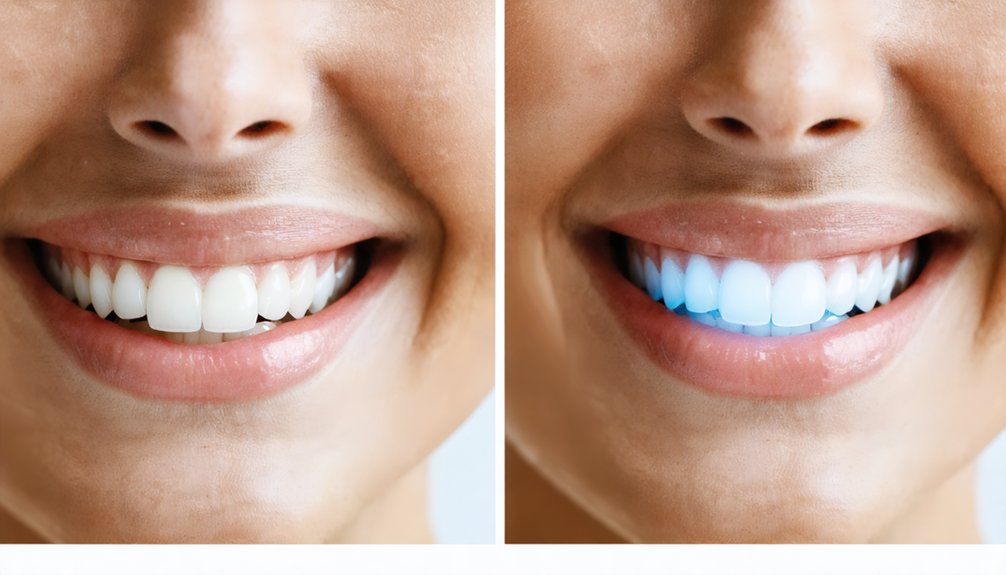
When comparing laser and LED treatments to standard in-office whitening, the clinical differences are narrower than marketing often suggests. Both approaches use high-concentration bleaching agents to oxidize teeth pigmentation, typically achieving 5 to 8 shades of improvement.
Light activation accelerates the peroxide reaction but doesn’t fundamentally alter the ceiling of achievable results. Standard in-office protocols using 25–40% hydrogen peroxide without light activation produce comparable ΔE values of 4 to 8 in a single session.
Laser and LED systems may reduce chair time and enhance patient comfort, but peer-reviewed data doesn’t consistently support superior shade outcomes. Your stain type, enamel porosity, and baseline shade remain the dominant variables—not the light source used during treatment.
At-Home Kits: What Shade Results Should You Expect?
At-home kits deliver measurably lower shade improvements than in-office systems, and understanding that gap helps you set realistic clinical expectations.
Dentist-supervised custom trays using 10–22% carbamide peroxide whitening gel formulation typically achieve 3 to 6 shades over one to four weeks.
Thorough home protocols average 4 to 6 VITA units, comparable to dual in-office applications when you maintain consistent wear schedules.
Over-the-counter strips, by contrast, yield only 1 to 3 shade units due to lower-concentration whitening gel formulation and reduced contact time.
Dental sensitivity is a primary compliance barrier, particularly with higher-carbamide options worn overnight.
You can mitigate dental sensitivity by reducing daily application frequency or selecting desensitizing adjuncts.
Non-compliant patients retain only 30–40% of improvement at twelve months versus 55–60% for those maintaining protocol adherence.
Over-the-Counter Products: Where Do They Fall Short?
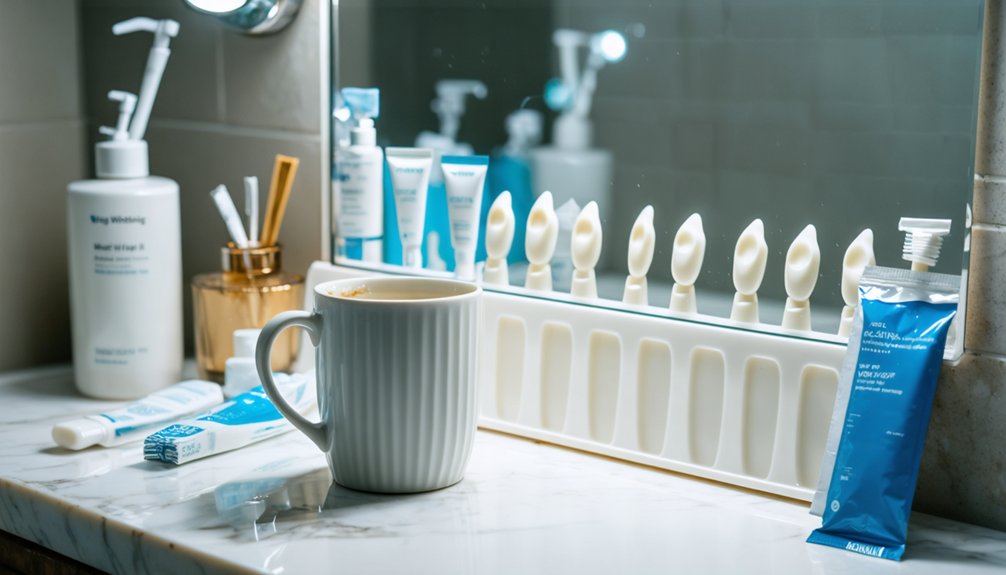
Over-the-counter whitening products occupy the lowest tier of efficacy, delivering only 1 to 3 shade units on average—well below the 3 to 6 shades achievable with dentist-supervised custom trays.
Strips, paint-on gels, and whitening washes utilize low-concentration peroxide formulations that can’t penetrate enamel deeply enough to address moderate or severe discoloration.
If your dietary habits include regular coffee, tea, or wine consumption, OTC products will likely fail to counteract the staining load effectively.
Tooth sensitivity from these products remains comparatively mild due to their diluted active ingredients, but that reduced irritation reflects reduced potency rather than advanced formulation.
You’re fundamentally trading meaningful shade improvement for convenience—a compromise that yields cosmetically insufficient results if your baseline discoloration exceeds superficial extrinsic staining.
How Extrinsic vs. Intrinsic Stains Determine Your Whitening Ceiling
The origin of your tooth discoloration—whether extrinsic or intrinsic—directly sets the ceiling on how many shades any whitening protocol can realistically deliver.
Extrinsic stains from coffee, tea, or wine respond aggressively to peroxide-based stain removal, frequently yielding 6 to 10 shade improvements under professional protocols. Your enamel porosity accelerates peroxide penetration, amplifying results but also elevating dental sensitivity risk.
Intrinsic discoloration—caused by tetracycline exposure, fluorosis, or pulpal hemorrhage—resists standard bleaching chemistry. Even high-concentration peroxide achieves limited ΔE values against mineralized chromogens embedded within dentin.
You’re working against structural pigmentation, not surface deposits, which fundamentally compresses your achievable range. Identifying your stain classification before committing to any protocol isn’t optional—it’s the clinical variable that determines whether your whitening ceiling sits at 3 shades or 10.
Why Enamel Porosity and Stain Depth Alter Your Final Shade
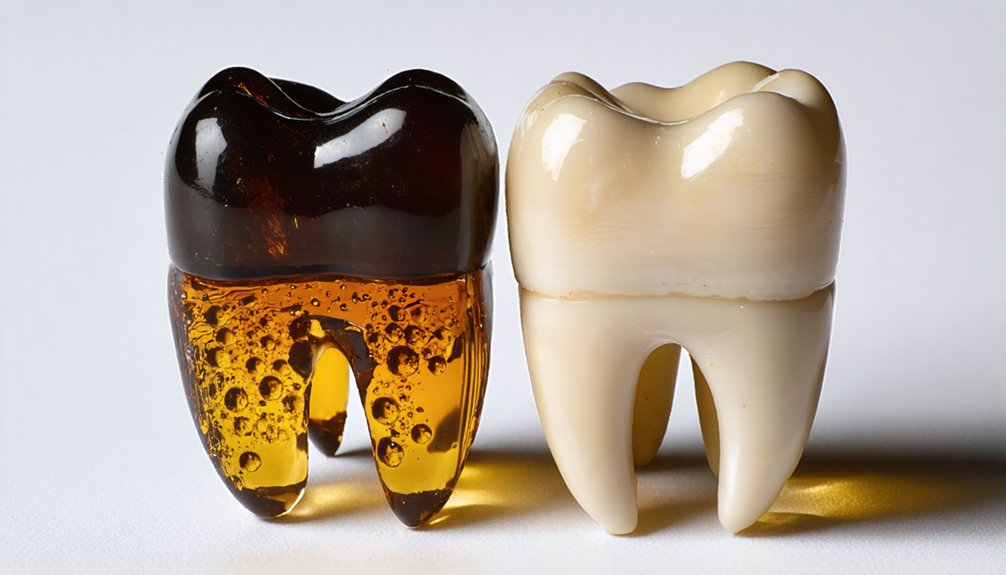
Enamel porosity directly controls how deeply peroxide ions penetrate toward chromogen-laden dentin, making it one of the strongest predictors of your final shade outcome. Highly porous enamel accelerates peroxide diffusion, enabling faster chromophore oxidation and greater shade gains—often reaching the upper range of 6 to 8 VITA units.
Conversely, dense, low-porosity enamel restricts peroxide migration, capping your results closer to 2 to 4 units regardless of treatment concentration.
Stain depth compounds this variable significantly. Superficial extrinsic deposits respond predictably within a single session, while deeply embedded chromogens within dentinal tubules demand extended exposure times or repeated applications.
If your staining originates below the enamel-dentin junction, even high-concentration peroxide protocols typically plateau below their maximum advertised shade improvement range.
How Long Do Your Whitening Results Actually Last?
After achieving your target shade, you can expect results to hold reasonably well for the first several months before shade rebound begins progressing between 6 and 12 months post-treatment.
Your compliance with maintenance protocols directly determines how much improvement you retain — compliant patients preserve 55 to 60% of their whitening gains at 12 months, while non-compliant patients retain only 30 to 40%.
To extend your results, you’ll need a structured maintenance plan that accounts for your stain type, enamel porosity, and the whitening method originally used.
Typical Results Timeline
Whitening results don’t last indefinitely, and understanding the typical timeline helps set realistic expectations. Shade rebound begins progressively within 6 to 12 months post-treatment, driven by dietary pigments reabsorbing into teeth enamel and ongoing lifestyle factors.
Without maintenance, non-compliant patients retain only 30 to 40% of their achieved improvement at the 12-month mark. Patients who implement structured maintenance protocols—typically periodic applications of whitening gels via custom trays—retain 55 to 60% of improvement at 12 months.
In-office results may feel dramatic initially, but your retention rate depends heavily on compliance. Scheduling touch-up sessions every 3 to 6 months and limiting staining agents like coffee and wine gives you measurable control over long-term outcomes.
Shade Rebound Factors
How long your results last depends less on the treatment itself and more on the biological and behavioral factors that accelerate shade rebound. Rebound occurs progressively over 6 to 12 months post-treatment, with compliant patients retaining 55 to 60% of improvement while non-compliant patients retain only 30 to 40%.
Key accelerants include chromogenic dietary exposure, tobacco use, and enamel erosion from acidic beverages, which increases surface porosity and accelerates stain uptake. Dental sensitivity following treatment often signals compromised enamel integrity, a condition that predisposes teeth to faster rebound if protective protocols aren’t followed.
Your initial tooth shade, enamel thickness, and staining origin—extrinsic versus intrinsic—also directly influence retention rates. Controlling these variables through maintenance protocols gives you measurable leverage over long-term results.
Maintaining Your Whitening
The longevity of your whitening results depends on a measurable retention curve: shade rebound progresses over 6 to 12 months, and whether you retain 55 to 60% or drop to 30 to 40% of your achieved improvement hinges entirely on protocol compliance.
Control your outcomes by implementing these evidence-backed maintenance strategies:
- Schedule quarterly touch-up sessions using dentist-supervised take-home trays to counteract progressive rebound and protect your cost considerations investment
- Monitor dental sensitivity patterns as a clinical signal to adjust bleaching frequency before enamel stress compounds rebound
- Track your shade baseline monthly so objective data—not perception—drives your re-treatment decisions
Non-compliant patients lose the majority of measurable gains within one year. Compliance isn’t optional; it’s the variable separating lasting clinical success from wasted expenditure.
Frequently Asked Questions
Can Teeth Whitening Work on Dental Crowns, Veneers, or Implants?
Whitening won’t alter your crowns, veneers, or implants—these dental materials don’t respond to peroxide. You’ll face strict whitening limitations, as only natural enamel lightens, potentially creating shade mismatches between treated teeth and existing restorations.
Is Teeth Whitening Safe for People With Sensitive Teeth or Gums?
Worried about discomfort? You can safely whiten with sensitive teeth—lower peroxide concentrations minimize tooth sensitivity and gum irritation. You’ll want to consult your dentist to select an appropriate protocol that protects your enamel and soft tissues effectively.
How Old Do You Need to Be for Teeth Whitening?
Most dentists recommend you wait until you’re 18, ensuring age considerations align with full dental maturity requirements. Your permanent teeth must’ve fully erupted and root development completed before you safely undergo any professional whitening protocol.
Can Whitening Treatments Damage Tooth Enamel Permanently Over Time?
Professional whitening won’t cause permanent enamel erosion when used correctly. You’ll face minimal long-term effects if you follow recommended protocols, as evidence confirms that supervised treatments preserve enamel integrity while delivering effective, controlled shade improvements.
How Many Whitening Sessions Are Typically Needed for Optimal Results?
You’ll typically need one to three in-office sessions or two to four weeks of at-home tray use for ideal results. Whitening consistency and managing dental sensitivity between sessions guarantee you’re achieving maximum, evidence-based shade improvement efficiently.
References
- https://www.suttonpda.com/teeth-whitening-results/
- https://dentalpedia.co/clinical/teeth-whitening-results-complete-guide.html
- https://dentalcareofchinohills.com/blog/how-many-shades-whiter-will-my-teeth-be-after-whitening/
- https://pearlysmiledentalstudio.com/teeth-whitening-how-many-shades-can-your-teeth-lighten/
- https://www.teethwhiteningseoul.com/blog/how-many-shades-can-teeth-whitening-improve
- https://www.innovasmilesdental.com/calculator/whitening
- https://www.doylestowndentalgroup.com/blog/shades-whiter-expect-teeth/48850
- https://www.dentistrytoday.com/sp-440471052/
- https://drlorengrossman.com/how-many-shades-whiter-with-zoom-can-you-actually-get/
- https://harleyteethwhitening.co.uk/how-many-shades-whiter-can-your-teeth-go/