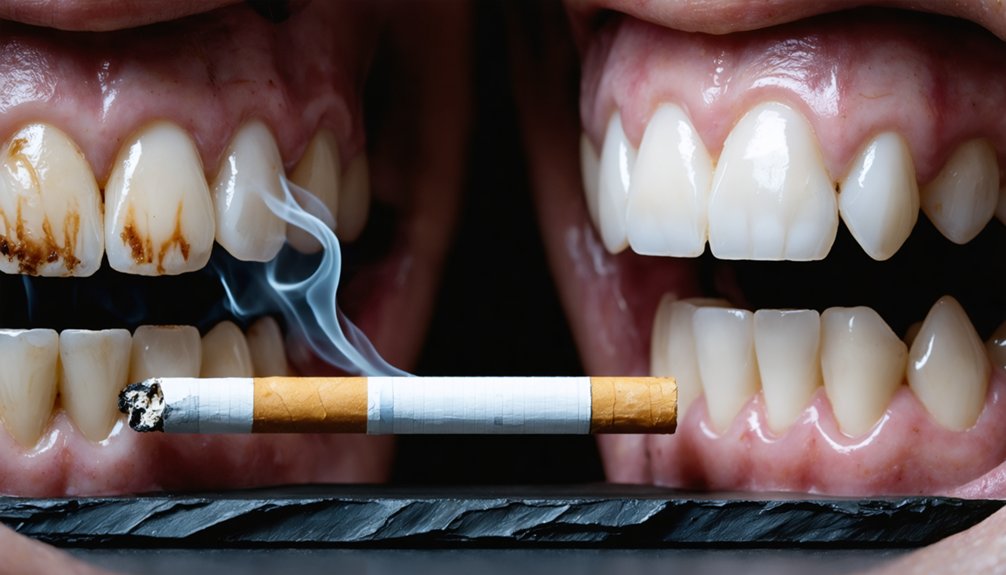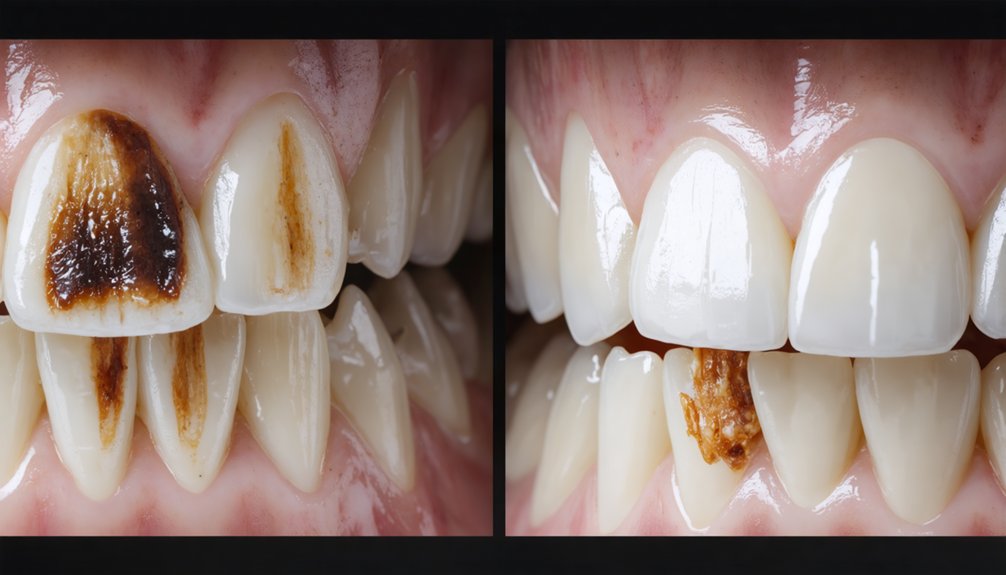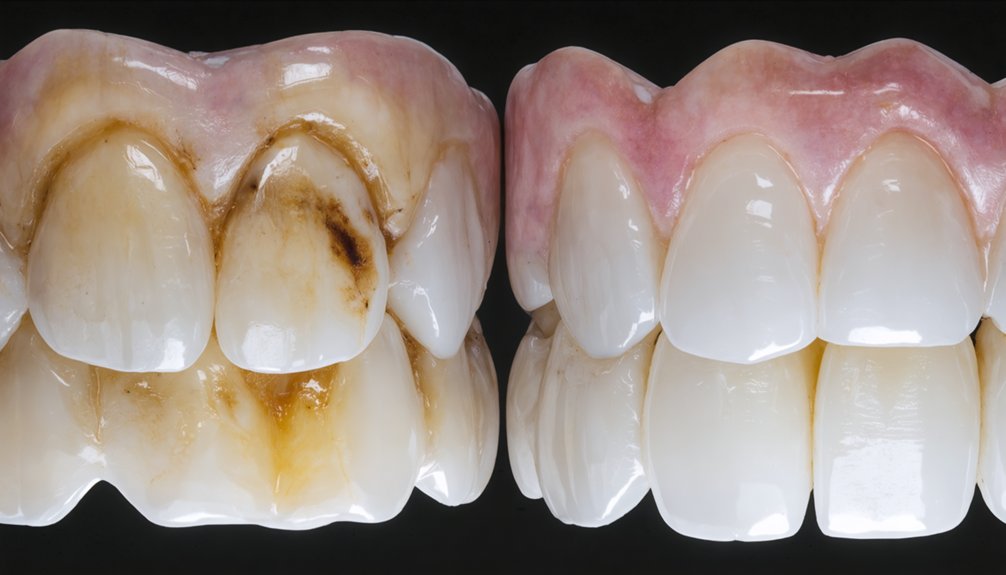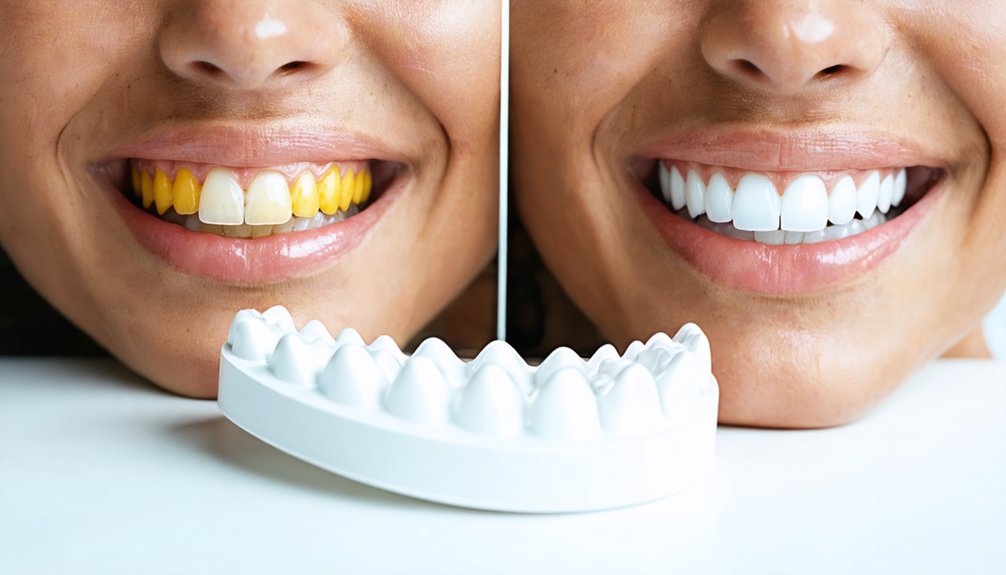
Whitening smoker’s teeth can take anywhere from a single in-office session to several weeks of consistent treatment, depending on how deeply nicotine and tar have penetrated your enamel. Surface stains may clear up within 7–10 days using at-home kits, while long-term smokers often need 3–4 professional sessions for deeper discoloration. Standard whitening agents struggle to break through chemically bonded tobacco compounds, so targeted strategies matter. The sections below cover everything you need to know to get real results.
Key Takeaways
- In-office whitening delivers results within 15 minutes to one hour, though heavily stained smoker’s teeth may require multiple sessions.
- At-home LED whitening kits typically show visible results within 7–10 days with consistent daily use.
- Moderate surface stains usually need 1–2 whitening sessions, while deep discoloration from long-term smoking requires 3–4 sessions.
- Overall treatment duration ranges from a single session to several weeks, depending on stain severity and depth.
- Ongoing smoking can undo whitening results within months, requiring touch-ups every 3–6 months to maintain brightness.
Why Smoker’s Teeth Are Harder To Whiten Than Others
Smoking doesn’t just stain your teeth on the surface—it drives nicotine and tar deep into your enamel, where standard whitening agents struggle to reach. Over time, these compounds penetrate the porous enamel structure, creating discoloration that surface-level treatments can’t fully address.
Nicotine and tar don’t just stain your teeth—they penetrate deep into enamel where standard whitening can’t reach.
Your dental hygiene routine matters, but even consistent brushing won’t reverse the chemical bonding that tobacco creates within the enamel layers.
Additionally, prolonged smoking can increase tooth sensitivity, which limits the concentration of whitening agents you can tolerate during treatment. Higher-strength formulas are often necessary to break through deeply embedded stains, yet they must be applied carefully to avoid aggravating sensitive teeth.
This balance between effectiveness and comfort is precisely why smoker’s teeth demand a more strategic, targeted whitening approach than non-smokers typically require.
How Long Does It Actually Take To Whiten Smoker’s Teeth?
Depending on the severity of your staining and the treatment method you choose, whitening smoker’s teeth can take anywhere from a single session to several weeks of consistent treatment.
In-office professional whitening delivers results in 15 minutes to one hour, though long-term smokers often require multiple sessions to address staining agents that have penetrated deep into the dental enamel.
At-home LED kits with high-concentration professional gel typically produce noticeable results within 7–10 days when used 30 minutes daily.
Over-the-counter strips work more gradually, showing improvement within days to a week for surface stains only.
The deeper the staining agents have saturated your dental enamel, the longer your treatment timeline becomes.
Choosing a higher-concentration professional method gives you the most control over achieving faster, measurable results.
What Happens During Professional In-Office Whitening
Professional in-office whitening is your fastest path to measurable results, making it the go-to option when staining runs deep. Your dentist applies a high-concentration peroxide gel directly to your teeth, often activating it with a specialized light. The entire session runs 15 minutes to one hour, giving you immediate, visible improvement while protecting your dental health.
Here’s what you can expect during treatment:
- Preparation – Your dentist isolates your gums to shield soft tissue from the bleaching agent.
- Application – High-concentration gel targets both surface stains and deeper discoloration embedded in enamel.
- Activation – A curing light accelerates the whitening process, maximizing enamel strength preservation while breaking down stubborn tobacco compounds.
Smokers with heavy staining may require multiple sessions for *ideal* results.
At-Home Whitening Options That Work on Tobacco Stains
If you’re looking for effective at-home solutions, your dentist can provide professional take-home whitening kits with custom-fitted trays and high-concentration gel that deliver stronger results than anything available over the counter.
These kits are particularly useful for tobacco stains because the custom trays guarantee consistent gel contact across all tooth surfaces.
For a more accessible option, whitening strips and gels offer gradual improvement when you use them consistently, though they’re better suited for surface stains than deeply embedded discoloration.
Professional Take-Home Whitening Kits
When over-the-counter strips and gels fall short of tackling deep tobacco stains, professional take-home whitening kits offer a stronger, more targeted solution. Your dentist custom-fits trays to your teeth, ensuring the high-concentration gel reaches every surface consistently—something generic strips can’t guarantee. This precision directly supports your dental health and long-term oral hygiene.
Here’s what makes these kits effective for smokers:
- Higher peroxide concentration — Dentist-prescribed gels penetrate enamel more deeply than retail alternatives.
- Custom-fitted trays — Eliminate gel leakage and maximize contact time with stained surfaces.
- Controlled treatment schedules — Your dentist tailors usage frequency to your staining severity, reducing overuse risks.
Results typically appear within 7–10 days, making this one of the most efficient at-home options available.
Whitening Strips And Gels
Whitening strips and gels offer a convenient middle ground between professional treatments and basic oral care products, though their effectiveness on tobacco stains depends heavily on the concentration of hydrogen or carbamide peroxide in the formula.
Unlike natural remedies or herbal extracts, clinically formulated strips and gels deliver measurable peroxide penetration into enamel. For smokers, you’ll need products containing at least 10–15% carbamide peroxide to see noticeable results.
Consistent daily application over 7–14 days produces the most reliable outcome. Surface tobacco stains respond faster than deeply embedded discoloration, so long-term smokers may require extended use or multiple cycles.
Without professional-grade concentration, over-the-counter strips typically fall short against stubborn tar buildup, making formula strength your most critical selection factor.
How Many Sessions Do Long-Term Smokers Usually Need?
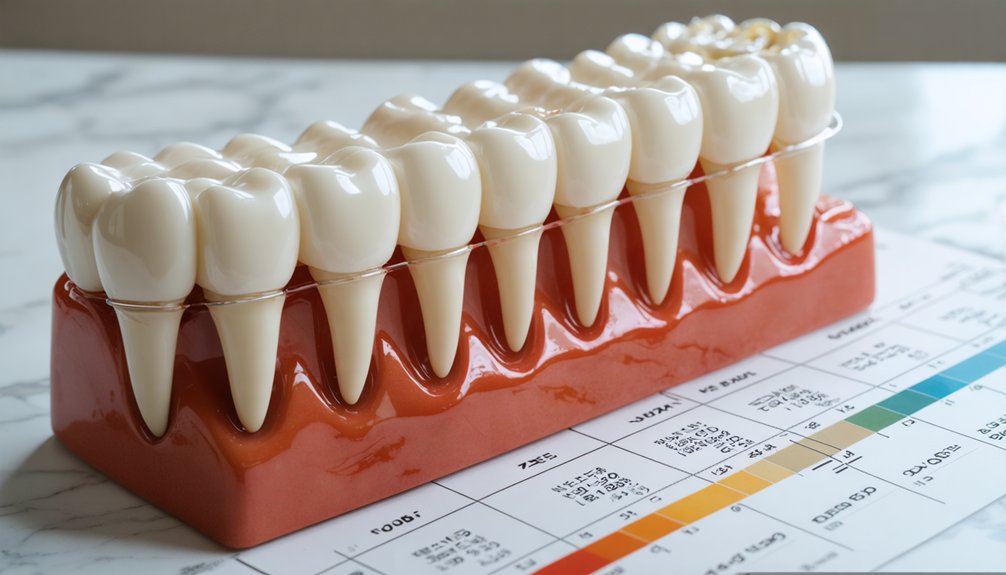
Long-term smokers typically require more than one professional whitening session to achieve noticeable results, since deeply embedded tobacco stains don’t respond the same way surface stains do. Your treatment plan depends on your smoking history, enamel condition, and exposure to dietary acids, which accelerate discoloration and increase tooth sensitivity.
Deeply embedded tobacco stains require multiple professional sessions — your smoking history, enamel condition, and diet all shape your treatment plan.
Here’s what you can expect:
- 1–2 sessions – Suitable for moderate smokers with surface-level staining and manageable tooth sensitivity.
- 3–4 sessions – Necessary for long-term smokers with deeply embedded discoloration that resists standard bleaching concentrations.
- Ongoing maintenance sessions every 3–6 months – Required to sustain results if you continue smoking after treatment.
You control the outcome by combining professional sessions with consistent at-home care and reduced smoking frequency.
Does Quitting Smoking Speed Up Whitening Results?
Quitting smoking doesn’t instantly brighten your teeth, but it does stop new nicotine and tar stains from accumulating, which allows whitening treatments to work more effectively and last markedly longer.
Surface stains may begin fading within 3–6 months with consistent dental hygiene, while deeper discoloration often requires professional treatment to fully address.
Once you quit, your whitening results can last considerably longer—potentially years rather than months. You’ll also need touch-ups far less frequently.
Pairing whitening treatments with improved dietary habits, such as reducing coffee and acidic foods, amplifies your results.
Ex-smokers typically see their best natural improvement within 6–12 months.
Ultimately, quitting gives every whitening method—professional or at-home—the best possible conditions to deliver lasting, measurable results.
How Long Do Results Last if You Still Smoke?
If you continue smoking after whitening, you can expect your results to fade within a few months due to constant nicotine and tar exposure.
You’ll need touch-ups every 3–6 months—roughly twice as often as non-smokers—to maintain visible brightness.
Quitting or even reducing your smoking frequency considerably extends your whitening results and cuts down on the cost and time of repeat treatments.
Results Fade Quickly
Whitening results don’t last long if you continue smoking. Nicotine and tar redeposit stains rapidly onto enamel, undoing treatment within months. Your oral hygiene routine and dietary habits directly influence how quickly discoloration returns.
Key factors accelerating fade:
- Nicotine and tar exposure — Each cigarette deposits fresh staining compounds onto enamel, compressing your results window from months to weeks.
- Poor oral hygiene — Inconsistent brushing and skipping professional cleanings allow surface stains to embed deeper, making future whitening less effective.
- Dietary habits — Combining smoking with staining foods and beverages like coffee or wine speeds up discoloration much faster than smoking alone.
Without behavioral changes, you’ll need touch-ups every three to six months just to maintain a baseline level of brightness.
Touch-Ups More Frequent
Smokers typically need touch-ups every three to six months, compared to the six months to two years non-smokers enjoy between treatments. If you smoke heavily, monthly touch-ups may become necessary to maintain visible brightness. This accelerated schedule increases your overall cost, and since dental insurance rarely covers cosmetic whitening, you’ll want to budget accordingly.
Frequent treatments also raise your risk of tooth sensitivity, so spacing sessions strategically matters. Using a desensitizing toothpaste between treatments helps manage discomfort without sacrificing maintenance frequency.
Professional dental cleanings remain essential, as they remove surface buildup before it embeds deeper into enamel. Brushing immediately after smoking and rinsing with alcohol-free mouthwash after each cigarette reduces stain accumulation between sessions, making each touch-up more effective and extending your results slightly longer.
Quitting Extends Whitening
Here’s what quitting delivers:
- Stopped stain accumulation — Nicotine and tar no longer penetrate enamel, preserving your whitened baseline immediately.
- Extended whitening duration — Results that last months for active smokers can extend to one to two years after quitting.
- Improved treatment effectiveness — Without constant re-staining, whitening agents work deeper and hold longer between sessions.
You control how long your results last. Quitting removes the primary variable that undermines every whitening investment you make.
How Often Do Smokers Need Whitening Touch-Ups?

Because smoking continuously exposes your teeth to nicotine and tar, touch-ups are needed far more frequently than for non-smokers. You’ll typically require professional whitening every 3–6 months, compared to the 6–24 months most non-smokers manage. Depending on how heavily you smoke, monthly touch-ups may be necessary to maintain visible results.
Maintaining consistent dental hygiene is critical between sessions. Brushing immediately after smoking removes surface tar before it embeds into enamel. Rinsing with an alcohol-free mouthwash after each cigarette also slows restaining.
Be mindful of tooth sensitivity, which can intensify with frequent whitening treatments—your dentist can recommend lower-concentration formulas or spacing adjustments to minimize discomfort. Whitening pens offer a controlled, targeted option for maintaining brightness between scheduled professional appointments.
Daily Habits and Products That Slow Staining Between Treatments
Slowing stain buildup between whitening sessions requires consistent daily habits rather than reactive cleaning. Your oral hygiene routine directly controls how quickly tobacco compounds re-embed into enamel. Maintaining dental health between treatments means adopting targeted behaviors, not just brushing more frequently.
- Brush immediately after smoking — Removing tar and nicotine within minutes prevents chemical adhesion to enamel surfaces.
- Rinse with alcohol-free hydrogen peroxide mouthwash — This delivers mild bleaching action while supporting oral hygiene without drying tissues that accelerate staining.
- Use a whitening pen daily — Applying concentrated gel between sessions maintains brightness and counteracts incremental tobacco discoloration.
You’re not just preserving whitening results — you’re actively managing your dental health on a schedule that keeps staining compounds from gaining a foothold.
Frequently Asked Questions
Can Smoking Through a Straw Reduce Staining on Your Teeth?
Smoking through a straw won’t guarantee staining reduction or meaningful straw effectiveness. You’re still exposing your teeth to tar and nicotine. Brushing immediately after smoking and scheduling regular professional cleanings remain your best protective strategies.
Are There Specific Toothpaste Brands Best Suited for Smokers?
You’ll find that toothpastes containing activated charcoal or high-abrasive formulas maximize dental stain removal for smokers. Brands like Colgate Optic White and Arm & Hammer boost whitening toothpaste effectiveness, but they won’t replace professional treatment for deep tobacco stains.
Does the Type of Tobacco Smoked Affect Whitening Treatment Duration?
Like choosing between a light and dark roast, tobacco types directly affect staining severity. Darker tobaccos, like cigars or pipe tobacco, embed deeper stains, meaning you’ll need longer, more frequent whitening treatments than cigarette smokers typically require.
Can Teeth Whitening Damage Existing Dental Crowns or Veneers?
Whitening procedures won’t damage your crowns or veneers, but they won’t lighten them either. For ideal dental health, you should consult your dentist to guarantee your whitening treatment matches your existing restorations effectively.
Is Teeth Whitening Covered by Dental Insurance for Smokers?
Like pulling teeth, securing insurance coverage for whitening is tough—most dental plans won’t cover it since it’s cosmetic. You’ll typically pay out-of-pocket, but exploring flexible spending accounts can improve treatment affordability considerably.
References
- https://www.lockportdentalgroup.com/how-long-does-teeth-whitening-last-if-you-smoke/
- https://www.pittsfordfamilydental.com/blog/teeth-whitening-for-smoking-stains/
- https://parkwaysmiles.com/teeth-whitening-for-smokers/
- https://www.prosmiledentalcare.com/how-teeth-whitening-holds-up-for-smokers-coffee-drinkers/
- https://www.healthline.com/health/how-to-remove-nicotine-stains-from-teeth
- https://lygosdental.com/do-teeth-get-whiter-after-quitting-smoking/
- https://www.youtube.com/watch?v=1azaO9QWOs8
- https://martindaledental.com/how-to-keep-teeth-white-even-if-you-smoke/
- https://thewhiteningstore.com/blogs/smileblog/teeth-whitening-for-smokers