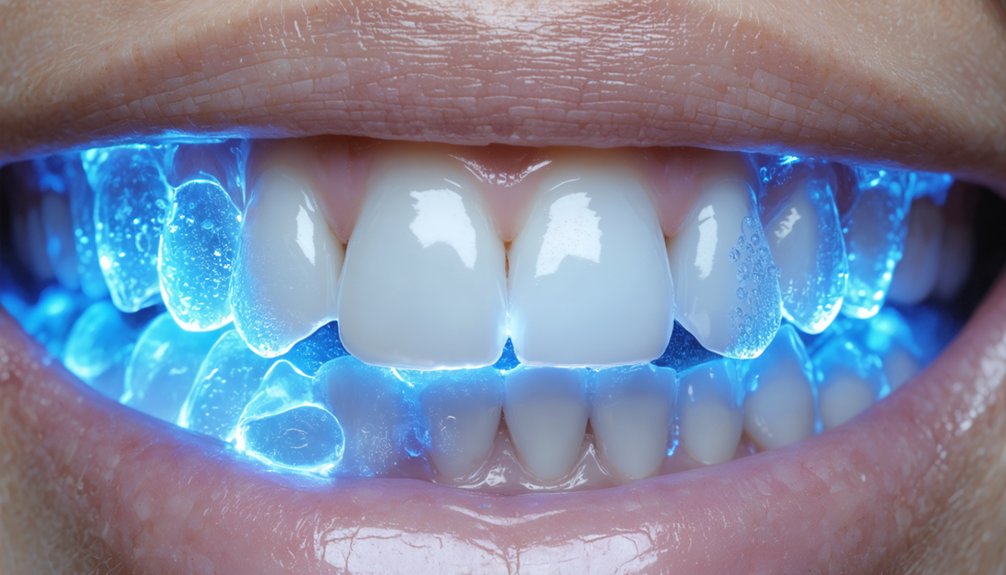
Blue LED light is the most widely used option in professional whitening systems, but it doesn’t actually speed up your results in any clinically meaningful way. The peroxide gel does the real work by penetrating enamel and oxidizing stain molecules. Light concentration and contact time drive your final shade change, not the light source. If you want to understand what truly separates effective whitening from marketing hype, keep going.
Key Takeaways
- Blue LED light is the most commonly used whitening light, offering lower heat output and consistent performance compared to halogen or laser alternatives.
- Violet LED (405–410 nm) shows some promise in accelerating whitening but lacks sufficient clinical evidence to confirm superior results.
- Clinical evidence suggests no light significantly accelerates whitening beyond what peroxide gel alone achieves.
- Gel concentration and contact time are the primary drivers of whitening speed, not the light source used.
- Speed claims associated with whitening lights are largely marketing-driven and not consistently supported by clinical trial data.
Does Whitening Light Actually Work, or Does the Gel Do Everything?
When you see a whitening kit advertised with a glowing blue light, it’s easy to assume the light is doing the heavy lifting—but the chemistry tells a different story. The actual chemical reactions that break down stains are driven by hydrogen peroxide or carbamide peroxide in the gel.
Light is marketed as an accelerant, but clinical evidence consistently shows it adds minimal benefit beyond what the peroxide accomplishes alone. Multiple reviews confirm that gel concentration and contact time are the variables you should control, not the light source.
Patient comfort also depends more on peroxide strength than on light exposure. If you want predictable results, focus on the protocol and formulation—those factors carry the real whitening power.
How Peroxide Drives Whitening: And Where Light Fits In
Peroxide is the chemical engine behind every meaningful whitening result you’ll get from a bleaching product. Hydrogen peroxide or carbamide peroxide penetrates enamel and breaks apart chromogen molecules through oxidation — that’s what shifts your shade.
Light enters the picture as a secondary variable. Some systems use blue or violet LED to accelerate the peroxide reaction, but clinical evidence consistently shows the gel’s concentration and contact time drive outcomes far more than the light source does.
Alternative marketing tactics often position light as the active agent, which distorts your decision-making. Patient preference toward high-tech devices is understandable, but your results depend on selecting the right peroxide strength and wearing protocol.
Control what’s clinically proven to matter — the chemistry, not the theater.
Why Blue LED Became the Default Whitening Light
When you look at most consumer whitening kits and dental office setups today, you’ll find blue LED as the standard light source—a position it earned largely through convenience, cost-efficiency, and smart marketing.
Blue LED produces considerably less heat than older halogen systems, reducing discomfort risk and making it practical for longer or repeated sessions.
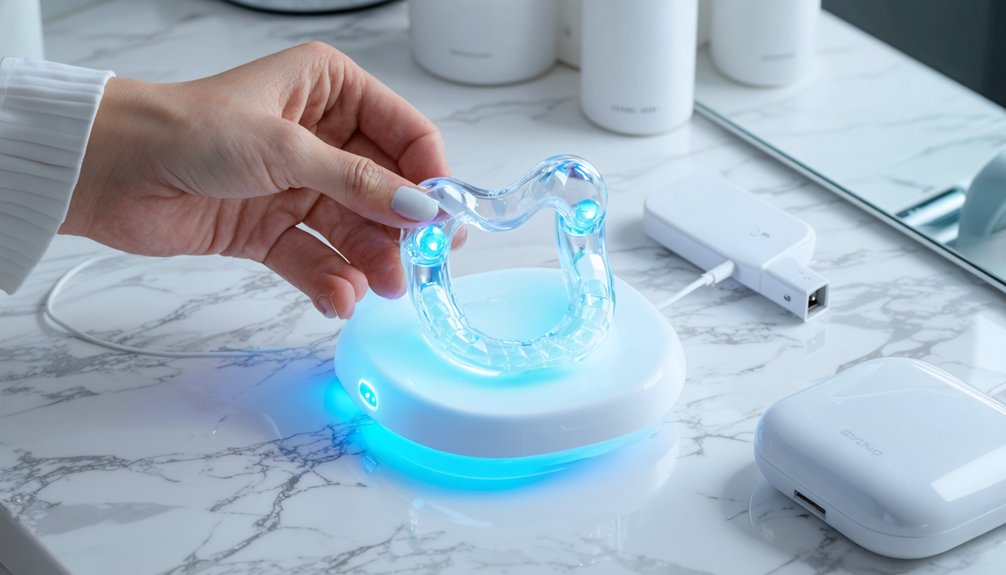
You’ll typically find these units paired with custom trays or mouthpieces that hold peroxide gel against your teeth, with the LED serving as a complement to the active bleaching agent rather than the primary whitening mechanism.
Blue LED’s Market Rise
Blue LED didn’t become the dominant whitening light by accident—it got there through a combination of practical engineering advantages and aggressive marketing.
Compared to halogen and plasma-arc predecessors, LED units run cooler, reducing thermal stress on enamel and supporting better enamel safety during treatment. Manufacturers also capitalized on blue wavelengths’ association with peroxide activation, positioning the technology as a precision accelerator rather than a passive light source. That narrative drove adoption across both professional and consumer markets.
What you should understand is that color stability in your results depends far more on gel concentration and contact time than on the blue spectrum itself. The light became the default because it’s cost-effective and marketable—not because the evidence conclusively separates it from well-formulated gel alone.
Heat Reduction Over Halogen
One of the clearest reasons LED displaced halogen in whitening protocols is thermal output. Halogen systems generated significant heat, which risked pulpal sensitivity and compromised spectrophotometer accuracy by altering tooth hydration during measurement.
Blue LED units resolved this by operating at lower temperatures without sacrificing activation wavelength.
Three factors drove that shift:
- Reduced thermal load — LEDs don’t overheat tissue, keeping your baseline conditions stable.
- Consistent light output — Stable intensity supports more reliable spectrophotometer accuracy across sessions.
- Higher patient satisfaction — Lower heat means less discomfort, which directly improves compliance and treatment completion rates.
When you control the thermal variable, you’re measuring gel performance more accurately.
Patient satisfaction follows naturally when the protocol prioritizes precision over outdated technology.
Gel And LED Pairing
Although blue LED didn’t win out over halogen purely on performance merits, its combination of thermal safety, cost efficiency, and wavelength compatibility with peroxide-based gels made it the practical default across both clinical and consumer whitening systems.
When you pair blue LED with carbamide or hydrogen peroxide gel, the gel drives the actual whitening—the light primarily supports patient comfort by minimizing heat exposure during treatment.
Innovative light technologies have refined LED output to align with peroxide activation wavelengths, making the pairing functionally coherent even if not clinically transformative.
What you’re controlling when you choose this combination is risk reduction and protocol consistency, not a dramatic acceleration of shade change.
The gel concentration and contact time remain the variables that actually determine your outcome.
Is Violet LED Whitening Promising or Just Overhyped?
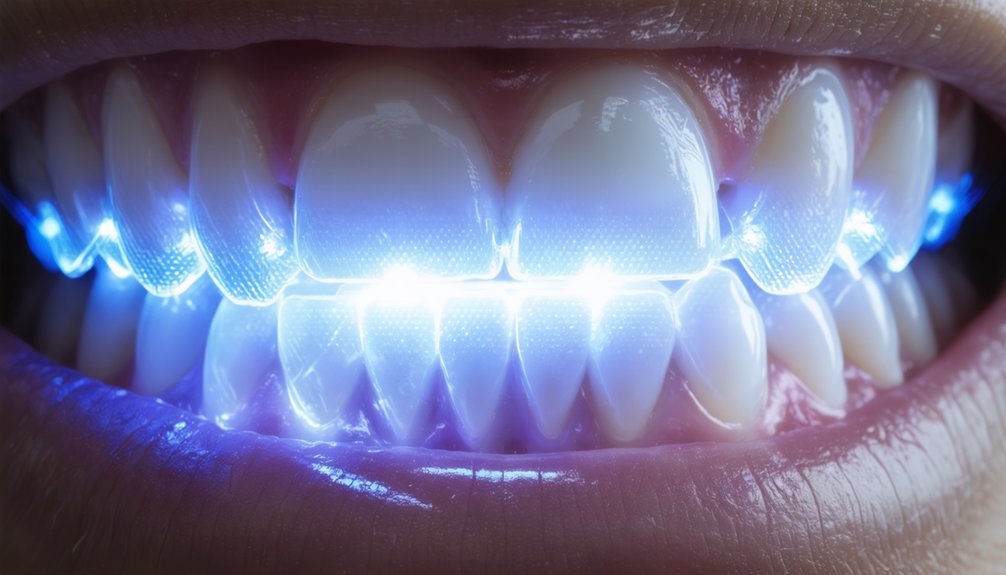
Violet LED whitening sits in an interesting middle ground—showing genuine promise in some studies while falling short of the hype in others. Operating around 405–410 nm, violet LED’s clinical efficacy depends heavily on how you’re using it:
- Alone, it produces measurable color change in lab settings but delivers weaker results clinically.
- Paired with hydrogen peroxide, it performs comparably to conventional whitening methods in select trials.
- Without peroxide, it’s not a reliable standalone solution if you’re targeting meaningful shade improvement.
The evidence isn’t strong enough yet to call violet LED clearly superior. If you want predictable results, prioritize gel concentration and contact time.
Violet LED may enhance your protocol, but it shouldn’t replace the chemistry driving actual whitening.
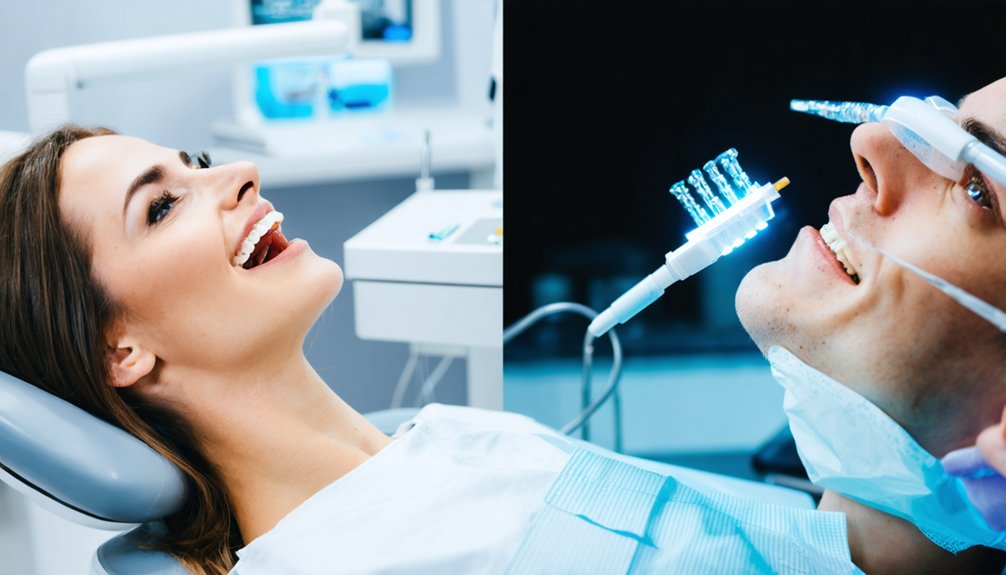
Do Lasers and Halogen Lights Outperform Gel Alone?
When comparing lasers and halogen lights against gel alone, you’ll find that clinical evidence consistently fails to support the added value of these older light sources.
Split-mouth trials, which allow direct side-by-side comparison within the same patient, frequently show no meaningful difference in whitening between the light-activated side and the gel-only side.
Any short-term gains you might see after a single session tend to disappear once additional sessions are completed, suggesting the peroxide protocol—not the light—is driving the result.
Light Versus Gel Alone
Do lasers and halogen lights actually outperform gel alone? Clinical evidence says no. Split-mouth trials and comparative studies consistently show these light sources don’t deliver meaningful aesthetic improvements beyond what peroxide gel achieves independently. Patient perceptions of faster results often reflect the active gel protocol, not the light source.
Key findings you should know:
- Halogen and laser activation produced no measurable acceleration in whitening efficacy across multiple in-office trials.
- Short-term shade gains observed after one session typically disappeared following additional treatment sessions.
- No strong clinical evidence supports routine light use as a driver of superior outcomes.
You’re better served evaluating gel concentration, wear time, and protocol design. Those variables control your results far more reliably than the light technology applied.
Split-Mouth Trial Findings
Split-mouth trials offer some of the cleanest evidence available because they test two conditions simultaneously in the same patient—one side receiving light activation, the other relying on gel alone. Measured with spectrophotometer accuracy, these trials repeatedly show minimal or no meaningful shade difference between the light-treated and gel-only sides.
Lasers and halogen systems, despite their higher price points and clinical framing, don’t produce consistent added whitening beyond what the peroxide gel achieves independently. Patient comfort outcomes also remain comparable across both conditions, meaning you’re not trading sensitivity risk for a measurable gain.
If you’re making decisions based on clinical evidence rather than marketing, split-mouth data gives you a clear signal: the gel protocol drives your results, and the light source rarely changes that outcome.
Short-Term Versus Long-Term Gains
Some individual studies do report faster shade change after a single laser or halogen session, which might seem like a compelling case for light activation—but those early gains tend to dissolve once additional sessions are completed.
Marketing hype around light-based systems often capitalizes on that initial result before the full picture emerges.
By the final session, gel-only protocols typically match light-assisted outcomes. Here’s what you should track:
- Shade stability — Compare results after all sessions, not just the first.
- Teeth sensitivity levels — Light systems don’t consistently reduce sensitivity despite premium positioning.
- Gel concentration and contact time — These variables drive long-term outcomes more reliably than the light source.
Control your protocol variables, and you’ll control your results.
Which Whitening Light Pairs Best With Peroxide Gel?
When pairing a whitening light with peroxide gel, blue LED remains the most widely used option across both clinical and consumer settings. Its compatibility with hydrogen peroxide and carbamide peroxide formulas makes it practical, and its lower heat output reduces comfort concerns compared to older halogen systems.
If you’re prioritizing color stability and patient satisfaction, blue LED paired with an appropriate peroxide concentration gives you a controllable, well-documented protocol.
Violet LED around 405–410 nm shows some promise in hybrid protocols, producing results comparable to conventional methods in select trials. However, evidence remains limited.
Lasers and halogen lights haven’t demonstrated consistent advantages over gel alone. Your best pairing focuses on gel concentration and contact time first, using the light as a secondary variable rather than the primary driver.
Why Speed Claims From Whitening Lights Are Usually Misleading
Speed claims from whitening lights don’t hold up well under clinical scrutiny. Reviews consistently show that light activation doesn’t reliably accelerate whitening beyond what peroxide gel achieves alone. Understanding this protects you from poor decisions driven by marketing rather than evidence.
Three points you should control for:
- Perceived speed often reflects gel concentration and contact time, not light activation.
- Cost implications are real—light-enhanced systems carry premium pricing without proportional clinical benefit.
- Patient perceptions of faster results frequently stem from in-session shade changes that equalize after multiple treatments.
Your whitening outcome depends on peroxide strength, wear duration, and protocol consistency. The light is largely incidental.
Prioritize gel quality and supervised application over technology claims that lack strong clinical support.
Why Gel Concentration and Wear Time Matter More Than the Light
Once you set aside the light variable, what’s left are the two factors that actually drive whitening outcomes: gel concentration and wear time. Higher peroxide concentrations penetrate enamel more aggressively, breaking down chromogens faster. Longer contact time compounds that effect. Neither outcome depends on a lamp.
Alternative marketing strategies have successfully shifted patient perception toward technology and light activation, but that framing obscures what the clinical data actually supports. When you control for gel strength and application duration, light contributes little measurable difference in final shade change.
If you want predictable results, prioritize gel formulation and strict adherence to wear schedules. Choosing a device based on LED features rather than peroxide protocol means you’re optimizing the wrong variable entirely.
Frequently Asked Questions
Can Whitening Lights Cause Permanent Damage to Tooth Enamel or Nerves?
Like a double-edged sword, whitening lights rarely cause permanent damage alone—but you’re not risk-free. They can trigger tooth sensitivity and enamel erosion when paired with high-concentration peroxide without proper supervision.
Are At-Home Whitening Light Kits as Safe as Professional Dental Treatments?
At-home over the counter whitening kits are generally safe, but they’re not equivalent to professional care. You’ll find lower peroxide concentrations reduce home remedy safety risks, yet professional supervision better controls sensitivity, gum protection, and treatment precision.
How Often Should Whitening Light Treatments Be Repeated for Lasting Results?
Picture your smile fading like paint in sunlight—you’ll maintain it with treatment intervals every 3–6 months. Your frequency maintenance depends more on gel strength and protocol than on light exposure alone.
Can Whitening Lights Worsen Existing Dental Restorations or Crowns?
Whitening lights won’t directly damage crowns, but you should assess dental material compatibility carefully. The peroxide gel poses greater restorative material risks, potentially altering composite margins or discoloring bonding agents—so consult your dentist before proceeding.
Are Whitening Lights Safe to Use During Pregnancy or Breastfeeding?
You should avoid whitening lights during pregnancy and breastfeeding. Current pregnancy safety guidelines recommend postponing elective dental procedures, and breastfeeding guidelines similarly caution against peroxide exposure until clearer evidence confirms it’s completely risk-free.
References
- https://www.oralhealthguides.org/whitening/do-led-teeth-whitening-lights-actually-work/
- https://pmc.ncbi.nlm.nih.gov/articles/PMC4178330/
- https://pmc.ncbi.nlm.nih.gov/articles/PMC3466022/
- https://pmc.ncbi.nlm.nih.gov/articles/PMC11904167/
- https://pmc.ncbi.nlm.nih.gov/articles/PMC7881219/
- https://www.knoxvillesmiles.com/how-does-led-teeth-whitening-work/
- https://www.healthline.com/health/dental-and-oral-health/blue-light-teeth-whitening
- https://learn.thedentalprotocol.com/best/teeth-whitening-light
- https://www.sciencedirect.com/science/article/abs/pii/S0300571212003260
- https://link.springer.com/article/10.1007/s10103-023-03884-1