Charcoal whitening can lift surface tobacco stains, but it won’t reach the deeper nicotine and tar embedded in your enamel. Loose activated charcoal powder mixed with water is your safest option, since premixed pastes often contain additives that accelerate enamel erosion. Limit use to once or twice weekly, and always follow up with fluoride toothpaste. For long-term smokers with pre-existing enamel damage, the risks deserve careful consideration before you start—and there’s much more you should know first.
Key Takeaways
- Activated charcoal powder mixed with water is preferred over premixed pastes; avoid products containing baking soda to prevent enamel erosion.
- Use charcoal once or twice weekly only, never as a daily toothpaste replacement, to minimize abrasive damage risks.
- Charcoal lifts surface tobacco stains but cannot remove deep nicotine and tar embedded in enamel.
- Long-term smokers face accelerated enamel thinning from charcoal’s abrasiveness, making professional dental consultation essential before starting any regimen.
- Professional bleaching remains the most effective option for stubborn, deep stains common in long-term smokers.
Why Smoker Stains Are Harder to Remove Than Regular Discoloration
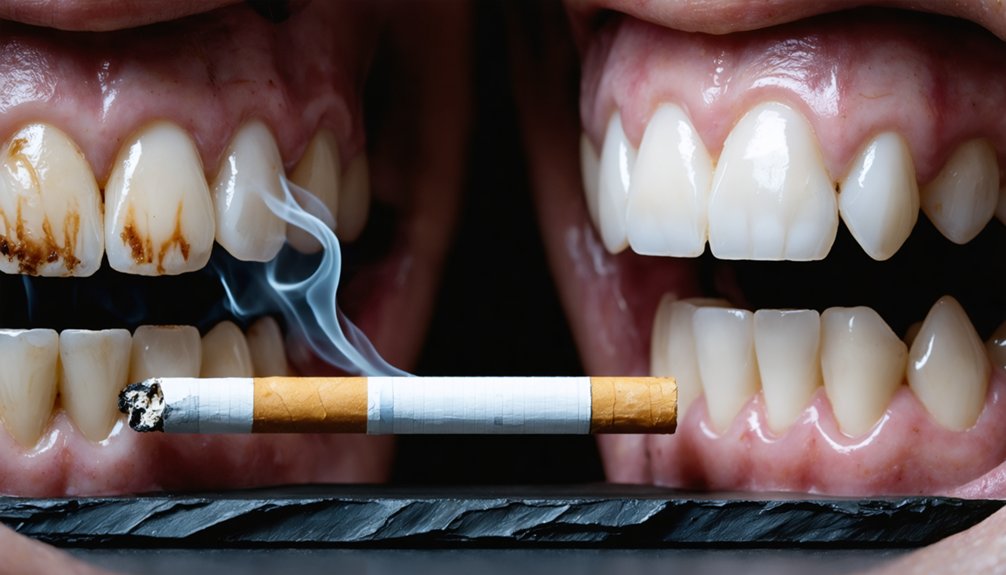
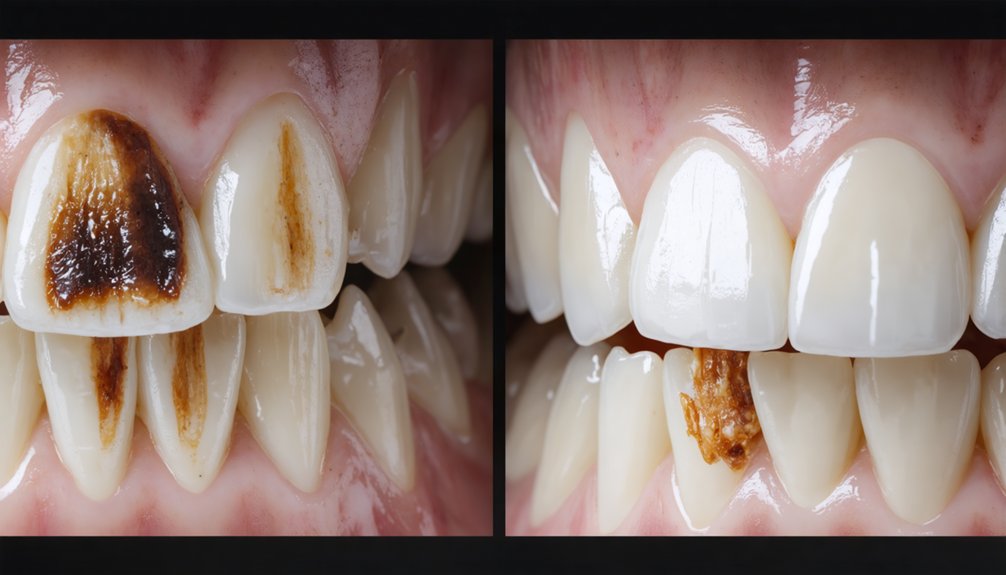
Smoker stains penetrate beyond the enamel surface because tar and nicotine compounds bind directly to the dentin layer beneath, making them far more resistant to removal than the superficial discoloration caused by coffee or tea.
Unlike dietary habits that deposit pigments superficially, tobacco byproducts chemically infiltrate enamel over time, creating stains that standard oral hygiene and over-the-counter products can’t fully address.
Activated charcoal only adsorbs surface-level deposits, so it won’t reach the deeper staining embedded in dentin.
Long-term smokers typically require professional bleaching to achieve meaningful results.
If you’re relying solely on charcoal, you’re likely underestimating the stain depth you’re dealing with.
Understanding this distinction helps you make informed, realistic decisions about which whitening approach will actually work for your situation.
How Does Charcoal Actually Work on Tobacco Stains?
When activated charcoal contacts your teeth, it works through adsorption—binding surface-level tobacco deposits and plaque to its porous structure, then lifting them away during rinsing. Among natural remedies, it’s one of the more mechanically straightforward alternative treatments available without a prescription.
Activated charcoal binds surface tobacco deposits and plaque, lifting them away through simple adsorption—no prescription required.
However, you need to understand its limitations. Charcoal targets only superficial stains. Nicotine and tar that have penetrated enamel require professional-grade bleaching agents—charcoal simply can’t reach those deeper layers.
Clinical data suggests smokers typically see 40%–60% improvement over four to six weeks, but complete stain removal remains unlikely without in-office intervention.
You should also know that continued smoking causes rapid re-staining, effectively negating any progress charcoal provides. It manages surface accumulation; it doesn’t reverse long-term tobacco damage.
The Best Charcoal Whitening Products for Heavy Smokers
Knowing how charcoal works on tobacco stains helps you evaluate which products are actually worth using. Despite the appeal of natural remedies and DIY techniques, no charcoal whitening product currently holds the ADA Seal of Acceptance. That absence matters when you’re selecting products for heavy, long-term staining.
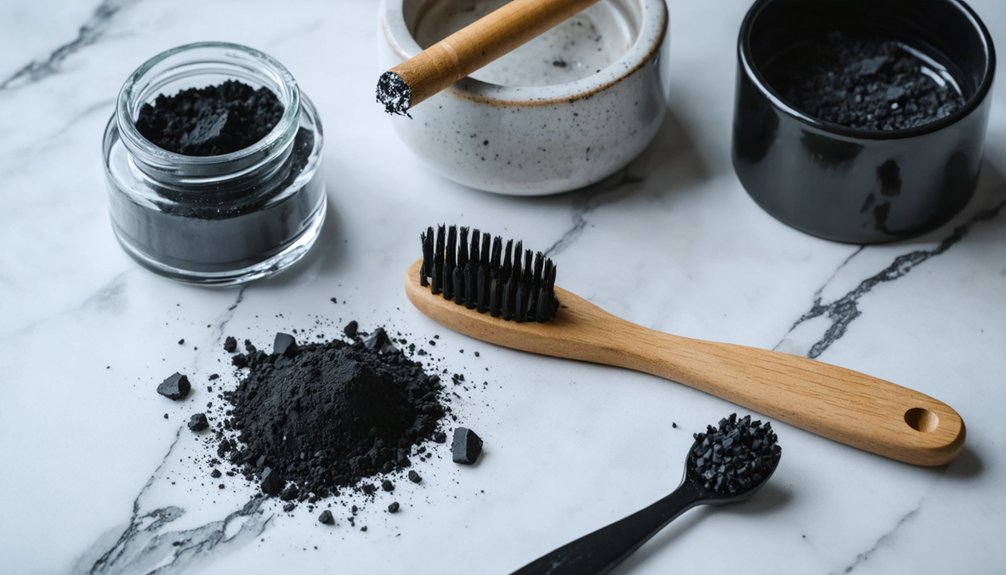
If you still choose charcoal, prioritize loose activated charcoal powder over premixed pastes, which typically carry higher abrasion indices. Mix it yourself to control concentration and consistency.
Avoid products combining charcoal with baking soda, as the combined abrasion accelerates enamel thinning.
For heavy smokers, charcoal alone won’t deliver complete results. Pair any charcoal regimen with an ADA-approved whitening toothpaste containing hydrogen peroxide or pyrophosphates, and consult your dentist before starting.
How to Use Charcoal Powder Without Damaging Your Enamel
Protecting your enamel starts before you open the charcoal jar. Charcoal application done incorrectly accelerates enamel erosion, increasing sensitivity and decay risk. You’re in control of minimizing that damage.
Charcoal used carelessly erodes enamel fast. Apply it wrong, and sensitivity and decay follow.
Follow these evidence-based steps for enamel preservation:
- Mix charcoal powder with a few drops of water, forming a paste—never apply dry powder directly to teeth.
- Use a soft-bristled brush and rub gently for one to two minutes using circular motions, avoiding aggressive scrubbing.
- Rinse thoroughly, then brush with a fluoride toothpaste to restore enamel protection immediately after.
Limit charcoal application strictly to once or twice weekly. Daily use thins enamel irreversibly.
The ADA has approved no charcoal product, so treat this method as an occasional supplement, never a replacement for standard oral care.
How Often Should Smokers Use Charcoal Whitening?
Although charcoal can lift surface tobacco stains, you should limit its use to once or twice per week to avoid irreversible enamel thinning. Exceeding this frequency accelerates abrasion, raising your risk of tooth sensitivity and structural damage that no whitening product can reverse.
For smokers, consistent daily stain removal is better managed with ADA-approved whitening toothpastes containing hydrogen peroxide or pyrophosphates. Reserve charcoal as a weekly supplement, not a replacement for your regular oral care routine.
If you continue smoking, expect rapid re-staining regardless of how often you apply charcoal. Professional in-office bleaching remains the most effective option for deep tobacco discoloration.
Track your sensitivity levels weekly and reduce charcoal use immediately if discomfort develops.
How Charcoal Compares to Whitening Strips and Professional Bleaching
When you compare charcoal to whitening strips, ADA-accepted options like Crest 3D White Whitestrips deliver more consistent, clinically supported results by using hydrogen peroxide to address mild-to-moderate staining in 7–14 days.
Charcoal only adsorbs surface residue, leaving deeper nicotine and tar stains untouched.
If you’re dealing with long-term smoker stains, professional in-office bleaching with high-concentration peroxide remains the most effective intervention, far outperforming what charcoal can achieve.
Charcoal Versus Whitening Strips
Charcoal and whitening strips operate through fundamentally different mechanisms, and that distinction matters when you’re managing tobacco stains. Charcoal relies on physical adsorption, making it one of the more popular natural remedies and DIY solutions, but it only lifts surface debris.
Whitening strips deliver hydrogen peroxide, which penetrates enamel to address deeper discoloration.
Consider these clinical differences before choosing:
- Stain depth: Strips target intrinsic staining; charcoal addresses extrinsic buildup only.
- Safety profile: Crest 3D Whitestrips carry the ADA Seal; no charcoal product does.
- Timeline: Strips produce measurable results in 7–14 days; charcoal shows 40–60% surface improvement over 4–6 weeks.
If you’re a smoker with moderate-to-severe staining, whitening strips offer more evidence-backed, controlled outcomes.
Professional Bleaching Versus Charcoal
How does professional bleaching stack up against charcoal when your stains run deeper than the surface? When tobacco’s staining mechanisms penetrate beyond the enamel layer, charcoal can’t reach them. Activated charcoal adsorbs only surface debris, delivering a 40–60% improvement over four to six weeks. That’s insufficient for long-term smoker stains.
In-office bleaching uses high-concentration peroxide to break down deep discoloration that no abrasive can touch.
Custom take-home kits from your dentist offer a middle option, addressing moderate staining over one to two weeks. Both options support stronger dental hygiene outcomes than charcoal alone.
If you’re serious about removing tobacco stains rather than temporarily masking them, professional treatment isn’t optional—it’s the evidence-based choice your enamel and long-term oral health actually require.
Is Charcoal Whitening Safe for Long-Term Smokers?
If you’re a long-term smoker considering charcoal whitening, you need to understand that charcoal’s high abrasivity can scratch and thin your enamel with repeated use, raising your sensitivity and decay risk over time.
The ADA hasn’t granted its Seal of Acceptance to any charcoal whitening product, which signals a lack of confirmed safety data for extended use.
You should limit application to once or twice per week and consult your dentist before starting any charcoal regimen.
Enamel Abrasion Risks
While charcoal whitening may seem like a convenient fix for smoker stains, its abrasive nature poses serious risks to enamel integrity—especially with long-term use. Frequent application accelerates enamel erosion, leaving teeth vulnerable to sensitivity and decay.
Protect yourself by following these evidence-based abrasion prevention strategies:
- Limit charcoal use to once or twice weekly—never as a daily toothpaste substitute.
- Use a soft-bristled toothbrush with gentle, circular motions to minimize mechanical damage.
- Follow each charcoal treatment with a fluoride toothpaste to help remineralize weakened enamel.
The ADA hasn’t granted its Seal of Acceptance to any charcoal whitening product, signaling legitimate safety concerns. You’re responsible for protecting your enamel—careless overuse can cause irreversible structural damage no whitening treatment can reverse.
Long-Term Safety Concerns
For long-term smokers, repeated charcoal use compounds an already serious enamel risk. Tobacco itself promotes dental erosion through acidic byproducts and reduced saliva flow.
Adding a highly abrasive agent on top of compromised enamel accelerates thinning faster than occasional users experience. Once enamel wears away, it doesn’t regenerate—there’s no biological mechanism for enamel strengthening after significant loss occurs.
You’re also contending with a compounding timeline. Years of nicotine and tar exposure weaken enamel structure before you ever open a charcoal product.
The ADA has granted no Seal of Acceptance to any charcoal whitening product, meaning long-term safety data simply doesn’t exist.
If you’re a long-term smoker, consult a dentist before committing to any charcoal regimen—the cumulative damage risk outweighs the surface-level cosmetic benefit.
Safer Daily Alternatives Between Charcoal Treatments
Between charcoal treatments, you’ll need a safer daily option to maintain results without accelerating enamel wear. Natural remedies and alternative treatments rarely match the evidence behind clinically tested products, so choosing wisely matters.
Prioritize these three daily alternatives:
Prioritize these three daily alternatives to maintain your whitening results safely and effectively between charcoal treatments.
- Whitening toothpaste with hydrogen peroxide or baking soda — Brands like Colgate Optic White and Crest 3D White carry the ADA Seal, confirming safety and efficacy.
- Pyrophosphate-containing toothpaste — Controls tartar buildup specific to tobacco use, reducing re-staining between charcoal applications.
- Fluoride toothpaste — Protects enamel integrity compromised by occasional charcoal abrasion.
Pair daily brushing with consistent flossing to maximize stain control.
Continued smoking will accelerate re-staining regardless of your regimen, so manage expectations and consult your dentist before combining any whitening approaches.
Frequently Asked Questions
Can Charcoal Whitening Interact With Dental Crowns or Veneers?
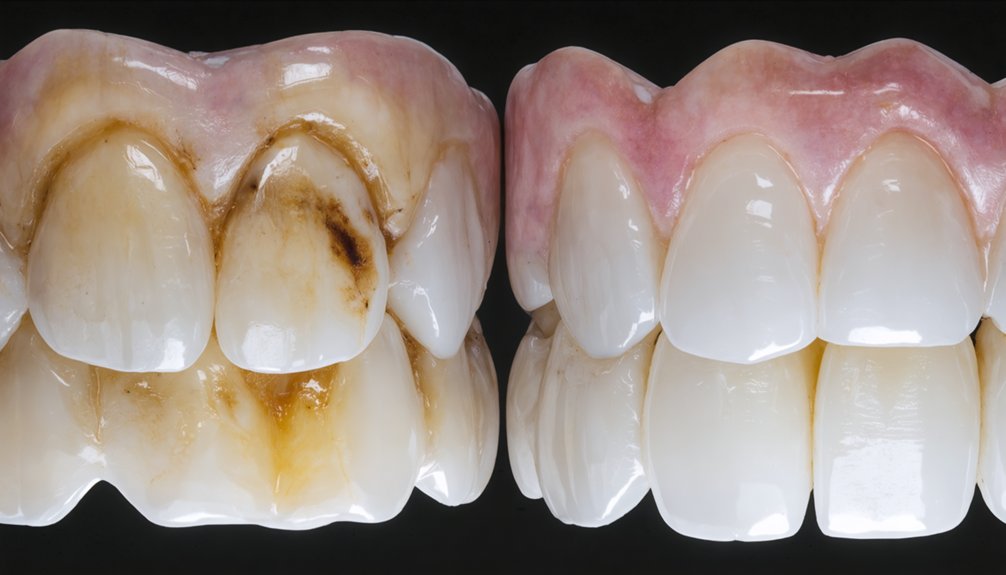
Ever wondered about dental safety with restorations? Charcoal’s abrasiveness compromises material compatibility, scratching crowns and veneers irreversibly. You’ll risk dulling their polished surfaces. Consult your dentist before applying charcoal near any dental restorations.
Does Charcoal Whitening Affect Gum Tissue Health in Smokers?
Charcoal’s abrasiveness can worsen gum irritation, especially since smoking already compromises your gum tissue. You’ll likely experience heightened oral sensitivity with frequent use. Limit application to once weekly and consult your dentist before proceeding.
Are There Age Restrictions for Smokers Using Charcoal Whitening Products?
Before you act, know this: no formal age restrictions exist, but safety considerations demand caution. You shouldn’t use charcoal whitening if your enamel’s still developing—consult your dentist first to protect your long-term dental health.
Can Charcoal Whitening Products Stain Bathroom Sinks or Grout?
Yes, charcoal powder can cause bathroom stains and grout discoloration. You’ll want to rinse your sink immediately after use. Cover surfaces beforehand, and you’ll prevent stubborn black residue from embedding into porous grout lines permanently.
Does Diet Affect How Quickly Smoker Stains Return After Charcoal Treatment?
Yes—stain recurrence accelerates with dark foods and drinks. Diet impact matters: coffee, wine, and acidic foods speed re-staining by up to 50%. You’ll lose charcoal’s gains faster if you don’t control your dietary habits post-treatment.
References
- https://www.youtube.com/watch?v=poCyziikjCQ
- https://www.mygroovyguide.com/best-toothpaste-for-smokers/
- https://www.dentaly.org/us/teeth-whitening/activated-charcoal-teeth/
- https://mysmiledentalcare.com/remove-cigarette-stains-tar-buildup-from-teeth
- https://whiteglo.com/collections/smokers-stains
- https://www.dentalrave.com/best-whitening-toothpaste-for-smokers-achieve-a-brighter-smile/
- https://www.laserglowspa.com/products/activated-charcoal-whitening-powder
- https://cloveoralcare.com/pages/best-toothpaste-for-smokers-in-india-2025-top-picks-for-stain-removal-bad-breath-gum-protection
- https://teethcare360.co.uk/best-charcoal-teeth-whitening-powder-uk/
- https://teethcare360.co.uk/whitening-for-smokers-teeth-uk/