Whitening genetically discolored teeth isn’t as straightforward as removing surface stains. Because the discoloration originates inside your enamel or dentin, standard whitening products often fall short. You’ll need targeted strategies like professional bleaching, custom trays, internal bleaching, veneers, or dental bonding to achieve meaningful results. Supporting these treatments with smart daily habits helps prevent further darkening. Each approach addresses a different severity level, and understanding which one fits your situation makes all the difference.
Key Takeaways
- Professional in-office whitening uses high-concentration bleaching agents to lighten mild to moderate genetic discoloration faster than over-the-counter products.
- Custom-fitted trays with carbamide peroxide gel allow gradual, controlled whitening tailored to individual discoloration patterns.
- Internal bleaching places agents inside the pulp chamber, targeting localized discoloration in nonvital teeth effectively.
- Dental bonding covers intrinsic stains using composite resin, lasting 5–7 years and suits mild to moderate cases.
- Veneers and restorative procedures provide reliable coverage when bleaching fails to sufficiently lighten deep structural stains.
What Makes Genetic Tooth Discoloration Different
Genetic tooth discoloration differs from surface staining because the color change originates inside the enamel or dentin rather than on the tooth’s exterior.
Genetic factors such as dentinogenesis imperfecta or amelogenesis imperfecta cause structural variations that alter how your teeth form and absorb light. These conditions affect the tooth’s internal composition, making standard brushing or polishing ineffective at producing any real color change.
You can’t scrub away what’s built into the tooth’s structure. Because intrinsic discoloration responds differently than extrinsic staining, accurate diagnosis is essential before you choose a treatment.
Your dentist needs to confirm whether your discoloration is truly hereditary and how deeply it affects your enamel or dentin. That distinction directly determines which whitening or restorative approaches will actually work for you.
Start With Professional Whitening for Genetic Tooth Discoloration
Professional whitening is often the first cosmetic step worth trying when you’re dealing with genetically yellowed teeth that still respond to bleaching. Genetic factors influence how deeply tooth pigmentation is embedded, so stronger clinical-grade agents give you a better starting advantage than store-bought options.
In-office treatments use higher-concentration bleaching agents, giving you more control over outcomes early in the process. Here’s what professional whitening offers:
- Stronger bleaching concentrations than over-the-counter alternatives
- More noticeable shade improvement in mild to moderate cases
- Faster, more durable results with professional application
- Accurate assessment of how your tooth pigmentation responds to treatment
When genetic factors have caused only moderate intrinsic staining, professional whitening can deliver measurable improvement before you consider more involved cosmetic procedures.
Use Custom Bleaching Trays When In-Office Whitening Falls Short
When in-office whitening doesn’t deliver the shade improvement you’re after, custom take-home bleaching trays are a practical next step. Your dentist fabricates trays fitted precisely to your teeth, then prescribes a carbamide peroxide gel—typically 10%—that you apply on a controlled schedule.
This approach works well when enamel thickness and dentin transparency affect how light interacts with your teeth at a structural level. Extended, consistent gel contact allows the bleaching agent to penetrate more gradually, targeting deeper chromogens that a single in-office session may not fully reach.
Custom trays also let you adjust treatment duration based on your sensitivity tolerance and response rate. For moderate genetic staining, this method often produces meaningful improvement—though severe intrinsic discoloration may still require cosmetic restorations for predictable results.
Try Internal Bleaching If Your Tooth Has Had a Root Canal
If you have a tooth that’s had a root canal and shows internal darkening, internal bleaching may be a viable option. Your dentist places a bleaching agent directly inside the pulp chamber and seals it temporarily, whitening the tooth from the inside out rather than at the surface.
This method works best on single, nonvital teeth with localized discoloration, though results can vary depending on how deep or structurally complex the staining is.
How Internal Bleaching Works
Internal bleaching works from the inside out, targeting discoloration that standard surface whitening can’t reach. Your dentist accesses the tooth chamber through a small opening, removes stained pulp tissue, and applies bleaching agents directly inside the tooth structure.
Here’s what the process involves:
- Access opening: Your dentist drills a small entry point through the back of the tooth
- Chamber preparation: Residual pulp material is cleared to allow direct bleaching agent contact
- Agent placement: A concentrated bleaching solution is sealed inside the chamber temporarily
- Monitoring: You’ll return for follow-up appointments to assess shade progress and replace the agent if needed
Once you’ve reached your target shade, your dentist seals the chamber permanently, restoring full tooth structure integrity.
Candidacy For Internal Bleaching
Internal bleaching suits a narrow set of candidates, so your tooth needs to meet specific criteria before this option makes sense.
First, the tooth must be nonvital and have completed root canal treatment.
Second, the discoloration must be intrinsic pigmentation originating inside the pulp chamber, not surface staining or enamel-level genetic factors.
Third, your dentist must confirm that the surrounding periodontal tissue and root structure are healthy enough to withstand the procedure safely.
If your tooth has an incomplete root filling, active infection, or significant structural compromise, internal bleaching isn’t appropriate.
External resorption also disqualifies a candidate immediately.
Your dentist will take radiographs to assess root integrity and seal quality before proceeding.
Meeting all criteria gives you the strongest chance of achieving meaningful, controlled color correction from the inside out.
Expected Results And Limitations
Most patients who undergo internal bleaching see meaningful color improvement, but results vary based on the severity and source of discoloration. Genetic factors and natural variation in dentin composition directly influence how your tooth responds to treatment.
Key limitations to understand before proceeding:
- Deep structural staining from inherited conditions may only partially lighten, even with repeated sessions.
- Natural variation in enamel thickness affects how much the brightened dentin shows through.
- Genetic factors tied to dentinogenesis imperfecta often produce less predictable outcomes than trauma-related discoloration.
- Rebound discoloration can occur over time, requiring follow-up treatment or restorative masking.
If bleaching doesn’t deliver adequate results, veneers or bonding remain reliable next steps. Internal bleaching works best as part of a broader, staged treatment plan your dentist actively manages.
Choose Veneers When Genetic Tooth Discoloration Won’t Bleach Away
Veneers offer two key advantages when genetic discoloration resists bleaching: predictable color correction and durable coverage that whitening alone can’t achieve. When genetic factors produce deep intrinsic staining or compromised enamel, bleaching agents can’t reach or alter the source of the color shift.
Veneers bypass that limitation entirely by masking the affected surface with a precisely shaded porcelain or composite shell.
Tooth transparency also influences how discoloration appears and how well bleaching works. Highly translucent teeth often show underlying dentin color more intensely, making whitening less effective.
Veneers control that variable by establishing a defined, opaque-to-translucent layer over the tooth. Your dentist can calibrate veneer shade, thickness, and translucency to match surrounding teeth, giving you a consistent, long-term result that bleaching protocols can’t reliably deliver.
Use Dental Bonding as a Lower-Cost Masking Alternative
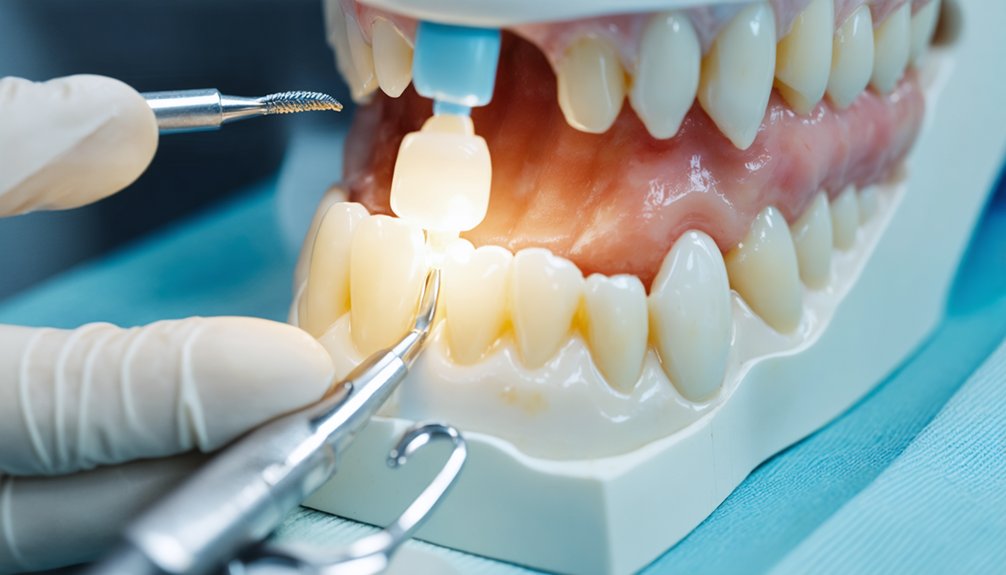
Dental bonding gives you a more affordable path to masking genetic discoloration when veneers fall outside your budget. It’s a cost-effective masking solution where your dentist applies tooth-colored composite resin directly over discolored enamel. Results are immediate, and the procedure typically requires no enamel removal.
Dental bonding offers immediate, budget-friendly coverage for genetic discoloration — no enamel removal required.
Dental bonding works well when you need targeted coverage across specific teeth affected by intrinsic staining. Keep these limitations in mind:
- Composite resin stains more easily than porcelain over time
- Bonding typically lasts 5–7 years before needing repair or replacement
- It’s better suited for mild to moderate discoloration than severe structural defects
- Surface polishing can restore appearance between replacements
You retain control over timing, cost, and which teeth receive treatment.
Build Daily Habits That Prevent Further Discoloration
Brushing and flossing daily removes surface buildup that can make genetic discoloration appear darker and harder to treat.
You should also limit stain-heavy foods and drinks like coffee, tea, and red wine, which add extrinsic staining on top of existing intrinsic color.
Scheduling regular dental visits lets your dentist monitor whether discoloration is stable or compounding, and keeps your enamel protected through professional cleaning.
Brush And Floss Daily
While genetic discoloration originates inside the tooth structure, daily brushing and flossing help prevent surface buildup from compounding the problem. Extrinsic stains from food and drinks can layer over intrinsic discoloration, making your teeth appear darker than their baseline shade. Consistent hygiene keeps that surface layer controlled.
Follow these targeted daily practices:
- Use a soft-bristled toothbrush to minimize enamel erosion, especially if your enamel is already structurally compromised
- Brush twice daily with fluoride toothpaste to strengthen enamel and reduce tooth sensitivity
- Floss once daily to remove interdental buildup that brushing misses
- Avoid abrasive whitening toothpastes that can worsen enamel erosion on genetically vulnerable teeth
These habits won’t reverse intrinsic staining, but they prevent additional discoloration from reducing your whitening results.
Limit Stain-Causing Foods
Certain foods and beverages accelerate extrinsic staining that compounds your underlying genetic discoloration. Coffee, tea, red wine, and dark sauces deposit chromogens onto enamel surfaces, darkening teeth beyond their hereditary baseline. Reducing consumption or rinsing with water immediately after exposure limits additional pigment buildup.
Don’t fall for dietary myths suggesting acidic fruits or oil pulling reverse intrinsic discoloration—they don’t. Natural remedies like activated charcoal or lemon juice lack clinical evidence and risk enamel erosion, particularly dangerous if you have structurally compromised enamel from conditions like amelogenesis imperfecta.
Instead, use a straw for staining beverages, maintain consistent brushing timing, and attend regular professional cleanings. These targeted habits preserve whitening outcomes and prevent extrinsic layers from making your genetic shade appear considerably darker than it actually is.
Schedule Regular Dental Visits
Regular dental visits serve two critical functions when you’re managing genetic tooth discoloration: professional cleaning removes extrinsic buildup that compounds your hereditary baseline shade, and your dentist can monitor whether discoloration is stable or progressing.
Because genetic factors create natural variations in enamel density and translucency, routine evaluations help distinguish inherited color from new staining.
Schedule visits every six months to:
- Remove surface deposits masking your tooth’s true genetic baseline
- Track shade changes that signal progression beyond natural variations
- Adjust your whitening protocol based on current discoloration patterns
- Identify early enamel vulnerabilities linked to genetic factors before they worsen
Consistent professional oversight keeps your treatment strategy accurate and responsive. Without it, you’re managing a moving target without reliable data.
Frequently Asked Questions
Can Genetic Tooth Discoloration Affect Children’s Baby Teeth as Well?
Yes, genetic causes can affect your child’s baby teeth too. Conditions like amelogenesis imperfecta impact primary dentition early. You’ll want to consult a pediatric dentist promptly to explore appropriate cosmetic procedures and protective treatments.
Does Genetic Discoloration Worsen With Age Even Without Lifestyle Factors?
Like fading ink on old parchment, yes—your genetics and pigmentation can deepen over time. As aging and enamel naturally thin, underlying dentin shows more, darkening your smile even without lifestyle triggers.
Are Whitening Results for Genetic Stains Covered by Dental Insurance Plans?
Cosmetic dentistry procedures for genetic stains typically don’t qualify for insurance coverage since plans classify whitening as elective. You’ll need to explore flexible spending accounts or payment plans to manage out-of-pocket costs effectively.
Can Genetic Tooth Discoloration Be Detected Before Teeth Fully Emerge?
Yes, you can detect genetic tooth discoloration before eruption through dental genetics testing and family history analysis. Genetic markers tied to amelogenesis or dentinogenesis imperfecta let you anticipate intrinsic staining and plan early cosmetic intervention proactively.
Is Genetic Tooth Discoloration Linked to Other Inherited Health Conditions?
Like branches of the same tree, hereditary causes of tooth discoloration often connect to broader systemic conditions. Your genetic markers can signal disorders like dentinogenesis imperfecta, which you’ll frequently find linked to osteogenesis imperfecta.
References
- https://www.ada.org/resources/ada-library/oral-health-topics/whitening
- https://www.i20familydental.com/blog/2023/10/13/all-about-teeth-whitening-and-genetics/
- https://clubwhitesmile.com/best-strategies-for-whitening-genetic-tooth-discoloration/
- https://www.ncbi.nlm.nih.gov/books/NBK603756/
- https://www.iosrjournals.org/iosr-jdms/papers/Vol24-issue7/Ser-3/F2407033137.pdf
- https://my.clevelandclinic.org/health/symptoms/10958-tooth-discoloration
- https://www.nylaserdentistry.com/can-teeth-whitening-work-on-deep-intrinsic-stains/
- https://www.mynewportdentist.com/blog/2024/12/13/is-some-tooth-discoloration-hereditary/
- https://theivory.dental/dentist-news/internal-whitening
- https://www.prachdds.com/blog/2022/11/are-stained-teeth-a-hereditary-condition/