Tetracycline stains penetrate deep into your dentin, making them far more resistant to whitening than surface discoloration. Mild to moderate cases can respond to extended professional bleaching protocols, like KöR or Opalescence PF, over several months. Severe gray or banded staining often requires restorative solutions such as veneers or composite bonding for reliable aesthetic results. Matching your treatment to your stain severity and budget is essential, and there’s much more to uncover about your options.
Key Takeaways
- Tetracycline stains are permanently embedded in dentin, making them far more resistant to treatment than surface discoloration from food or drinks.
- Mild to moderate tetracycline staining responds best to extended bleaching protocols using systems like KöR Whitening or Opalescence PF custom trays.
- Deep gray or blue-gray banded stains resist bleaching due to dentin penetration depth, making restorative solutions more appropriate.
- Porcelain veneers reliably mask severe tetracycline discoloration, while composite bonding offers a less invasive, budget-friendly alternative for moderate cases.
- Professional consultation is essential to classify stain severity and match the most effective, realistic treatment to individual needs.
Why Tetracycline Stains Resist Whitening More Than Other Discoloration
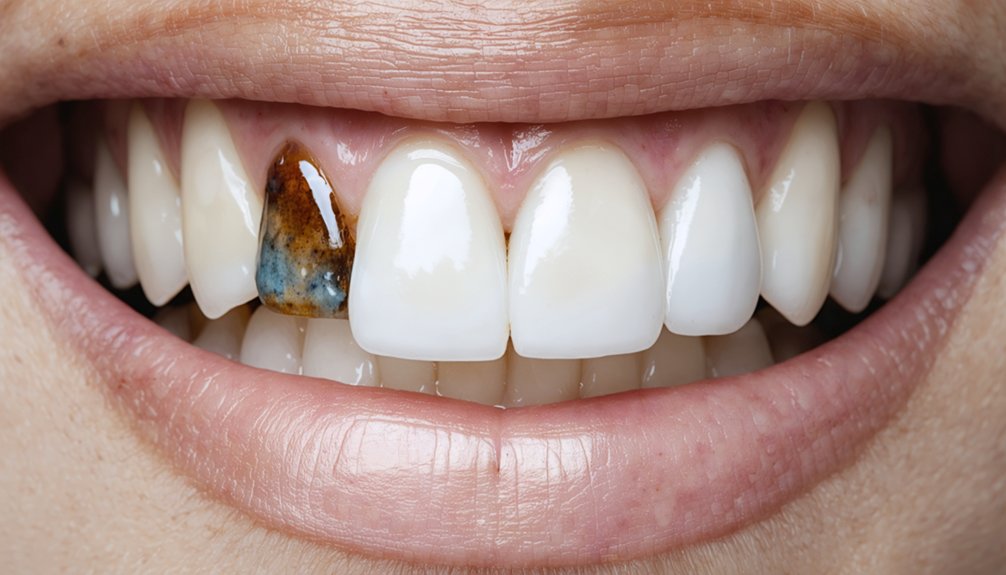
Because tetracycline binds directly to calcium ions during tooth development, it becomes permanently incorporated into the dentin and enamel—not simply deposited on the surface like coffee or wine stains.
Tetracycline doesn’t stain teeth—it becomes part of them, binding permanently into dentin and enamel at the structural level.
That stain penetration into the tooth’s structural layers is precisely what makes conventional whitening ineffective for many patients.
Unlike surface discoloration types—which respond quickly to peroxide—tetracycline staining varies in depth, color, and banding pattern.
Yellow hues tend to respond better, while dark gray or brown bands are notably more resistant. The timing and duration of antibiotic exposure during development directly influence severity.
Understanding this distinction helps you set realistic expectations.
You’re not dealing with ordinary staining—you’re addressing a structural alteration that requires a more targeted, often prolonged treatment strategy.
How Severe Is Your Tetracycline Discoloration?
Knowing why tetracycline stains resist whitening leads directly to a more practical question: where does your discoloration fall on the severity scale? A thorough discoloration assessment shapes every decision that follows.
Mild cases typically present as uniform yellow or light brown tones and respond reasonably well to professional bleaching. Moderate staining shows darker or banded patterns that require extended treatment but still benefit from advanced whitening protocols.
Severe cases — deep gray, blue-gray, or heavily banded — often exhaust whitening’s limits and require cosmetic restoration. Identifying your classification isn’t guesswork; your dentist evaluates color intensity, band depth, and dentin involvement to determine realistic treatment options.
Understanding exactly what you’re dealing with puts you in the strongest position to choose a targeted, effective approach.
What Professional Bleaching Can Actually Do for Tetracycline Stains
Professional bleaching occupies a specific and useful — though limited — role in managing tetracycline discoloration. Because staining causes intrinsic pigmentation within dentin and enamel, no bleaching agent eliminates it entirely.
One of the most persistent whitening myths is that professional-grade peroxide delivers dramatic, fast results. It doesn’t — not with tetracycline.
What bleaching can do is meaningfully lighten mild to moderate discoloration over an extended treatment period. Custom tray systems with concentrated peroxide gels produce gradual improvement across weeks or months.
You’ll likely see a reduction in color intensity rather than complete stain removal.
If your staining is deep, banded, or dark gray, bleaching alone won’t achieve the aesthetic outcome you want. Understanding this distinction helps you make informed, realistic decisions about your treatment path.
KöR Whitening: The Go-To for Stubborn Tetracycline Cases
If standard bleaching hasn’t delivered the results you’re hoping for, KöR Whitening is widely regarded as one of the most effective systems for stubborn tetracycline discoloration.
It combines in-office treatment with custom overnight trays using refrigerated, high-potency peroxide gels designed to maximize whitening depth.
Even so, you should expect gradual improvement rather than complete stain elimination, particularly if your discoloration is severe or deeply banded.
How KöR Whitening Works
KöR Whitening stands apart from conventional bleaching systems by addressing the core challenge of tetracycline staining: deep dye penetration into dentin.
The KöR technique combines in-office treatment with extended custom tray use at home, maximizing whitening effectiveness across both enamel and dentin layers.
What makes this system distinct is its use of refrigerated, high-potency whitening gel, which preserves peroxide activity until application.
You’re not working with degraded product—you’re delivering full-strength gel directly where discoloration lives.
Treatment typically unfolds over several weeks, with nightly tray wear amplifying the results of each in-office session.
This dual-phase approach gives you measurable control over progress, allowing gradual but significant lightening even in cases that have resisted standard bleaching protocols.
Treating Stubborn Tetracycline Stains
When tetracycline staining runs deep into the dentin, standard whitening protocols often fall short—and that’s precisely where KöR Whitening earns its reputation.
A thorough stain assessment helps determine whether your discoloration falls within the range KöR can meaningfully address.
For mild to moderate cases, KöR combines in-office treatments with refrigerated, high-potency gel used in custom overnight trays at home—maximizing peroxide activity throughout the process.
You’re not passively waiting; you’re actively managing a structured protocol designed to penetrate resistant dentin.
Your treatment options expand greatly with this system, as results develop gradually over weeks to months.
However, it’s important to understand that severe banding or dark gray staining may still require cosmetic restoration, even after completing a full KöR regimen.
KöR’s Limitations and Expectations
Even the most advanced whitening systems carry real boundaries, and KöR is no exception.
While KöR effectiveness is well-documented for mild to moderate tetracycline discoloration, severe staining — particularly deep gray or banded cases — often resists full correction. You shouldn’t expect complete elimination of discoloration. Instead, you’re working toward meaningful lightening that improves overall tooth appearance.
Realistic outcomes depend heavily on how deeply tetracycline penetrated your dentin during development.
Darker, more diffuse staining typically responds more slowly and incompletely than lighter yellow or brown tones. If KöR produces insufficient improvement, porcelain veneers or composite bonding become your next clinical options.
Knowing these limits upfront allows you to make informed decisions about your treatment path rather than being surprised by incomplete results.
Extended Tray Bleaching Systems Like Opalescence for Tetracycline Stains
Extended tray bleaching systems like Opalescence PF offer one of the more practical approaches for addressing mild to moderate tetracycline discoloration, though they require patience and clinical oversight to yield meaningful results.
Opalescence effectiveness depends greatly on tray customization, ensuring precise gel contact across every tooth surface for consistent peroxide delivery. Your provider will typically begin with a lower concentration and adjust upward as your sensitivity tolerance allows.
Progress is gradual, often unfolding over several months of consistent nightly use. Regular photo documentation helps you track slow but measurable improvement objectively.
While you won’t achieve instant transformation, this system gives you structured, controlled participation in your treatment. For deeper staining, extended tray protocols work best when integrated into a broader cosmetic plan rather than used as a standalone solution.
Signs Your Tetracycline Staining Is Too Deep for Bleaching
Recognizing the limits of bleaching early can save you months of effort and redirect you toward solutions that actually work.
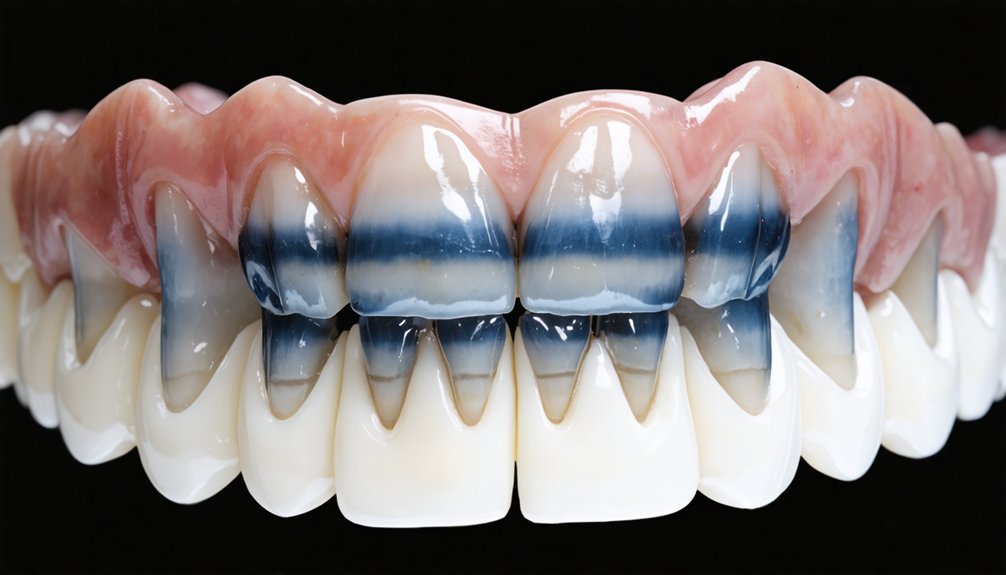
Common Misconceptions about bleaching often lead patients to believe any stain can be erased with enough time and peroxide. That’s rarely true for tetracycline. If your staining appears as dark gray or blue-gray banding, penetrates deeply into dentin, or shows uneven distribution across the tooth, bleaching likely won’t deliver meaningful results.
Bleaching can’t erase every stain—deep gray tetracycline banding is chemistry’s limit, not a patience problem.
Treatment Myths also suggest extended tray use guarantees improvement—it doesn’t. When multiple professional whitening cycles produce minimal change, your staining has exceeded what chemistry alone can correct.
At that point, porcelain veneers or crowns offer the predictable, lasting improvement you’re seeking. Accepting this distinction early puts you back in control of your outcome.
Veneers, Crowns, and Bonding for Severe Tetracycline Staining
When bleaching fails to produce meaningful improvement, cosmetic restoration becomes your most reliable path forward.
Porcelain veneers cover the front surfaces of affected teeth and offer highly predictable masking of even severe discoloration, while crowns provide broader coverage for teeth with more extensive structural involvement.
If your staining falls somewhere in the mild-to-moderate range and you’re seeking a less invasive option, composite bonding can improve appearance, though it carries lower durability than either veneers or crowns.
When Bleaching Falls Short
Even with the most aggressive bleaching protocols, severe tetracycline staining often doesn’t respond well enough to meet aesthetic goals.
When bleaching falls short, restorative treatment options give you direct control over your outcome. Patient experiences consistently show that cosmetic restorations deliver more predictable results for deep, banded discoloration.
Consider these three solutions:
- Porcelain veneers — Bond to front tooth surfaces, completely masking stain with natural-looking, durable ceramic.
- Dental crowns — Encase extensively affected teeth when full coverage is structurally or aesthetically necessary.
- Composite bonding — A conservative, lower-cost option for mild-to-moderate cases, though less durable long-term.
Each option requires a clinical consultation to match your stain severity, tooth structure, and aesthetic priorities before committing to a treatment path.
Veneers Versus Crowns Explained
Choosing between veneers and crowns comes down to how much tooth structure is affected and how much coverage you actually need.
Veneer benefits include minimal tooth reduction, precise color masking, and a natural-looking result — making them the preferred choice when the underlying tooth structure remains intact. They bond to the front surface only, leaving more of your natural tooth preserved.
When tetracycline staining is severe and the tooth requires broader structural coverage, crown durability becomes the deciding factor. Crowns encase the entire tooth, offering superior strength and complete color control.
Composite bonding presents a third option for moderate cases, though it’s less durable and may stain over time.
Your dentist will recommend the approach that best balances aesthetic outcome with long-term tooth health.
Composite Bonding As Alternative
Composite bonding offers a middle-ground solution for tetracycline staining that falls between mild discoloration and the severity that demands veneers or crowns.
Understanding the composite bonding process and composite bonding benefits helps you make an informed restorative decision.
Your dentist applies tooth-colored resin directly onto affected surfaces, sculpting and polishing it to mask underlying discoloration.
Key considerations include:
- Cost accessibility — Composite bonding typically costs less than porcelain veneers, making it a financially controlled entry point.
- Minimal tooth reduction — Little to no enamel removal is required, preserving your natural structure.
- Reversibility — Unlike veneers, bonding can be modified or removed without permanent commitment.
However, composite material stains over time and carries lower durability, meaning you’ll likely need periodic touch-ups or replacement.
How to Match Your Treatment to Your Stain Severity and Budget
Because tetracycline staining spans a wide spectrum of severity, your treatment options and associated costs should reflect where your case actually falls on that spectrum.
Mild to moderate discoloration responds well to extended bleaching protocols like KöR or Opalescence PF, making them strong starting points with manageable budget considerations. You’ll invest time, but these systems cost considerably less than restorative work.
Mild to moderate tetracycline staining often responds well to extended bleaching—a budget-friendly starting point before considering restorative alternatives.
Moderate to severe banding, particularly gray or brown tones, often resists bleaching alone. In those cases, composite bonding offers a mid-range alternative, while porcelain veneers deliver the most predictable, lasting correction at a higher price point.
Matching your treatment options to both your stain classification and financial reality helps you avoid wasted spending and positions you for genuinely satisfying results.
Frequently Asked Questions
Can Tetracycline Staining Return After Successful Whitening Treatment Is Completed?
Tetracycline’s intrinsic staining won’t recur once whitening longevity is maintained, as the discoloration is structural. However, you can experience new surface staining from diet or habits, requiring periodic touch-up treatments to preserve your results.
Are Children Who Took Tetracycline Always Guaranteed to Develop Visible Staining?
Like Pandora’s box, outcomes aren’t guaranteed—tetracycline exposure doesn’t always produce visible staining. Your staining severity depends on dosage, timing, and duration, meaning some children escape noticeable discoloration entirely while others don’t.
Does Dental Insurance Ever Cover Whitening Specifically for Tetracycline-Stained Teeth?
Most insurance policies don’t cover cosmetic whitening, even for tetracycline staining. You’ll want to explore your coverage options carefully, as some plans may partially address treatment when it’s deemed medically necessary rather than purely aesthetic.
Can Tetracycline Staining Affect the Strength or Structure of Your Teeth?
Tetracycline staining doesn’t compromise your tooth strength or enamel structure—it’s purely a cosmetic concern. Your teeth remain structurally sound, giving you full control over addressing the discoloration through targeted whitening or restorative solutions.
How Long Do Porcelain Veneers Typically Last on Tetracycline-Stained Teeth?
With proper care, your porcelain veneers can last 10–15 years, offering reliable veneer longevity. Among available treatment options, they’re your most predictable, aesthetically controlled solution for masking severe tetracycline discoloration effectively and durably.
References
- https://en.cnys.com/ask/351760.html
- https://myserenitydental.com/remove-tetracycline-stains-from-teeth/
- https://vegassmilesuite.com/how-to-whiten-teeth-with-tetracycline-stains/
- https://blog.ultradent.com/transforming-tetracycline-stains-with-opalescence-whitening
- https://www.korwhitening.com/6-things-know-treating-tetracycline-patient-kor-whitening-products/
- https://www.healthline.com/health/tetracycline-teeth
- https://cosmetic-dentistry.com/blog/teeth-whitening-brands-improve-tetracycline-stains-look-better.html
- https://www.scrippsdentalcare.com/cosmetic-dentistry/how-can-i-get-rid-of-tetracycline-stains/
- https://www.mydrdennis.com/blog/bonding-whitening-and-tetracycline-stains/
- https://www.stanleysmiles.com/blog/how-can-i-whiten-my-tetracycline-stains