Teeth whitening delivers transformative results — but only when you match the method to your stain type. Extrinsic stains from coffee or tea respond best, yielding 6–8 shades of improvement. Age-related yellowing follows closely, while tetracycline stains produce just 3–5 shades. In-office treatments like Zoom® work fastest, while home systems offer a slower, budget-friendly path. Existing crowns and veneers won’t whiten, so realistic expectations matter. Everything you need to choose wisely is just ahead.
Key Takeaways
- Extrinsic stains from coffee and tea respond best, achieving 6–8 shades of whitening through peroxide-based treatments.
- In-office Zoom® whitening delivers dramatic 7–8 shade improvements in just 30–60 minutes.
- Tetracycline and grey intrinsic stains are most resistant, yielding only 3–5 shades even with extended treatment.
- Crowns, veneers, and fillings don’t respond to whitening agents, potentially causing mismatched tooth color.
- Natural remedies lack peroxide chemistry and produce no clinically measurable shade changes.
How Peroxide Breaks Down Stains Without Damaging Your Enamel
When hydrogen peroxide contacts your tooth enamel, it breaks down into water and oxygen free radicals that penetrate the enamel’s porous surface and oxidize the organic compounds responsible for discoloration. This targeted chemical reaction enables enamel preservation by addressing stains at their molecular source rather than abrading the tooth’s surface structure.
Concentration determines both efficacy and risk. Over-the-counter formulas contain 3%–10% hydrogen peroxide, while professional treatments reach up to 43%. Higher concentrations accelerate results but increase tooth sensitivity and can cause enamel softening with aggressive or prolonged use.
Home-based systems consistently produce less sensitivity than in-office treatments, making them a strategically sound option if you’re managing tolerance thresholds. Controlling your concentration level and application frequency lets you balance measurable whitening outcomes against preventable enamel and soft-tissue damage.
Will Teeth Whitening Actually Work on Your Stain Type?
Your stain type is the single most important factor in predicting how well whitening will work for you. Extrinsic stains from coffee and tea typically respond with 6–8 shades of improvement.
While age-related yellowing yields 5–7 shades, and tetracycline or grey stains produce only moderate 3–5 shade gains.
Whitening agents also can’t change the color of crowns, veneers, or fillings, which limits outcomes if restorations are present in your smile zone.
Identifying Your Stain Type
Before investing in any whitening treatment, understanding your stain type is critical—because not all discoloration responds equally to bleaching agents. Stains fall into two categories: extrinsic and intrinsic.
Extrinsic stains, including those from coffee, tea, or dental plaque buildup, respond exceptionally well—yielding 6–8 shades of improvement.
Intrinsic stains, such as tetracycline-related grey discoloration, are markedly harder to treat, producing only 3–5 shades of improvement at best.
Your tooth’s structural history also matters. Crowns, veneers, and fillings won’t respond to any whitening agent.
Additionally, if you already experience tooth sensitivity, high-concentration peroxide treatments may intensify that sensitivity considerably.
Identifying your stain type before selecting a treatment protocol ensures you pursue an option that’s both clinically appropriate and likely to deliver measurable results.
Stain Response by Treatment
Matching the right whitening treatment to your specific stain type isn’t just a preference—it’s what determines whether you’ll see meaningful results or none at all. Your dental hygiene history and enamel health directly influence how your teeth respond.
Evidence shows clear outcome differences by stain category:
- Coffee and tea stains respond excellently, yielding 6–8 shades of improvement—you can reclaim a noticeably brighter smile.
- Age-related yellow stains improve 5–7 shades, giving you meaningful, visible control over time’s effects.
- Tetracycline or grey stains only achieve 3–5 shades—managing expectations here isn’t defeat; it’s informed decision-making.
Critically, crowns, veneers, and fillings won’t respond to any whitening agent. Knowing your stain type before treatment isn’t optional—it’s essential.
Limitations of Whitening Agents
While the previous section outlined outcome differences by stain category, understanding *why* certain stains resist whitening helps you set realistic expectations before committing to treatment.
Peroxide-based agents oxidize organic pigments, meaning extrinsic stains from dietary influences like coffee and tea respond well. Intrinsic discoloration from tetracycline or structural changes yields only moderate improvement regardless of concentration used.
Natural remedies lack the peroxide chemistry required to penetrate enamel and eliminate deeper pigmentation entirely.
Critically, no whitening agent alters the color of crowns, veneers, or composite fillings — dental restorations remain unchanged while surrounding natural teeth lighten, creating visible mismatches.
If you have existing restorations, consult your dentist before beginning any regimen to assess whether your results will be clinically acceptable and aesthetically consistent.
Which Teeth Whitening Method Delivers the Fastest Results?
When speed is the priority, in-office treatments consistently outperform every other whitening method. Professional Zoom® Whitening delivers 7–8 shades of improvement in a single 30–60 minute session, giving you measurable, immediate control over your results. Don’t let teeth whitening myths or natural remedies mislead you into slower, less effective alternatives.
In-office whitening wins on speed — one session, measurable results, no myths, no waiting.
Consider what rapid, professional whitening actually means for you:
- Confidence restored in under an hour, without waiting days or weeks
- Clinically verified shade improvements, not guesswork or unsubstantiated home remedy claims
- Precision treatment guided by a professional, minimizing sensitivity and maximizing outcome
Strip-based kits typically require 10–12 days for noticeable results, while paint-on gels yield only 1–2 shades within days. If speed and accuracy matter, in-office treatment is your most decisive option.
Side Effects That Catch Most People Off Guard
Even the most effective whitening treatments carry side effects that many patients don’t anticipate until they’re mid-treatment. Tooth sensitivity is the most frequently reported reaction, ranging from mild discomfort to sharp pain triggered by temperature changes.
In-office bleaching with 35% hydrogen peroxide has caused sensitivity in every documented case involving restored teeth.
Your dental hygiene routine also faces complications. Aggressive peroxide concentrations soften enamel and increase surface roughness, making teeth temporarily more vulnerable to bacterial adhesion.
Gum irritation emerges when peroxide contacts soft tissue, particularly with ill-fitting trays.
Notably, home-based systems produce less sensitivity than in-office treatments, giving you a measurable trade-off between speed and comfort.
Understanding these risks before starting treatment lets you select concentrations and application durations that align with your tolerance thresholds.
How Long Do Teeth Whitening Results Really Last?
Results vary considerably depending on your lifestyle habits and the treatment method you choose. Combined in-office and take-home maintenance can protect your dental enamel and sustain brightness for 1–3 years. Without adjustments, tooth discoloration returns in as little as 4–6 weeks.
You control how long your results last:
- Avoiding coffee, tea, and red wine can extend your results to 6–12 months—don’t surrender your investment to preventable habits.
- Skipping maintenance touch-ups accelerates fading; 7–10 days of post-treatment care preserves what you’ve achieved.
- Neglecting your whitening protocol means watching your confidence fade alongside your results.
Consistent maintenance isn’t optional—it’s the difference between lasting transformation and temporary change.
Which Teeth Whitening System Fits Your Budget, Timeline, and Stain
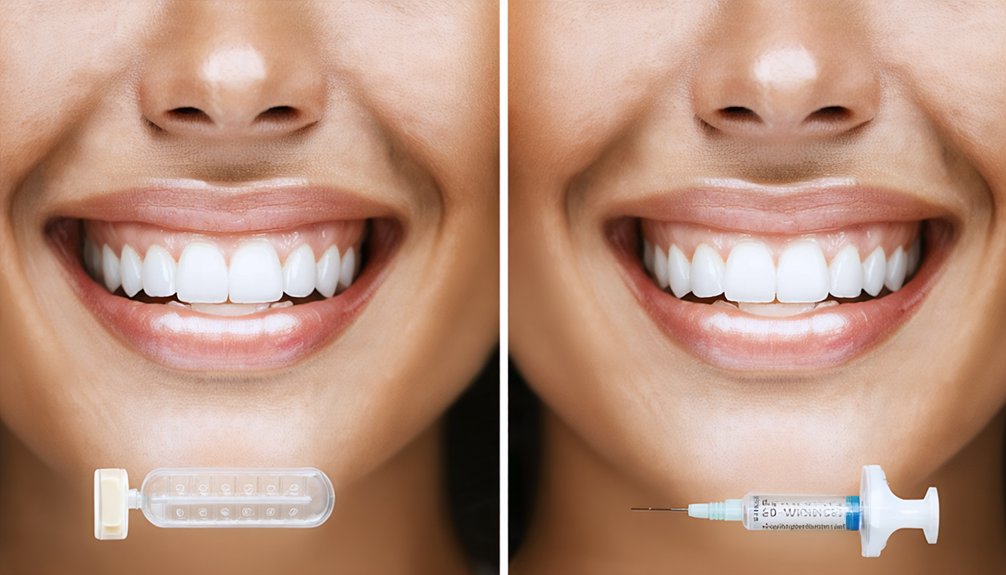
Your choice of whitening system should align with your budget, the nature of your stains, and how quickly you need results.
Over-the-counter strips and paint-on gels offer cost-effective entry points.
While professional in-office treatments deliver faster, more dramatic shade improvements for stubborn or deep-set discoloration.
Matching the right system to your specific stain type—whether coffee-related, age-related, or antibiotic-induced—directly determines how much improvement you can realistically expect.
Budget-Friendly Whitening Options
When budget is the primary concern, the whitening system you choose should align not only with cost but also with your stain type and how quickly you need results. Dental insurance rarely covers cosmetic whitening, so cost-effective over-the-counter options become essential. Natural remedies lack clinical evidence and won’t deliver measurable shade changes.
Choose strategically based on what’s proven:
- Whitening strips deliver noticeable differences within 10–12 days using 3%–10% hydrogen peroxide, giving you control without clinic fees.
- Paint-on gels offer 1–2 shade improvements within days — a fast, low-cost entry point for mild staining.
- Whitening washes require roughly 3 months for 1–2 shade results, making them the slowest but most affordable daily option.
Match your stain type to the right system — your results depend on it.
Timeline by Stain Type
Stain type determines not just how much whitening you’ll achieve, but how long it takes to get there. Coffee and tea stains respond fastest, delivering 6–8 shades of improvement with consistent treatment. Age-related yellowing follows closely, yielding 5–7 shades over a comparable timeline.
Tetracycline and grey stains are the most resistant, producing only 3–5 shades of improvement even with extended treatment.
You’ll need to balance speed against safety. Higher concentrations accelerate results but increase your risk of enamel erosion and gum sensitivity—particularly with in-office treatments using 35% hydrogen peroxide or above.
Crowns, veneers, and fillings won’t respond to any whitening agent, so factor existing restorations into your timeline expectations. Knowing your stain type lets you choose the right system with precision.
Choosing Your Whitening System
Three variables should drive your whitening system selection: budget, timeline, and stain type. Skip natural remedies and herbal extracts—evidence doesn’t support meaningful shade improvements from either. Instead, match your clinical needs to a validated system:
- Budget-conscious and patient? Home trays with 10% carbamide peroxide deliver 6–8 shades within 14 days—you control the pace.
- Need fast, significant results? Professional Zoom® Whitening yields 7–8 shades in a single 60-minute session—reclaim your confidence immediately.
- Struggling with stubborn stains? Tetracycline discoloration responds moderately; managing your expectations protects your decision-making.
Crowns, veneers, and fillings won’t respond to any agent. Identify your restorations before committing.
Your stain type, schedule, and budget define your ideal protocol—own that decision.
Frequently Asked Questions
Can Teeth Whitening Treatments Affect Dental Crowns, Veneers, or Fillings?
Whitening agents won’t change your crowns, veneers, or fillings. Dental crown durability remains unaffected, but veneer color matching becomes problematic, as restorations can develop unacceptable discoloration, leaving you with mismatched results you can’t control.
How Many Shades Lighter Can Professional Zoom® Whitening Realistically Achieve?
You’ll achieve an average of 7–8 shades lighter with Professional Zoom® Whitening—a striking transformation. The bleaching gel may trigger temporary tooth sensitivity, but you’re in control of a clinically proven, evidence-based result.
Does Avoiding Coffee and Red Wine Significantly Extend Teeth Whitening Results?
Yes, avoiding coffee and red wine considerably extends your results. These diet restrictions and lifestyle habits can prolong whitening from a mere 4–6 weeks to 6–12 months, giving you measurable, lasting control over your outcomes.
Are Home Whitening Systems Safer With Fewer Side Effects Than In-Office Treatments?
While in-office treatments feel more controlled, home whitening’s DIY safety profile is actually stronger — you’ll experience less tooth sensitivity than with clinical bleaching, giving you effective results with fewer side effects on your terms.
How Does Opalescence Go Compare to Other Highly Effective Home Whitening Options?
Opalescence Go’s 10% hydrogen peroxide whitening gels make it a top home option. You’ll experience effective results with minimal gum sensitivity, rivaling Boutique systems’ 6–8 shade improvement, while maintaining safer peroxide levels than in-office treatments.
References
- https://www.suttonpda.com/teeth-whitening-results/
- https://www.forbes.com/sites/forbes-personal-shopper/article/best-teeth-whitening-kit/
- https://www.youtube.com/watch?v=soUnsoOPnn8
- https://pmc.ncbi.nlm.nih.gov/articles/PMC4058574/
- https://www.teethwhitening.london/smile-gallery
- https://thelondondentalcentre.co.uk/before-and-after-teeth-whitening-results-at-our-london-practice
- https://www.healthline.com/health/dental-and-oral-health/best-teeth-whitening