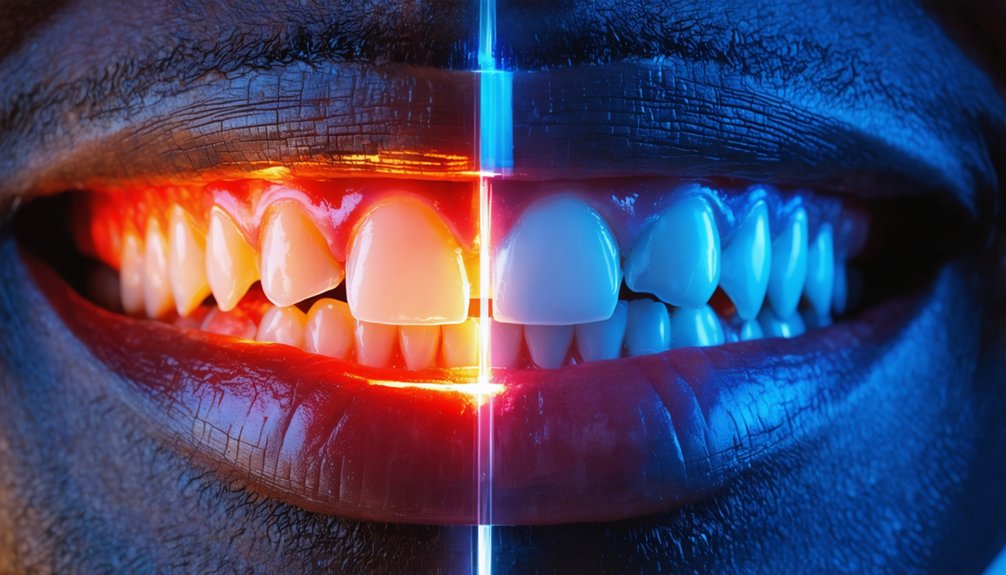
Blue and red light serve completely different roles in teeth whitening. Blue light activates peroxide-based gels, generating free radicals that break down enamel stains—it won’t whiten teeth without the gel. Red light targets soft tissue, reducing inflammation and supporting gum recovery without changing tooth shade. Blue light carries conditional sensitivity risks, while red light demonstrates a stronger safety profile. Understanding these five key differences helps you choose the right treatment for your specific clinical goal.
Key Takeaways
- Blue light activates peroxide gels to accelerate tooth bleaching, while red light focuses solely on soft tissue health and gum repair.
- Blue light produces visible whitening results only when paired with peroxide gel; red light produces no measurable tooth shade change.
- Red light reduces gum inflammation and stimulates collagen synthesis; blue light targets superficial enamel pigmentation breakdown.
- Red light carries a stronger safety profile with minimal thermal output; blue light risks increased tooth sensitivity if improperly applied.
- Blue light is chosen for whitening efficacy; red light is selected for tissue recovery and post-treatment sensitivity reduction.
How Blue and Red Light Work Differently on Teeth
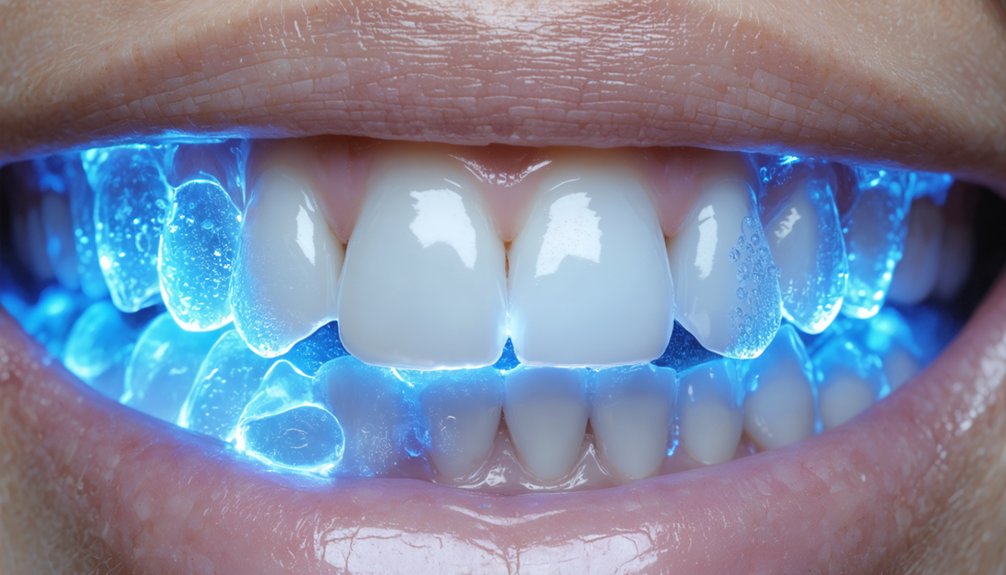
When comparing blue and red light in teeth whitening, each wavelength targets a completely different biological mechanism. Blue light activates peroxide-based gels, generating free radicals that break down pigmented molecules on your enamel surface. It functions as a catalyst, accelerating the bleaching reaction rather than acting independently.
Blue light doesn’t whiten teeth alone — it activates peroxide gels, triggering the chemical reaction that breaks down stains.
Enamel preservation remains achievable when you use blue light within non-ionizing wavelength ranges, typically between 450 nm and 470 nm.
Red light operates through an entirely separate pathway. It drives microcirculation improvement in your gum tissue, stimulating blood flow to reduce inflammation and support soft tissue repair.
It produces no measurable color change on tooth shade. Instead, it strengthens the surrounding tissue environment, reducing post-treatment sensitivity without altering your enamel’s structure.
Does Blue Light Actually Whiten Teeth: or Just Activate the Gel?
Blue light doesn’t whiten teeth on its own—it accelerates the chemical reaction within peroxide-based gels. When you apply hydrogen or carbamide peroxide to the enamel surface, blue light activates the formula, generating free radicals that break down pigmented molecules. Without the gel, you’re not achieving meaningful color stability or measurable shade change.
Light penetration plays a key role here. Blue light operates at 400–500 nm, targeting superficial enamel layers where chromophores accumulate. It functions as a catalyst, not an independent bleaching agent.
Clinical in-vitro studies confirm that blue light increases the bleaching rate and raises the final ΔE value—but only when paired with peroxide chemistry.
If you want results you can measure, the gel does the work; blue light simply makes it faster.
What Red Light Does for Your Gums During Whitening
Red light doesn’t bleach your enamel—it works on the soft tissue surrounding it. During whitening sessions, peroxide gels can irritate your gums, triggering localized inflammation. Red light, operating between 620–740 nm, penetrates gum tissue to stimulate microcirculation and accelerate cellular repair. This directly supports inflammation reduction, minimizing post-treatment soreness you’d otherwise manage reactively.
Beyond comfort, red light promotes gum regeneration by encouraging collagen synthesis in connective tissue. You’re not just suppressing symptoms—you’re supporting structural recovery at the tissue level. Clinical data confirms red light produces no measurable enamel color change, so its role is precisely defined: gum health maintenance, not whitening.
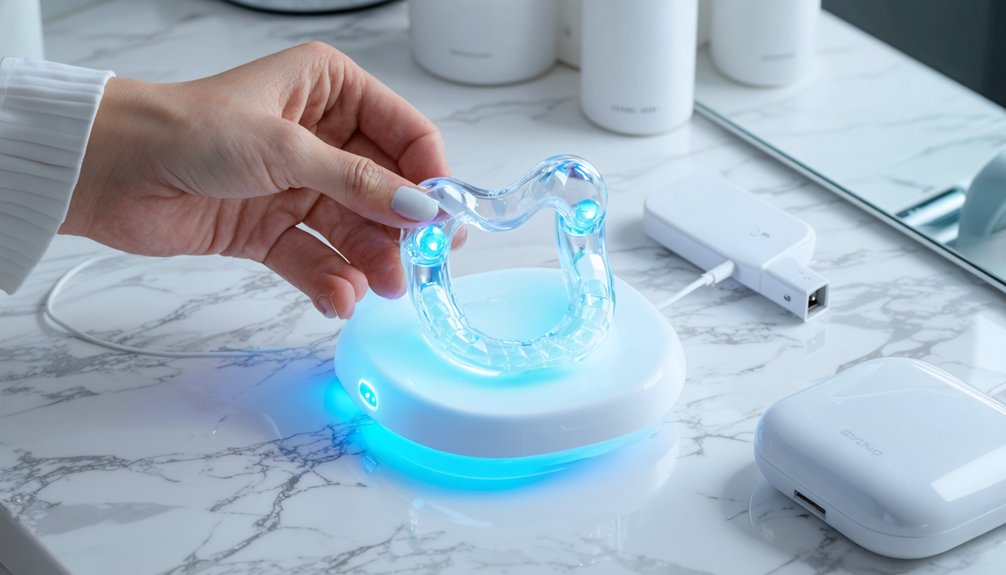
When you use a combined device, red light handles soft tissue protection while blue light manages the bleaching chemistry.
Which Light Is Safer: Blue, Red, or Neither?
Safety isn’t identical across both wavelengths—and understanding the distinction helps you make smarter clinical decisions. In any technology comparison, red light consistently demonstrates a stronger safety profile. It emits no ionizing radiation, generates minimal thermal output, and poses no documented risk to enamel or soft tissue.
Red light consistently demonstrates a stronger safety profile—minimal thermal output, no ionizing radiation, no documented risk to tissue.
Blue light carries conditional risks—not from the wavelength itself, but from the peroxide gel it activates. Without proper gel application, blue light can increase tooth sensitivity through thermal effects.
For cosmetic enhancement purposes, neither wavelength is inherently dangerous when used correctly, but blue light demands stricter protocol adherence. Red light tolerates broader application with fewer adverse variables.
If patient sensitivity is your primary concern, red light gives you more controlled, predictable outcomes with considerably fewer contraindications to manage.
Blue Light vs Red Light: Which One Do You Actually Need?
Knowing which light is safer gets you halfway there—the other half is matching the right wavelength to your actual clinical goal. If you’re targeting visible shade improvement, blue light paired with peroxide gel is your protocol. It activates free radicals, accelerates bleaching rate, and raises final ΔE values.
Red light doesn’t whiten—it reduces post-procedure inflammation and supports gum tissue recovery.
Your decision comes down to outcome priority. Choose blue light when treatment duration and whitening efficacy are the primary metrics. Choose red light when gum sensitivity or soft tissue restoration drives the session.
Laser safety standards apply to both, but blue light carries greater risk without a compatible chromophore present. Know your goal, then select accordingly.
Frequently Asked Questions
Can Red and Blue Light Be Used Simultaneously in One Session?
Yes, you can use both lights simultaneously. Combined devices deliver blue light’s whitening activation alongside red light’s gum healing. This light combination’s treatment safety profile remains strong, letting you maximize bleaching efficacy while minimizing post-procedure inflammation in one session.
How Long Does Each Whitening Session With Blue Light Typically Last?
Your blue light session typically lasts 15–30 minutes per application. You’ll often repeat cycles two to three times. Factor in treatment costs and verify laser safety compliance with your clinician before proceeding with peroxide-activated protocols.
Are At-Home Blue Light Devices as Effective as Professional Treatments?
Professional results shine brighter; your home whitening device doesn’t match clinical-grade laser safety protocols or peroxide concentrations. You’ll achieve moderate improvements, but professional treatments deliver markedly higher ΔE values and controlled efficacy you can’t replicate independently.
Does Red Light Therapy Help With Existing Tooth Sensitivity Before Whitening?
Red light therapy can reduce your tooth sensitivity before whitening by stimulating microcirculation and promoting tissue repair in your gums. It won’t bleach enamel, but it’ll improve gum health, lowering discomfort risk during treatment.
How Many Sessions Are Needed Before Visible Whitening Results Appear?
You’ll notice your smile’s luminous transformation within 3–6 blue light sessions. Color stability emerges gradually, while treatment longevity depends on gel concentration and compliance. Consistent protocols maximize your measurable ΔE outcomes effectively.
References
- https://www.instagram.com/reel/DHWJOa1xl0p/?hl=en
- https://www.teethwhiteningsmile.com/news/blue-vs-red-light-teeth-whitening/
- https://www.bestelectrictoothbrushclub.com/what-is-the-difference-between-red-and-blue-light-snow-whitening/
- https://pmc.ncbi.nlm.nih.gov/articles/PMC11904167/
- https://www.lighttherapyinsiders.com/red-light-vs-blue-light-therapy/
- https://www.advancedsmilesmarion.com/resources/at-home-led-teeth-whitening-guide
- https://llrncare.com/led-teeth-whitening-devices-clinical-evidence-vs-marketing-hype/
- https://oralucent.com/pages/light-technology
- https://lighttherapyred.com/the-truth-about-light-therapy-for-teeth-whitening-vs-healing
- https://www.powsmart.com/principle-of-red-and-blue-light-teeth-whitening-device/