Tea stains penetrate deep into enamel, making standard whitening ineffective. Your best in-office options include Zoom Whitening, which uses LED-activated hydrogen peroxide gel to lighten teeth up to eight shades in under 90 minutes, laser whitening for breaking down stubborn molecular bonds, and Opalescence Pro for clinically controlled results in as little as one hour. Costs range from $150 to $1,000 depending on the procedure. Keep exploring to discover which treatment best matches your specific situation.
Key Takeaways
- Zoom Whitening uses high-concentration hydrogen peroxide gel activated by LED light, achieving up to eight shades lighter in under 1.5 hours.
- Laser whitening targets deep-seated tea stains by breaking down molecular bonds that standard bleaching methods cannot reach.
- Opalescence Pro Treatment delivers results in one hour using high-concentration gel that effectively breaks down tea and coffee stains.
- Professional in-office treatments address tannins and chromogens that penetrate enamel deeply, where standard over-the-counter products typically fail.
- In-office whitening costs range from $150 to $1,000, varying by procedure type, location, and dentist expertise.
Why Tea Stains Are Harder to Remove Than You Think
Tea contains three types of compounds — tannins, theaflavins, and thearubigins — that don’t just sit on your enamel’s surface.
These molecules bind directly to your enamel’s protein matrix, penetrating microscopic surface pores and embedding deep within the tooth structure. That’s what makes tea stain causes fundamentally different from surface-level discoloration.
Tea stain molecules don’t just sit on enamel — they penetrate deep into its structural matrix.
Standard over-the-counter products rarely reach these embedded chromogens, which is why whitening challenges persist even with consistent brushing.
Your enamel’s porous nature works against you — the longer staining compounds remain, the deeper they infiltrate. Acidic tea further erodes enamel, widening those pores and accelerating pigment absorption.
Effectively reversing this discoloration requires professional-strength agents capable of breaking down stain molecules at the structural level.
Zoom Whitening: Fast Results for Deep Tea Discoloration
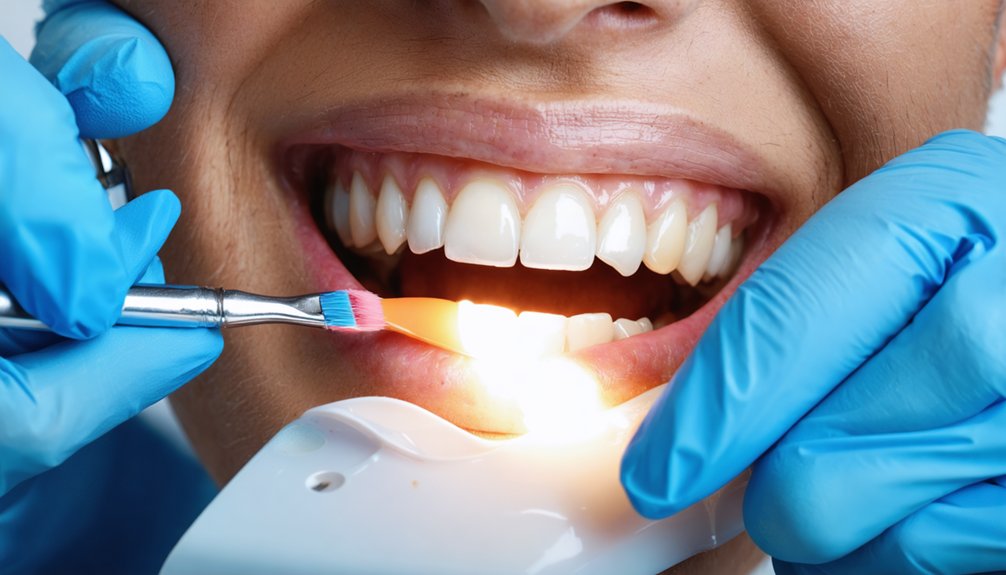
If you’re dealing with stubborn tea discoloration, Zoom Whitening offers a clinically proven solution that works by applying a high-concentration hydrogen peroxide gel, activated by an LED light to accelerate the bleaching process and break down stain molecules.
Your dentist applies the gel in short, monitored cycles, completing the entire procedure in under 1.5 hours and achieving results of up to eight shades lighter in a single visit.
You can expect to invest between $300 and $1,000 for this treatment, with costs varying based on your dental office and geographic location.
How Zoom Whitening Works
Zoom Whitening uses a high-concentration hydrogen peroxide gel paired with an LED light to break down the discoloration molecules responsible for deep tea stains.
Zoom Technology activates the gel in short, controlled cycles, allowing precise Shade Monitoring throughout your session. Your dentist manages Gel Application carefully, adjusting concentration based on your enamel’s response.
Patient Comfort remains a priority, as desensitizing agents are incorporated to minimize sensitivity during Treatment Duration, which runs under 1.5 hours. You’ll leave with results up to eight shades whiter in a single visit.
Post Care Tips include avoiding tea, coffee, and pigmented foods for 48 hours to protect your results. Following these guidelines guarantees your whitening outcome remains stable and professionally controlled long-term.
Zoom Whitening Treatment Costs
Most patients find that Zoom Whitening costs range from $300 to $1,000, depending on your dental office’s location, expertise, and included services.
When weighing cost comparison against treatment benefits, you’re investing in clinically monitored results, safety considerations, and professional post-treatment care that over-the-counter alternatives can’t match.
Your whitening expectations should account for the full value: immediate results, dentist supervision, and desensitizing agents that protect enamel during the procedure.
Patient experiences consistently confirm that long-term results justify the higher price point compared to at-home trays, which cost $150 to $400 but require weeks of consistent use.
Ask your dentist what’s included in the quoted fee—some offices bundle touch-up trays, ensuring you maintain your results effectively for months following your session.
How Laser Whitening Removes Tea Stains Nothing Else Can Touch
When tea stains resist conventional whitening methods, laser teeth whitening offers a clinically superior solution by using concentrated light energy to penetrate deep into the enamel.
Unlike standard bleaching, laser effectiveness stems from its ability to break down the molecular bonds responsible for deep-seated discoloration that over-the-counter products can’t reach.
Laser whitening targets the molecular bonds behind deep discoloration — reaching what standard bleaching simply cannot.
In stain comparison testing, laser whitening consistently outperforms traditional methods on stubborn, set-in tea stains.
The procedure pairs concentrated light energy with a professional-grade bleaching gel, enhancing penetration for faster, more uniform results.
You’ll typically see noticeable improvement in a single session.
The American Dental Association considers hydrogen peroxide-based laser methods safe, giving you confidence that you’re choosing a clinically validated approach to reclaim full control over your smile’s appearance.
Opalescence Pro: One Hour to a Noticeably Whiter Smile
Opalescence Pro is a dentist-administered, in-office treatment that applies professional-strength whitening gel directly to your teeth for controlled, precise results in as little as one hour.
You’ll leave the appointment with noticeably whiter teeth, as the high-concentration gel effectively breaks down stains from tea, coffee, and other discoloring agents.
To sustain those results, your dentist can pair the in-office treatment with custom Opalescence Go trays for at-home maintenance on your schedule.
Professional-Strength Gel Application
For patients seeking a noticeably whiter smile in a single appointment, professional-strength gel application through Opalescence Pro delivers results in as little as one hour.
Your dentist applies a high-concentration peroxide gel directly to your teeth, controlling both coverage and intensity throughout the process. This precise application technique maximizes professional gel effectiveness by ensuring uniform contact with stained enamel surfaces, particularly those discolored by repeated tea consumption.
Unlike over-the-counter alternatives, your dentist monitors the gel’s interaction with your enamel in real time, adjusting concentration or exposure as needed.
This controlled environment reduces sensitivity risks while optimizing outcomes. You’re not guessing—you’re working within a clinically supervised framework that targets tea stains efficiently, giving you measurable, predictable whitening results within a structured, single-visit protocol.
One-Hour Whitening Results
Within a single appointment, Opalescence Pro delivers noticeably whiter teeth in as little as one hour—a timeline that distinguishes it from gradual at-home alternatives. That one hour convenience means you’re not committing to weeks of tray-wearing to see measurable results.
Instead, your dentist applies professional-strength gel directly, controlling concentration and exposure with precision throughout the session.
For tea stains specifically, this controlled environment matters. Your dentist monitors shade progression and adjusts application accordingly, giving you accurate results rather than guesswork.
You leave with immediate confidence in your outcome, knowing a credentialed professional managed every stage of the process.
Opalescence Pro also integrates seamlessly with at-home maintenance trays, so you retain control over long-term results without sacrificing the clinical foundation that one in-office session establishes.
At-Home Maintenance Trays
Once your in-office Opalescence Pro session concludes, at-home maintenance trays help you sustain and extend those results over time.
Your dentist complements the treatment with Opalescence Go trays, giving you precise control over long-term whitening tips and at-home care.
Key maintenance guidelines include:
- Wear trays consistently for the dentist-recommended duration to prevent tea stain recurrence
- Use prescribed gel concentrations to maintain enamel safety and whitening efficacy
- Schedule touch-ups every one to three months for sustained brightness
- Avoid staining beverages for 48 hours post-treatment to protect results
- Store trays properly in their protective case to preserve tray integrity
Following these protocols guarantees you maintain professional-grade whitening outcomes between office visits efficiently.
How LED Light Therapy Removes Tea Stains Faster Than Gel Alone
When it comes to removing tea stains, LED light therapy outperforms gel-alone treatments by accelerating the chemical reaction that breaks down discoloration molecules.
The LED activation benefits stem from how concentrated light energy excites the peroxide molecules in the whitening gel, intensifying their oxidizing power against stubborn chromogens responsible for tea discoloration.
Understanding the stain breakdown mechanism helps you make informed treatment decisions.
LED activation causes peroxide to release free radicals more rapidly, penetrating enamel deeper and dissolving tannin-based stains that gel alone can’t efficiently reach within a single session.
Dental sources confirm this combination delivers superior results compared to passive gel application.
You’ll also benefit from integrated desensitizing agents within LED-compatible systems, which minimize post-treatment sensitivity while maintaining the accelerated whitening effectiveness you need for measurable, controlled results.
High-Potency Bleaching Gel: The One-Session Option for Severe Staining
High-potency bleaching gel addresses severe tea staining through concentrated hydrogen peroxide formulations that penetrate enamel deeply enough to dissolve stubborn chromogens in a single session.
You’ll benefit from one session effectiveness by having your dentist apply high potency gel with precise, uniform coverage across all surfaces.
Key protocol elements include:
- Gel concentrations typically range from 25–40% hydrogen peroxide
- Light activation enhances peroxide penetration for accelerated results
- Treatment targets stubborn chromogen molecules directly within enamel
- Post-treatment aftercare requires avoiding staining foods for 48 hours
- Maintenance touch-ups every 1–3 months preserve achieved whiteness
This approach gives you measurable, clinically controlled outcomes without extended treatment timelines.
Your dentist monitors each application cycle, adjusting concentration and exposure based on your enamel’s response.
How Much Does In-Office Teeth Whitening Actually Cost?
When considering in-office teeth whitening, you’ll find that costs typically range from $150 to $1,000 depending on the procedure and provider.
Zoom whitening, for example, runs between $300 and $1,000, while custom tray systems offer a more affordable alternative at $150 to $400.
Factors such as geographic location, dentist expertise, and the specific technology used directly influence what you’ll pay for treatment.
Average Treatment Price Ranges
In-office teeth whitening typically falls within 3 price tiers, depending on the method your dentist recommends. Understanding these ranges helps you balance treatment effectiveness and patient comfort against your budget.
- Zoom Whitening: $300–$1,000 per session
- Laser Whitening: $400–$1,500 depending on clinic and technology
- Opalescence Pro: $300–$700 for a single in-office session
- Power Whitening Sessions: $200–$600, often paired with light activation
- Custom Tray Whitening: $150–$400, the most cost-accessible professional option
Higher-tier treatments typically deliver faster, more dramatic results for stubborn tea stains.
Lower-tier options, like custom trays, require more time but maintain clinical precision.
Ask your dentist which tier aligns with your stain severity and whitening goals before committing.
Factors Affecting Whitening Costs
Several variables directly influence what you’ll pay for in-office whitening, making cost comparisons between clinics more complex than they first appear. Geographic location, dentist expertise, and clinic overhead greatly shift pricing.
Whitening technology advancements—such as LED-activated systems or laser platforms—command higher fees than conventional peroxide-only treatments, reflecting equipment investment and procedural sophistication.
Patient comfort considerations also factor into final costs. Clinics incorporating desensitizing agents, customized protocols, or extended monitoring sessions may charge premiums that justify the added clinical attention.
Treatment duration, gel concentration, and number of application cycles contribute additional pricing variability.
Understanding these cost drivers lets you evaluate quotes critically rather than defaulting to the cheapest option. Prioritize clinics that transparently itemize charges, ensuring you’re paying for clinically validated outcomes rather than marketing alone.
In-Office vs. Custom Trays: Which Removes Tea Stains Better?
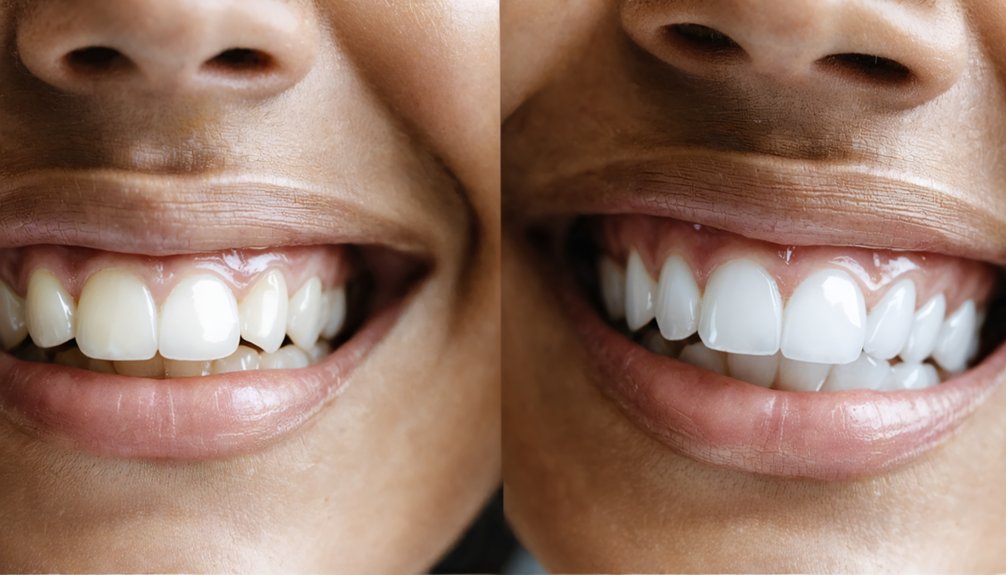
Choosing between in-office whitening and custom trays depends largely on the severity of your tea stains and how quickly you want results.
In-office treatments deliver immediate, clinically controlled stain removal, while custom trays offer gradual, flexible whitening on your schedule.
Consider these key distinctions:
- Speed: In-office sessions whiten up to 8 shades in one visit; custom trays require 1–2 weeks
- Concentration: In-office gels use higher peroxide percentages for deeper stain removal
- Cost: Custom trays run $150–$400; in-office ranges from $300–$1,000
- Control: Custom trays let you manage treatment timing and intensity
- Longevity: Both methods produce lasting results when paired with proper maintenance
If your tea stains are deeply set, in-office treatment provides faster, more precise results.
What to Expect From Your In-Office Whitening Appointment
When you arrive for your in-office whitening appointment, your dentist will begin by evaluating your current tooth shade and reviewing your medical history to confirm you’re a suitable candidate.
Appointment preparation typically involves a professional cleaning to remove surface debris, ensuring the whitening gel penetrates evenly. Your gums and soft tissues receive protective barriers before high-concentration peroxide gel is applied to your enamel.
Treatment cycles run approximately 15 minutes each, with your dentist monitoring shade progression and patient comfort throughout.
LED or laser light activation may accompany the gel, accelerating the bleaching process. Most sessions conclude within 60 to 90 minutes.
You’ll leave with documented shade results and specific aftercare instructions, including avoiding tea, coffee, and dark foods for at least 48 hours post-treatment.
How to Stop Tea Stains From Returning Between Whitening Sessions

Once your whitening appointment wraps up, protecting your results becomes the immediate priority. Preventive measures and dietary adjustments directly determine how long your whitening lasts.
- Avoid tea, coffee, and dark beverages for 48 hours post-treatment.
- Use a straw when drinking tea to minimize enamel contact.
- Rinse your mouth with water immediately after consuming staining beverages.
- Maintain custom tray touch-ups every one to three months.
- Brush with whitening toothpaste twice daily to manage surface discoloration.
You control the longevity of your results through consistent habits.
Switching to lighter teas like white or green varieties reduces staining compounds considerably.
Scheduling periodic in-office sessions alongside your at-home maintenance protocol guarantees discoloration doesn’t compromise your investment between professional whitening visits.
Frequently Asked Questions
Can In-Office Whitening Damage Existing Dental Crowns or Veneers?
In-office whitening won’t damage your crowns or veneers, but you’ll notice crown sensitivity or color mismatches. Protect veneer longevity by informing your dentist beforehand, ensuring they customize treatment to safeguard your existing restorations effectively.
How Long Do In-Office Whitening Results Typically Last for Tea Drinkers?
With 6+ monthly tea cups accelerating stain recurrence, your whitening longevity typically spans 6–12 months. You’ll extend results through consistent tea stain prevention—using touch-up trays every 1–3 months and limiting tea consumption post-treatment.
Is In-Office Teeth Whitening Safe During Pregnancy or Breastfeeding?
You shouldn’t pursue in-office whitening during pregnancy or breastfeeding due to safety concerns around hydrogen peroxide exposure. Instead, you’ll want to explore alternative options like fluoride treatments, consulting your dentist for personalized, evidence-based guidance.
Can In-Office Whitening Treat Stains Caused by Medications Like Tetracycline?
Like shadows etched deep in stone, tetracycline stains resist standard stain removal. In-office whitening can’t fully treat these medication types, as they’re embedded in dentin, but multiple sessions may lighten them noticeably.
How Many In-Office Whitening Sessions Are Needed for Severe Tea Stains?
For severe tea stains, you’ll typically need one to three sessions for effective stain removal. Your dentist determines whitening frequency based on discoloration depth, often recommending follow-up touch-ups every one to three months for sustained results.
References
- https://www.forbes.com/sites/forbes-personal-shopper/article/best-teeth-whitening-kit/
- https://opalescence.com/products/opalescence-pro-in-office-teeth-whitening
- https://www.kneibdentistry.com/dentistry-blog/best-in-office-teeth-whitening-solutions
- https://www.colonnadedental.care/2024/12/15/teeth-whitening-options/
- https://clubwhitesmile.com/whitening-treatments-for-stubborn-tea-stains/
- https://abritersmile.com/best-teeth-whitening-in-los-angeles-top-in-office-options-compared/
- https://g-p-dental.com/best-teeth-whitening-for-tea-and-coffee-drinkers/
- https://www.nbcnews.com/select/shopping/best-otc-teeth-whitening-products-rcna267151
- https://www.yourdentistryguide.com/professional-whitening/