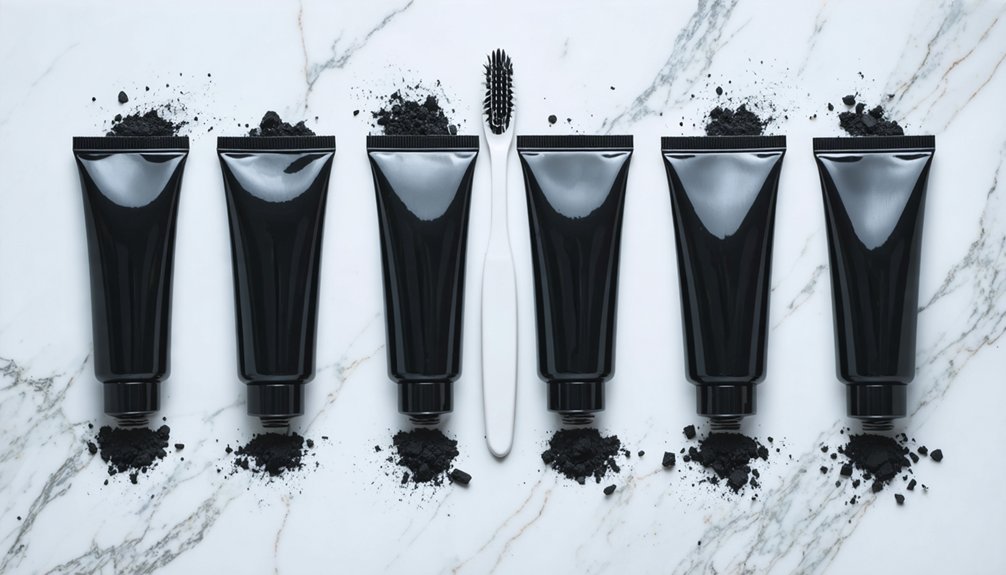
When comparing top charcoal whitening brands, Active Wow leads in consumer validation with thousands of verified reviews, while Dr. Song offers a 100-day money-back guarantee for added security. LaserGlow, Beaming White, and Dental Duty target daily maintenance with low-abrasion formulas. You should prioritize coconut shell-derived, ultra-fine particle products to reduce enamel wear risk. No major dental organization endorses charcoal whitening, so caution matters. The full brand breakdown ahead reveals what marketing won’t tell you.
Key Takeaways
- Active Wow leads in consumer popularity, boasting over 9,000 reviews averaging above four stars, making it the most validated charcoal whitening brand.
- Dr. Song offers a 100-day money-back guarantee, reducing financial risk for consumers unsure about charcoal whitening effectiveness.
- LaserGlow and Beaming White focus on daily maintenance formulas, emphasizing low-abrasion claims suitable for sensitive enamel.
- Dental Duty provides a convenient mint-flavored toothpaste format, making charcoal whitening more accessible for everyday users.
- Coconut shell-derived charcoal is preferred across top brands for finer particle structure, which reduces enamel abrasion risk.
How Does Charcoal Actually Whiten Your Teeth?
When you brush with activated charcoal, its porous surface binds to surface-staining compounds from coffee, tea, wine, and tobacco, then lifts them away as you rinse.
Activated charcoal’s porous surface binds to staining compounds from coffee, tea, and wine, lifting them away when you rinse.
This stain removal mechanism works through adsorption, not bleaching, meaning charcoal activation targets extrinsic discoloration only. It won’t alter your tooth’s intrinsic shade.
You should understand that this process is mechanical polishing, not chemical whitening. The results depend on stain depth, brushing frequency, and particle size.
Ultra-fine formulas reduce abrasion risk, but repeated daily use still warrants caution. Enamel doesn’t regenerate, so aggressive application can cause irreversible wear.
Use charcoal whitening as a controlled, periodic maintenance tool rather than a primary whitening solution, and consult your dentist before making it a regular part of your routine.
Powder or Toothpaste: Which Format Removes More Stains?
Choosing between a charcoal powder and a charcoal toothpaste isn’t purely a matter of preference—it directly affects stain removal performance. Powders typically deliver higher charcoal concentration per application, which translates to stronger surface polishing.
If you’re targeting heavy staining from coffee, wine, or tobacco, powder formats generally outperform toothpastes in that regard.
Toothpaste effectiveness, however, shouldn’t be dismissed. Formulas like Dental Duty’s mint-based charcoal toothpaste offer consistent daily contact with enamel, making them practical for maintenance.
Powder convenience is limited—the application process is messier and less intuitive.
The tradeoff is straightforward: powders offer intensity, toothpastes offer regularity. If you want measurable stain reduction, start with a powder. If you need something sustainable long-term, a toothpaste fits better into daily use.
The Best Charcoal Whitening Brands Ranked
Format matters, but brand selection determines what you’re actually putting on your enamel. When you’re comparing brands, ingredient efficacy should drive your decision, not marketing aesthetics.
Active Wow leads in consumer volume, carrying over 9,000 reviews averaging above four stars, with coconut shell charcoal as its base. Dr. Song adds purchase protection through a 100-day money-back guarantee.
Active Wow dominates by volume; Dr. Song counters with a 100-day guarantee where reviews fall short.
LaserGlow and Beaming White both position their formulas for daily maintenance, though daily charcoal use warrants caution given abrasion risk.
Dental Duty delivers a mint-flavored toothpaste format, prioritizing convenience over concentrated stain removal.
Every brand claims enamel safety, but you should verify particle size and abrasivity data independently.
Brand comparisons only hold value when you’re evaluating actual formulation transparency, not just guarantee structures or review counts.
What Separates Active Wow From Every Other Brand?
When you compare Active Wow to competing charcoal whitening brands, its review volume alone sets it apart — with over 9,000 Amazon ratings averaging above four stars.
Media outlets like BuzzFeed consistently rank it among the top charcoal whitening picks, giving it a level of third-party recognition that most brands haven’t earned.
That consumer footprint doesn’t guarantee superior results, but it does signal a scale of real-world use that’s worth weighing carefully.
Massive Review Volume
One metric that consistently sets Active Wow apart from competing charcoal whitening brands is its review volume — over 9,000 consumer ratings averaging above four stars on Amazon alone.
That level of consumer feedback strengthens review credibility in ways smaller brands can’t replicate.
Before relying on volume as your sole indicator, consider what the data actually reflects:
- High review counts reduce the statistical impact of outlier experiences
- Sustained four-star averages suggest consistent product performance
- Featured placements on BuzzFeed listicles amplify consumer feedback loops
- Volume doesn’t guarantee safety or clinical efficacy
- Popularity signals market trust, not regulatory approval
You’re better positioned to evaluate a product when you separate social proof from verified performance data.
Use review volume as one data point, never the deciding one.
Widespread Media Recognition
Beyond review volume, Active Wow has secured a form of brand validation that most charcoal whitening competitors haven’t achieved: repeated editorial placement on high-traffic media platforms like BuzzFeed.
That level of media exposure isn’t accidental—it reflects consistent product performance and consumer demand that editors recognize as credible.
For you, this matters. Brand visibility in editorial roundups signals that independent voices, not just paid advertisers, have evaluated the product and found it worth recommending.
That’s a meaningful distinction when you’re comparing options with similar ingredient claims.
Most charcoal whitening brands rely solely on marketplace presence. Active Wow’s editorial footprint adds a layer of third-party accountability.
If you prioritize evidence-backed choices over marketing language, media recognition is a signal worth factoring into your decision.
Unmatched Consumer Popularity
More than 9,000 consumer reviews averaging above 4 stars places Active Wow in a category most charcoal whitening brands haven’t approached. That volume reflects measurable consumer preferences, not marketing claims.
Brand loyalty this consistent signals a pattern worth examining before you commit to any product.
Active Wow’s review profile stands out because:
- Review count exceeds competitors by a documented margin
- Ratings remain stable across high purchase volumes
- BuzzFeed and similar platforms repeatedly validate its position
- Coconut-based charcoal formula aligns with dominant ingredient preferences
- Consumer feedback sustains purchasing cycles without heavy promotional pressure
You’re making a decision that affects enamel and long-term oral health. Popularity doesn’t guarantee safety, but it does confirm that Active Wow delivers results consistent enough to build and retain a measurable, loyal user base.
Coconut Charcoal, Bentonite, and the Ingredients That Matter
When evaluating charcoal whitening products, the ingredient list matters more than the marketing. Coconut shell-derived activated charcoal offers measurable coconut benefits over wood or peat sources, including finer particle structure and more consistent porosity, both of which reduce enamel abrasion risk.
You should verify the charcoal source before purchasing.
Bentonite is another ingredient worth examining. Its bentonite properties include mild alkalinity and trace mineral content, which some formulas use to support remineralization. However, clinical evidence supporting this claim remains limited.
Look for ultra-fine particle size, fluoride-free formulation, and absence of artificial additives if you’re prioritizing safety alongside whitening.
Ingredients like orange seed oil appear in select products but carry no significant whitening evidence. Prioritize transparency over claims.
Is Charcoal Whitening Safe for Your Enamel?
When you use charcoal whitening products, enamel abrasion becomes your most pressing concern, since charcoal particles are harder than conventional toothpaste abrasives and can wear down enamel with repeated use.
You’ll want to look for formulas marketed as ultra-fine or low-abrasion, as these reduce mechanical damage while still delivering surface-stain removal.
Some roundup sources caution that even products labeled “enamel-safe” carry risk if you brush too aggressively or use them too frequently.
Enamel Abrasion Risks
Although charcoal whitening products are widely marketed as enamel-safe, the science tells a more cautious story. Abrasion concerns remain a legitimate risk you shouldn’t overlook when choosing a whitening method.
Here’s what you need to control for:
- Charcoal is inherently abrasive, regardless of particle size claims
- “Ultra-fine” labeling doesn’t guarantee enamel protection
- Daily use increases cumulative wear on tooth surfaces
- No major dental organization currently endorses charcoal whitening
- Irreversible enamel loss can increase sensitivity and decay risk
Your enamel doesn’t regenerate once it’s gone.
If you’re committed to using charcoal products, limit frequency, choose verified low-abrasion formulas, and consult your dentist. Marketing language isn’t a substitute for clinical evidence—your long-term dental health depends on informed, cautious decision-making.
Low-Abrasion Formula Benefits
Not all charcoal formulas carry the same abrasion risk, and understanding what separates a lower-abrasion product from a higher-abrasion one can help you make a more informed choice.
Low abrasion benefits become relevant when you’re selecting a product for regular use, since repeated mechanical polishing compounds cumulative enamel wear. Brands that emphasize ultra-fine particle sizing reduce that mechanical load on your enamel surface.
Enamel protection also improves when manufacturers omit harsh secondary abrasives and rely solely on finely milled coconut shell charcoal. Fluoride-free, peroxide-free formulas eliminate chemical stressors, but they don’t offset physical abrasion unless particle size is controlled.
You should verify RDA values when available, since marketing language like “gentle” or “enamel-safe” isn’t standardized and carries no regulatory enforcement behind it.
Which Brands Are Safest for Sensitive Teeth?
Sensitive teeth require careful product selection, and not every charcoal whitening brand is formulated with that concern in mind. When evaluating sensitivity concerns, prioritize brands offering gentle formulations with ultra-fine particles and no peroxide.
Consider these brand-specific safety factors:
- Active Wow uses coconut shell charcoal with fine particle sizing to minimize abrasion.
- Dental Duty offers a mint-flavored toothpaste format, reducing direct powder contact with enamel.
- Beaming White markets its formula specifically for daily maintenance with low-abrasion claims.
- LaserGlow positions its product as everyday-safe, emphasizing controlled whitening over aggressive stain removal.
- Dr. Song provides a 100-day guarantee, allowing you to assess tolerance without financial risk.
Peroxide-free formulas across these brands reduce chemical irritation, giving you measurable control over your sensitivity exposure.
Do Any Charcoal Brands Actually Guarantee Results?
When you’re spending money on a whitening product, guarantees matter. Few charcoal brands offer verifiable proof of guaranteed effectiveness, but some do back their claims with purchase protection. Dr. Song stands out by offering a 100-day money-back guarantee, which reduces financial risk if results disappoint. That kind of policy signals a baseline of consumer trust, though it doesn’t confirm clinical efficacy.
You should distinguish between a satisfaction guarantee and proven whitening outcomes. A refund policy protects your wallet; it doesn’t validate the science.
Charcoal products primarily remove surface stains through mechanical polishing, not chemical bleaching. Before purchasing, look for transparent return policies, review volume, and third-party testing disclosures. These factors provide more reliable consumer trust signals than marketing language alone.
Which Charcoal Whitening Brand Should You Buy?
Choosing the right charcoal whitening brand depends on your priorities—format preference, ingredient transparency, and return policy—rather than marketing claims alone. Match your selection to verified factors:
Choosing the right charcoal whitening brand means prioritizing verified factors over persuasive marketing claims alone.
- Active Wow suits high usage frequency needs with strong consumer validation and review volume.
- Dr. Song offers a 100-day money-back guarantee, reducing financial risk.
- Dental Duty works better if you prefer toothpaste convenience over loose powder.
- LaserGlow and Beaming White both support daily maintenance whitening with low-abrasion claims.
- Ingredient sourcing matters—prioritize coconut shell charcoal with confirmed ultra-fine particle size.
Avoid brands that omit abrasivity data or obscure ingredient origins.
Peroxide-free and fluoride-free formulas reduce sensitivity risk but don’t replace clinical whitening.
Always verify label claims independently before committing.
Frequently Asked Questions
Can Charcoal Whitening Powders Stain Grout, Sinks, or Bathroom Surfaces?
Yes, charcoal composition can leave dark residue on grout, sinks, and porous surfaces, causing surface damage. You’ll want to rinse immediately, avoid spills, and clean thoroughly after each use to maintain control.
How Long Does One Jar of Charcoal Whitening Powder Typically Last?
Like rationing medicine, your jar’s a 4–6 week supply if you’re disciplined. Application techniques matter—overuse depletes it faster. Ingredient comparisons reveal denser coconut charcoal powders last longer, so you’ll control your whitening timeline more precisely.
Are Charcoal Whitening Products Safe to Use With Dental Veneers?
You shouldn’t use charcoal whitening products on veneers. They won’t improve whitening effectiveness on porcelain, and abrasive particles risk increasing veneer sensitivity or causing surface damage. Consult your dentist before proceeding.
Can Children or Teenagers Safely Use Charcoal Teeth Whitening Products?
You shouldn’t let children use charcoal whitening products. For child dental health and teenage oral hygiene, these abrasive formulas can damage developing enamel. Consult your dentist before introducing any whitening treatment to young users.
Do Charcoal Whitening Products Expire or Lose Effectiveness Over Time?
Yes, they do expire. You should check the shelf life before using any product, as ingredient stability declines over time, reducing whitening effectiveness and potentially increasing the risk of bacterial contamination or enamel irritation.
References
- https://healthyhomebuys.com/the-best-charcoal-teeth-whitening-products-reviews-and-buyers-guide/
- https://mayalamode.com/charcoal-teeth-whitening-products/
- https://www.youtube.com/watch?v=P6_i7nAJg50
- https://www.laserglowspa.com/products/activated-charcoal-whitening-powder
- https://beamingwhite.com/shop/maintenance/natural-activated-charcoal-teeth-whitening-powder/
- https://www.amazon.com/charcoal-teeth-whitening/s?k=charcoal+teeth+whitening
- https://www.buzzfeed.com/emmamcanaw/teeth-whiteners-that-work-so-well-its-like-magic
- https://www.checkli.com/checklists/facentials/best-charcoal-powder-for-teeth
- https://www.forbes.com/sites/forbes-personal-shopper/article/best-teeth-whitening-kit/
- https://www.pinterest.com/pin/the-5-best-charcoal-teeth-whitening-products-reviews-2021–615585842822091451/