If you’re avoiding artificial sweeteners, you can still find whitening toothpastes with clinically supported active ingredients. Supersmile uses Calprox to dissolve stain-binding proteins, while Opalescence relies on calibrated hydrated silica for professional-grade surface cleaning. Arm & Hammer combines sodium bicarbonate with peroxide for mechanical and chemical stain removal. For fluoride-free protocols, hydroxyapatite-based options like RiseWell support remineralization without synthetic additives. Each formula targets a distinct whitening mechanism, and knowing which one matches your goal changes everything.
Key Takeaways
- Supersmile Whitening Toothpaste uses Calprox to dissolve stain-binding proteins, offering effective whitening without artificial sweeteners.
- Arm & Hammer Advance White combines sodium bicarbonate and peroxide for natural, artificial sweetener-free surface stain removal.
- Opalescence Whitening Toothpaste delivers clinical-grade stain removal using hydrated silica, free from artificial sweeteners.
- Crest 3D White Brilliance prevents new stains with a fluoride-based formula containing no artificial sweeteners.
- Fluoride-free options like RiseWell, Davids, and Ela Mint use hydroxyapatite for remineralization without artificial sweeteners.
What Artificial Sweeteners Are Actually Doing in Your Toothpaste
Toothpaste manufacturers add artificial sweeteners like saccharin and sucralose primarily to mask the bitter or medicinal taste of active ingredients like fluoride, peroxide, and abrasive silica compounds. These flavor additives serve no therapeutic function—they’re purely sensory manipulation designed to increase compliance and palatability.
You’re not getting whitening benefit from them. What you’re getting is a chemical compromise that some users report sensitivity reactions to, particularly with saccharin. Beyond the formula itself, packaging materials often list sweeteners last, burying them in long ingredient strings.
If you’re managing your intake of synthetic compounds deliberately, you need to read past the front-panel claims. Artificial sweeteners in toothpaste don’t strengthen enamel, reduce staining, or accelerate whitening—they exist solely to make the product taste acceptable.
The Ingredients That Make Artificial Sweetener-Free Whitening Toothpaste Work
When you’re choosing an artificial sweetener-free whitening toothpaste, the active ingredients determine how effectively it removes stains without compromising enamel.
Natural whitening agents like Calprox, sodium bicarbonate, and hydrated silica work by polishing surface discoloration.
While enamel-safe abrasives keep that action from becoming erosive.
Fluoride strengthens enamel through remineralization.
Hydroxyapatite offers a fluoride-free alternative that can address early-stage mineral loss.
Natural Whitening Agents Explained
Behind every artificial sweetener-free whitening toothpaste is a set of active ingredients doing the actual work. Understanding these agents helps you cut through whitening myths and make informed choices based on mechanism, not marketing.
Calprox dissolves the protein pellicle that binds stains to enamel.
Hydrated silica acts as a mild abrasive, physically polishing surface discoloration.
Sodium bicarbonate disrupts stain adhesion through alkalinity.
Hydrogen peroxide and carbamide peroxide penetrate enamel to address deeper discoloration beyond color matched shades of surface buildup.
Hydroxyapatite remineralizes enamel without fluoride, supporting structural integrity alongside whitening.
Each ingredient targets a distinct mechanism. You should match the agent to your specific discoloration type—surface staining, intrinsic discoloration, or enamel degradation—rather than selecting based on packaging claims alone.
Enamel-Safe Abrasive Ingredients
Whitening agents like peroxides and Calprox address discoloration at the chemical level, but abrasives handle the mechanical side—physically removing surface stains through controlled friction. The key is selecting abrasives calibrated to clean without degrading enamel.
Hydrated silica—used in Opalescence Opal Whitening Toothpaste—is a well-documented enamel-safe option that polishes effectively within safe RDA (Relative Dentin Abrasivity) thresholds.
Sodium bicarbonate, found in Arm & Hammer Advance White, offers gentler mechanical action while supporting surface stain removal.
When you’re evaluating formulas free of sugar substitutes and unnecessary flavor enhancers, pay close attention to abrasive type and concentration—these directly determine enamel safety.
Prioritizing products with clinically validated abrasive systems gives you precise control over whitening outcomes without compromising structural integrity.
Fluoride And Hydroxyapatite Benefits
Enamel integrity depends on remineralization, and two ingredients lead that process in artificial sweetener-free whitening formulas: fluoride and hydroxyapatite.
Fluoride binds to enamel surfaces, forming fluorapatite, a compound more resistant to acid erosion than natural enamel. Hydroxyapatite, used in RiseWell Mineral Toothpaste, mimics your enamel’s natural mineral structure and supports remineralization of early-stage lesions.
When you’re avoiding sugar substitutes and synthetic flavor enhancers, these mineral agents become your primary enamel defense. Hydroxyapatite works without fluoride, making it viable for fluoride-free protocols, while fluoride remains clinically supported for cavity prevention.
Selecting a formula built on either compound gives you measurable structural protection, not just surface-level cosmetic whitening. Both ingredients deliver function you can verify rather than marketing claims you can’t.
How to Choose the Right Artificial Sweetener-Free Whitening Toothpaste
When choosing an artificial sweetener-free whitening toothpaste, you’ll want to evaluate key active ingredients—such as Calprox, hydrated silica, sodium bicarbonate, hydroxyapatite, or peroxide—since each targets stains through distinct mechanisms.
You should then match the formula to your specific goal, whether that’s surface stain removal, enamel remineralization, sensitivity management, or natural or fluoride-free formulation.
Aligning ingredient function with your clinical priority reduces guesswork and improves the likelihood of a measurable whitening outcome.
Key Ingredients to Evaluate
Choosing the right artificial sweetener-free whitening toothpaste starts with understanding which active ingredients actually deliver results. Skip color changing agents and superficial flavor enhancers — they signal marketing priority over efficacy.
Instead, evaluate formulas based on clinically supported compounds:
- Calprox or hydrated silica — physically removes surface stains through controlled abrasion
- Sodium bicarbonate — disrupts stain adhesion and supports surface-level whitening
- Sodium fluoride or hydroxyapatite — strengthens enamel and supports remineralization
- Hydrogen or carbamide peroxide — penetrates enamel to address deeper discoloration
You’re looking for transparency in ingredient listing and a formula where each component serves a documented function.
If a product leads with flavor or cosmetic appeal over active whitening agents, it’s not optimized for results.
Matching Formula to Goals
Knowing which ingredients work is only half the equation — how you apply that knowledge depends on what you’re actually trying to fix.
If surface discoloration is your primary concern, prioritize peroxide or hydrated silica formulas like Opalescence.
If you’re managing dental plaque alongside whitening, look for fluoride-containing options that reinforce tooth enamel while disrupting biofilm accumulation.
For sensitivity, hydroxyapatite-based formulas support remineralization without abrasive peroxide exposure.
If you want a fully natural profile, hello Naturally Whitening delivers whitening without artificial sweeteners, synthetic dyes, or harsh additives.
Match ingredient function to your specific clinical need — not brand positioning.
Cross-reference ADA Seal status where available, and confirm the absence of artificial sweeteners by reviewing the full inactive ingredients list directly.
Hello Naturally Whitening Toothpaste: Best Natural Artificial Sweetener-Free Pick
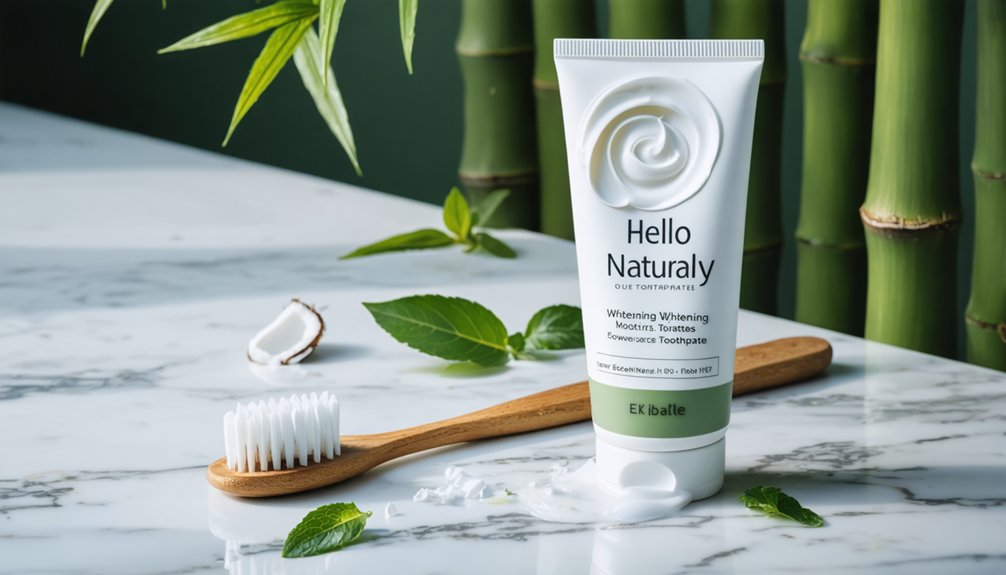
If you’re looking for a natural whitening toothpaste without artificial sweeteners, hello Naturally Whitening Toothpaste stands out as the top pick in 2026 dentist-and-editor testing.
Its formulation targets surface stains while supporting dental enamel integrity, and the toothpaste packaging clearly identifies it as vegan and cruelty-free.
Key verified attributes:
- No artificial sweeteners confirmed in formulation
- Vegan and cruelty-free as stated on toothpaste packaging
- Natural whitening action without harsh synthetic additives
- Dentist-and-editor tested in 2026 comparative evaluations
You’re selecting a product with a transparent ingredient profile and a defined testing record.
If dental enamel preservation and clean-label sourcing are your priorities, this option delivers measurable alignment with those criteria without requiring compromise on whitening efficacy.
Supersmile Whitening Toothpaste: Best Overall Without Artificial Sweeteners
While hello Naturally Whitening Toothpaste leads among natural formulas, Supersmile Whitening Toothpaste earned the top overall ranking in 2026 dentist-and-editor testing across all whitening toothpaste categories.
Its active whitening compound, Calprox, distinguishes it within toothpaste history as a departure from conventional peroxide-heavy formulations. If you’re prioritizing dental hygiene without artificial sweeteners, Supersmile positions itself as a precise, clinically oriented choice.
Calprox sets Supersmile apart—a clinically precise formula free from artificial sweeteners and conventional peroxide dependency.
Its formula targets whitening directly rather than addressing sensitivity or stain prevention as secondary benefits. You’ll want to note, however, that Supersmile hasn’t confirmed ADA Seal of Acceptance status in available testing summaries—a factor worth verifying before committing.
If whitening efficacy and ingredient control are your primary criteria, Supersmile’s overall ranking makes it a defensible, data-supported selection.
Arm & Hammer Advance White: Best Baking Soda Whitening Formula
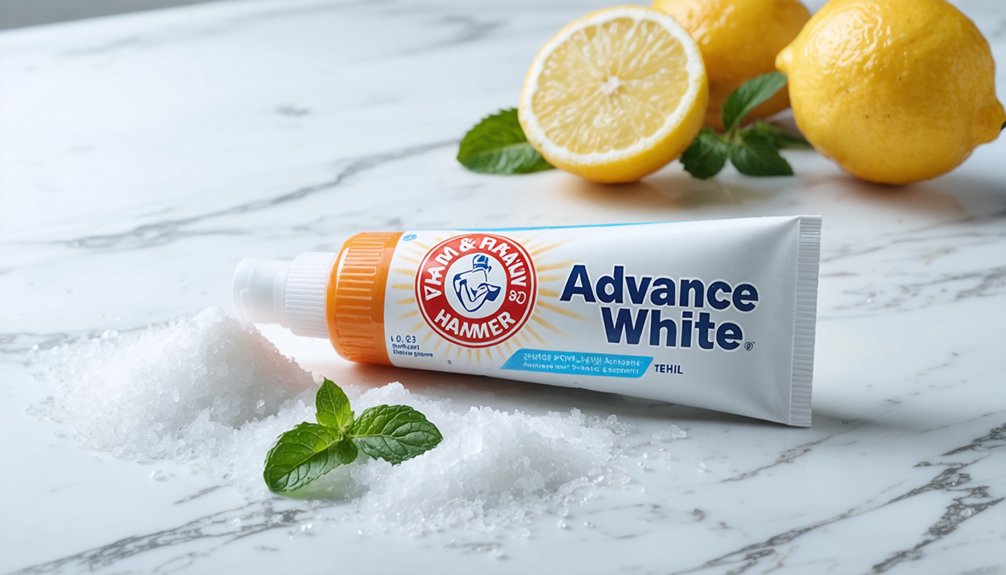
Arm & Hammer Advance White earned its ranking as the best baking soda whitening formula in 2026 testing, combining sodium bicarbonate with peroxide to target surface stains through mild mechanical and chemical action.
If you’re avoiding artificial sweeteners and sugar alcohols, this formula delivers whitening through natural abrasives rather than chemical additives.
Key formulation details worth noting:
- Sodium bicarbonate acts as a gentle natural abrasive for surface stain removal
- Peroxide provides chemical whitening support alongside mechanical action
- No artificial sweeteners or sugar alcohols identified in the product summary
- Strong flavor profile — factor this into your preference-based selection
You’re getting a dual-action approach that prioritizes functional stain removal over cosmetic formulation choices, giving you measurable whitening control without unnecessary additives.
Crest 3D White Brilliance: Best for Blocking New Stains
Baking soda formulas excel at removing existing stains, but Crest 3D White Brilliance takes a different approach by targeting the problem before it sets. Its sodium fluoride base strengthens enamel while creating a surface barrier that resists new discoloration—giving you proactive control rather than reactive correction.
The toothpaste texture is particularly smooth, allowing even distribution across tooth surfaces to maximize contact with enamel. This consistency supports the kind of dental gloss that signals genuinely clean, polished teeth rather than surface-level freshness.
Flavored with peppermint, the formula delivers a clean finish without relying on artificial sweeteners. If your priority is intercepting stains at the source rather than treating them after they’ve bonded, Crest 3D White Brilliance offers a clinically focused, prevention-first strategy worth integrating into your daily routine.
Opalescence Whitening Toothpaste: Best Professional-Grade Formula
For those who want professional-grade results without a dental office visit, Opalescence Whitening Toothpaste delivers through hydrated silica—an abrasive compound that polishes surface stains directly off enamel without compromising tooth structure.
Dentists recognized it among top 2026 whitening options for its targeted approach to surface discoloration.
Dentists rank Opalescence among the top 2026 whitening toothpastes for precision surface stain removal.
Key clinical advantages include:
- Hydrated silica physically removes stains while preserving tooth enamel integrity
- Dental plaque disruption reduces surface buildup that accelerates discoloration
- Professional-grade positioning prioritizes stain polishing over cosmetic additives
- No artificial sweeteners listed, aligning with ingredient-conscious formulation preferences
You get measurable whitening action through mechanical stain removal rather than chemical masking.
If you want clinical-level precision in your daily routine, Opalescence gives you direct control over surface stain management.
Fluoride-Free Whitening Options Without Artificial Sweeteners
What if you want whitening results without fluoride or artificial sweeteners? Several targeted options exist. RiseWell Mineral Toothpaste uses hydroxyapatite to remineralize enamel and support small cavity repair, making it a clinically relevant fluoride alternative. Davids Premium Natural Toothpaste and Ela Mint Toothpaste also appear in fluoride-free roundups, both prioritizing ingredient transparency in their formulations.
When evaluating these products, scrutinize flavor masking agents carefully. Fluoride-free formulas sometimes substitute artificial sweeteners to compensate for flavor loss from removed synthetic compounds. Confirm that sweeteners, binders, and surfactants are fully disclosed on the label.
You should also verify ADA guidance compatibility, since fluoride-free options carry different remineralization trade-offs. Selecting a product with clear, complete labeling gives you the ingredient control these formulas are designed to support.
Frequently Asked Questions
Can Artificial Sweetener-Free Toothpaste Still Effectively Fight Cavities Long-Term?
Yes, you can effectively fight cavities long-term without artificial sweeteners. Fluoride and hydroxyapatite guarantee ingredient stability and cavity protection, while natural flavor enhancement options maintain palatability—keeping you consistent with brushing habits that drive real, measurable oral health outcomes.
Are Artificial Sweetener-Free Whitening Toothpastes Safe for Young Children to Use?
Many artificial sweetener-free whitening toothpastes with natural ingredients are generally safe for young children, but you should verify fluoride levels and age-specific formulations, as taste preferences and abrasive compounds can affect both safety and compliance.
How Long Does Whitening Typically Take With Natural Sweetener-Free Toothpaste Formulas?
While results won’t appear overnight, you’ll typically notice whitening duration improvements within 2–4 weeks of consistent use. Natural ingredients work gradually but effectively, removing surface stains through daily mechanical and chemical action with measurable results by week six.
Do Artificial Sweetener-Free Toothpastes Cost More Than Conventional Whitening Toothpastes?
You’ll often pay more for artificial sweetener-free whitening toothpastes due to ingredient transparency demands and cleaner formulations. Price comparison shows premiums exist, but options like hello Naturally Whitening remain competitively accessible without sacrificing formulation integrity.
Can These Toothpastes Worsen Existing Tooth Sensitivity Over Extended Daily Use?
Like Icarus flying too close, overuse can backfire—some whitening agents may worsen your sensitivity. You’ll want to monitor ingredient stability and flavor consistency changes, as these signal formula breakdown that could aggravate existing sensitivity with extended daily use.
References
- https://www.health.com/the-9-best-whitening-toothpastes-of-2023-or-tested-by-health-7484465
- https://www.health.com/condition/oral-health/best-natural-toothpaste
- https://www.health.com/best-whitening-toothpaste-11909626
- https://greenfield.clinic/5-best-whitening-toothpaste-in-2025/
- https://www.healthline.com/health/dental-and-oral-health/natural-organic-toothpastes
- https://www.womenshealthmag.com/beauty/g26031480/best-natural-toothpastes/