For severe coffee stains, over-the-counter strips won’t cut it—you need professional-grade intervention. In-office whitening uses high-concentration hydrogen peroxide (25–40%) with laser or light activation to break down deep tannin deposits in a single session. Custom take-home trays with carbamide peroxide gel work well if you have sensitivity. A professional cleaning beforehand guarantees bleaching agents penetrate effectively. The right protocol depends on your stain depth, and there’s much more to take into account before choosing your treatment.
Key Takeaways
- In-office whitening treatments use high-concentration hydrogen peroxide (25-40%) with laser technology to achieve multiple shade improvements in a single session.
- Professional cleaning removes plaque and tartar deposits, allowing whitening agents to better penetrate enamel for more effective stain removal.
- Custom take-home trays with carbamide peroxide gel (10-16%) effectively treat severe stains over a 2-4 week period.
- Over-the-counter products are insufficient for severe coffee stains, as deep tannin deposits require professional-grade treatments to break down effectively.
- Regular professional cleanings every six months, combined with daily whitening toothpaste, help maintain results and prevent future stain buildup.
Why Coffee Stains Teeth So Deeply
Coffee’s dark pigments, called tannins, bind directly to your tooth enamel through a chemical adhesion process that makes surface-level cleaning insufficient for complete removal.
Coffee acidity compounds this problem by softening enamel temporarily, creating microscopic pores that allow pigments to penetrate deeper into the tooth structure. Once embedded beneath the surface, these stains resist standard brushing and become increasingly resistant to removal over time.
Enamel erosion from repeated acid exposure progressively weakens your tooth’s protective outer layer, accelerating discoloration with each cup consumed.
The combination of chemical adhesion and structural compromise means coffee staining operates on two simultaneous fronts. Understanding this mechanism explains why effective treatment requires targeted whitening agents capable of penetrating enamel rather than simply addressing surface deposits.
How Bad Are Your Coffee Stains? (Mild vs. Severe)
Before choosing a whitening method, you need to assess how severely coffee has stained your teeth, since treatment effectiveness depends heavily on stain depth and duration.
Mild stains typically appear as light yellowing confined to surface enamel, responding well to over-the-counter strips, whitening toothpastes, or baking soda paste.
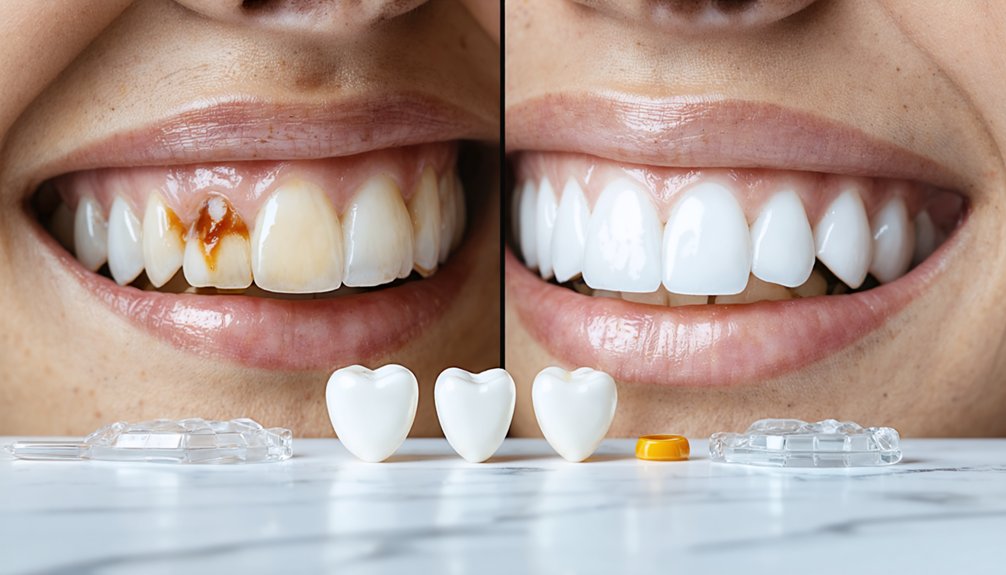
Severe stains present as deep, brownish discoloration that has penetrated the enamel over years of exposure, requiring professional-grade interventions like in-office bleaching or custom take-home trays to achieve meaningful results.
Identifying Your Stain Severity
How severely coffee has stained your teeth determines which whitening method will actually work for you.
Mild staining from moderate coffee consumption appears as slight yellowing on enamel surfaces, responding well to over-the-counter stain removal options like whitening strips or toothpastes. You’ll notice these stains primarily on front-facing surfaces.
Severe staining presents differently. Years of heavy coffee consumption create deep discoloration that penetrates beyond surface enamel, appearing brownish or grayish rather than simply yellow.
Standard over-the-counter stain removal products won’t reach these embedded pigments effectively.
Assess your severity honestly: if whitening toothpaste hasn’t produced noticeable improvement after consistent use, you’re likely dealing with moderate-to-severe staining requiring professional-grade intervention.
Accurate self-assessment prevents wasted time and money on treatments that won’t deliver results.
Mild Versus Severe Stains
Distinguishing mild from severe coffee stains determines whether you’ll need a trip to the dentist or can manage results at home.
Mild stain characteristics typically include light yellowing confined to surface enamel, responding well to over-the-counter strips or whitening toothpastes. You’ll notice these stains haven’t yet penetrated deeper enamel layers.
Severe stain causes involve years of accumulated tannin deposits, compounded by inadequate cleaning routines, acidic erosion, and high-frequency coffee consumption.
These stains penetrate beyond surface enamel, producing brown or grayish discoloration that resists standard at-home treatments. You’ll recognize severity by discoloration that persists despite consistent use of commercial whitening products.
Your honest self-assessment here matters — misidentifying your stain category leads to wasted effort, money, and delayed results.
In-Office Whitening for Severe Coffee Stains
When your coffee stains have progressed beyond what over-the-counter products can address, in-office whitening delivers results through high-concentration hydrogen peroxide (25–40%) applied under professional supervision.
Your dentist can activate the whitening gel using laser or specialized light technology, driving the peroxide deeper into enamel to break down stubborn, years-old staining.
In a single session lasting one to two hours, you can achieve multiple shade improvements that at-home methods simply can’t replicate.
High-Concentration Peroxide Treatments
For severe coffee stains that resist over-the-counter solutions, professional in-office whitening delivers the most clinically significant results.
Dentists apply high-concentration hydrogen peroxide (25-40%) directly to your enamel, activating the gel with laser or specialized light to break down deeply embedded tannin deposits.
Unlike at-home solutions, this approach penetrates beyond surface discoloration to address stains accumulated over years.
You’ll achieve multiple shade improvements within a single 1-2 hour appointment.
Protective barriers shield your gums, reducing irritation risks that at-home alternatives can’t replicate.
Don’t let whitening myths convince you that store-bought kits produce comparable outcomes for severe staining—they don’t.
Professional treatments produce longer-lasting results precisely because the concentration levels and clinical application methods exceed anything available without a dental professional’s oversight.
Light-Activated Gel Benefits
Light-activated gels take professional whitening a step further by accelerating the chemical breakdown of tannin deposits that standard peroxide alone can’t fully dislodge.
The light-activated benefits stem from photochemical activation, which drives hydrogen peroxide deeper into enamel layers where years of coffee staining have accumulated.
You’re targeting discoloration at its source rather than treating surface-level symptoms.
Gel effectiveness improves considerably when laser or specialized light energy excites the peroxide molecules, producing a more aggressive oxidation reaction.
This controlled acceleration means you’ll achieve multiple shade improvements within a single appointment rather than waiting weeks for gradual results.
The precision of light activation also allows your dental professional to concentrate treatment on severely stained areas, giving you measurable, predictable outcomes backed by clinical evidence.
Dramatic Single-Session Results
That photochemical acceleration translates directly into something practical: a single in-office session can eliminate severe coffee stains that years of at-home products couldn’t touch.
High-concentration hydrogen peroxide (25–40%) penetrates deep enamel layers, breaking down stubborn tannin deposits accumulated over years of daily consumption. Professional techniques deliver multiple shade improvements within one to two hours—results you simply can’t replicate with strips or whitening toothpaste.
Enamel safety remains controlled throughout the process. Dental professionals apply protective barriers to your gum tissue before treatment begins, greatly reducing irritation risk.
Laser or light activation enhances gel penetration without compromising enamel integrity when administered correctly. You’re not guessing at concentrations or application times—your provider manages every variable, giving you predictable, measurable outcomes from a single appointment.
Do Take-Home Trays Work If Your Teeth Are Sensitive?
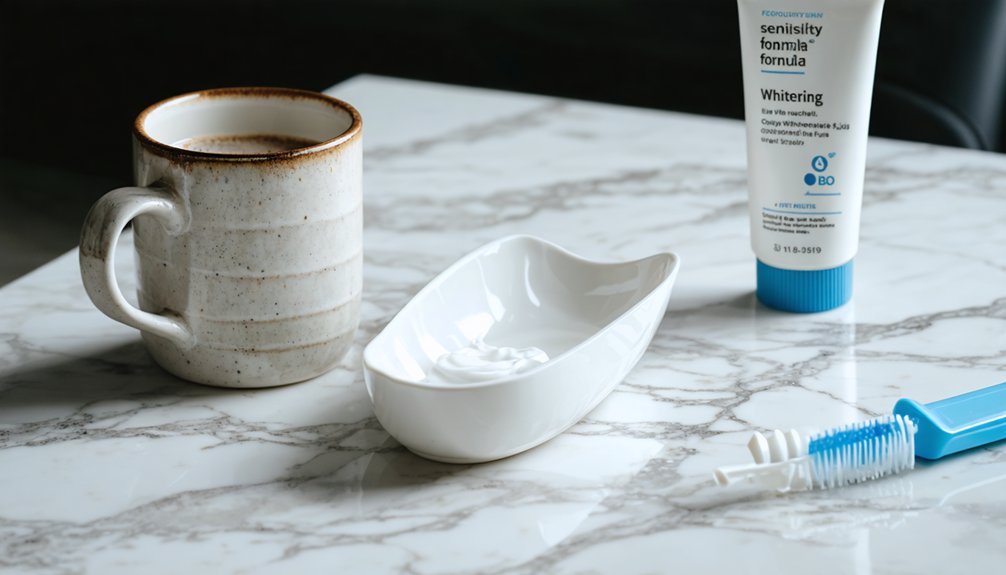
If you have sensitive teeth, custom take-home trays from your dentist can still be an effective whitening option. Your dentist prescribes lower-concentration carbamide peroxide gel (10–16%), which allows for gradual whitening over 2–4 weeks rather than a single aggressive session.
This controlled approach gives you direct oversight of your sensitivity management, letting you adjust wear time if discomfort arises.
Custom-fitted trays prevent gel leakage onto gum tissue, reducing irritation that generic strips often cause. You’re also able to pause treatment temporarily if sensitivity increases, then resume without losing meaningful progress.
Custom trays minimize gum irritation and let you pause treatment without sacrificing the whitening progress you’ve already achieved.
For moderate to severe coffee stains, this method delivers measurable shade improvement while keeping your comfort within tolerable limits—something over-the-counter kits rarely provide with the same precision or consistency.
How Whitening Strips Compare to Professional Treatments
Custom trays from your dentist handle sensitivity well, but they’re not the only whitening option worth understanding—whitening strips offer a different set of trade-offs that affect both your results and your budget.
Clinical research confirms that hydrogen peroxide-based strips outperform whitening toothpaste in whitening effectiveness, making them a legitimate step above basic maintenance products. However, they fall short of professional treatments when addressing severe coffee stains.
High-concentration in-office gels penetrate deeper into enamel, producing more dramatic shade improvements in a single session.
The cost comparison is straightforward: strips cost considerably less upfront, but they deliver proportionally reduced results on stubborn staining.
If your discoloration is moderate, strips may suffice. For severe staining, professional treatment delivers measurably superior outcomes.
Why Professional Cleaning Before Whitening Matters
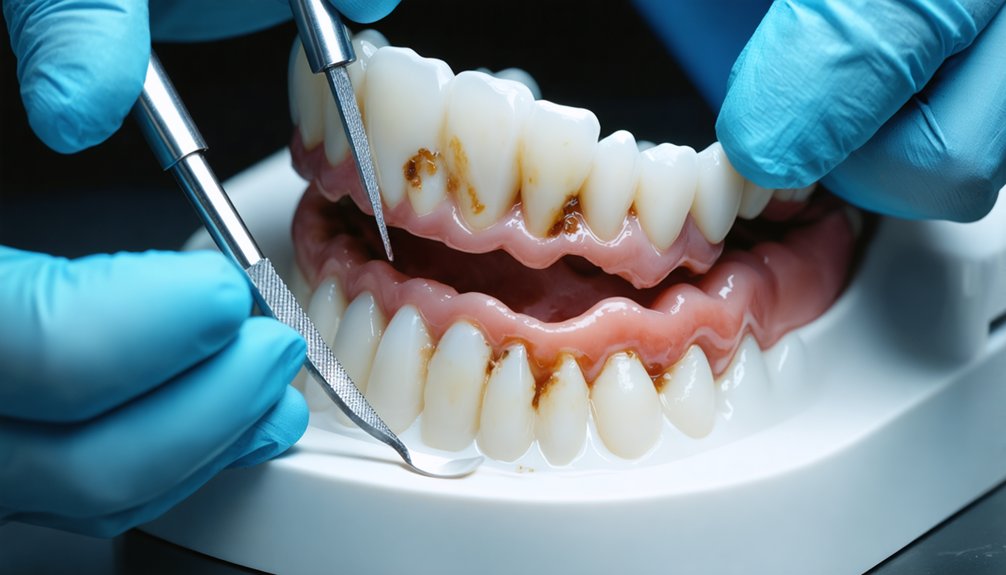
Before you pursue any whitening treatment, scheduling a professional cleaning removes the plaque, tartar, and surface deposits that intensify discoloration and block whitening agents from reaching enamel directly.
Dental hygienists use specialized tools to clear accumulated buildup in a single appointment, giving whitening gels unobstructed contact with tooth surfaces.
This preparatory step enhances your treatment’s effectiveness, ensuring bleaching agents work on actual stains rather than layers of debris.
Removing Built-Up Deposits
When plaque and tartar accumulate on your teeth, they create a barrier that prevents whitening agents from making direct contact with the enamel surface.
Professional cleaning eliminates these deposit types, giving whitening treatments direct access to stained enamel for maximum stain removal effectiveness.
A dental hygienist addresses three critical deposit types during your cleaning:
- Plaque — soft bacterial film that hardens into tartar if left untreated
- Tartar — calcified deposits requiring specialized tools for complete removal
- Surface stains — tannin-based discoloration embedded in enamel from chronic coffee consumption
Skipping this step compromises your whitening results considerably.
You’re fundamentally applying bleaching agents over a contaminated surface.
Prioritizing professional cleaning first guarantees your chosen whitening treatment performs at its full clinical capacity.
Enhancing Whitening Treatment Effectiveness
Professional cleaning dramatically amplifies how your whitening treatment performs by ensuring bleaching agents contact enamel directly rather than working through a contaminated surface layer.
Plaque and tartar deposits block peroxide penetration, reducing treatment efficacy regardless of concentration strength.
Once hygienists remove accumulated buildup, you’re positioned to maximize custom tray benefits.
Prescription-strength carbamide peroxide gel distributes evenly across clean enamel surfaces, producing more consistent shade improvements throughout your dentition.
This combination approach also supports sensitivity management, since clean teeth respond more predictably to whitening agents, allowing you to control application duration and frequency without triggering excessive discomfort.
Your dentist’s professional assessment following cleaning determines whether surface removal alone achieves adequate results or whether higher-concentration in-office treatment remains necessary for your specific staining severity.
Does the Baking Soda and Hydrogen Peroxide Paste Actually Work?
How well does the baking soda and hydrogen peroxide paste actually perform as a whitening method? Research supports its baking soda effectiveness for mild to moderate staining through peroxide synergy—hydrogen peroxide oxidizes tannin particles while baking soda amplifies the reaction chemically.
Here’s what you need to know:
- Application time: Apply the paste for up to 20 minutes to allow adequate stain breakdown contact.
- Frequency control: Limit use to 1-2 times weekly to prevent enamel erosion from overuse.
- Realistic expectations: This method addresses surface stains effectively but won’t penetrate deep discoloration from years of heavy coffee consumption.
For severe staining, consider this a supplementary tool rather than a primary treatment strategy.
Which Whitening Toothpastes Help With Coffee Stains
While the baking soda and hydrogen peroxide paste addresses surface stains through direct application, whitening toothpastes offer a more convenient daily approach to managing coffee discoloration.
Your whitening effectiveness depends heavily on toothpaste ingredients — specifically hydrogen peroxide, sodium bicarbonate, and calcium carbonate. These compounds work through two mechanisms: chemical oxidation breaks down stain molecules, while mild abrasives physically buff surface deposits.
Not all whitening toothpastes are equal — the right ingredients make all the difference.
Hydrogen peroxide-containing formulas deliver the strongest results among over-the-counter options, targeting tannin buildup from daily coffee consumption.
However, you should understand their limitations — whitening toothpastes address surface staining effectively but won’t penetrate deep enamel discoloration.
They’re best positioned as maintenance tools, preventing new stains from accumulating rather than reversing severe, long-standing discoloration.
For persistent coffee stains, professional intervention remains necessary.
How to Stop Coffee Stains From Coming Back
Preventing coffee stains from returning requires a multi-layered approach combining consistent oral hygiene, behavioral modifications, and periodic professional maintenance.
Implement these stain prevention strategies to maintain your whitening results:
- Rinse immediately after coffee consumption — Water neutralizes tannins before they penetrate enamel, markedly reducing discoloration accumulation.
- Make dietary adjustments — Drink coffee through a straw to minimize tooth surface contact, and avoid prolonged sipping sessions that extend enamel exposure.
- Schedule professional cleanings every six months — Hygienists remove surface deposits before they intensify into deeper stains, preserving your whitening investment.
Additionally, use whitening toothpaste daily and reapply custom take-home trays periodically as your dentist recommends.
Consistency across these combined approaches determines how long your results actually last.
When Coffee Stains Need a Dentist, Not a Kit
Consistent prevention strategies go a long way, but they don’t resolve every staining situation. When stains penetrate beyond the enamel surface, over-the-counter kits can’t deliver adequate stain removal.
You’ll recognize this threshold when whitening strips produce no visible change after full treatment cycles, or when discoloration appears grayish rather than yellow.
In these cases, professional intervention becomes your most effective option. High-concentration hydrogen peroxide treatments break down deep tannin deposits that at-home products can’t reach.
Custom trays with prescription-strength carbamide peroxide offer controlled, gradual results if you’re managing sensitivity.
Switching to coffee alternatives like green tea or herbal beverages reduces recontamination between professional treatments.
Your dentist can assess stain depth and recommend the precise treatment protocol your specific situation requires.
Frequently Asked Questions
Can Whitening Treatments Damage Existing Dental Crowns or Veneers?
Whitening treatments won’t damage your crowns or veneers, but they won’t lighten them either. You’ll risk uneven color matching. Prioritize crown longevity and veneer maintenance by consulting your dentist before beginning any whitening regimen.
How Long Should I Wait After Whitening Before Drinking Coffee Again?
Like a freshly painted wall, your teeth need time to set—wait at least 48 hours before drinking coffee again. You’ll minimize teeth sensitivity and protect your whitening duration results most effectively.
Are Whitening Treatments Safe During Pregnancy or While Breastfeeding?
You should avoid whitening treatments during pregnancy or breastfeeding. Whitening safety hasn’t been established for these conditions, so pregnancy precautions mean you’ll want to consult your dentist and delay treatment until after you’ve finished breastfeeding.
Does Teeth Whitening Work on Stains Caused by Medications Like Tetracycline?
tetracycline’s medication effects cause deep intrinsic teeth staining that standard whitening can’t fully reverse. You’ll need professional treatments, though they offer partial improvement rather than complete elimination of severe discoloration.
How Much Does Professional Whitening Typically Cost Without Dental Insurance Coverage?
Without insurance, you’ll typically spend $300–$1,000 for professional whitening. If costs concern you, whitening products and home remedies offer affordable alternatives, though they’re less effective against severe staining than clinical treatments.
References
- https://www.barniescoffee.com/blogs/blog/a-coffee-lovers-guide-to-whiter-teeth
- https://www.advancedsmilesmarion.com/resources/teeth-whitening-coffee-stains
- https://www.lighthousedentalcentre.com/blog/how-to-eliminate-coffee-stains-on-teeth
- https://www.colgate.com/en-sg/oral-health/teeth-whitening/how-does-coffee-stain-teeth
- https://dentistinmanvel.com/goodbye-to-coffee-stains-8-effective-methods-to-brighten-your-smile/
- https://www.goodrx.com/conditions/dental-care/remove-coffee-stains-teeth
- https://youngdentalcare.com/ways-to-remove-coffee-stains-from-your-teeth/
- https://www.emmydental.net/ways-to-remove-coffee-stains-from-your-teeth/
- https://www.portlandcitydental.com/how-to-remove-coffee-stain-from-teeth/
- https://www.reddit.com/r/beauty/comments/xs409k/to_my_daily_coffee_lovers_how_do_you_keep_your/