If you have existing dental problems, teeth whitening can actively worsen your condition rather than just underperform. Whitening agents penetrate cavities, inflamed gums, and weakened enamel far more aggressively, accelerating erosion, deepening microcracks, and intensifying sensitivity. They can also destabilize fillings, sealants, and crowns while creating color mismatches. Managing underlying issues before whitening isn’t optional—it’s critical. The full extent of these risks depends on your specific dental conditions, and what follows breaks each one down precisely.
Key Takeaways
- Whitening with cavities or gum disease accelerates enamel erosion and worsens sensitivity by increasing peroxide penetration to vulnerable tooth structures.
- Hydrogen peroxide deepens microcracks and surface porosity in weakened enamel, exceeding the tooth’s natural remineralization capacity.
- Receding gums expose cementum and dentin, allowing whitening agents to rapidly penetrate, causing inflammation and prolonged sensitivity.
- Existing fillings, crowns, and sealants degrade chemically when exposed to peroxides, increasing restoration failure risk and causing color mismatches.
- Untreated dental conditions allow peroxide to reach the pulp faster, creating intense, rapid sensitivity that proper prior care could prevent.
Is Teeth Whitening Safe If You Already Have Dental Problems?
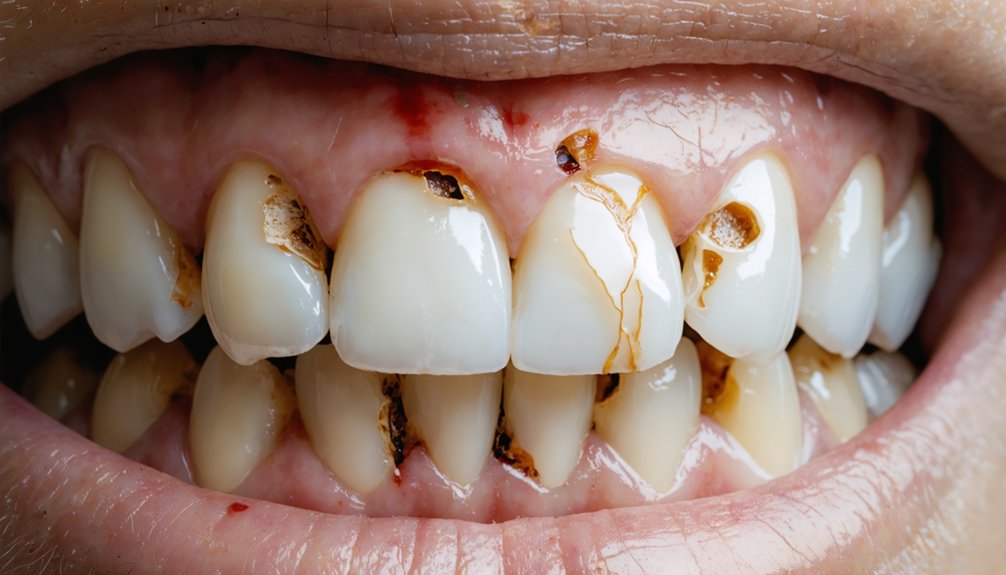
Teeth whitening carries heightened risks when underlying dental problems already exist. If you have active cavities, compromised restorations, or gum disease, peroxide-based agents can accelerate enamel erosion, worsen sensitivity, and destabilize existing fillings or sealants.
Whitening with untreated cavities or gum disease accelerates enamel erosion and destabilizes existing restorations.
Continuous bleaching prevents remineralization, increasing your susceptibility to further structural damage. Before pursuing whitening, you must undergo a thorough dental evaluation to assess intraoral conditions.
Cost considerations matter here — treating complications from ill-timed whitening far exceeds the expense of prior restorative care. Alternative treatments, such as professional bonding or veneers, may deliver safer aesthetic outcomes without compromising compromised teeth.
You retain control over these decisions, but only when you act on accurate clinical information rather than convenience-driven choices that bypass necessary preparatory dental treatment.
How Whitening Accelerates Damage on Already Weakened Enamel
When your enamel is already weakened, whitening agents don’t just pose incremental risk — they accelerate structural breakdown at a measurable rate. Hydrogen peroxide increases enamel permeability, deepening existing enamel microcracks and expanding surface porosity beyond what remineralization can reverse.
What healthy enamel might partially recover from, compromised enamel can’t.
Mineral loss compounds this problem directly. Whitening agents demineralize enamel surfaces, creating shallow depressions and increasing susceptibility to brushing abrasion. If your baseline enamel is already thin or eroded, each treatment strips away structure you can’t afford to lose.
High-concentration peroxides make underlying dentin progressively more exposed, which explains why sensitivity intensifies with repeated use.
You’re not just whitening damaged enamel — you’re accelerating its deterioration on a clinically documented trajectory.
How Cavities and Gum Disease Amplify Whitening Sensitivity
Structural enamel breakdown doesn’t exist in isolation — cavities and gum disease create additional pathways that make whitening-induced sensitivity considerably worse. Decay exposes compromised tooth microstructure, allowing hydrogen peroxide to penetrate deeper and reach pulp tissue faster than it would through intact enamel. You’re fundamentally removing a critical barrier that limits peroxide diffusion.
Gum disease compounds this further. Receding gums expose root surfaces that lack enamel entirely, and increased enamel porosity from periodontal inflammation means whitening agents absorb more readily into vulnerable tissue.
Research confirms that sensitivity develops within two to three days post-treatment — but in patients with active cavities or gum disease, that response is faster and more intense. Whitening without addressing these conditions first isn’t a calculated risk — it’s a preventable one.
Why Sensitive or Receding Gums React Worse to Whitening
Receding gums strip away the protective tissue barrier that keeps root surfaces shielded from whitening agents. When your gum line pulls back, it exposes cementum and dentin — structures far more permeable than enamel.
Receding gums expose vulnerable root surfaces, leaving cementum and dentin unprotected against penetrating whitening agents.
Whitening peroxides penetrate these surfaces rapidly, triggering acute pulpal inflammation and intensified sensitivity.
Compromised tooth mineralization weakens your teeth’s natural defense against chemical infiltration. Roots lack the enamel porosity resistance that crowns provide, making them especially vulnerable to peroxide-induced breakdown.
Gingival irritation typically begins within one day of treatment, and receding gums accelerate this response by expanding direct agent contact with soft tissue.
If you have gum recession, standard whitening concentrations carry disproportionate risks. You’ll likely experience prolonged sensitivity and mucosal damage that far exceeds what intact gum tissue would sustain.
Why Whitening Threatens Crowns, Fillings, and Sealants
Dental restorations don’t whiten the way natural enamel does, and that chemical mismatch creates compounding structural problems. Restoration compatibility becomes a critical concern because whitening agents interact differently with synthetic materials.
Peroxide-based formulas chemically react with ceramic crowns, composite fillings, glass ionomer cements, and sealants—accelerating material degradation rather than brightening them. Your existing restorations won’t match your newly whitened teeth, creating visible color discrepancies.
Beyond aesthetics, aggressive bleaching reduces the structural stability of these materials, increasing restoration failure risk. Sealants lose integrity, composites weaken, and cements deteriorate under repeated peroxide exposure.
If you have multiple restorations, unsupervised whitening compounds your risk considerably. A clinician must assess your intraoral conditions before any whitening protocol begins.
Frequently Asked Questions
Can Teeth Whitening Worsen Existing Tooth Decay or Cavities?
Yes, teeth whitening can worsen existing decay. You’ll accelerate enamel erosion and heighten tooth sensitivity, as peroxide penetrates compromised tooth structure, enlarging cavities and intensifying pulp inflammation. You must address decay before pursuing any whitening treatment.
How Long Should You Wait After Dental Work Before Whitening?
While waiting feels unnecessary, you should delay whitening at least four weeks after dental work. This protects against tooth sensitivity and enamel erosion, giving restorations time to fully stabilize before peroxide exposure compromises their structural integrity.
Are There Whitening Alternatives Safer for People With Dental Issues?
You’ve got safer options: natural remedies like oil pulling and baking soda reduce staining with minimal risk. Dietary adjustments—limiting staining foods—prevent discoloration effectively. These approaches won’t compromise existing restorations or exacerbate sensitivity like peroxide-based treatments can.
Can Whitening Products Cause Permanent Damage to Already Weakened Teeth?
Yes, whitening products can compromise your already vulnerable teeth. You’re accelerating enamel erosion and heightening tooth sensitivity when you use these formulations on weakened dentition, potentially creating irreversible structural degradation that remineralization can’t adequately restore.
Should You Consult a Dentist Before Whitening With Existing Dental Problems?
Yes, you should consult a dentist before whitening. Existing dental problems heighten your risk of dental sensitivity and gingival irritation, and a dentist can tailor a safe, evidence-based whitening protocol specific to your intraoral conditions.
References
- https://health.clevelandclinic.org/is-teeth-whitening-safe
- https://www.dentistryofwestbend.com/teeth-whitening-risks-and-side-effects/
- https://adanews.ada.org/huddles/risks-of-frequent-teeth-whitening/
- https://pmc.ncbi.nlm.nih.gov/articles/PMC4058574/
- https://narrewarrendentalcare.com.au/risks-of-teeth-whitening-what-you-need-to-know-before-getting-started/
- https://www.ada.org/resources/ada-library/oral-health-topics/whitening
- https://www1.deltadentalins.com/wellness/conditions-and-treatments/articles/teeth-whitening-risks.html
- https://www.ijmsdr.org/published paper/1i1i36/Side-Effects-of-Using-Teeth-Whitening-Products-Literature-Review.pdf
- https://ec.europa.eu/health/opinions/en/tooth-whiteners/l-3/5-tooth-whitening-products.htm
- https://www.health.com/condition/oral-health/how-to-keep-whitening-toothpastes-from-hurting-your-teeth