Laser whitening outperforms LED on speed, shade improvement, and stain depth — but whether it’s the right choice depends on your teeth, your sensitivity threshold, and your budget. Laser delivers 8–14 shades of improvement in a single session, while LED typically requires multiple visits for comparable results. LED is gentler and more affordable, making it better suited for mild stains and sensitive teeth. The sections below break down exactly how each method compares across every factor that matters.
Key Takeaways
- Laser whitening delivers 8–14 shades of improvement in one hour, while LED typically requires multiple sessions for comparable results.
- Laser penetrates deeper, effectively treating internal, resistant stains like tetracycline and fluorosis, whereas LED targets mild to moderate surface stains.
- Laser results last 9–18 months; professional LED lasts 6–12 months; home LED kits fade within 1–3 months.
- LED causes minimal sensitivity and costs $200–$500 per session; laser increases post-treatment sensitivity and costs $600–$1,000 per session.
- Laser is better for deep or stubborn stains; LED suits mild discoloration, routine maintenance, and patients with sensitive teeth.
How LED and Laser Teeth Whitening Work
Both LED and laser teeth whitening work by activating a peroxide-based bleaching gel applied to the tooth surface, but they differ considerably in how they deliver light energy.
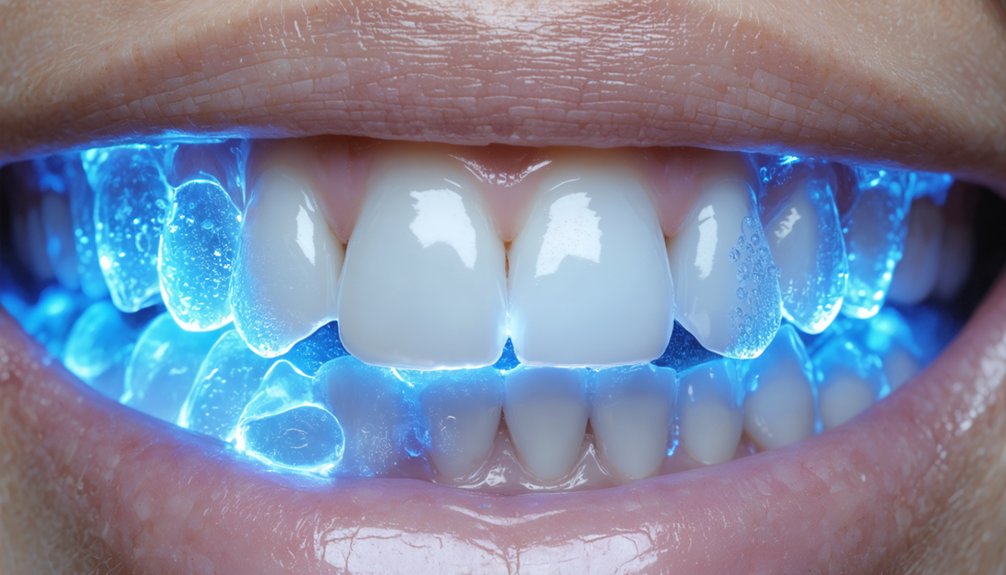
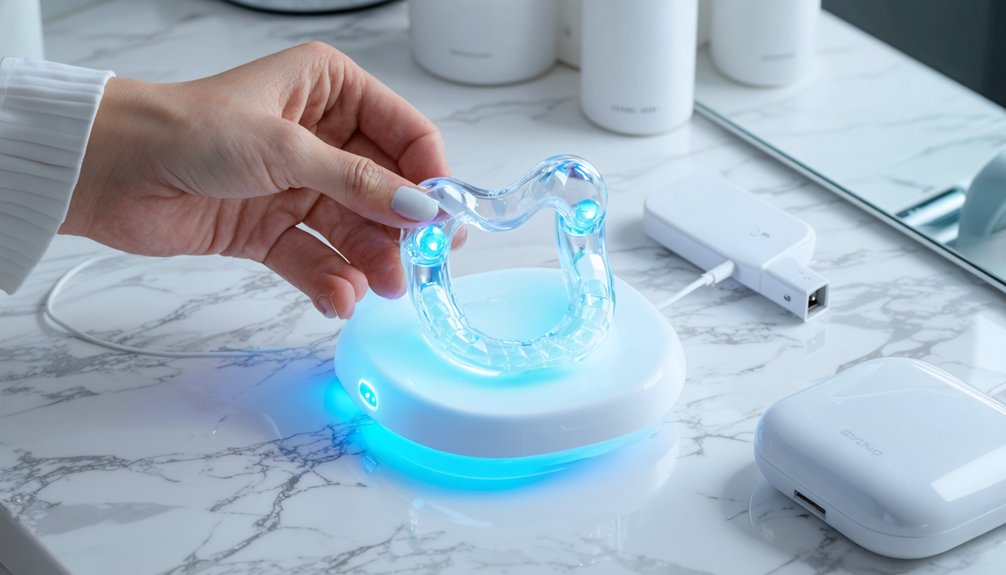
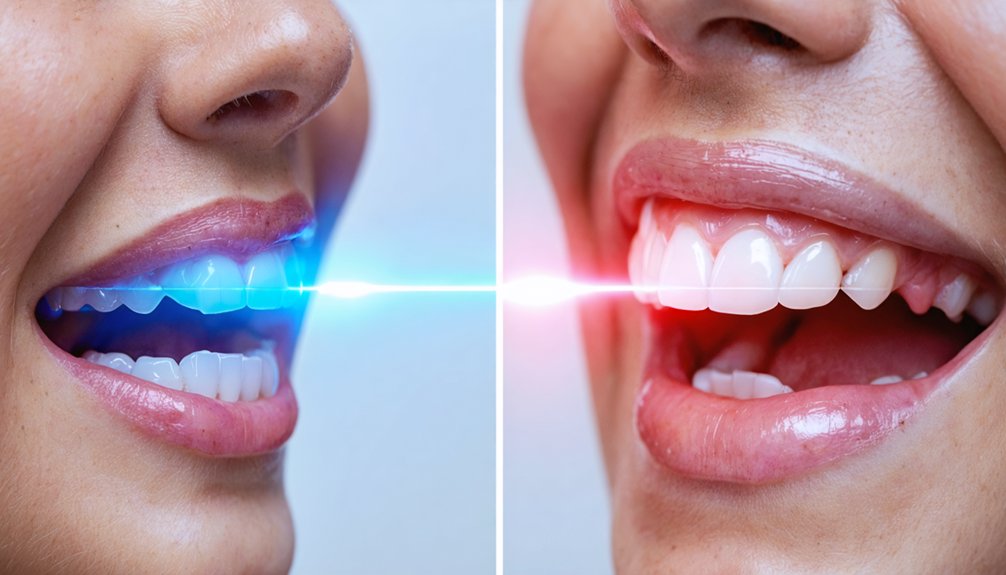
LED systems emit a broad-spectrum, low-intensity blue light that gently activates the whitening gel composition, making them suitable for patients with standard dental anatomy and mild to moderate staining.
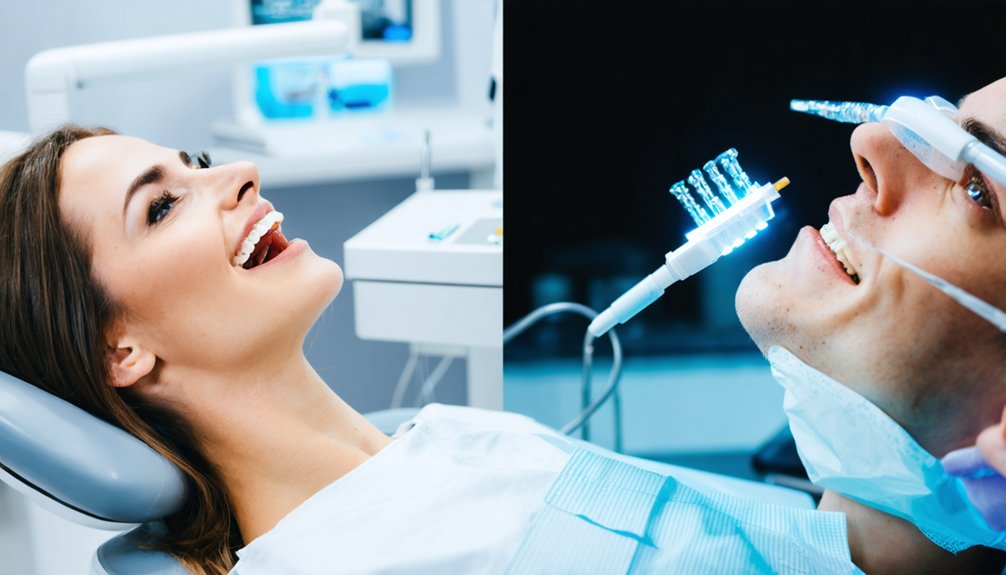
Laser systems, by contrast, use a focused, high-intensity beam — typically a diode laser — that penetrates deeper into the tooth structure, targeting intrinsic discolouration more precisely.
Your dental anatomy directly influences how effectively each light source interacts with the whitening gel composition.
Laser energy accelerates the oxidation reaction faster, while LED relies on longer exposure times to achieve comparable activation, which is why session frequency differs between the two methods.
Which Whitens Faster: LED or Laser, and by How Many Shades?
When speed matters, laser whitening outperforms LED by a significant margin. A single one-hour laser session delivers 8–14 shades of improvement, with only 15–20 minutes of active lasing time.
LED systems, by contrast, require multiple sessions to achieve comparable results, making them less efficient if you’re targeting moderate-to-severe staining.
Both methods use whitening gels, but laser energy activates those gels more deeply, reaching internal stains that LED’s gentler light can’t address.
If you’re considering dental veneers as a backup option, laser whitening often reduces that need by achieving dramatic improvements in a single visit.
Most patients see 5–8 shades improvement on average, but diode lasers consistently push that ceiling higher, giving you greater control over your final outcome.
What Stains Does Each Method Treat Best?
Speed and shade improvement only tell part of the story — the stain type you’re dealing with ultimately determines which method gives you the best outcome.
For stain removal and discoloration correction, each method has a defined clinical range:
- LED whitening targets mild to moderate surface staining from coffee, tea, and wine.
- Laser whitening penetrates deeper, making it effective for internal stains and moderate to severe discoloration.
- Diode lasers handle the most resistant cases — tetracycline staining, fluorosis, and heavy smoker stains.
- LED systems remain effective for routine in-clinic and at-home maintenance treatments.
If your staining is superficial, LED delivers reliable results.
If you’re managing deep or stubborn discoloration, laser whitening gives you the clinical precision required.
Which Is Gentler on Sensitive Teeth: LED or Laser?
If you have sensitive teeth, LED whitening is the safer choice, as tooth and gingival sensitivity scores remain low throughout treatment.
Laser whitening, by contrast, increases pulp chamber temperature, and research shows that all patients treated with laser activation reported heightened dental sensitivity.
Your dentist can also recommend desensitizing agents before or after either procedure to help you manage any post-treatment discomfort.
Laser Sensitivity Concerns
Sensitivity is one of the most clinically significant differences between LED and laser whitening, and the evidence clearly favours LED for patients with sensitive teeth.
Laser activation raises pulp chamber temperature, triggering post-treatment discomfort regardless of teeth discoloration severity or whitening gel composition used.
Key clinical findings confirm:
- All patients in laser-treated groups reported increased dental sensitivity post-session
- Laser’s high-intensity beam penetrates deeper, elevating pulpal thermal stress
- LED-treated patients maintained sensitivity scores below the mild threshold throughout treatment
- LED’s gentler light activates the gel without significant thermal transfer to surrounding tissue
If you’re managing pre-existing sensitivity, LED whitening gives you a controlled, lower-risk pathway.
Laser delivers power — but that power comes with a predictable sensitivity trade-off you need to factor into your decision.
LED Gentler Option
When sensitivity is already part of your dental picture, the choice between LED and laser whitening isn’t just about results — it’s about how much thermal stress your pulp can tolerate.
LED systems emit lower-intensity light, producing minimal heat and keeping tooth and gingival sensitivity scores below mild throughout treatment. That makes LED the clinically safer option if you’re prioritising enamel health alongside colour improvement.
Laser activation, by contrast, raises pulp chamber temperature directly, with studies confirming that all laser-treated patients reported increased sensitivity post-session.
LED’s gentler energy output supports a more natural whitening process — gradual, controlled, and less physiologically disruptive.
If your baseline sensitivity is moderate to high, LED gives you measurable results without compromising your comfort or long-term tissue integrity.
Managing Tooth Sensitivity
Managing tooth sensitivity during whitening starts with understanding how each light source interacts with your pulp tissue. Laser activation raises pulp chamber temperature, directly increasing sensitivity risk.
LED whitening gels work at lower intensities, keeping sensitivity scores below mild throughout treatment.
To protect your tooth enamel and control discomfort, apply these clinical strategies:
- Choose desensitising whitening gels containing potassium nitrate or fluoride before and after sessions
- Opt for LED systems if you already experience baseline sensitivity
- Request shorter laser exposure intervals to limit pulpal heat accumulation
- Apply dentist-prescribed remineralisation agents to tooth enamel post-treatment
You hold the control here. Discussing your sensitivity history with your dentist before selecting a system lets you match the whitening method to your biological tolerance, not the other way around.
LED vs Laser Whitening Cost in Australia
When considering LED vs laser teeth whitening in Australia, cost is often a deciding factor. You’ll typically pay $200–$500 per session for LED whitening.
While laser whitening runs $600–$1,000 per session.
Your choice should reflect not just your budget, but also the number of sessions you’ll likely need to achieve your target result.
LED Whitening Session Costs
LED whitening sessions in Australia typically cost between $200 and $500, making them a more accessible option if you’re working within a tighter budget. Despite common teeth whitening myths, professional LED treatment delivers clinically measurable results without requiring a significant financial commitment.
Key cost factors to weigh up:
- Single session pricing ranges from $200–$500 depending on the clinic and technology used
- Multiple sessions are often required, so factor in cumulative costs when comparing options
- Dental insurance rarely covers cosmetic whitening, meaning you’ll likely pay out-of-pocket
- At-home LED kits cost less upfront but yield results lasting only 1–3 months, reducing long-term value
Understanding these variables lets you make an informed decision that aligns with both your whitening goals and financial boundaries.
Laser Whitening Session Costs
Laser whitening sessions in Australia cost between $600 and $1,000 per appointment — roughly two to three times the price of LED treatment. That premium reflects the technology’s precision, speed, and depth of penetration. You’re paying for measurable outcomes: up to 8–14 shade improvements in a single session, with longer-lasting results compared to LED systems.
Reputable clinics include enamel protection protocols and tooth remineralization support — typically fluoride or calcium-based treatments applied post-session — to offset the sensitivity risks associated with laser activation. These added measures justify part of the cost differential.
If you have moderate to severe staining and want results from one appointment, laser whitening delivers a stronger return on investment than multiple, lower-cost LED sessions that may still fall short of your target shade.
Value For Your Budget
Knowing what each method costs is only half the equation — what matters is whether you’re getting proportional value for that spend.
LED suits tighter budgets and mild staining. Laser justifies its cost when you need faster, longer-lasting results. Dental insurance rarely covers either, so you’re paying out-of-pocket regardless.
Cut through common teeth whitening myths when evaluating value:
- LED ($200–$500) delivers 6–12 months of results with lower sensitivity risk
- Laser ($600–$1,000) produces 8–14 shade improvements lasting 9–18 months in one session
- Laser shows less colour regression at 6 months than LED
- LED requires multiple sessions, potentially narrowing the cost gap over time
Match the method to your stain severity, sensitivity tolerance, and how frequently you’re willing to retreat.
How Many Sessions Does LED or Laser Whitening Require?
When choosing between LED and laser whitening, the number of sessions required differs considerably. Laser whitening typically delivers ideal results in a single one-hour appointment, with active lasing time averaging just 15–20 minutes. That efficiency makes it comparable in outcome to more permanent cosmetic options like dental veneers, but without the irreversible commitment.
Laser whitening delivers veneer-level results in a single appointment — without the irreversible commitment.
LED whitening, by contrast, requires multiple in-office sessions to achieve comparable results. The whitening gels used in LED treatments are activated by gentler light energy, meaning cumulative exposure matters.
While LED systems show significant colour improvement after the in-office stage, at-home phases contribute minimally.
If you’re prioritising fewer appointments and faster outcomes, laser whitening gives you greater control over your timeline.
LED suits those comfortable with a staged, multi-visit approach.
How Long Do LED and Laser Whitening Results Last?
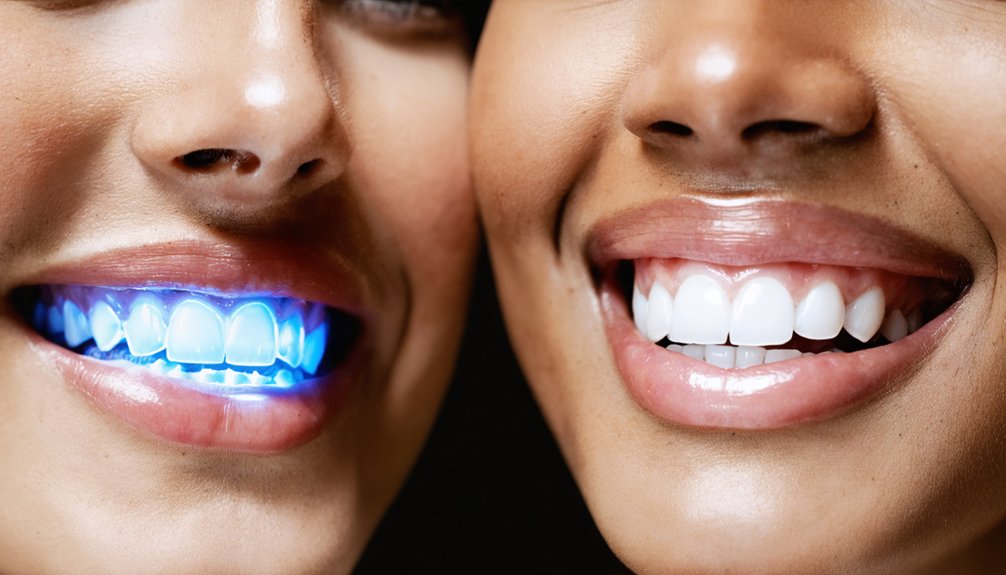
How long your results last depends on which system you choose and how well you maintain them. Neither method permanently alters your tooth enamel, so lifestyle habits directly influence longevity. Since dental insurance rarely covers whitening, protecting your investment matters.
- Laser whitening: Results last 9–18 months, with less colour regression at 6 months
- Professional LED whitening: Results last 6–12 months with consistent maintenance
- Home LED kits: Results fade within 1–3 months
- Key maintenance factors: Avoiding staining foods, tobacco, and maintaining regular hygiene appointments
Laser whitening gives you the longest-lasting outcome per session. LED requires more frequent retreatment to sustain results.
If you want maximum control over longevity with fewer touch-ups, laser whitening delivers a measurably more durable outcome.
How to Choose the Right Whitening Treatment for Your Teeth
Choosing between LED and laser whitening comes down to three practical factors: your stain severity, sensitivity tolerance, and budget.
Historical advancements in both technologies have expanded your options, but the right choice depends on your specific clinical profile.
If you’re managing mild to moderate staining with sensitive teeth, LED whitening offers a gentler, more affordable path at $200–$500 per session.
If you’re dealing with deep tetracycline, fluorosis, or heavy smoker stains, laser delivers measurably superior results in a single session, despite the higher $600–$1,000 cost.
Dental health implications matter here — laser increases pulp sensitivity, so pre-existing sensitivity is a contraindication.
Discuss your full dental history with your clinician before committing to either method.
Frequently Asked Questions
Can LED or Laser Whitening Be Done During Pregnancy Safely?
You shouldn’t pursue LED or laser whitening during pregnancy. Pregnancy safety concerns arise because hormonal effects can increase sensitivity and gum vulnerability, and whitening agents lack sufficient safety data for pregnant or breastfeeding patients.
Does Teeth Whitening Work on Crowns, Veneers, or Dental Implants?
Whitening won’t alter crowns, veneers, or implants — they’re color-fixed at manufacture. With 5–8 shades possible on natural teeth, dental material compatibility creates mismatches. Plan replacements around your target tooth shade durability for consistent, controlled results.
Can I Eat Normally Immediately After a Whitening Treatment Session?
You shouldn’t eat normally right after whitening. Follow strict diet restrictions—avoid dark foods and acidic drinks for 48 hours. For sensitivity management, choose lukewarm, white, or neutral foods to minimize discomfort and protect your results.
How Soon After Whitening Can I Drink Coffee or Red Wine?
Wait 48 hours before risking stain reapplication. Your enamel’s pores remain open post-treatment, making caffeine sensitivity and pigment absorption heightened. Avoiding coffee and red wine during this window protects your whitening investment completely.
Is Teeth Whitening Covered by Dental Insurance in Australia?
Dental insurance in Australia doesn’t typically cover teeth whitening, as it’s classified under cosmetic procedures. You’ll need to pay out-of-pocket, with LED whitening costing $200–$500 and laser whitening ranging $600–$1,000 per session.
References
- https://www.beautifulsmilesdentist.com/what-is-the-difference-between-laser-and-led-teeth-whitening/
- https://dalyellupdental.com.au/led-vs-laser-teeth-whitening-whats-the-difference-and-which-works-better/
- https://pmc.ncbi.nlm.nih.gov/articles/PMC5410669/
- https://smile2impress.com/uk/blog/teeth-bleaching-led
- https://pmc.ncbi.nlm.nih.gov/articles/PMC3466022/
- https://www.fernwhiteningsupplies.ca/blogs/news/understanding-teeth-whitening-led-vs-laser
- https://pmc.ncbi.nlm.nih.gov/articles/PMC4911750/
- https://pmc.ncbi.nlm.nih.gov/articles/PMC11493155/
- https://www.pioon.com/en/events/blogs/laser-light-teeth-whitening-difference-between-diode-laser-and-led.html