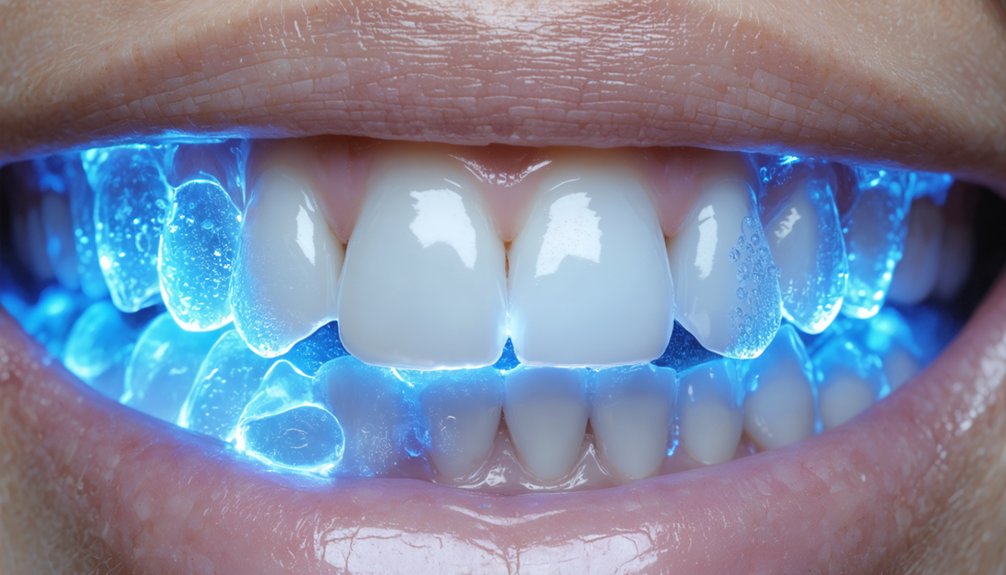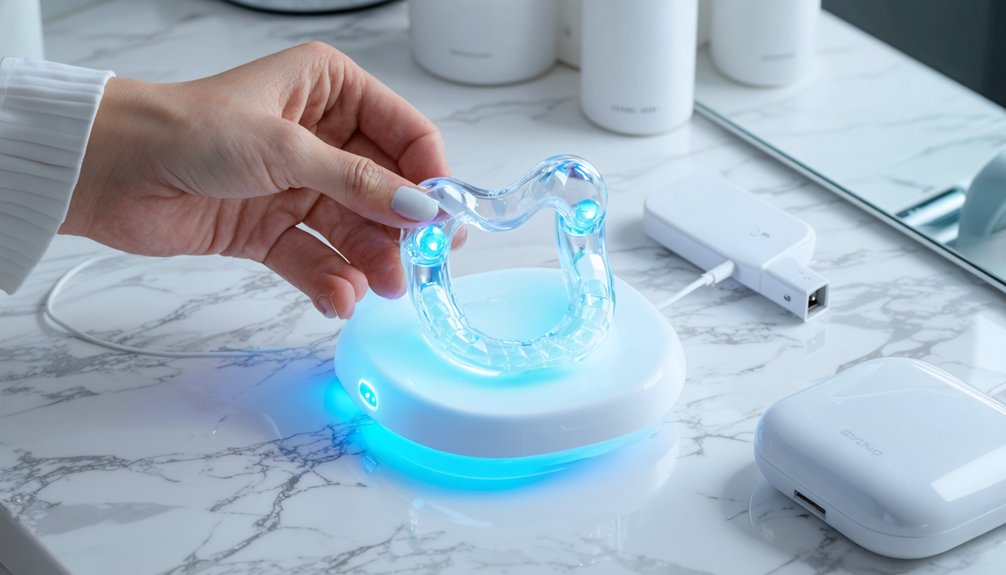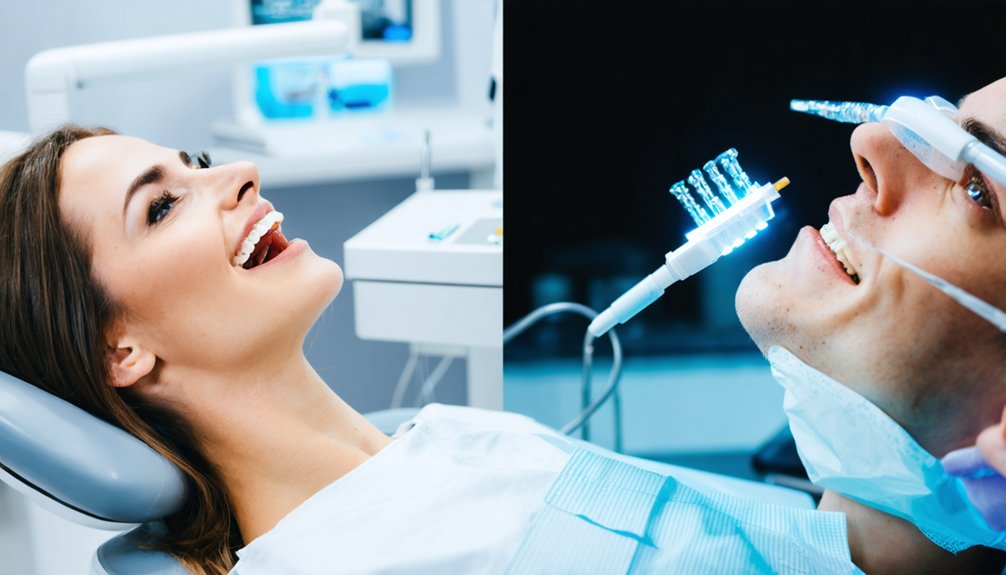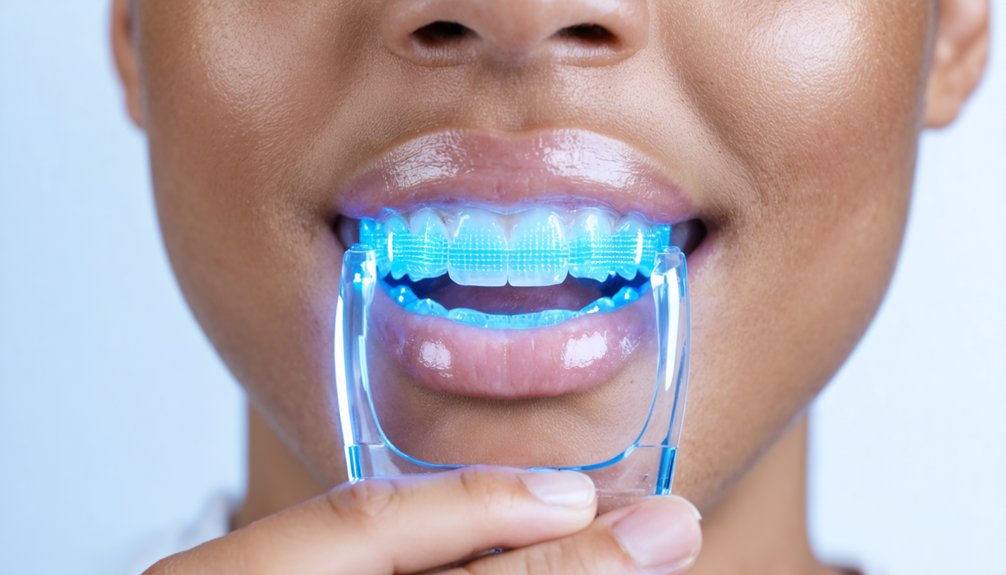
LED teeth whitening devices can lighten your teeth, but don’t give the LED light too much credit. The peroxide gel does the actual whitening by breaking down stain molecules in your enamel. Systematic reviews show no significant difference between treatments with and without light activation. That immediate brightness you see after treatment? It’s likely just temporary dehydration. If you want the full picture, there’s more you should know.
Key Takeaways
- LED light does not whiten teeth on its own; the peroxide gel is solely responsible for breaking down stain molecules.
- Systematic reviews find no significant difference in whitening outcomes between treatments with and without LED light activation.
- Immediate brightness after LED use is a temporary illusion caused by tooth dehydration, not actual whitening.
- At-home kits can lighten teeth 4–8 shades over two weeks, driven by gel concentration, not the LED device.
- LED whitening is generally safe, though overuse may cause sensitivity, gum irritation, and potential enamel roughening over time.
Do LED Teeth Whitening Devices Actually Work?
Although LED teeth whitening devices are widely marketed as a breakthrough solution, the evidence tells a more complicated story. If you’re pursuing improved dental aesthetics, you need to understand what’s actually driving results.
LED teeth whitening devices are widely marketed as a breakthrough — but the evidence tells a more complicated story.
The LED light doesn’t whiten your teeth independently — the peroxide gel does the heavy lifting. Light may accelerate the chemical reaction, but systematic reviews show no significant difference in outcomes between treatments with and without light activation.
What you’re sometimes seeing isn’t true whitening. LED exposure causes tooth dehydration, temporarily making teeth appear brighter before the effect fades. That’s not a shade change — it’s surface moisture loss.
Long-term results depend almost entirely on gel concentration and application consistency, not the light source you’re using.
Why Does Peroxide Gel Whiten Teeth, Not the LED Light?
When you apply a whitening product, the peroxide gel — not the LED light — is what’s chemically dismantling stain molecules. Hydrogen or carbamide peroxide penetrates enamel and oxidizes discoloration at the molecular level.
The LED contributes no independent whitening action.
What you may perceive as dramatic brightness immediately after light exposure are largely cosmetic illusions driven by dehydration effects. The light temporarily draws moisture from your enamel, creating a whiter appearance that fades within hours. That’s not whitening — that’s surface manipulation.
Systematic reviews confirm no measurable difference in outcomes between gel-only and gel-plus-light treatments. If you want verifiable results, the formulation and concentration of your peroxide gel determines your outcome.
The LED is secondary — don’t let marketing convince you otherwise.
Does LED Light Speed Up Whitening Results?
Blue-light LED devices operating at 480–520 nm do trigger photocatalysis — a process that accelerates peroxide breakdown and speeds up stain oxidation. Light activation heats the peroxide gel, driving the chemical reaction faster than gel alone would allow. In theory, you’d get quicker, more uniform results.
However, the clinical evidence doesn’t fully support that promise. A 2014 literature review found light activators produced no meaningful improvement in whitening outcomes compared to gel-only treatments. Systematic reviews echo this conclusion.
What you’re likely seeing is a combination of accelerated chemistry and temporary tooth dehydration — not a dramatic improvement in final shade. The LED supports the process, but it doesn’t control it. The gel’s peroxide concentration remains the dominant variable determining your actual results.
At-Home vs. In-Office LED Whitening: What Does the Research Say?
Research comparing at-home and in-office LED whitening reveals a clear performance gap. In-office treatments combine professional-grade peroxide concentrations with LED activation, producing measurable aesthetic improvements—one 2012 study recorded a 1.8-unit color change.
However, a 2014 literature review found that light activators didn’t *substantially* improve results even in clinical settings.
At-home kits can lighten teeth 4–8 shades over two weeks, but your user experience depends heavily on gel formulation, not the LED itself.
Systematic reviews consistently show no notable difference between treatments with and without light activation.
You’re *primarily* paying for convenience and perceived technology. If you want reliable aesthetic improvements, prioritize the peroxide concentration in your gel—that’s what drives your actual results, regardless of the light source.
Are LED Teeth Whitening Devices Safe to Use?
For most users, LED teeth whitening devices are generally safe—hydrogen and carbamide peroxide formulations combined with blue-light activation show no measurable damage to enamel microhardness or surface integrity. However, you should expect common side effects, including increased tooth sensitivity and gum irritation.
Frequent use raises additional concern: repeated LED exposure accelerates tooth dehydration, which can gradually roughen and soften enamel over time. Long-term effects remain insufficiently studied, so overuse carries a real risk.
Pediatric safety is another critical consideration—current evidence doesn’t support LED whitening use in children or adolescents, whose enamel is still developing. If you’re managing someone else’s treatment decisions, consult a dentist before proceeding.
Controlled, infrequent use within recommended guidelines remains your safest approach.
Frequently Asked Questions
How Long Do LED Teeth Whitening Results Typically Last?
Your results won’t last forever — whitening duration typically spans weeks, not years. You’ll maintain brightness longer by avoiding staining foods, but dental sensitivity signals overuse, which risks enamel damage and diminishing long-term outcomes.
Can LED Whitening Devices Work on Dental Crowns or Veneers?
LED whitening devices won’t change your crowns or veneers—dental material compatibility limits peroxide’s effect to natural enamel only. Don’t expect veneer stain removal either; you’ll need professional alternatives to address discoloration on these restorations effectively.
How Often Should You Use an LED Teeth Whitening Device?
You shouldn’t overuse LED whitening devices—limit sessions to manufacturer guidelines, typically two weeks. Weigh cost considerations carefully, as frequent use raises safety precautions around enamel dehydration, potentially roughening and softening your teeth long-term.
Does Teeth Whitening With LED Work on All Stain Types?
No, LED whitening doesn’t work on all stains. If you have tetracycline-stained teeth, you’ll see minimal stain removal or tooth brightness improvement — peroxide-based gels target surface oxidation, not intrinsic or medication-based discoloration effectively.
What Concentration of Peroxide Gel Is Best for LED Whitening?
For ideal strength, you’ll want a peroxide concentration of 10–22% carbamide or 3–6% hydrogen peroxide for LED whitening. Higher concentrations increase sensitivity risks, so consult your dentist to determine what’s safest and most effective for you.
References
- https://pmc.ncbi.nlm.nih.gov/articles/PMC3466022/
- https://www.healthline.com/health/dental-and-oral-health/blue-light-teeth-whitening
- https://nymag.com/strategist/article/do-at-home-led-teeth-whiteners-work.html
- https://azdentist.com/get-your-glow-on-the-ultimate-guide-to-led-teeth-whitening-kits/
- https://www.today.com/style/do-led-teeth-whitening-kits-work-i-tried-teeth-whitening-t138437
- https://dentalhealth.com/blogs/news/do-led-teeth-whitening-kits-work
- https://biancabright.com/blogs/news/does-led-teeth-whitening-work-the-science-behind-blue-light-whitening
- https://www.knoxvillesmiles.com/how-does-led-teeth-whitening-work/
- https://www.youtube.com/watch?v=O9-IeFR6GT0