Your stain type determines which whitening tray will actually work for you. Surface stains from coffee or tobacco respond well to pre-filled trays using 10%–15% hydrogen peroxide, often clearing within 7–10 days. Intrinsic stains need custom-fit trays with carbamide peroxide up to 35% for meaningful results. Costs range from $10 for boil-and-bite options to $750 for custom trays. The guide ahead breaks down everything you need to choose wisely.
Key Takeaways
- Custom trays with carbamide peroxide (10%-35%) best treat intrinsic stains, achieving up to 6 shades improvement but cost $300-$750.
- Pre-filled trays ($40-$80) use 10%-15% hydrogen peroxide, delivering up to 5 shades improvement within 10 days.
- Boil-and-bite trays ($10-$30) offer the least precise fit, achieving only 1-3 shades for mild surface staining.
- Surface stains from coffee, tea, or tobacco respond well to OTC trays, clearing within 7-10 days.
- Higher peroxide concentrations increase sensitivity risk; managing it requires desensitizing gel, limited wear time, and spaced sessions.
Which Whitening Tray Works Best for Your Stain Type?
Not all whitening trays address every stain type equally, so matching your tray to your specific discoloration is vital for achieving meaningful results.
Surface stains from coffee, tea, or tobacco respond well to pre-filled trays using 15% hydrogen peroxide, often clearing within 7 to 10 days.
Surface stains from coffee, tea, or tobacco often clear within 7 to 10 days using 15% hydrogen peroxide trays.
If you’re dealing with intrinsic stains embedded deeper in your enamel, you’ll need custom-fit trays with carbamide peroxide concentrations between 10% and 35% to achieve up to 6 shades of improvement.
Understanding your stain types helps you eliminate ineffective whitening methods before investing time or money.
Severe discoloration may require 3 to 4 weeks of consistent treatment. Consulting a dental professional guarantees you select the appropriate concentration and tray design for your specific condition.
How Peroxide Concentration Affects Whitening Results on Stained Teeth
Peroxide concentration directly determines how aggressively a whitening tray breaks down stain molecules within your enamel. Understanding peroxide potency helps you select the right system for your stain severity and tolerance.
- 10%–15% hydrogen peroxide suits mild staining with minimal sensitivity risk.
- 16%–25% carbamide peroxide targets moderate stains, reducing whitening duration to 10–14 days.
- 26%–35% carbamide peroxide addresses stubborn intrinsic stains, achieving up to 6 shades of improvement.
- 38% hydrogen peroxide delivers clinical-grade results but requires professional supervision to manage sensitivity.
Higher concentrations accelerate results but increase transient gum irritation and enamel sensitivity.
If you’re managing significant staining, you’ll need to balance peroxide potency against your sensitivity threshold to optimize both safety and outcome.
Custom vs. Pre-Filled vs. Boil-and-Bite: Which Wins for Stained Teeth?
When choosing between custom, pre-filled, and boil-and-bite trays for stained teeth, you’ll find that each option differs notably in its active ingredients, fit quality, and overall stain-fighting capacity.
Custom trays use carbamide peroxide at concentrations up to 35%, giving you the strongest action against intrinsic stains, while pre-filled trays rely on lower hydrogen peroxide concentrations of 10% to 15%.
Boil-and-bite options often fall short in both ingredient potency and precise fit. Your decision ultimately comes down to how you weigh upfront cost—ranging from as little as $10 for boil-and-bite to over $750 for custom lab-made trays—against the clinical effectiveness you need to achieve meaningful shade improvement.
Stain-Fighting Ingredient Comparison
The active ingredient inside your whitening tray determines how effectively it breaks down stains, and the differences across tray types are significant.
Matching ingredient efficacy to your specific stain types gives you a measurable advantage.
- Custom-fit trays use carbamide peroxide (10%–35%), targeting deep intrinsic stains effectively.
- Pre-filled trays deliver hydrogen peroxide (10%–15%), working best on moderate extrinsic surface staining.
- Boil-and-bite trays typically carry lower-concentration formulas, limiting their effectiveness on stubborn or set-in discoloration.
- Higher concentrations accelerate results but increase sensitivity risk—choose based on stain severity, not speed alone.
You’ll get the most precise outcome by aligning peroxide type and concentration directly to your stain profile rather than defaulting to whichever tray is most convenient.
Fit And Effectiveness Tradeoffs
Knowing which ingredient to use only gets you halfway—how well the tray holds that ingredient against your teeth determines whether whitening actually works.
Custom-fit trays deliver the strongest contact between gel and enamel, enabling up to 6 shades of improvement by targeting intrinsic stains precisely. That tight seal minimizes gel dilution from saliva, maximizing active peroxide exposure.
Pre-filled trays sacrifice some contact precision for user convenience, yet still achieve 3 to 5 shades in 10 days.
Boil-and-bite options offer moderate tray comfort and adaptability, though uneven molding reduces consistent gel contact and limits overall effectiveness.
Your choice directly controls your outcome. If severe staining is your concern, prioritize fit over cost. A poorly sealed tray wastes both the formula and your time.
Cost Versus Results Breakdown
Every dollar you spend on whitening should translate into measurable shade improvement—but that relationship isn’t linear across tray types. Tray comfort and user experiences vary greatly across price tiers, directly affecting compliance and outcomes.
- Boil-and-bite ($10–$30): Delivers 1–3 shades; limited tray comfort reduces consistent wear.
- Pre-filled ($40–$80): Achieves up to 5 shades in 10 days with 15% hydrogen peroxide; minimal preparation required.
- Dentist take-home (mid-range): Custom fit improves user experiences and supports longer daily wear sessions.
- Custom lab trays ($300–$750+): Up to 6 shades of improvement; highest upfront cost, strongest ROI for stubborn intrinsic stains.
Match your investment to stain severity—overspending on mild discoloration wastes resources; underspending on deep staining extends treatment unnecessarily.
What Do Whitening Trays Actually Cost?
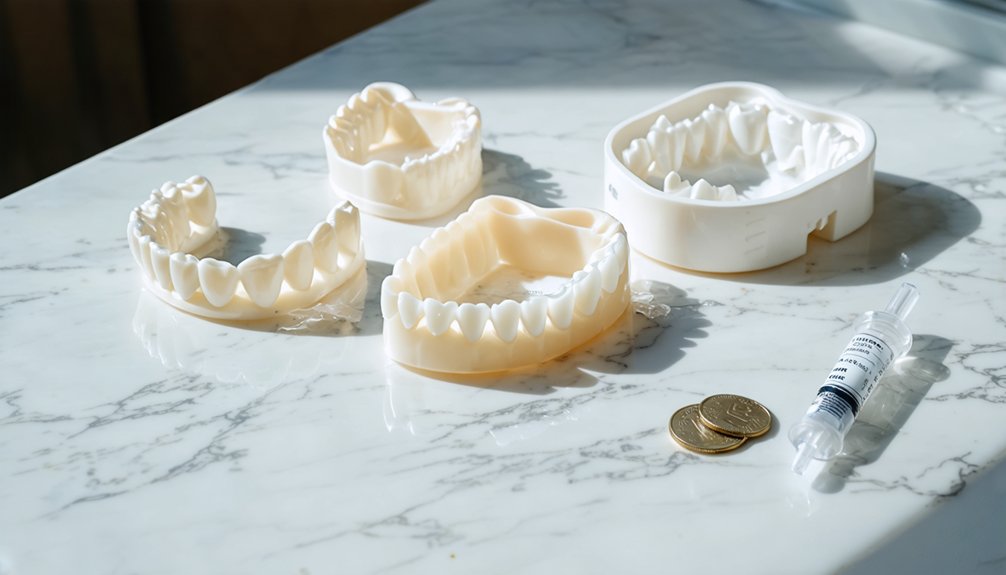
When budgeting for whitening trays, you’ll find options ranging from boil-and-bite kits at $10–$30 to pre-filled systems at $40–$80, making entry-level whitening accessible without a dental visit.
Mid-range take-home trays from a dentist offer a professional-grade gel and custom fit at a lower upfront cost than in-office treatments.
At the premium end, custom-fit trays fabricated from professional impressions run $300–$750 or more, reflecting the lab fees and clinical oversight included in that price.
Budget-Friendly Tray Options
Three main price tiers define the whitening tray market, and knowing where each option falls helps you match your budget to your clinical needs.
Applying smart budget strategies lets you maximize results without overspending:
- Boil-and-bite trays run $10–$30 and suit mild surface staining with short-term use.
- Pre-filled trays cost $40–$80 and deliver up to 5 shades of improvement using 15% hydrogen peroxide.
- Take-home dentist trays provide custom fit and professional-grade gel at a mid-range price point.
- In-office sessions represent the highest investment but deliver results within one hour.
Consumer reviews consistently highlight pre-filled trays as the strongest value tier, balancing cost, convenience, and measurable whitening outcomes for moderate staining without requiring professional supervision.
Mid-Range Professional Costs
Moving up from over-the-counter options, take-home trays from a dental office occupy a compelling middle ground.
You’ll receive custom-fitted trays paired with professional-grade carbamide peroxide gel, typically concentrated between 10% and 35%. This combination delivers mid range effectiveness that surpasses standard retail kits without requiring in-office bleaching fees.
Costs generally fall below the $300–$750+ range associated with fully supervised custom systems, making them a financially strategic choice.
Your whitening duration typically spans one to three weeks of daily wear, with sessions ranging from 45 minutes to several hours depending on concentration. You control the pace, adjusting usage based on sensitivity or desired shade.
For patients targeting meaningful, measurable results without committing to full clinical pricing, this tier offers a precise, dentist-supported solution.
Premium Custom Tray Pricing
At the premium end of the whitening spectrum, custom-fit trays from a dental professional typically cost between $300 and $750 or more, factoring in professional impressions and lab fabrication fees. This investment reflects tray customization precision and premium materials that over-the-counter options can’t replicate.
Here’s what your cost covers:
- Professional dental impressions for exact anatomical fit
- Lab fabrication using premium materials for durability and comfort
- Carbamide peroxide gel in concentrations between 10% and 35%
- Clinical oversight ensuring safe, controlled application
You’re not simply paying for a tray—you’re funding a system engineered to target intrinsic staining effectively, delivering up to 6 shades of improvement.
For patients prioritizing precision and measurable outcomes, this tier justifies its cost.
How Long Until You See a Whiter Smile?
How quickly you see results depends on the tray system you choose and the severity of your staining. Understanding expected results and treatment timelines helps you select the right protocol for your goals.
Lighter surface stains typically respond within 7 to 10 days using standard over-the-counter pre-filled trays. For more stubborn intrinsic staining, you’ll need 3 to 4 weeks of consistent daily use to achieve maximum shade reduction.
LED-compatible systems deliver noticeable changes within 3 to 10 days, making them effective when faster outcomes matter.
Custom-fit trays offer up to 6 shades of improvement, while pre-filled systems with 15% hydrogen peroxide deliver up to 5 shades in 10 days. Your stain severity and chosen concentration directly determine how quickly your smile responds.
How Do You Manage Sensitivity When Whitening Stained Teeth?
Sensitivity is a common side effect when whitening heavily stained teeth, but you can manage it effectively with the right approach. Implement these evidence-based sensitivity solutions for ideal pain management:
- Choose lower concentrations first — Start with 10% carbamide peroxide or hydrogen peroxide below 15% to reduce enamel irritation.
- Limit wear time — Reduce daily application sessions if sensitivity develops, particularly with custom-fit trays worn up to 3 hours.
- Use desensitizing gel — Apply potassium nitrate or fluoride gel immediately after whitening to calm nerve response.
- Space your sessions — Alternate whitening days to allow enamel recovery between treatments.
If sensitivity persists beyond mild discomfort, consult your dental professional before continuing your whitening protocol.
Frequently Asked Questions
Can Whitening Trays Damage Existing Dental Crowns, Veneers, or Fillings?
Whitening trays won’t damage crowns, veneers, or fillings, but they won’t whiten them either. You’ll notice crown compatibility mismatches in shade. Monitor teeth sensitivity closely, as peroxide can irritate surrounding gum tissue near restorations.
Are Whitening Trays Safe to Use During Pregnancy or Breastfeeding?
Absolutely every expert agrees: you shouldn’t use whitening trays during pregnancy. Pregnancy safety demands caution, as peroxide absorption risks remain unstudied. Breastfeeding considerations similarly warrant avoidance until you’ve consulted your healthcare provider for personalized, evidence-based guidance.
How Should Whitening Trays Be Properly Cleaned and Stored After Use?
Rinse your tray thoroughly with cool water after each use—apply cleaning techniques like gentle brushing with a soft toothbrush. Follow storage tips by keeping it in a ventilated case, away from heat and direct sunlight.
Can Children or Teenagers Safely Use Teeth Whitening Tray Systems?
You shouldn’t use whitening tray systems on children or teenagers due to significant youth dental safety concerns. Developing enamel and pulp tissues remain vulnerable to peroxide exposure, making professional consultation essential before initiating any whitening protocol.
Do Whitening Trays Expire, and How Long Does the Gel Remain Effective?
Yes, whitening trays do expire. Your gel potency gracefully fades after 12–24 months, while tray lifespan depends on material integrity. You’ll want to store gel refrigerated and inspect trays regularly for structural compromise to maintain treatment efficacy.
References
- https://www.forbes.com/sites/forbes-personal-shopper/article/best-teeth-whitening-kit/
- https://www.health.com/condition/oral-health/teeth-whitening-kits
- https://stevecash.net/article/6-best-teeth-whitening-trays-gels-kits-of-2025
- https://nwdentalatlanta.com/blog/comparing-take-home-trays-vs-in-office-teeth-whitening/
- https://www.newmouth.com/dentistry/cosmetic/whitening/trays/
- https://luigilunari.com/article/the-4-best-at-home-teeth-whitening-trays-smile-prep
- https://www.allinthefamilydental.com/blog/in-office-vs-take-home-whitening/
- https://teethcare360.co.uk/best-teeth-whitening-trays-uk/
- https://www.dentistsanfrancisco.com/dental-whitening-trays/
- https://opalescence.com/pages/compare