Years of smoking stains on your teeth can be reversed, but the path forward depends on how deeply the tobacco has penetrated your enamel. Surface stains respond well to professional whitening treatments, while deeper discoloration may require veneers or a combination of approaches. Quitting smoking and maintaining consistent oral hygiene greatly improve your results. The type of staining you have determines which treatment will work best for you, and there’s a lot more to contemplate before choosing your next step.
Key Takeaways
- Tobacco stains are either extrinsic (surface) or intrinsic (deep), with extrinsic stains responding well to professional whitening treatments.
- Professional in-office bleaching uses higher-concentration agents than over-the-counter products, making it more effective for reversing heavy smoker stains.
- Deep intrinsic stains that resist whitening treatments may require veneers to restore a natural, aesthetic appearance.
- Quitting smoking is the most effective step, preventing re-staining and extending the longevity of any whitening treatment results.
- Regular professional cleanings every six months remove tartar deposits that trap tobacco pigments, helping interrupt the staining cycle effectively.
Why Smoking Stains Teeth So Deeply
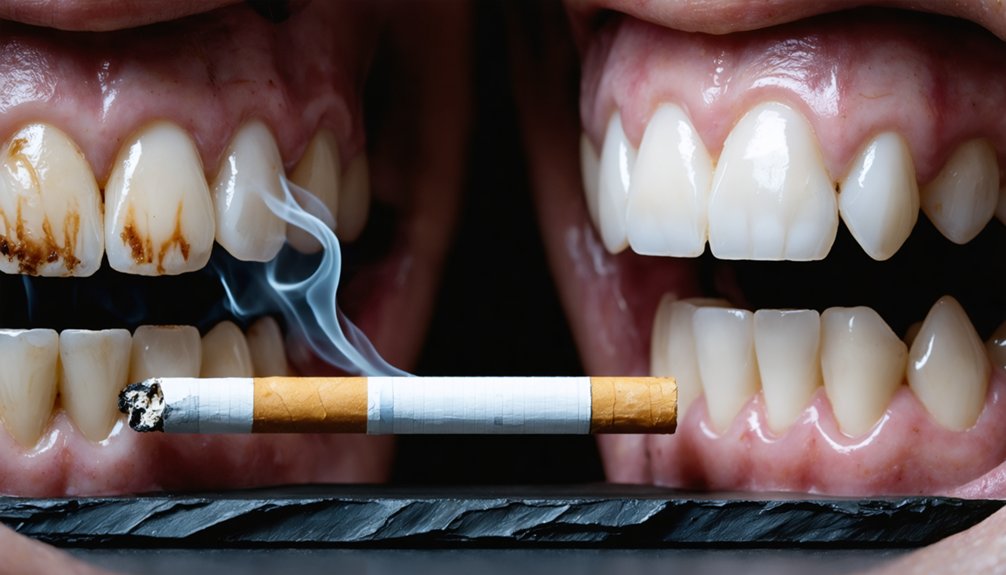
Tobacco smoke contains two primary compounds responsible for deep dental staining: tar and nicotine. Tar deposits a dark brown residue directly onto enamel, while nicotine oxidizes and turns yellow on contact with air.
Your enamel isn’t smooth at a microscopic level—it contains tiny pores that absorb these compounds with each exposure. Over time, repeated absorption drives staining deeper into the enamel surface, making stain prevention increasingly difficult without professional intervention.
Long-term smoking also reduces saliva production, which weakens your mouth’s natural cleansing mechanism. Saliva normally helps rinse away surface deposits, but dry mouth allows stain compounds to linger longer.
This combination of chemical absorption, pore penetration, and reduced saliva creates cumulative oral health damage that goes well beyond surface discoloration.
Surface Stains vs. Deep Discoloration: What Type Do You Have?
Understanding how deeply your stains have settled determines which treatments are likely to work.
Surface discoloration sits on your enamel’s outer layer, making it more responsive to professional cleaning and whitening. If you’ve smoked for a shorter period or maintained consistent oral hygiene, your stains are likely extrinsic and more manageable.
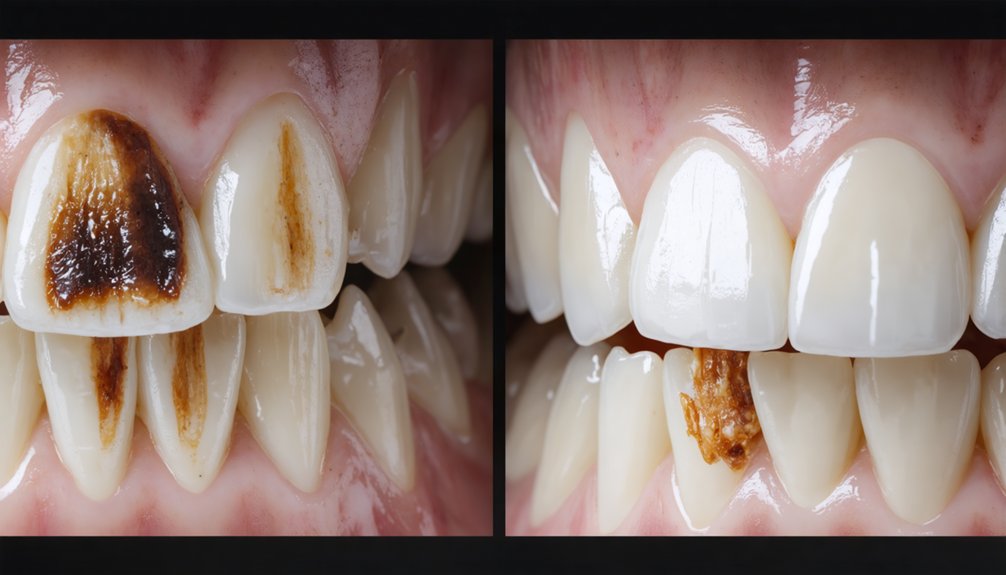
Deep discoloration is different. Years of tar and nicotine exposure allow stain compounds to penetrate enamel’s microscopic pores, making standard stain removal less effective.
You’ll notice these stains appear darker, more uniform, and resistant to over-the-counter products.
To identify what you’re dealing with, schedule a professional evaluation. Your dentist can assess stain depth and recommend targeted treatment, whether that’s bleaching, cleaning, or veneers for severe cases.
Can Years of Tobacco Staining Actually Be Reversed?
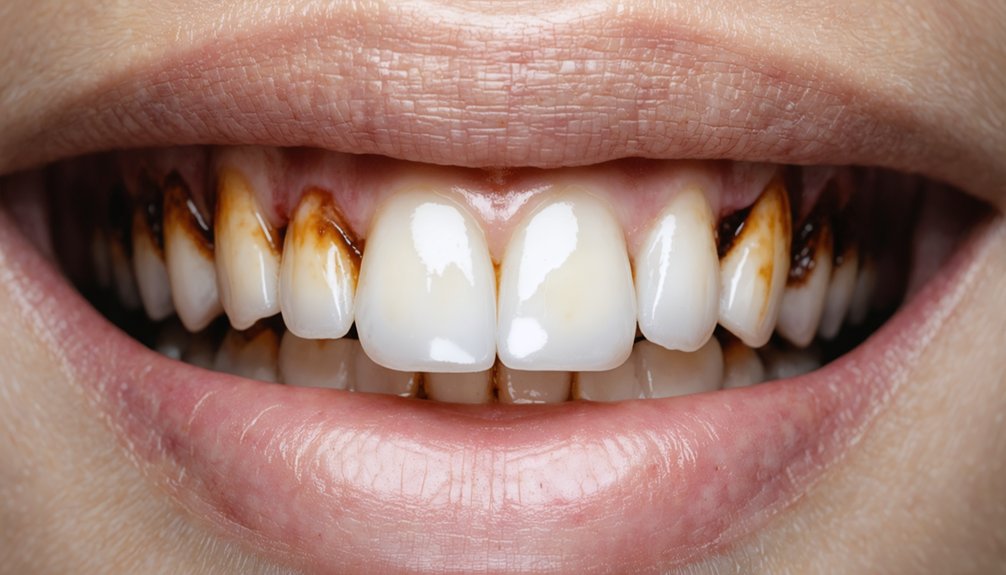
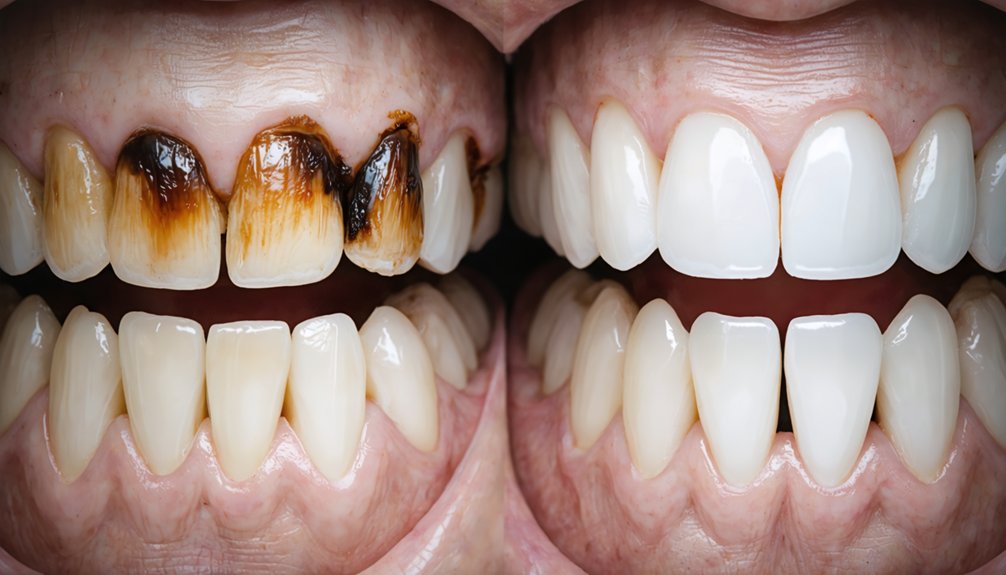
If your stains are extrinsic—sitting on the outer enamel surface—professional whitening can markedly reduce years of tobacco discoloration.
Intrinsic stains, which penetrate deeper into the tooth structure, respond less predictably to bleaching and may require veneers for meaningful improvement.
Understanding which type you’re dealing with helps you and your dentist choose the most effective treatment path.
Extrinsic Vs. Intrinsic Stains
Whether years of tobacco staining can actually be reversed depends largely on where the discoloration has settled in your teeth.
Extrinsic stains sit on the outer enamel surface and respond well to professional whitening and cleaning. These are the stains you can most effectively target through stain prevention habits and enamel protection strategies like regular brushing and timely dental cleanings.
Intrinsic stains, however, penetrate deeper into the tooth structure, making them considerably harder to reverse. Long-term smoking can push discoloration past the enamel and into the dentin beneath it.
At that stage, whitening treatments produce limited results, and veneers may become the more practical solution. Understanding which type of staining you’re dealing with helps you and your dentist choose the most effective treatment path.
Whitening Options For Smokers
Years of tobacco staining can often be markedly reduced, though the degree of reversal depends on how deeply the discoloration has set into your teeth.
Extrinsic stains respond well to professional whitening techniques, including in-office bleaching and dentist-supervised at-home treatments. Combining both approaches typically produces stronger results for heavily stained teeth.
When staining is severe, porcelain veneers offer an effective alternative by masking discoloration that whitening can’t fully address.
Routine dental cleanings also remove surface buildup that deepens the appearance of stains.
Stain prevention remains equally important after treatment. Continued smoking rapidly re-stains treated teeth, so quitting markedly extends your results.
Limiting additional staining exposures, like coffee and tea, further preserves any improvement you’ve achieved through professional care.
Professional Whitening Results for Heavy Smokers
For heavy smokers, professional whitening can produce meaningful results, though the degree of improvement depends on how deeply tar and nicotine have penetrated the enamel.
Your smoking habits directly influence how aggressively staining occurs and how much whitening can realistically reverse.
In-office bleaching uses higher-concentration agents than over-the-counter products, making it more effective for stubborn discoloration.
Your dentist may combine in-office treatment with supervised at-home bleaching to target heavier staining more thoroughly.
Enamel health also plays a critical role — compromised enamel limits treatment options and can increase sensitivity during bleaching.
When staining exceeds what whitening can address, porcelain veneers offer a reliable alternative for front teeth.
Without reducing tobacco use, however, even strong professional results will fade quickly.
When Whitening Alone Won’t Remove Tobacco Stains
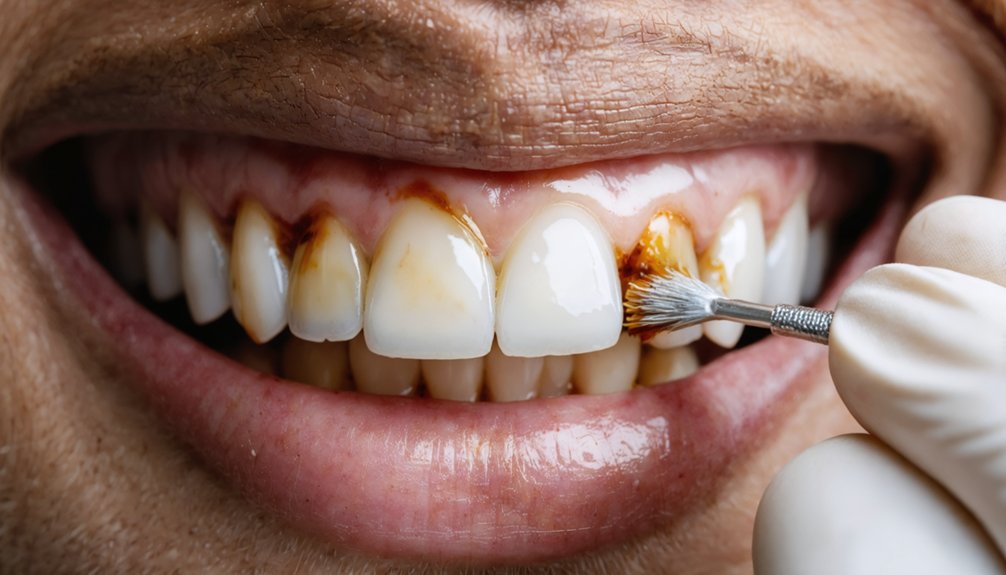
Although professional whitening addresses many tobacco stains, it has clear limits when discoloration has penetrated deeply into the enamel or when years of heavy smoking have produced intrinsic changes within the tooth structure.
When tobacco effects include enamel damage that’s reached beyond the surface layer, bleaching agents can’t fully correct what’s become structural discoloration rather than surface staining.
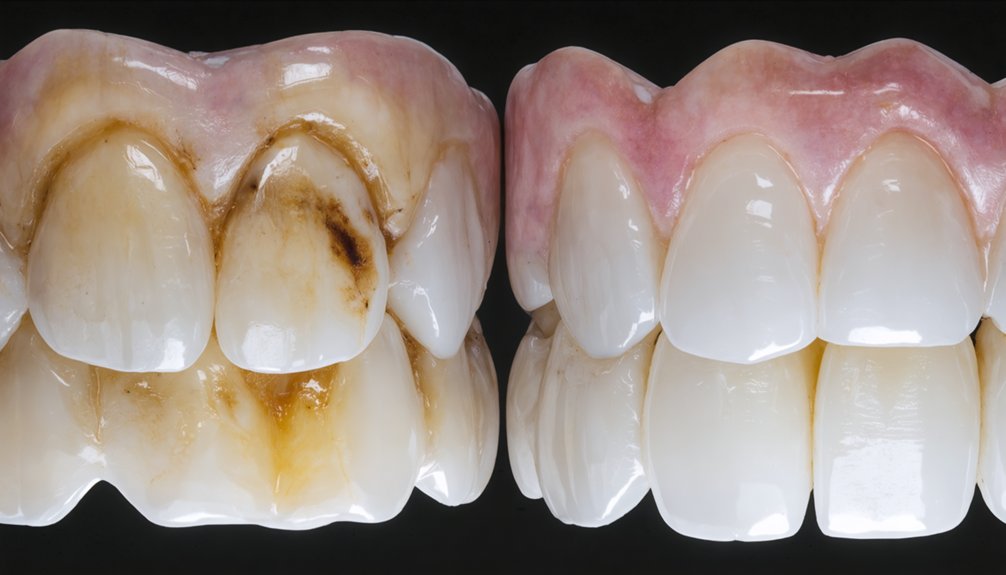
In these cases, porcelain veneers offer a reliable solution. Your dentist bonds thin ceramic shells to the front of affected teeth, masking discoloration that whitening can’t reach.
Veneers also provide a protective barrier against future staining. If you’re dealing with severe, long-standing tobacco stains, discussing veneer candidacy with your dentist gives you a concrete path toward lasting improvement rather than repeated whitening cycles with diminishing returns.
At-Home Ways to Reduce Tobacco Staining Between Visits
Between professional visits, a few targeted habits can slow tobacco staining and help maintain whatever whitening progress you’ve made. Brush promptly after smoking to limit tar and nicotine contact with enamel. When brushing isn’t possible, rinse with water to reduce residue retention. Whitening toothpaste addresses mild surface discoloration, though it won’t reverse deep staining on its own.
Regarding natural remedies, baking soda offers mild abrasive action but use it sparingly—overuse erodes enamel and increases sensitivity.
Dietary influences also matter greatly. Coffee, tea, red wine, and dark sodas compound tobacco discoloration, so reducing those exposures extends your whitening results. Consistent flossing removes plaque that traps stain compounds along the gumline.
These habits won’t replace professional treatment, but they give you measurable control between appointments.
Why Long-Term Smokers Often Need More Than One Treatment

When you’ve smoked for years, staining compounds penetrate enamel’s microscopic pores repeatedly, building layers of discoloration that a single whitening session can’t fully address.
Decades of smoking embed stain upon stain into enamel, creating layers no single whitening session can fully erase.
Deep, entrenched tobacco stains require staged treatment protocols that combine professional in-office bleaching with supervised at-home applications over several weeks.
Your dentist may also schedule a thorough cleaning before whitening begins, since tartar and plaque make stain removal less effective and can mask the true extent of discoloration.
If bleaching doesn’t produce sufficient results, veneers offer a reliable next step for severely affected front teeth.
Expect the process to take time. Each treatment builds on the last, gradually lifting accumulated discoloration.
Committing to the full protocol gives you the strongest, most lasting outcome possible.
The Fastest Way to Stop Tobacco Stains From Coming Back
If you want to keep tobacco stains from returning after treatment, quitting smoking is the single most effective step you can take.
Pairing cessation with consistent daily brushing, flossing, and rinsing removes residual stain compounds before they penetrate enamel.
Scheduling regular professional cleanings further protects your results by clearing surface deposits that home care alone can’t fully address.
Quit Smoking Immediately
Quitting smoking is the single most effective step you can take to stop tobacco stains from returning after treatment. Once you quit smoking, tar and nicotine no longer contact your enamel, eliminating the primary source of discoloration. This means any whitening or professional treatment you’ve invested in holds longer without constant re-staining working against your results.
Beyond appearance, the health benefits of quitting extend well past cosmetics. Reduced gum disease risk, improved saliva production, and lower oral cancer rates are among the documented outcomes.
Saliva’s natural cleansing function also restores more effectively once smoking stops, helping your mouth manage surface stains more efficiently.
If you’re serious about maintaining brighter teeth long-term, stopping tobacco use isn’t optional—it’s the foundation everything else depends on.
Maintain Consistent Oral Hygiene
Stopping tobacco use removes the primary staining agent, but consistent oral hygiene determines how quickly residual discoloration accumulates between treatments.
Brush twice daily using a whitening toothpaste to address surface stains before they penetrate enamel pores.
Apply proper flossing techniques—working the floss in a C-shape around each tooth—to eliminate plaque buildup that intensifies discoloration along the gumline.
Rinse after brushing to leverage mouthwash benefits, particularly formulas containing hydrogen peroxide or cetylpyridinium chloride, which disrupt stain-causing compounds and reduce bacterial load.
Rinsing with water immediately after tobacco exposure also limits chemical contact time with enamel.
Together, these habits slow re-staining between professional treatments and give whitening results a stronger foundation to last.
Schedule Regular Dental Cleanings
Even with strong daily hygiene habits, professional cleanings remain the most reliable mechanism for interrupting tobacco stain cycles before they become entrenched.
Scheduling cleanings every six months supports your dental health while giving clinicians the opportunity to remove calculus and surface pigmentation that brushing can’t address.
Three stain prevention advantages professional cleanings deliver:
- Tartar removal — eliminates the hardened deposits that trap tobacco pigments and darken overall appearance
- Early intervention — catches developing stains before they penetrate enamel pores deeply
- Baseline assessment — lets your dentist track stain progression and adjust your whitening strategy accordingly
You stay ahead of discoloration when you treat professional cleanings as a non-negotiable part of your maintenance plan.
How to Keep Teeth Bright After Whitening
Once you’ve invested in whitening treatment, protecting those results requires consistent daily habits. Brush twice daily, floss regularly, and rinse your mouth after tobacco use to support teeth maintenance and slow stain prevention.
Whitening toothpaste can help manage mild surface buildup between professional visits.
Limit additional staining exposures like coffee, tea, and wine, since these compounds compound discoloration alongside tobacco. If you continue smoking, understand that results will fade faster, making maintenance care non-negotiable rather than optional.
Schedule periodic professional cleanings to remove accumulating plaque and tartar before they deepen new staining. Your dentist may also recommend touch-up bleaching treatments to extend your results.
Consistency across all these habits determines how long your whitening investment actually lasts.
Frequently Asked Questions
Does Smoking Through a Filter Reduce the Amount of Staining on Teeth?
Filters offer minimal stain prevention, as tar and nicotine still reach your teeth. Don’t rely on filter effectiveness alone—you’ll still develop discoloration. Consistent brushing, rinsing after smoking, and professional cleanings remain your strongest defense against staining.
Can Smokeless Tobacco or Chewing Tobacco Cause the Same Staining as Cigarettes?
Yes, smokeless tobacco’s composition delivers tar and nicotine directly onto your enamel, making stain removal equally challenging. You’ll likely experience similar yellowing and browning, requiring the same professional whitening or veneer solutions as cigarette smokers.
Are Certain Tooth Shapes or Sizes More Prone to Absorbing Tobacco Stains?
Your tooth anatomy doesn’t greatly dictate stain absorption—your oral hygiene habits do. You can prioritize stain prevention by brushing consistently, rinsing after tobacco use, and scheduling regular cleanings to maintain control over discoloration progression.
Does Secondhand Smoke Exposure Cause Noticeable Staining on Non-Smokers’ Teeth?
secondhand smoke can affect your dental health. You’re still absorbing tar and nicotine particles through the air, gradually staining your enamel. Prioritizing regular cleanings and consistent oral hygiene helps you actively combat this discoloration.
Can Dental Insurance Ever Cover Whitening Treatments Caused by Tobacco Staining?
Most insurance policies don’t cover cosmetic whitening, even tobacco-related. You’ll want to verify your plan’s specifics, as some policies may offer partial coverage. Exploring your whitening options with your dentist helps you identify affordable, effective solutions.
References
- https://www.johngoodmandds.net/blog/2014/08/20/restoring-the-brightness-of-teeth-147956/
- https://www.healthline.com/health/how-to-remove-nicotine-stains-from-teeth
- https://guelphdentist.com/remove-teeth-stains-caused-smoking/
- https://potachmitchelldental.com/2025/06/how-smoking-affects-teeth-whitening-and-how-to-reverse-it/
- https://www.peterabasdds.com/removing-smoking-stains-from-teeth/
- https://thesugarhousedentist.com/natural-ways-to-reverse-teeth-stains/
- https://www.mondaygrazianidds.com/coffee-wine-and-smoking-can-teeth-whitening-really-reverse-the-damage/
- https://www.smilesbyhanna.com/remove-stains-of-smoking-teeth/
- https://smilesofpuntagorda.com/can-smoking-stains-be-removed-from-teeth/
- https://pmc.ncbi.nlm.nih.gov/articles/PMC9932248/