Start your whitening journey 6–12 months before your wedding with a full dental check-up to address cavities and gum disease. Schedule deep whitening treatments 3–6 months out, combining in-office sessions with custom at-home trays. Complete your final touch-up two weeks before the ceremony, giving your enamel time to stabilize and sensitivity to resolve. Avoid staining agents on your wedding day to protect your results. The details ahead will sharpen your exact timeline.
Key Takeaways
- Start smile planning 6–12 months before your wedding with a full dental check-up to address cavities, gum disease, and baseline shade.
- Schedule deep whitening treatments 3–6 months before the wedding, combining in-office sessions with custom at-home trays for consistent results.
- Plan your final whitening touch-up 2–3 weeks before the wedding, allowing sensitivity to resolve and enamel to stabilize naturally.
- On your wedding day, avoid coffee, red wine, dark juices, and heavily pigmented sauces to protect your whitening results.
- Carry a small dental kit with whitening strips and a travel tray for quick touch-ups between wedding day events.
What Happens to Your Teeth After Whitening (And Why It Matters for Wedding Photos)
After professional whitening, your teeth go through a brief but important recovery phase that directly affects how they’ll look in photos. Initially, teeth sensitivity peaks within the first 24–48 hours, then subsides as enamel rehydrates and stabilizes. During this window, color retention isn’t yet ideal—your teeth are still settling into their final shade.
Scheduling whitening 2–3 weeks before your wedding guarantees photo readiness at its peak. By then, sensitivity’s resolved, and your smile confidence reflects a natural, polished brightness rather than an over-bleached appearance.
Dental advice consistently supports this window for achieving authentic aesthetic results.
To sustain that brightness, prioritize whitening maintenance through touch-up treatments and dietary adjustments. Your treatment options and aesthetic preferences should guide every decision—always with precise, professional dental advice directing the sequence.
What Your Dentist Should Address 6–12 Months Before Your Wedding
Starting your wedding smile plan 6–12 months out gives your dentist enough time to catch and correct underlying issues before any cosmetic work begins.
Your initial smile assessment should include a full dental check-up to identify cavities, gum disease, or structural concerns that could compromise whitening results.
Addressing these foundational health factors first guarantees that any cosmetic treatments you pursue later will deliver lasting, ideal outcomes.
Initial Smile Assessment
Planning your wedding smile starts with one foundational step: a thorough dental assessment 6–12 months before your ceremony. This smile assessment gives your dentist a complete picture of your oral health before any cosmetic treatment begins.
During your dental consultation, your dentist identifies cavities, gum disease, or structural issues that could compromise whitening results. Cosmetic treatments applied over unhealthy teeth won’t hold — and they can worsen existing problems. Addressing these concerns first protects your investment and guarantees lasting outcomes.
Your dentist will also evaluate your baseline tooth shade and gum condition, establishing a clear treatment sequence tailored to your timeline.
You’ll leave with a precise roadmap — knowing exactly what needs correction, what’s cosmetically possible, and when each phase of treatment should begin.
Early Dental Health Evaluation
Once your dentist has mapped out your smile assessment, the real clinical work begins. At the 6–12 month mark, early dental intervention addresses foundational issues that determine whether your smile transformation succeeds or stalls.
Your dentist should identify and treat cavities, gum disease, or structural damage before any cosmetic procedure starts. Applying whitening treatments over compromised teeth produces unpredictable results and potential harm.
You’ll also receive a professional cleaning during this phase, clearing away buildup that would otherwise interfere with bleaching effectiveness.
This evaluation establishes your clinical baseline. Every cosmetic decision made afterward—shade selection, treatment sequencing, product strength—depends on the health data gathered now.
Skipping this step means building your wedding-day smile on an unstable foundation.
The 3–6 Month Window for Deep Whitening Results
The 3–6 month window before your wedding is the ideal phase for deep, lasting whitening results. During this period, you can strategically combine professional in-office whitening techniques with custom take-home trays to achieve superior shade consistency across all teeth.
In-office systems deliver accelerated brightening within a single session, while custom trays reinforce and extend those results over 10–14 days at home. This dual approach penetrates deeper stain layers that surface-level products can’t reach, producing a natural, uniform tone that holds through your ceremony and honeymoon.
Your cosmetic dentist will calibrate both treatments to complement your skin tone and facial aesthetics, ensuring your results look intentional rather than artificial.
Starting now gives you full control over the final outcome well before your wedding date.
In-Office vs. At-Home Whitening: Which Method Fits Your Timeline?
When time is limited, in-office treatments like Zoom laser whitening deliver results in a single appointment, making them the practical choice for brides working within a compressed schedule.
If you have two to six weeks available, at-home whitening strips, custom trays, or professional take-home kits offer a flexible alternative that fits around your daily routine.
Your ideal method depends on how much time you have left before the wedding and the level of whitening you want to achieve.
In-Office Whitening Speed
In-office whitening delivers results in as little as one treatment day, making it the fastest option for brides working with a tight timeline.
Zoom Laser whitening completes in a single session, while custom Zoom trays require 2-4 weeks for ideal results.
Whitening technology advancements have made professional treatments considerably more efficient, allowing high-strength bleaching gels to penetrate deeply while protecting surrounding gum tissue.
Patient comfort considerations remain central to in-office protocols, with trained professionals monitoring sensitivity and adjusting treatment intensity throughout each session.
If you need immediate brightness before engagement photos or bridal showers, scheduling your first Zoom treatment early lets you control both your timeline and your results.
You’ll walk out with measurable whitening that at-home products simply can’t match in speed.
At-Home Whitening Flexibility
While in-office whitening wins on speed, at-home options give you something equally valuable: flexibility. At-home convenience lets you control your schedule, pacing treatments around fittings, tastings, and other pre-wedding commitments.
Customized trays prescribed by your dentist deliver high-strength gel directly against enamel, producing gradual results over 10–14 days. This slower progression actually supports sensitivity management, giving tissues time to recover between sessions.
User experiences consistently favor custom trays over strips for comfort and consistency.
Your product options range from professional take-home kits to over-the-counter strips, though concentration levels differ markedly. Cost comparison favors at-home methods for whitening maintenance after an initial in-office treatment.
Together, both approaches protect your investment and sustain brightness straight through your ceremony date.
Your 2-Week Whitening Touch-Up Before the Ceremony
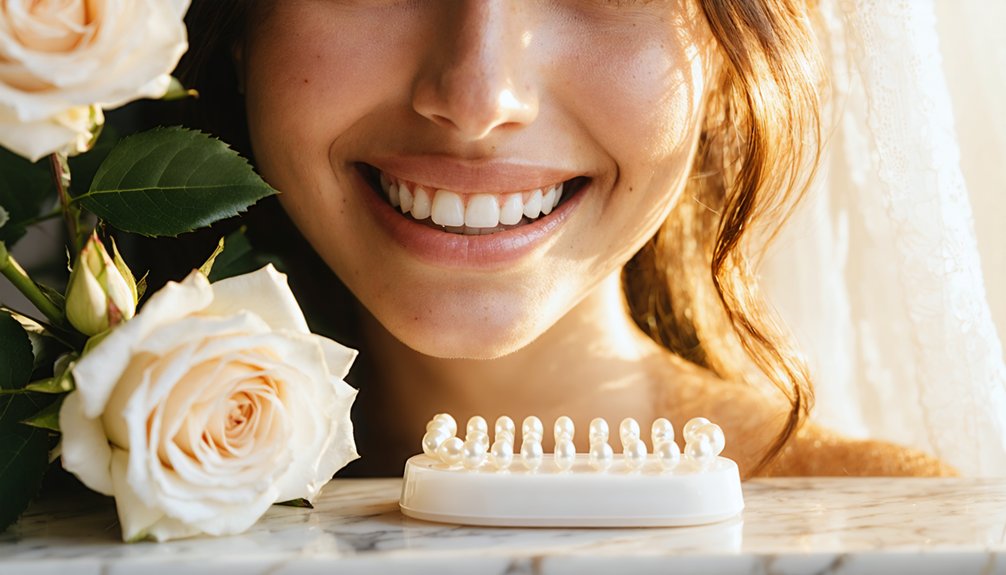
Two weeks before your ceremony is the ideal window to schedule a whitening touch-up, giving your teeth enough time to settle into their brightest, most natural appearance before you walk down the aisle.
Post-treatment sensitivity typically resolves within this timeframe, so you’ll feel completely comfortable on your wedding day. Your enamel also stabilizes during this window, allowing its natural luster to surface fully rather than appearing artificially stark from a same-day treatment.
Scheduling your whitening touch-up at this precise point maximizes smile confidence without compromising comfort.
Whether you opt for a professional Zoom session or your custom take-home trays, completing treatment two weeks out guarantees you’re photographed at your absolute best — from the ceremony through the reception.
How to Protect Your Whitening Results on the Wedding Day
Once your whitening results are locked in, protecting them on the wedding day itself becomes the next priority.
Start with whitening maintenance tips that limit exposure to staining agents. Avoid coffee, red wine, dark juices, and heavily pigmented sauces throughout the day. Avoiding staining foods and beverages during the reception greatly reduces the risk of discoloration between the ceremony and evening events.
Rinse with water after consuming anything acidic or colored. Use a whitening toothpaste touch-up if your schedule permits before photography sessions.
Carry a small dental kit with whitening strips or a travel-sized tray for quick maintenance between events. Your choices throughout that single day directly determine how consistently bright your smile appears across every photograph and memory captured.
Frequently Asked Questions
Can Teeth Whitening Treatments Affect Dental Veneers or Crowns Differently?
Like Cinderella’s glass slipper, one size doesn’t fit all—whitening won’t alter your veneers or crowns. You’ll need veneer maintenance and crown longevity strategies, as these restorations resist bleaching agents entirely differently than natural enamel does.
Does Teeth Whitening Work the Same Way for Naturally Yellow Versus Gray Teeth?
Teeth whitening doesn’t work the same way for both. Naturally yellow teeth respond well to whitening effectiveness, while gray teeth, caused by natural discoloration from medication or trauma, resist standard bleaching treatments considerably. You’ll need alternative cosmetic solutions.
Are There Specific Foods That Accelerate Teeth Staining After Whitening Treatments?
Yes, certain foods accelerate staining after whitening. You’ll want to avoid staining beverages like coffee, red wine, and tea, plus acidic foods such as citrus and tomatoes, as they’ll rapidly compromise your freshly whitened results.
Can Pregnancy Affect the Safety or Effectiveness of Professional Teeth Whitening?
Pregnancy effects make professional teeth whitening unsafe during your term. You shouldn’t pursue whitening safety protocols while pregnant, as chemicals may harm your baby. Consult your OB-GYN and dentist to schedule treatments before or after delivery.
How Does Smoking History Impact Whitening Results and Treatment Duration Needed?
Your smoking history intensifies stains, directly impacting smoking effects on whitening results. You’ll need extended treatment expectations, often requiring multiple in-office Zoom sessions combined with custom take-home trays to achieve your desired wedding-day brightness.
References
- https://www.lowesislanddentistry.com/blog/how-soon-before-my-wedding-should-i-get-my-teeth-whitened
- https://www.rwdentalarts.com/wedding-smiles-rock-hill-teeth-whitening-timeline/
- https://www.rinehartdentistry.com/tips-get-white-wedding-day-smile/
- https://biancabright.com/blogs/news/wedding-teeth-whitening-timeline-when-to-start
- https://www.mysmilelifedental.com/blog/weddingready-bright-smile-tips-brighter-teeth-wedding-season/52123
- https://www.semideydental.com/the-best-way-to-whiten-before-your-wedding-day/
- https://www.thecosmeticdentalclinic.com/blog/the-complete-wedding-smile-timeline-when-to-start-each-treatment-for-your-big-day/