The best teeth whitening method depends on your stain type. For surface stains from coffee or tobacco, whitening strips or toothpaste can work well. For deeper, intrinsic discoloration, you’ll need professional-grade bleaching agents or in-office treatments. Custom dentist trays offer precision and safety for moderate stains, while in-office whitening delivers the fastest results. Matching the right method to your specific stain type is what determines success—and there’s much more to uncover about each option ahead.
Key Takeaways
- In-office professional whitening delivers the fastest, most controlled results, typically lifting deep discoloration in a single supervised session.
- Custom dentist trays offer a precise, safe at-home alternative, minimizing gum irritation while providing consistent, professional-grade whitening.
- Whitening strips effectively treat mild stains but carry higher gum irritation risks and deliver slower, moderate results.
- Whitening toothpaste removes surface stains only and works best as a weekly supplement, not a primary whitening solution.
- Maintaining results requires limiting staining foods, using straws, regular cleanings, and periodic touch-up treatments.
Why Do Teeth Change Color in the First Place?
Teeth change color through two distinct pathways: extrinsic and intrinsic staining. Extrinsic stains accumulate on tooth enamel‘s surface, driven by coffee, tea, red wine, tobacco, and pigmented foods. These deposits bond to the enamel’s outer layer and respond well to professional cleaning and whitening agents.
Intrinsic staining runs deeper. Stain penetration reaches the dentin beneath the enamel, often caused by aging, trauma, certain medications like tetracycline, or excessive fluoride exposure during development. These stains don’t respond to surface-level treatments alone and typically require stronger bleaching protocols.
You need to identify which type of discoloration you’re dealing with before selecting a whitening approach. Misidentifying the cause leads to wasted effort and ineffective treatment. Accurate diagnosis drives effective results.
How Fast Does In-Office Whitening Actually Work?
When you’re looking for the fastest route to a noticeably whiter smile, in-office bleaching outpaces every other method. A dentist applies a concentrated whitening agent directly to your teeth, delivering controlled, measurable results within a single appointment.
- A clinical-strength gel visibly lifts deep discoloration in one session
- Supervised application prioritizes enamel preservation throughout the procedure
- Dental sensitivity is monitored and managed in real time by your provider
- You leave the chair with results that at-home methods take weeks to approach
No other whitening method compresses that level of color change into one visit. If speed and precision matter to you, in-office treatment gives you the strongest outcome with the tightest control over your results.
Are Custom Dentist Trays Worth the Cost?
When you choose custom dentist trays, you get a precise fit that reduces gel leakage and gum irritation—advantages that generic store trays can’t reliably match.
The upfront cost runs higher than over-the-counter options, but the stronger, more controlled results often justify the difference for moderate to severe discoloration.
If you’re weighing professional trays against drugstore alternatives, the evidence consistently favors custom trays for both safety and effectiveness.
Custom Fit Advantages
Why pay more for a custom tray when drugstore options line every pharmacy shelf? The answer comes down to precision. A dentist-fabricated tray fits your exact arch, controlling gel placement and protecting your enamel health from unnecessary chemical exposure.
- Gel stays on tooth surfaces, not pooling against gum tissue
- Uniform contact produces consistent dental gloss across every tooth
- Thin construction lets you speak and work during treatment
- Accurate fit reduces saliva dilution, keeping concentration stable
Generic trays can’t replicate that control. Ill-fitting edges allow gel migration, increasing sensitivity risk and reducing whitening efficiency. When you choose a custom tray, you’re not paying for convenience—you’re paying for measurable precision that delivers stronger, safer results than any shelf product can reliably offer.
Comparing Costs To Results
Three factors determine whether custom dentist trays justify their higher price: initial cost, result quality, and longevity.
You’ll typically pay more upfront compared to over-the-counter strips or trays, but dental technology closes that gap quickly when you measure outcomes.
Custom trays use professional-grade whitening formulas with higher active concentrations than OTC alternatives.
You get a precise fit that controls gel contact, reduces gum irritation, and maximizes enamel exposure.
That precision drives stronger, more consistent color change.
Longevity matters too.
You can reuse your custom trays repeatedly, replacing only the whitening formulas as needed.
OTC strips offer single-use convenience at lower per-unit cost, but require more frequent repurchase.
Over time, custom trays often deliver superior value when weighed against cumulative spending on repeated store-bought treatments.
Professional Versus Store-Bought
Choosing between custom dentist trays and store-bought options comes down to fit, concentration, and controlled application. Custom trays deliver professional-grade gel precisely against your enamel, reducing teeth sensitivity from gel overflow onto gum tissue. Store-bought strips and trays use lower concentrations with generic sizing, limiting both effectiveness and safety control. Check whether your dental insurance covers custom tray fabrication, as partial coverage can close the cost gap significantly.
- Custom trays hugging each tooth contour evenly, gel staying exactly where it belongs
- Generic strips bunching at edges, uneven contact leaving patchy results
- A dentist reviewing your sensitivity thresholds before prescribing gel concentration
- Side-by-side shade comparisons showing measurable gradient differences after two weeks
If you want predictable, controlled outcomes, custom dentist trays consistently outperform store-bought alternatives.
How Do Whitening Strips Compare to Professional Treatments?
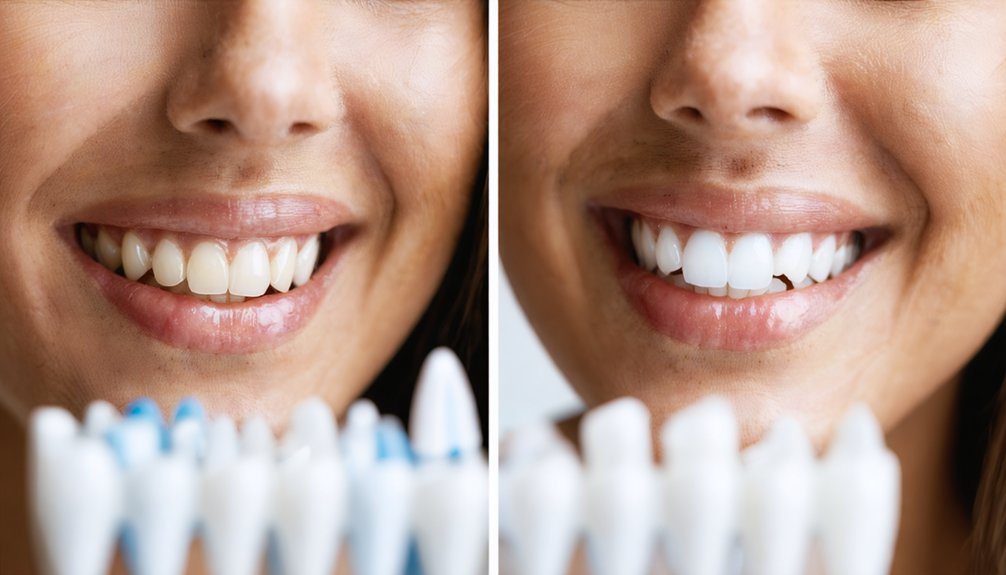
Whitening strips and professional treatments differ across three key factors: strength, speed, and safety. Strips use lower-concentration peroxide, delivering mild to moderate results over several weeks.
Whitening strips rely on lower-concentration peroxide — effective for mild results, but progress unfolds gradually over weeks.
Professional in-office treatments apply stronger agents, sometimes activated by a dental laser, compressing that timeline into a single visit.
On enamel safety, the distinction matters. Strips, when misused or over-applied, increase the risk of gum irritation and uneven exposure. Custom professional trays and in-office applications are dentist-supervised, reducing misapplication risk considerably.
If you’re managing mild surface staining, strips offer a controlled, accessible option.
If you’re targeting deeper discoloration or want measurable results faster, professional treatment gives you greater precision.
Your choice should align with the severity of discoloration and your tolerance for treatment timelines.
Does Whitening Toothpaste Actually Remove Stains?
Whitening toothpaste works by using mild abrasives and low-level chemical agents to polish and lift surface stains from your enamel.
However, it can’t reach the deeper, intrinsic discoloration that forms within the tooth structure.
You’ll get the most reliable results when you use it once or twice a week as a complement to your regular brushing routine rather than as a standalone whitening solution.
If your staining goes beyond superficial discoloration, you should consider stronger professional options, as whitening toothpaste functions best as a maintenance tool.
How Whitening Toothpaste Works
Although whitening toothpaste is widely marketed as a tooth-brightening solution, it works primarily by polishing away surface stains rather than chemically bleaching the tooth’s inner structure. Unlike professional treatments, it doesn’t penetrate enamel to alter deeper discoloration. You’re fundamentally managing external buildup, not reversing intrinsic staining.
- Mild abrasives scrub coffee, tea, and tobacco residue from enamel surfaces.
- Enamel health remains a concern—overuse can gradually wear protective layers.
- Natural remedies like baking soda operate similarly, targeting surface-level staining only.
- ADA-approved formulas offer the most reliable balance between stain removal and safety.
Use whitening toothpaste once or twice weekly rather than daily. Treat it as a maintenance tool, not a primary whitening method, for precise, controlled results.
Surface Stains Versus Deep Stains
Understanding the difference between surface and deep stains determines whether whitening toothpaste will actually work for you.
Surface stains, called extrinsic stains, form on enamel from coffee, tea, and tobacco. Whitening toothpaste targets these effectively through mild abrasives and polishing agents.
Deep stains, called intrinsic stains, develop within the tooth’s inner structure. Whitening toothpaste can’t reach them. If your discoloration originates internally, from aging, medication, or trauma, you’ll need professional bleaching instead.
You should also weigh enamel erosion risks. Overusing abrasive whitening toothpaste damages enamel over time, increasing sensitivity.
Choosing an ADA-approved formula that includes fluoride benefits your enamel by strengthening it while controlling surface staining.
Use whitening toothpaste strategically, not as a daily default, to protect long-term enamel integrity.
Best Use Practices
Knowing what type of stain you’re dealing with is only half the equation — how you actually use whitening toothpaste determines whether it delivers any real benefit.
Lifestyle factors like coffee consumption, tobacco use, and diet directly influence how frequently you’ll need to apply it. Dental insurance rarely covers cosmetic whitening, so using these products correctly maximizes your investment.
Follow these evidence-based practices:
- Replace your regular toothpaste with whitening toothpaste once or twice weekly, not daily
- Brush for a full two minutes using controlled, circular strokes across all surfaces
- Use a straw when drinking stain-causing beverages to reduce direct enamel contact
- Reserve whitening toothpaste for surface stain maintenance, not intrinsic discoloration correction
Precision in application protects enamel while delivering measurable stain control.
Which Home Whitening Remedies Work and Which to Skip
When exploring home whitening remedies, it’s important to distinguish between options backed by evidence and those that may cause harm. Among natural remedies, baking soda offers mild surface stain removal through gentle polishing, making it a reasonable occasional option.
Hydrogen peroxide at low concentrations—1.5% or 3%—is another defensible choice when used sparingly.
Home safety becomes a concern with popular alternatives like activated charcoal, vinegar, and lemon juice. Despite their visibility online, these carry real risks of enamel erosion with limited whitening evidence to justify the trade-off.
Oil pulling shows minimal proven effect and shouldn’t replace established methods.
Treat home remedies as stain-management tools, not primary whitening solutions. If you want reliable results, pair low-risk home options with professionally recommended treatments.
Which Teeth Whitening Method Is Right for You?
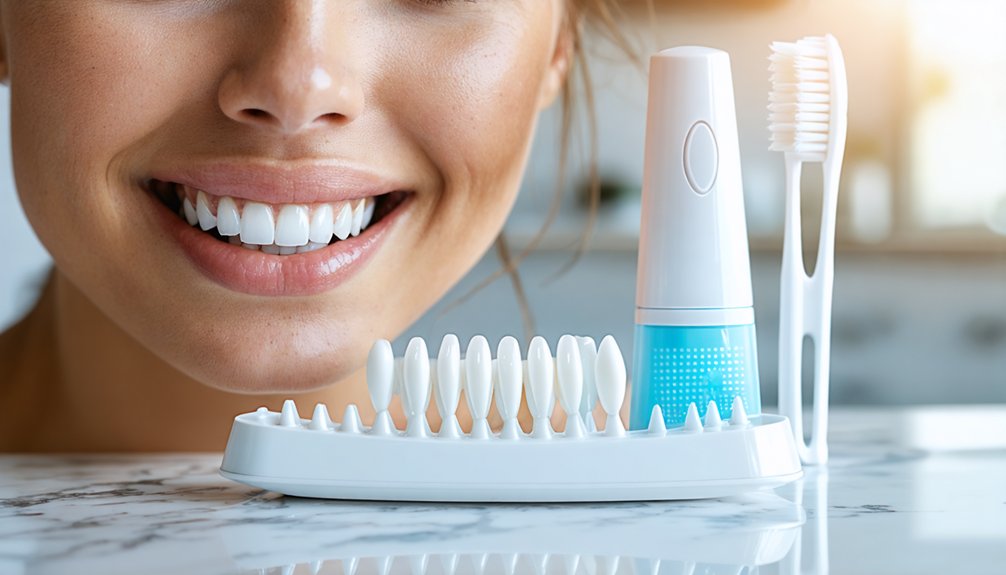
Home remedies can play a supporting role, but choosing the right primary whitening method depends on your specific situation, goals, and budget. Your dental health history and cosmetic considerations should drive every decision.
- Severe discoloration or time pressure: In-office bleaching delivers the strongest, fastest results under direct supervision.
- Strong results without clinic visits: Custom dentist-provided trays give you professional-grade control at home.
- Mild staining on a tight budget: ADA-approved OTC strips or toothpaste address surface discoloration adequately.
- Maintenance after treatment: Whitening toothpaste, mouthwash, and straw use protect your investment long-term.
Consult your dentist before starting any regimen, especially if you have restorations, sensitivity, or gum concerns. Matching the method to your actual condition prevents wasted effort and unnecessary risk.
How Long Do Teeth Whitening Results Last?
Teeth whitening results don’t last forever, and how long they hold depends largely on the method used and your daily habits. In-office treatments typically maintain noticeable brightness for one to three years, while custom trays and OTC strips often require touch-ups within months.
Your dental health practices directly influence longevity—consistent brushing, flossing, and professional cleanings slow stain reaccumulation. Enamel preservation also matters; weakened enamel absorbs stains faster, shortening results.
You’ll extend outcomes by limiting coffee, tea, red wine, and tobacco, and by drinking staining beverages through a straw. Periodic touch-up treatments, whether in-office or with dentist-provided trays, help you maintain control over color retention.
Treat whitening as an ongoing protocol, not a one-time procedure.
Daily Habits That Keep Your Teeth Whiter Longer
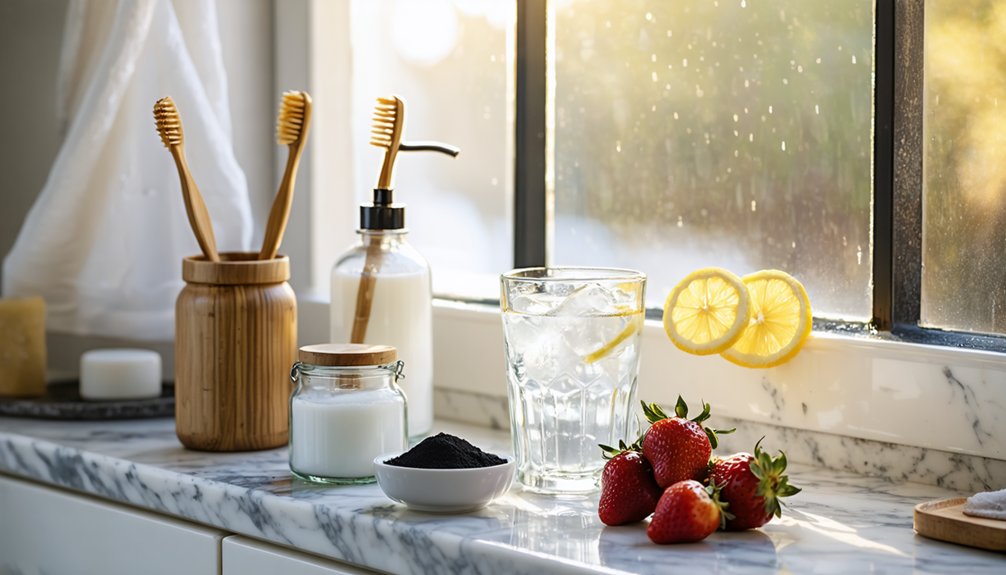
Protecting those results comes down to what you do every day. Your dietary choices and enamel health directly determine how long whitening lasts. Staining compounds bind quickly to enamel, so consistent daily discipline matters more than occasional treatment.
- Brush for two full minutes twice daily, removing plaque that traps pigment against enamel surfaces.
- Drink coffee, tea, and red wine through a straw, keeping staining liquids away from direct tooth contact.
- Limit tobacco, dark sauces, and soda, the primary dietary choices accelerating discoloration.
- Schedule regular professional cleanings, clearing surface buildup before stains embed deeper.
Each habit compounds over time. Neglecting even one area weakens your enamel health and shortens your results.
You control the outcome through what you consistently choose to do.
Frequently Asked Questions
Can Teeth Whitening Treatments Cause Long-Term Damage to Enamel?
When used correctly, you won’t cause long-term enamel erosion. However, overuse can trigger tooth sensitivity and enamel damage. Stick to recommended concentrations and frequency to protect your enamel effectively.
Is Teeth Whitening Safe for People With Dental Crowns or Veneers?
Like Cinderella’s glass slipper, whitening doesn’t fit all surfaces equally. You’ll find dental crown compatibility is limited, as restorations won’t respond to bleaching agents. Veneer whitening limitations mean you risk uneven, mismatched results across your smile.
At What Age Is Teeth Whitening Considered Safe for Teenagers?
Most dentists don’t recommend whitening until around age 14–16. Teen safety depends on enamel maturity, and age considerations matter—you should consult your dentist to confirm your teenager’s teeth are fully developed before beginning treatment.
Can Whitening Treatments Help With Teeth Stained by Medications Like Tetracycline?
Like rust stained deep into metal, tetracycline-driven medication stains penetrate enamel internally. Standard whitening treatments struggle against this tooth discoloration. You’ll likely need professional in-office bleaching for any noticeable improvement, though results remain limited and unpredictable.
Does Teeth Whitening Work Differently on Sensitive Teeth?
Yes, whitening affects sensitive teeth differently—you’ll experience heightened discomfort as peroxide penetrates exposed dentin. Avoid unproven natural remedies and DIY solutions, as they’re riskier. You should consult your dentist to select lower-concentration treatments tailored to your sensitivity level.
References
- https://www.hopkinsmedicine.org/health/treatment-tests-and-therapies/teeth-whitening
- https://www.webmd.com/oral-health/teeth-whitening
- https://www.sandiegoartofdentistry.com/blog/what-is-the-best-teeth-whitening-method/
- https://www.northeastdentalarts.com/blog/what-is-the-least-damaging-way-to-whiten-your-teeth/
- https://www.healthline.com/nutrition/whiten-teeth-naturally
- https://health.clevelandclinic.org/how-to-whiten-teeth
- https://www.healthpartners.com/blog/safe-teeth-whitening/
- https://www.aarp.org/health/conditions-treatments/teeth-whitening/
- https://www.medicalnewstoday.com/articles/322421
- https://askthedentist.com/teeth-whitening/