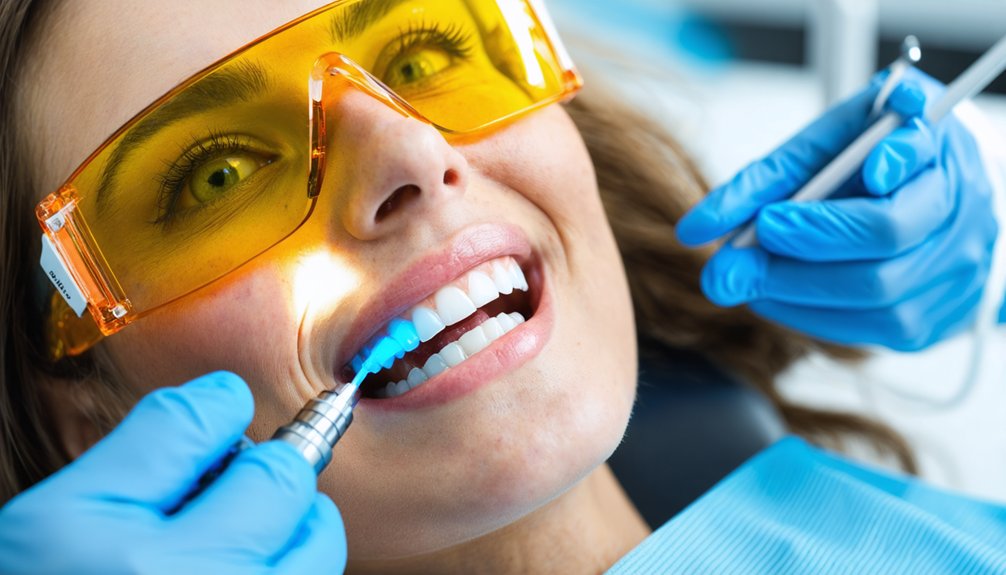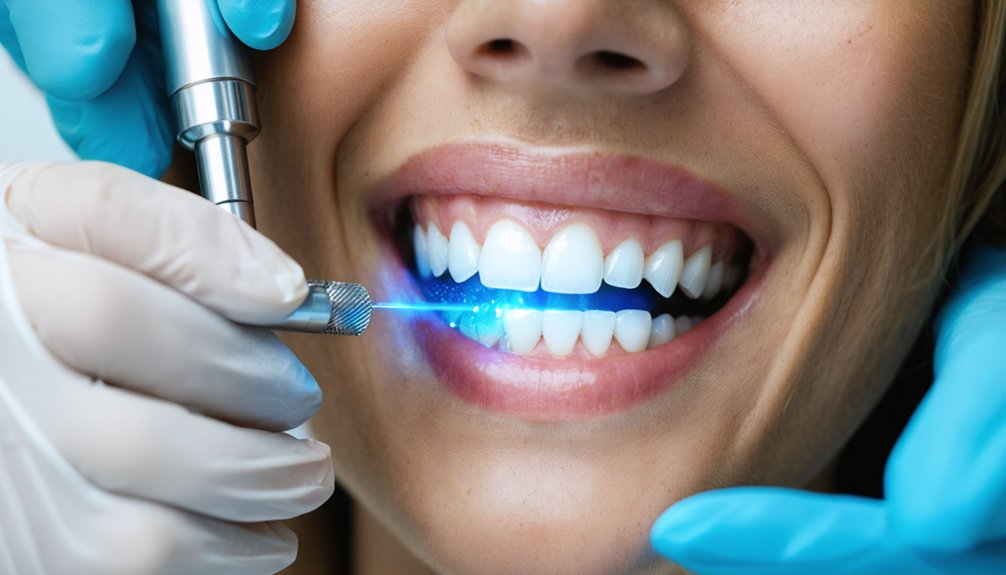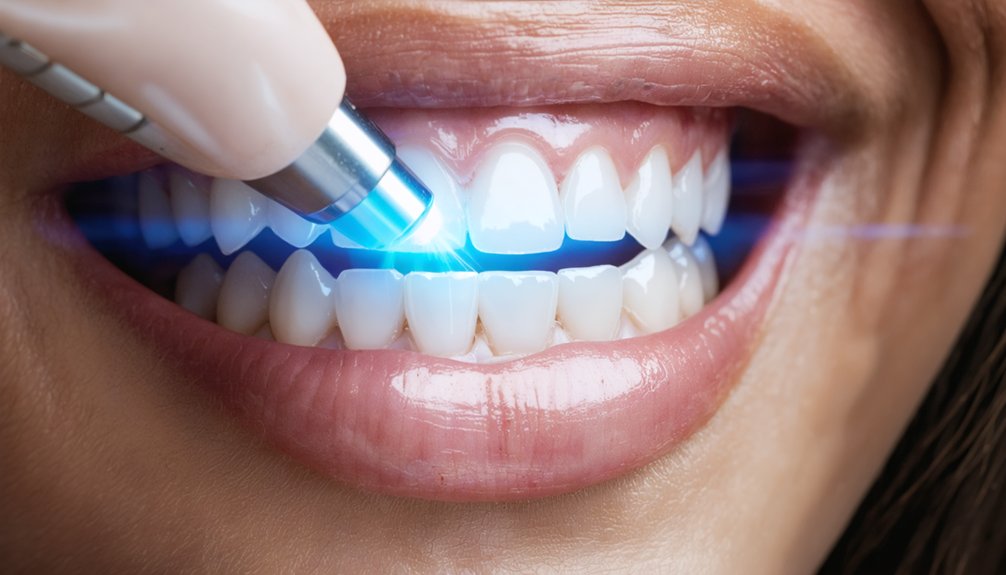
Laser teeth whitening does work — you’ll see measurable color changes, often within a single session. The laser accelerates hydrogen peroxide’s bleaching action, cutting gel contact time considerably. However, clinical evidence shows results are comparable to 14-day at-home bleaching over time. You’re fundamentally paying for speed and convenience, not a superior outcome. Your age, tooth shade, and baseline staining all influence how well it works, and there’s more to unpack.
Key Takeaways
- Laser teeth whitening accelerates hydrogen peroxide bleaching, producing measurable color changes within a single session lasting approximately 20 minutes.
- Results are comparable to at-home bleaching over time, with no significant long-term advantage from laser treatment.
- Younger patients with less intrinsic staining and hue A tooth shades achieve better whitening outcomes.
- Between 30% and 78% of patients experience sensitivity post-treatment, though it typically resolves within days.
- The premium cost of laser whitening reflects speed and convenience rather than superior or lasting results.
Does Laser Teeth Whitening Actually Work?
Laser teeth whitening does work, but perhaps not in the way most people expect. Laser activation accelerates the bleaching process by energizing hydrogen peroxide gel, producing measurable color changes.
However, clinical evidence shows that results are largely comparable to non-laser treatment protocols over time. You’ll achieve noticeable whitening, but the laser’s primary advantage is speed, not superior outcomes.
Color stability remains consistent across both laser and non-laser methods, with only slight rebound occurring around six months post-treatment.
You should also factor in sensitivity issues, as 30% to 78% of patients experience mild to moderate tooth sensitivity during treatment. This typically resolves within days.
Understanding these parameters helps you make an informed, controlled decision about which whitening approach genuinely serves your needs.
How Does Laser Whitening Compare to At-Home Bleaching?
When weighing your options, understanding how laser whitening stacks up against at-home bleaching reveals a more nuanced picture than marketing typically suggests.
Research shows that one in-office laser session with 35% hydrogen peroxide doesn’t outperform 14 days of home bleaching. Over time, lower-concentration at-home agents (10-16% carbamide peroxide) achieve comparable results to higher-concentration in-office procedures.
Your treatment preferences and cost comparison priorities matter here. In-office treatments produce ΔE values around 3.3 versus at-home’s 2.0—a measurable but modest difference.
At-home bleaching delivers similar long-term outcomes at considerably lower cost. If speed matters, laser activation reduces gel contact time considerably.
However, if you’re optimizing for value and comparable results, at-home bleaching remains a clinically supported alternative worth serious consideration.
Who Actually Gets the Best Results From Laser Whitening?
Not every patient responds equally to laser whitening—and the research identifies clear patterns in who benefits most. Your age plays a significant role: younger patients consistently achieve better outcomes, likely due to less intrinsic staining and more responsive enamel structure.
Gender, however, doesn’t affect your results.
Tooth shade also matters. If your teeth fall within hue A shades, you’ll see more dramatic improvement than patients starting with hue C or D shades.
You should also factor in sensitivity issues when evaluating your candidacy. Between 30% and 78% of patients experience mild-to-moderate sensitivity during treatment, though it typically resolves within days.
Understanding these patient demographics helps you set realistic expectations and determine whether laser whitening aligns with your specific clinical profile.
How Long Does Laser Whitening Take to Show Results?
Speed is one of laser whitening‘s most cited advantages—but the clinical picture is more nuanced than marketing suggests. You can see measurable color changes within a single session, with treatment duration typically involving 30-second laser exposures per tooth over roughly 20 minutes total.
However, research shows one in-office session doesn’t outperform 14 days of home bleaching in final results.
The whitening mechanisms activate quickly—laser energy accelerates peroxide breakdown, reducing gel contact time to as little as 10 minutes. Color change measurements stabilize within one month post-treatment, with only slight rebound appearing at six months.
Does Laser Whitening Add Enough Value to Justify the Cost?
Whether laser whitening justifies its premium price depends on what you’re actually paying for. A cost analysis of available evidence reveals that laser activation doesn’t consistently outperform standard peroxide treatments on healthy teeth.
You’re fundamentally paying more for speed and convenience, not superior results.
From a value perception standpoint, one in-office laser session can cost several times more than a 14-day home bleaching kit, yet clinical data shows comparable long-term color outcomes between both approaches.
Laser required 24% less peroxide to match standard results, but that efficiency benefit belongs to the clinician, not your wallet.
If you prioritize time over cost, laser whitening delivers faster visible changes.
If lasting results matter most, lower-concentration at-home treatments achieve equivalent outcomes at a fraction of the price.
Frequently Asked Questions
Does Laser Teeth Whitening Cause Permanent Damage to Tooth Enamel?
Laser teeth whitening doesn’t cause permanent enamel damage. You’ll experience only microstructural, reversible enamel changes at high peroxide concentrations. Enamel safety remains intact, and whitening longevity stays stable for one month, with slight color rebound at six months.
Can Laser Whitening Effectively Treat Teeth With Hue C or D Shades?
Laser whitening’s less effective on hue C and D shades for you. You’ll achieve better results combining professional treatment with home remedies, though whitening duration may be longer compared to treating more responsive hue A shades.
How Does Tooth Sensitivity During Laser Whitening Compare Across Different Age Groups?
You’ll experience more favorable outcomes when you’re younger, as age-related sensitivity varies based on dental health factors. While sensitivity affects 30-78% of patients regardless of age, it’s typically mild, resolving within days post-treatment.
Which Specific Laser Wavelength Produces the Most Consistent Whitening Results?
Despite promising advances in whitening technology, no single laser wavelength consistently outperforms others. You’ll find diode (808-841 nm), LED (450-500 nm), and argon (488 nm) lasers show variable effectiveness, regardless of treatment duration, with 35% hydrogen peroxide.
Does Demineralized Enamel Respond Differently to Laser Whitening Than Healthy Teeth?
Yes, demineralized enamel responds more favorably to laser whitening than healthy teeth. You’ll achieve greater whitening efficacy on compromised enamel, while sound teeth show comparable results to non-laser treatments, giving you less predictable improvement on healthy enamel.
References
- https://pmc.ncbi.nlm.nih.gov/articles/PMC9205357/
- https://www.loudfamilydentistry.com/blog/teeth-whitening-related-statistics-on-effectiveness-and-sensitivity-incidence
- https://pmc.ncbi.nlm.nih.gov/articles/PMC4751090/
- https://pmc.ncbi.nlm.nih.gov/articles/PMC4385673/
- https://pdfs.semanticscholar.org/2d01/d04be90f8ff2a9ea340b6abaaaf49e0779d9.pdf
- https://opendentistryjournal.com/VOLUME/10/PAGE/242/FULLTEXT/