Home teeth whitening kits use bleaching agents like hydrogen peroxide or carbamide peroxide to break down stain-causing compounds on your enamel. You’ll find five main types — trays, strips, LED kits, pens, and emulsions — each suited to different stain depths and lifestyles. Results typically appear within 10 to 20 days when you follow proper protocols. Choosing the right concentration and avoiding common application mistakes makes all the difference, and there’s much more to uncover below.
Key Takeaways
- Home whitening kits use hydrogen peroxide or carbamide peroxide to break down stains and penetrate enamel for effective whitening results.
- Choose your kit type based on stain depth: pens and strips suit surface stains, while trays target deeper discoloration.
- Most kits deliver noticeable results within 10–20 days, with strips achieving up to 18 shades lighter by day 20.
- Lower peroxide concentrations (6–10%) reduce sensitivity and gum irritation, making them safer for people with dental concerns.
- Avoid common mistakes like skipping pre-treatment brushing, inconsistent scheduling, and eating or drinking during treatment sessions.
What Home Teeth Whitening Kits Actually Do
Home teeth whitening kits work by applying bleaching agents—primarily hydrogen peroxide or carbamide peroxide—directly to the tooth surface to break down stain-causing compounds.
These agents penetrate enamel, fragmenting chromogenic molecules responsible for discoloration from coffee, tea, and wine. Understanding ingredient importance separates effective treatment from wasted effort—concentration levels dictate how deeply the bleaching agent penetrates and how markedly it alters tooth shade.
Don’t fall for effectiveness myths suggesting all kits deliver identical results. A 6% hydrogen peroxide formula performs differently than a 35% carbamide peroxide gel.
Your results depend on selecting the right active ingredient at the appropriate concentration for your specific stain type. Lower concentrations manage surface staining; higher concentrations address deeper discoloration.
Choosing correctly means you’re working with chemistry, not against it.
The 5 Types of Home Whitening Kits
Knowing how whitening agents work puts you in a better position to choose the right delivery system—because the format of a kit determines how effectively those active ingredients reach your teeth.
Understanding how whitening agents work helps you choose the delivery system that gets results.
Each format offers distinct advantages depending on your goals:
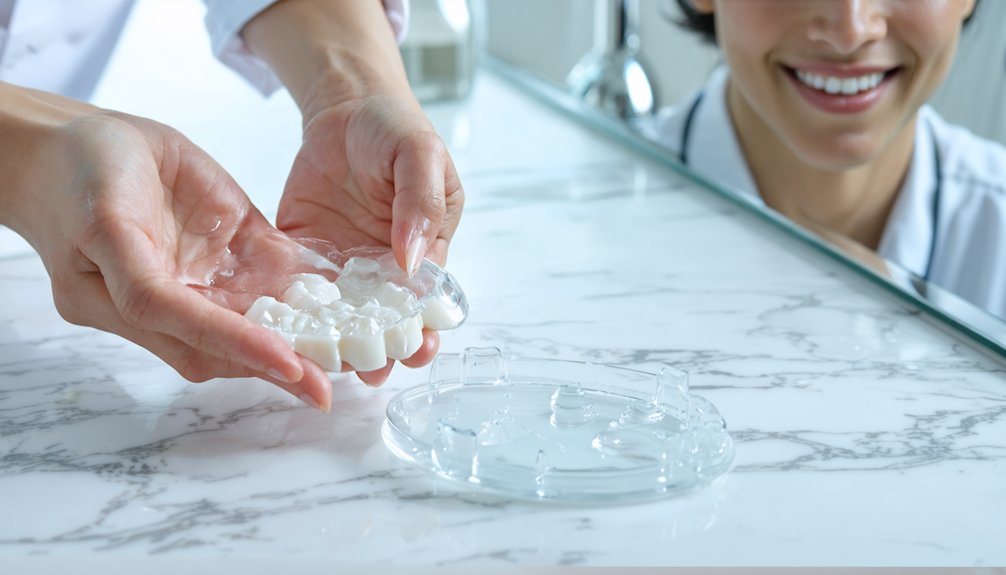
- Trays deliver tray advantages through extended gel contact, maximizing penetration for deep stains.
- Strips provide strip benefits via precise hydrogen peroxide application without requiring custom fitting.
- LED kits leverage LED effectiveness by accelerating peroxide activation through light energy.
Beyond these three, pen convenience makes targeted touch-ups practical for surface stains, while emulsion features—like leave-on gel formulas—allow passive treatment throughout daily routines.
Matching the delivery system to your stain type and lifestyle gives you precise control over your results.
Best Home Teeth Whitening Kits Right Now
With so many options on the market, choosing the right kit comes down to matching the product’s active ingredient concentration and delivery system to your specific whitening goals.
Latest trends favor LED-enhanced systems and leave-on emulsions for their convenience and speed.
Product comparisons reveal clear distinctions among top performers:
- Opalescence Go delivers 10–15% hydrogen peroxide via pre-filled trays, producing results within two weeks.
- Crest 3D Whitestrips achieve up to 18 shades in 20 days using adhesive hydrogen peroxide strips.
- Snow Advanced Wireless Kit uses 6% hydrogen peroxide with LED activation across five days.
- Auraglow provides 35% carbamide peroxide with rechargeable LED for 20 treatments.
Match concentration strength to your sensitivity level and target stain depth before committing to a specific system.
How to Pick the Right Home Whitening Kit
Selecting the right home whitening kit requires matching three core variables to your specific situation: stain depth, sensitivity level, and daily availability. These choosing criteria determine which delivery system and concentration you’ll actually commit to using.
- Stain depth: Surface stains respond to pens or strips; deep discoloration requires tray-based systems with 10–15% hydrogen peroxide or carbamide peroxide equivalents.
- Sensitivity concerns: Lower concentrations (6–10%) minimize irritation; consider gels containing potassium nitrate or fluoride for added protection.
- Daily availability: LED kits require only 8 minutes per session; trays demand 15–30 minutes.
Avoid overuse regardless of your chosen system. Higher concentrations require stricter adherence to schedules and benefit from professional supervision.
How to Use a Home Whitening Kit Step by Step
Once you’ve chosen the right kit, proper application technique determines whether you get consistent results or run into sensitivity issues.
Pre-treatment preparation is non-negotiable: brush and floss thoroughly before applying any gel or strip to guarantee direct contact between the active peroxide agent and your enamel surface.
Load trays or position strips precisely, avoiding gum overlap to minimize tissue irritation. For LED kits, activate the light immediately after inserting the mouthpiece and adhere strictly to the manufacturer’s timed sessions—typically 8 to 60 minutes depending on concentration.
Post-treatment care matters equally. Avoid staining beverages and acidic foods for at least one hour after each session.
Track your progress across the full treatment cycle—typically 5 to 20 days—to maintain consistent, measurable outcomes.
How Long Do Home Whitening Kits Take to Work?
When using a home whitening kit, you can expect to see noticeable results anywhere from one day to three weeks, depending on the product type and concentration of active ingredients.
Factors like the peroxide percentage, your baseline tooth color, and how consistently you follow the treatment schedule all influence how quickly you’ll achieve your target shade.
Strip-based kits like Crest 3D Whitestrips typically show results in 10-12 days, while LED kits like Snow Advanced can produce measurable whitening in as little as five days.
Tray-based systems generally require a full two weeks of daily use.
Expected Timeline for Results
Most home teeth whitening kits deliver noticeable results within 10 to 20 days, though the exact timeline depends on the product type, active ingredient concentration, and consistency of use.
Set accurate whitening expectations by understanding these treatment timelines:
- Strips (e.g., Crest 3D Whitestrips): Visible improvement appears within 10–12 days, with up to 18 shades of whitening achievable by day 20.
- LED kits (e.g., Snow Advanced): You’ll notice roughly one shade of improvement within one week using three 8-minute daily sessions.
- Tray-based kits (e.g., Opalescence Go): Expect measurable results within two weeks of consistent 15–30 minute daily sessions.
Skipping sessions extends your timeline.
Stick to the recommended schedule to maintain control over your outcomes.
Factors Affecting Whitening Speed
While timelines give you a useful benchmark, several variables determine whether your results arrive on schedule or fall short.
Whitening concentration directly impacts speed—higher percentages like Auraglow’s 35% carbamide peroxide accelerate stain breakdown, while lower concentrations require extended treatment cycles.
Application frequency matters equally; skipping sessions compounds delays, disrupting the cumulative bleaching process.
Your stain type also influences outcomes. Surface stains from coffee or tea respond faster than deep intrinsic discoloration, which resists standard over-the-counter formulas.
Enamel thickness and baseline tooth shade create additional variability between users.
Gel-to-tooth contact quality determines absorption efficiency. Ill-fitting trays reduce this contact, slowing results noticeably.
Control these factors deliberately—maintain consistent schedules, select appropriate concentrations, and guarantee proper fit to optimize your whitening speed.
Comparing Kit Treatment Durations
Treatment duration varies considerably across kit formats, so knowing what each system demands helps you plan realistically. Application frequency directly determines how quickly you’ll see measurable results.
- Tray-based kits (Opalescence Go): 15–30 minutes daily for 10–20 days, delivering reliable bleaching through sustained peroxide contact.
- Strip-based kits (Crest 3D Whitestrips): 60-minute daily sessions producing noticeable differences within 10–12 days and up to 18 shades by day 20.
- LED kits (Snow Advanced): Three 8-minute sessions daily for just 5 days, compressing treatment duration through higher application frequency.
Pen-based products require twice-daily use over two weeks for surface-level results.
Match your schedule to the kit’s demands before committing—consistency drives outcomes more than concentration alone.
Is Home Teeth Whitening Safe?
Home teeth whitening is generally safe when you use products correctly and choose concentrations suited to your dental health. Lower hydrogen peroxide concentrations minimize sensitivity concerns, particularly if you already experience discomfort with temperature changes.
Carbamide peroxide formulas release active agents more slowly, reducing gum and enamel irritation compared to higher-strength gels.
You’ll benefit from following professional recommendations before starting any regimen, especially if you have existing restorations, cavities, or gum disease. Custom trays from a dentist provide better fit, limiting gel contact with soft tissue.
Avoid exceeding recommended treatment durations, as overuse compromises enamel integrity. LED lights contribute minimally beyond the peroxide itself, so don’t equate intensity with safety.
Used within guidelines, at-home kits deliver effective results without significant risk.
Mistakes That Slow Down Your Results

Safety matters, but even when you’re using a kit that’s perfectly matched to your sensitivity level, avoidable missteps can undermine your progress. Common errors in application techniques consistently produce suboptimal outcomes.
Even the right kit can fail you — application errors quietly sabotage results before they begin.
- Skipping pre-treatment brushing — Plaque acts as a barrier, preventing direct gel-to-enamel contact and reducing bleaching efficacy.
- Inconsistent scheduling — Missing sessions disrupts the cumulative oxidation process. Trays and strips require consecutive daily use to sustain peroxide activity within enamel.
- Eating or drinking during treatment — Introducing substances mid-session dilutes the gel’s concentration, compromising its ability to fragment stain molecules effectively.
Controlling these variables keeps the active ingredients working at peak capacity, shortening your timeline to visible results.
Frequently Asked Questions
Can Home Whitening Kits Damage Existing Dental Work Like Crowns?
Home whitening kits won’t obliterate your crowns, but they can’t whiten them either, worsening dental discoloration mismatches. You’ll likely experience crown sensitivity. Consult your dentist before use to maintain control over your results.
Should You Whiten Teeth Before or After Getting Fillings Replaced?
You should whiten before getting fillings replaced. Whitening timeline considerations matter because composite fillings won’t respond to bleaching agents. Dental consultation importance can’t be overstated—your dentist matches filling shade to your newly whitened teeth for best results.
Can Pregnant Women Safely Use Hydrogen Peroxide Whitening Kits at Home?
Over 85% of dentists advise against it—you shouldn’t use hydrogen peroxide whitening kits during pregnancy due to serious safety concerns. Instead, explore alternative options like professional consultations or basic whitening toothpastes until after delivery.
Do Whitening Kits Expire, and Can You Still Use Them?
Yes, whitening kits expire. You’ll notice expiration signs like discolored or watery gel, indicating degraded peroxide that won’t effectively whiten. Practice safe storage in cool, dry areas to maximize shelf life and maintain ingredient potency.
Can Children or Teenagers Safely Use Home Teeth Whitening Kits?
You shouldn’t use home whitening kits on children or teenagers due to critical safety concerns. Age recommendations typically restrict use to adults 18+, as developing enamel and roots remain vulnerable to peroxide-induced sensitivity and irreversible damage.
References
- https://www.youtube.com/watch?v=qbUYI4CcW0E
- https://www.forbes.com/sites/forbes-personal-shopper/article/best-teeth-whitening-kit/
- https://www.gentledental.com/resources/articles/teeth-whitening-products
- https://www.claremontdentalgroupnh.com/how-to-use-a-home-teeth-whitening-kit-safely-and-effectively/
- https://www.webmd.com/oral-health/teeth-whitening
- https://glenburniedentalgroup.com/blog/at-home-teeth-whitening-kits/
- https://toothfairyapp.co.uk/knowledge/teeth-whitening-kit/
- https://www.dentystabirmingham.co.uk/en/home-teeth-whitening-kit/
- https://restoredentalco.com/post-op/at-home-teeth-whitening-instructions-and-maintenance/
- https://www.thedentistryblog.com/usa/teeth-whitening-kits-comprehensive-guide/