Medication stains, especially tetracycline, penetrate deep into dentin and resist standard whitening approaches. You’ll need peroxide-based treatments—hydrogen peroxide or carbamide peroxide are the only TGA-approved agents—but stain color matters: yellow responds well, while blue-gray resists bleaching considerably. Over-the-counter strips like Crest Whitestrips work for mild cases, but stubborn antibiotic stains often require professional-strength concentrations or serums used over several months. The right product choice depends on factors worth understanding more closely.
Key Takeaways
- Tetracycline stains penetrate deep into dentin, making them highly resistant to standard whitening products and often requiring professional treatment.
- Only hydrogen peroxide and carbamide peroxide are approved whitening agents; 10–15% carbamide peroxide is recommended for initial treatment.
- Yellowish stains respond best to whitening, while gray or blue-gray tetracycline stains are the most resistant to bleaching.
- Whitening serums like Colgate Optic White Overnight Serum can reverse up to 15 years of stains within one week.
- Combining professional in-office whitening with home serum therapy, plus maintenance every six months, delivers the best long-term results.
Why Medication Stains Are Harder to Whiten
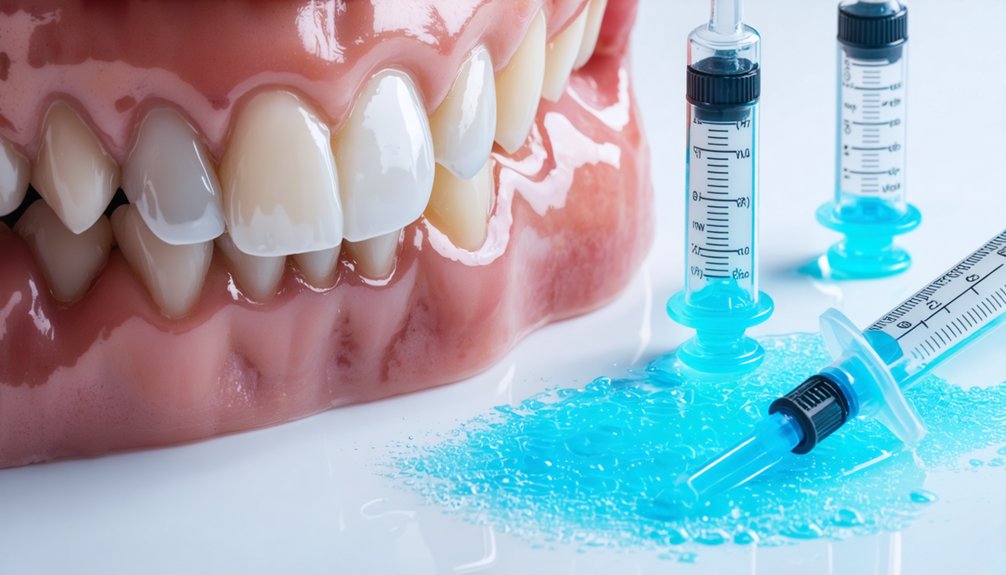
Medication stains penetrate deeper into the tooth structure than surface stains from food or drink, making them considerably harder to treat. Understanding medication stain causes helps you set realistic expectations.
Medication stains sink deeper into tooth structure than surface stains, making them far more stubborn to treat effectively.
Tetracycline, for example, binds directly to calcium within the dentin, producing discoloration that no surface treatment can easily reach.
Discoloration patterns also determine your treatment outcome. Yellowish stains respond well to peroxide-based whitening, while blue-gray stains may require six months of consistent home treatment.
Grayish or purple-toned teeth often don’t respond to bleaching at all. Brownish stains fall somewhere in between, yielding less predictable results.
If your staining runs deep, over-the-counter products alone may not be sufficient. Professional in-office intervention might be your most effective path forward.
Which Stain Colors Actually Respond to Whitening?
When it comes to medication-induced discoloration, stain color is one of the strongest predictors of whitening success. Yellowish teeth respond well to bleaching, making them the most treatable through conventional peroxide-based protocols.
Brownish discoloration yields moderate results, while grayish or purple-hued teeth may show little to no response to whitening agents.
Tetracycline-induced blue-gray staining presents the greatest challenge, often requiring six months of consistent home treatment.
Natural remedies and dietary influences, such as reducing stain-causing foods, can support outcomes but won’t replace clinical-grade intervention for deeper stains.
Understanding your stain’s specific hue helps you set realistic expectations and select targeted solutions.
If your discoloration falls into resistant categories, professional in-office treatment significantly improves your chances of achieving measurable results.
When You Need Professional Help for Antibiotic Stains
Some antibiotic stains fall well outside what any over-the-counter product can realistically address. If your teeth display blue-gray or deep gray discoloration from tetracycline, you’ll likely need professional in-office treatment rather than alternative home remedies or natural whitening options, which lack the concentration and clinical precision required for intrinsic stains this severe.
Professional bleaching protocols use higher peroxide concentrations under controlled conditions, markedly improving outcomes where consumer-grade products fail.
For stubborn antibiotic staining, your dentist may recommend extended treatment spanning several months.
In cases where bleaching doesn’t produce adequate results, veneers or bonding become viable clinical alternatives.
Recognize that pursuing ineffective remedies delays appropriate intervention. If surface-level treatments haven’t produced measurable results within four to six weeks, consult a dental professional immediately.
Hydrogen Peroxide vs. Carbamide Peroxide for Medication Stains
When choosing a whitening product for medication stains, you’ll need to understand the difference between hydrogen peroxide (HP) and carbamide peroxide (CP), the only two TGA-approved agents for safe teeth whitening.
Over-the-counter products typically contain 10% to 20% carbamide peroxide, which is equivalent in strength to approximately 3% hydrogen peroxide.
For initial treatment, you should start with middle-range peroxide levels of 10–15% to balance efficacy against the risk of sensitivity and enamel damage.
Approved Whitening Agents Compared
Only two agents carry TGA approval for safe teeth whitening: hydrogen peroxide (HP) and carbamide peroxide (CP). Unlike natural remedies, these compounds have measurable, evidence-based results. Dietary impacts from staining foods compound medication discoloration, making agent selection critical.
- HP acts faster, penetrating enamel directly to break down deep pigment bonds.
- CP (10–22%) releases HP slowly, equating to roughly 3% HP strength, making it gentler for sensitive users.
- Mid-range concentrations of 10–15% CP are recommended initially to balance efficacy with enamel safety.
You should match the agent to your stain type. Yellowish medication stains respond well to both.
Grayish or blue-gray tetracycline stains demand prolonged treatment, often requiring professional oversight beyond standard over-the-counter options.
Peroxide Levels and Efficacy
Choosing the right peroxide concentration directly affects how well a whitening product clears medication-related discoloration. Over-the-counter options typically contain 10%–20% carbamide peroxide, equivalent to roughly 3% hydrogen peroxide in active strength.
For initial use, you’ll want to start at the 10%–15% carbamide peroxide range to balance efficacy with enamel safety. Higher concentrations accelerate results but increase sensitivity risk.
Unlike alternative natural remedies, peroxide-based agents are TGA-approved and clinically validated for deeper stain penetration. Hydrogen peroxide acts faster, while carbamide peroxide releases more slowly, making it better suited for overnight applications.
For long-term whitening effects on medication stains, consistent use across 20 days shows two to four shades of measurable improvement, with maintenance top-ups recommended every six months.
What Peroxide Strength Is Safe for Sensitive Teeth?
If you have sensitive teeth, keeping hydrogen peroxide in whitening toothpaste under 3% is essential to avoid irritation and enamel erosion.
Middle-range peroxide levels between 10–15% carbamide peroxide are recommended for initial whitening treatments, balancing safety with efficacy.
Your dietary habits and oral hygiene routine directly influence how your enamel responds to peroxide exposure.
Key safety benchmarks to control your whitening approach:
- Stay under 3% hydrogen peroxide in daily-use toothpastes to prevent sensitivity and structural enamel damage
- Choose products with potassium nitrate, fluoride, or nano-hydroxyapatite to actively protect and soothe nerve endings
- Avoid charcoal-based products entirely if sensitivity is present, as excessive abrasivity compounds enamel vulnerability
Following these thresholds lets you whiten effectively without compromising long-term dental integrity.
Top Whitening Strips for Medication Discoloration
When choosing whitening strips for medication-induced discoloration, you’ll find strong clinical evidence behind two leading options.
Zimba strips delivered visible results in 100% of testers, lightening teeth by 2.7 shades within two weeks.
Crest 3D Whitestrips, formulated with 3% hydrogen peroxide, can remove up to 10 years of yellow staining over a four-week treatment course.
Zimba Strips Proven Results
Zimba whitening strips have earned strong clinical credibility, with 100% of testers reporting visibly whiter teeth after just two weeks of use, averaging a 2.7-shade improvement.
For medication stain prevention, these strips offer a measurable, controlled approach without requiring cosmetic dentistry intervention.
Key performance indicators you should know:
- Consistent results: Every tester achieved visible whitening, eliminating guesswork from your treatment plan
- Quantifiable improvement: A 2.7-shade average gives you a realistic benchmark to track your own progress
- Two-week timeline: Short treatment cycles let you assess effectiveness before committing to extended use
If you’re managing drug-induced discoloration, Zimba strips provide evidence-backed results within a defined timeframe.
You’re not relying on anecdotal claims—you’re working with verified outcome data to make informed whitening decisions.
Crest Whitestrips Stain Removal
Crest 3D Whitestrips with 3% hydrogen peroxide can remove up to 10 years of yellow stains within four weeks, making them a clinically relevant option for medication-related discoloration. Unlike natural remedies, this concentration penetrates enamel effectively, targeting yellowish medication stains that respond well to peroxide-based treatment.
You’ll apply strips for 15 consecutive minutes daily over seven days, allowing the active agent to break down embedded discoloration systematically. Brownish or grayish stains respond less predictably, so you should assess your stain’s hue before committing to this protocol.
Integrating consistent lifestyle habits — avoiding stain-causing foods and beverages during treatment — maximizes your results. Lab evaluations confirm daily use over 20 days achieves two to four shades of lightening, giving you measurable, controlled outcomes.
Best Whitening Serums for Stubborn Antibiotic Stains
Antibiotic stains—particularly tetracycline-induced blue-gray discoloration—are among the most resistant to standard whitening treatments, often requiring six months of consistent home therapy. Unlike yellowish stains that respond predictably, blue-gray and grayish-purple tones may not respond to bleaching at all.
Tetracycline stains are among the most stubborn—blue-gray discoloration may not respond to bleaching at all.
Whitening serums containing clinically approved hydrogen peroxide or carbamide peroxide give you targeted, evidence-backed control over stubborn discoloration.
Key considerations when selecting a serum:
- Colgate Optic White Overnight Serum reverses up to 15 years of stains within one week of nightly use
- Crest 3D White Daily Whitening Serum delivers nearly three shades of improvement within two weeks
- Natural remedies and lifestyle habits alone won’t penetrate antibiotic-induced intrinsic staining—peroxide-based serums are clinically necessary
For deep antibiotic stains, professional in-office treatment alongside home serum protocols produces the strongest outcomes.
How Whitening Toothpaste Tackles Medication-Related Yellowing
While whitening serums address deeper intrinsic staining, whitening toothpastes work through three distinct mechanisms to combat medication-related yellowing: abrasive particles like hydrated silica scrub surface deposits, hydrogen peroxide penetrates enamel to break down subsurface stains, and blue covarine deposits optical-brightening particles that produce an immediate whitening effect.
You’ll typically see noticeable results within two to four weeks of consistent use, though heavy medication staining may require six to eight weeks. Unlike natural remedies, clinically formulated toothpastes deliver measurable, evidence-backed outcomes.
Dietary considerations also matter—avoiding stain-causing foods and beverages accelerates results. Keep hydrogen peroxide concentration under 3% to minimize sensitivity, and verify the RDA rating stays below 150 to protect enamel integrity during daily application.
Enamel-Safe Ingredients to Look for in Whitening Products
Protecting enamel during whitening treatment requires selecting products with clinically validated ingredients. Unlike natural remedies or unverified dietary influences, evidence-backed compounds deliver measurable protection alongside whitening action.
Prioritize products containing:
- Potassium nitrate — desensitizes nerve pathways, reducing post-treatment sensitivity
- Nano-hydroxyapatite or fluoride — remineralizes enamel microstructure compromised by peroxide exposure
- Hydrogen peroxide under 3% — maintains whitening efficacy without triggering erosion or sensitivity
You should also confirm your toothpaste carries an RDA rating under 150, ensuring abrasive particles don’t degrade enamel over daily use.
Avoid charcoal-based formulas entirely — their abrasive profile outweighs any perceived benefit.
Selecting ingredients strategically puts you in direct control of both your whitening outcomes and long-term enamel integrity.
How Often to Top Up Whitening After Medication Stain Treatment
Once you’ve completed an initial medication stain treatment, maintaining results requires a structured top-up schedule. Medication-induced stains, particularly from tetracycline, are prone to gradual rebound, making consistent maintenance routines non-negotiable.
Medication stains don’t stay gone on their own — consistent maintenance is what makes results last.
Evidence supports using a top-up syringe approximately every six months to sustain your initial whitening outcome. Your top-up frequency may need adjustment depending on stain severity, dietary habits, and the original stain colour.
Yellowish stains typically hold results longer, while blue-gray or brownish stains may require more frequent intervention.
Between top-ups, use whitening toothpaste once or twice weekly rather than daily, pairing it with fluoride or nano-hydroxyapatite toothpaste on alternate days to protect enamel.
Structured maintenance directly determines how long your treatment investment lasts.
Frequently Asked Questions
Can Medication Stains Return After Successful Whitening Treatment Is Completed?
Like a shadow that returns at dusk, medication stain recurrence is real. You’ll need maintenance every six months to sustain whitening longevity, as active ingredients fade and deeper pigments resurface without consistent upkeep.
Are Whitening Products Safe to Use While Still Taking Staining Medications?
You can use whitening products while taking staining medications, but results may be limited. Forget home remedies or natural solutions—stick to hydrogen peroxide-based treatments, though ongoing medication exposure’ll continuously re-stain, reducing long-term efficacy.
How Does Age Affect the Success of Whitening Medication-Stained Teeth?
Imagine a 60-year-old struggling with tetracycline stains—age-related enamel changes reduce whitening success. Your older enamel’s increased medication absorption effects mean stains penetrate deeper, requiring longer treatment and professional intervention for meaningful results.
Can Children Use Whitening Products for Medication-Induced Tooth Discoloration?
You shouldn’t use whitening products on children due to child safety concerns and heightened tooth sensitivity risks. Developing enamel’s vulnerable, and peroxide agents can cause irreversible harm—consult a pediatric dentist for safe, age-appropriate interventions instead.
Does Dental Insurance Ever Cover Whitening Treatments Caused by Prescribed Medications?
Wondering if you’re covered? Insurance coverage rarely includes whitening, even for medication effects. You’ll typically need to advocate for yourself, presenting documented proof that prescribed medications directly caused your discoloration to maximize any reimbursement chances.
References
- https://www.goodhousekeeping.com/health-products/g28723133/best-at-home-teeth-whitening-products/
- https://www.colgate.com/en-sa/oral-health/teeth-whitening/teeth-stain-removal-types
- https://www.healthline.com/health/dental-and-oral-health/best-teeth-whitening
- https://elementdental.com.au/teeth-whitening-aftercare/
- https://www.businessinsider.com/guides/health/best-whitening-toothpaste
- https://www.today.com/shop/best-teeth-whitening-products-rcna214595
- https://www.kirklanddentalexcellence.com/blog/health/best-toothpaste-for-teeth-whitening/
- https://www.webmd.com/oral-health/teeth-whitening