If you’re dealing with genetic enamel discoloration, standard whitening strips won’t cut it. Your best options range from in-office bleaching and professional microabrasion to custom take-home trays, depending on how deep the discoloration runs. Severe cases often require porcelain veneers or crowns when conservative methods fall short. Understanding which approach matches your specific condition is critical to avoiding wasted treatment and further enamel compromise—and each method has distinct thresholds worth knowing before you commit.
Key Takeaways
- In-office bleaching uses high-concentration peroxide for deeper penetration, typically improving discoloration by 3–8 shades depending on enamel integrity.
- Over-the-counter whitening products cannot reach intrinsic discoloration sources, making them largely ineffective for genetic enamel conditions.
- Microabrasion removes compromised outer enamel, increasing porosity and enhancing effectiveness when combined with subsequent bleaching treatments.
- Sequential microabrasion followed by bleaching targets stubborn developmental stains, with fluoride application afterward to strengthen the treated enamel surface.
- When bleaching and microabrasion prove insufficient, porcelain veneers or crowns provide definitive aesthetic correction for genetically driven discoloration.
Genetic Enamel Discoloration and the Limits of Standard Whitening
When enamel discoloration stems from a genetic condition like amelogenesis imperfecta or dentinogenesis imperfecta, standard whitening treatments often fall short. These conditions produce intrinsic discoloration, meaning the color change originates within the enamel or dentin rather than on the surface. Because of this, over-the-counter products can’t reach the source.
Genetic factors directly influence how your teeth respond to bleaching. Enamel thickness, dentin shade, and discoloration severity all determine whether whitening produces meaningful results.
In moderate cases with intact tooth structure, professional bleaching may improve shade by three to eight levels. In severe cases, it won’t fully correct the problem.
Understanding these limitations helps you make informed treatment decisions. Whitening may still play a role, but it’s rarely the complete solution for genetically driven discoloration.
In-Office Bleaching as the Starting Point for Genetic Stains
When genetic staining is intrinsic, in-office bleaching gives you the strongest starting point because high-concentration hydrogen or carbamide peroxide penetrates deeper than any over-the-counter product can.
Under dental supervision, you can gain roughly 3 to 8 shades depending on enamel thickness and defect severity.
However, if your enamel structure is markedly compromised by conditions like amelogenesis imperfecta, bleaching alone won’t fully correct the discoloration, and you’ll likely need additional interventions.
Why In-Office Works
For genetic enamel stains, in-office bleaching stands as the strongest first-line intervention because it delivers high-concentration hydrogen or carbamide peroxide directly to compromised enamel under clinical supervision. Your dentist controls every variable — concentration, application time, and tissue protection — giving you measurable outcomes that OTC products can’t match.
Genetic discoloration often involves altered enamel permeability, meaning the bleaching agent must penetrate irregular or hypomineralized structure to reach the intrinsic stain. Higher-concentration agents accomplish this more effectively than consumer-grade formulas.
Sensitivity management is built into the clinical protocol. Your provider monitors tissue response and adjusts treatment intervals accordingly, reducing the risk of pulpal irritation. This supervised precision is what separates in-office bleaching from less controlled whitening methods when structural defects are involved.
Shades Gained From Bleaching
Knowing that in-office bleaching controls concentration and application time sets up a practical question: how much shade improvement can you actually expect?
In documented cases of genetic discoloration, professional bleaching can deliver roughly 3 to 8 shades of improvement. However, genetic factors directly influence where your result lands within that range.
If your enamel resilience is compromised by developmental defects like amelogenesis imperfecta, the bleaching agent penetrates unevenly, limiting your outcome.
Teeth with moderate discoloration and structurally sound enamel respond better than severely affected ones.
You shouldn’t expect full correction from bleaching alone when the stain originates deep within dentin.
Treat this shade range as a realistic ceiling, not a guarantee, and use it to plan whether restorative options need to follow.
When Results Stay Limited
Even when in-office bleaching delivers measurable shade improvement, genetic discoloration often resists full correction because the stain originates within dentin rather than on the enamel surface. Conditions like amelogenesis imperfecta or dentinogenesis imperfecta can limit how far bleaching agents penetrate, leaving residual discoloration despite multiple sessions.
You’ll notice that enamel thickness, defect severity, and dentin shade all directly influence your final outcome.
When bleaching reaches its ceiling, patient satisfaction depends on your willingness to pursue alternative cosmetic options. Porcelain veneers mask persistent intrinsic color effectively, while crowns address teeth that are both discolored and structurally compromised.
Recognizing these limits early lets you set realistic expectations, avoid unnecessary treatment cycles, and move deliberately toward restorative solutions that deliver the cosmetic control bleaching alone can’t provide.
Microabrasion for Genetic Discoloration Confined to Surface Enamel
When genetic discoloration stays confined to the outer enamel layer, microabrasion offers a conservative, noninvasive solution that doesn’t require bleaching or restorative intervention.
By mechanically removing a thin portion of the surface layer, your dentist can permanently eliminate superficial stains caused by enamel hypoplasia or mild developmental defects.
The procedure combines a mild acid with an abrasive compound, targeting only the affected enamel without disturbing deeper tooth structure.
You’ll see results immediately, and minimal enamel sacrifice makes it one of the most controlled options available for surface-limited discoloration.
If superficial stains persist after microabrasion, your dentist may follow up with bleaching to refine the outcome.
For cases where discoloration extends beyond the surface layer, microabrasion alone won’t suffice, and adjunctive treatment becomes necessary.
Custom Take-Home Trays for Maintaining Whitening Progress
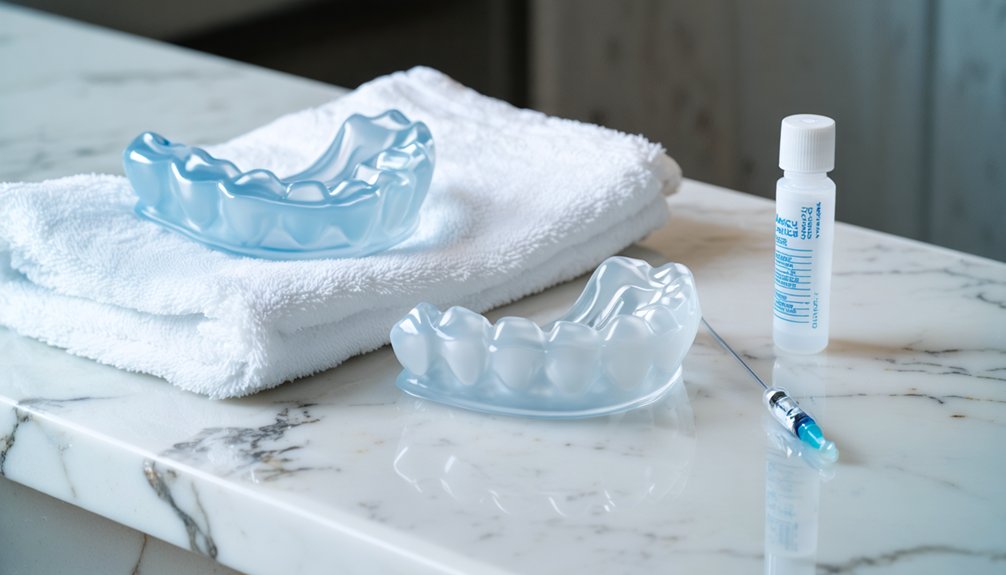
Custom take-home trays help you preserve and build on whitening gains achieved through in-office bleaching, making them a practical follow-up step in managing genetic enamel discoloration. Your dentist fits you with custom trays and prescribes carbamide peroxide gel at an appropriate concentration for your enamel’s condition and sensitivity threshold.
You’ll apply the trays on a schedule your dentist determines, typically nightly or every other night. Consistent oral hygiene reinforces results by minimizing surface buildup that can mask whitening progress.
Dietary influences also matter—limiting chromogenic foods and beverages reduces extrinsic staining that compounds intrinsic discoloration.
Understand that take-home trays produce slower, more incremental improvement than in-office treatment. For genetically driven discoloration, they’re best used as a maintenance tool rather than a standalone correction method.
Combining Microabrasion and Bleaching for Resistant Genetic Stains
Combining microabrasion with bleaching gives you a sequenced, two-phase approach when a single method fails to resolve resistant genetic staining. Microabrasion removes the outermost compromised enamel layer first, reducing surface irregularities that trap pigment and increasing enamel porosity in a controlled way.
Microabrasion clears the way first — removing compromised enamel so bleaching can tackle the staining underneath.
That improved porosity allows the subsequent bleaching agent to achieve deeper stain penetration, targeting discoloration that surface-only treatment can’t reach. Your dentist typically applies a microabrasive slurry, confirms adequate enamel reduction, then follows with either in-office or custom tray bleaching.
This sequenced protocol is documented for stubborn hypomineralized and developmentally discolored enamel. Fluoride application after microabrasion strengthens the treated surface before bleaching begins.
If combined results remain insufficient, your clinician can then escalate to veneer or crown-based masking.
When Veneers or Crowns Are the Right Fix for Genetic Enamel Defects
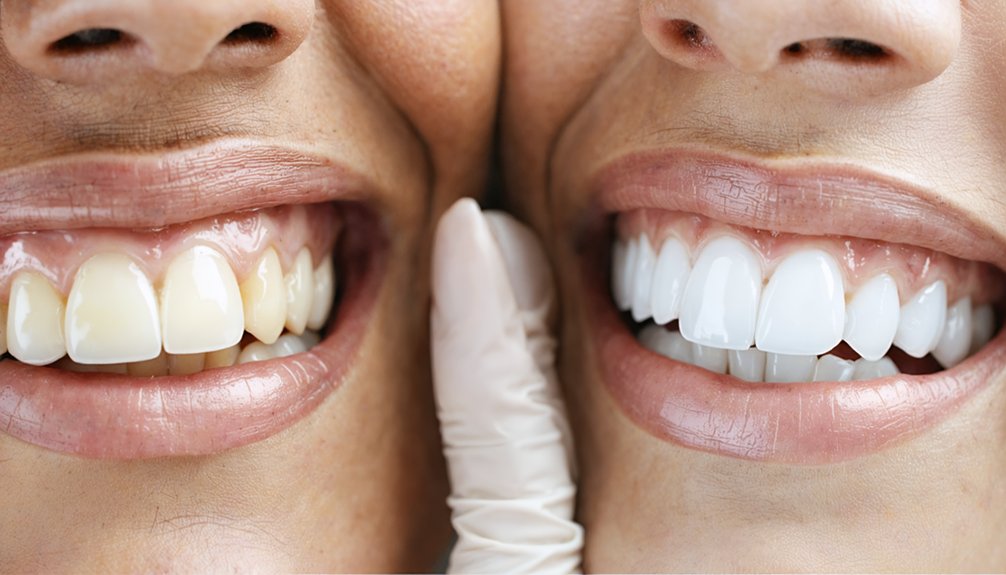
If bleaching and microabrasion have delivered limited correction, veneers or crowns become the clinically appropriate next step for managing genetic enamel defects.
Porcelain veneers serve as a primary alternative restoration when intrinsic discoloration persists despite conservative whitening protocols. They provide durable aesthetic integration by masking underlying dentin shade and structural irregularities without compromising surrounding tooth structure unnecessarily.
In conditions like amelogenesis imperfecta, veneers offer predictable cosmetic outcomes that bleaching simply can’t achieve.
When your tooth is structurally compromised beyond cosmetic concern, a crown becomes the indicated choice, addressing both integrity and appearance simultaneously.
Your dentist will assess enamel thickness, defect severity, and occlusal load before selecting the appropriate restoration.
Understanding these thresholds helps you make informed decisions when whitening options have reached their clinical limits.
Frequently Asked Questions
How Young Can a Child Be Before Whitening Treatment Begins?
You shouldn’t begin whitening before all permanent teeth have fully erupted, typically around age 14. Pediatric dental guidelines recommend early intervention focus on monitoring, not bleaching, until enamel maturation is confirmed by your dentist.
Does Genetic Enamel Discoloration Worsen With Age Over Time?
Genetic factors don’t typically worsen your discoloration over time, but your enamel strength can decline with age, wear, and acid exposure, making existing intrinsic staining appear more pronounced and reducing your whitening treatment outcomes.
Are Whitening Treatments Covered by Dental Insurance for Genetic Conditions?
Most dental insurance plans don’t cover whitening treatments, even for genetic conditions. You’ll typically find that insurance coverage classifies these procedures as cosmetic, so you’d need to explore out-of-pocket payment options directly with your provider.
Can Diet or Lifestyle Changes Help Slow Genetic Enamel Discoloration?
Diet modifications and lifestyle adjustments won’t reverse genetic enamel discoloration, but they can slow progression. You’ll reduce staining by avoiding pigmented foods, limiting acidic beverages, quitting tobacco, and maintaining consistent professional oral hygiene protocols.
How Long Do Whitening Results Typically Last for Genetic Discoloration?
“Nothing lasts forever”—your whitening durability for genetic discoloration typically ranges six to twelve months. You’ll need periodic touch-ups, and dental sensitivity may limit treatment frequency, so you must maintain consistent professional oversight to sustain results effectively.
References
- https://clubwhitesmile.com/genetic-tooth-discoloration-whitening/
- https://www.ada.org/resources/ada-library/oral-health-topics/whitening
- https://pmc.ncbi.nlm.nih.gov/articles/PMC9790475/
- https://scienceofbiogenetics.com/articles/how-to-whiten-yellow-teeth-caused-by-genetic-factors
- https://www.rcseng.ac.uk/dental-faculties/fds/publications-guidelines/clinical-guidelines/-/media/cdd564e8285641f18634e6d028e3d722.ashx
- https://pmc.ncbi.nlm.nih.gov/articles/PMC3220157/
- https://www.iajps.com/wp-content/uploads/2022/01/12.IAJPS12012022.pdf
- https://pubmed.ncbi.nlm.nih.gov/17966931/
- https://www.aapd.org/globalassets/media/publications/archives/wright3-02.pdf
- https://snuggymom.com/can-genetic-yellow-teeth-be-whitened/