Genetic tooth staining originates within your tooth’s structure, making surface-level whitening largely ineffective. Conditions like amelogenesis imperfecta and dentinogenesis imperfecta alter enamel and dentin at a molecular level, blocking peroxide penetration. Your best solutions range from professional bleaching for mild cases to dental bonding, porcelain veneers, or crowns for moderate to severe discoloration. The right choice depends on your staining depth, structural integrity, and budget—and there’s much more to evaluate before making your decision.
Key Takeaways
- Genetic tooth staining originates within the tooth structure, making standard surface whitening treatments largely ineffective for complete correction.
- Professional bleaching works best for mild cases, offering a minimally invasive, cost-effective first-line treatment option.
- Dental bonding masks moderate intrinsic stains using composite resin when bleaching alone proves insufficient.
- Porcelain veneers effectively cover severe structural discoloration from conditions like amelogenesis or dentinogenesis imperfecta without chemically altering enamel.
- Crowns provide the most comprehensive solution when extensive structural damage accompanies deep genetic staining.
What Causes Genetic Tooth Staining
Genetic tooth staining stems from inherited conditions that disrupt how your enamel or dentin develops, making it fundamentally different from everyday surface discoloration. When genetic factors interfere with normal tooth formation, the resulting discoloration is embedded within the tooth’s structure itself—not sitting on its surface.
Two primary conditions drive this: amelogenesis imperfecta, which compromises enamel genetics and produces weak, discolored enamel, and dentinogenesis imperfecta, which affects dentin development and creates a blue-gray or amber appearance. Because the defect originates during tooth formation, standard bleaching agents can’t fully correct it—the abnormal tissue simply doesn’t respond the same way healthy enamel does.
Understanding this distinction is essential before pursuing treatment, since the underlying cause directly determines which solutions will actually deliver results you can control.
Why Whitening Alone Rarely Works on Inherited Discoloration
When your tooth discoloration stems from a genetic condition like dentinogenesis imperfecta or amelogenesis imperfecta, the problem lives within the tooth’s structure itself, not on its surface.
Hydrogen peroxide and carbamide peroxide can’t effectively penetrate or correct abnormal enamel and dentin, so bleaching agents simply don’t produce meaningful results.
You’ll find that professional whitening, while effective for many stain types, hits a clear ceiling when inherited defects are the root cause.
Structural Discoloration Resists Bleaching
Unlike surface stains that respond predictably to bleaching agents, inherited discoloration originates within the tooth’s structural foundation—making whitening alone an unreliable solution.
Genetic factors directly alter how enamel and dentin develop, producing abnormal mineralization that bleaching agents can’t effectively penetrate or correct.
When tooth pigmentation stems from conditions like dentinogenesis imperfecta or amelogenesis imperfecta, the discoloration isn’t a surface deposit—it’s embedded in compromised tissue.
Hydrogen peroxide and carbamide peroxide work by oxidizing organic molecules within normal tooth structure.
When that structure is inherently defective, the chemistry simply doesn’t yield predictable results.
You’re not dealing with a stain you can dissolve; you’re dealing with architecture that formed incorrectly.
That distinction demands a different clinical strategy entirely.
Inherited Defects Block Peroxide
Peroxide-based whitening agents depend on normal enamel and dentin structure to work—specifically, their ability to diffuse through intact mineral matrices and oxidize discoloring organic compounds. When genetic factors have disrupted normal tissue formation, that pathway fails.
Enamel genetics directly controls crystalline density, protein composition, and mineralization patterns. In conditions like amelogenesis imperfecta or dentinogenesis imperfecta, those parameters are fundamentally altered—leaving you with enamel that’s either hypomineralized, hypoplastic, or structurally incompetent for standard bleaching chemistry.
Peroxide can’t oxidize what isn’t there. The discoloration isn’t a surface deposit or an infiltrating organic stain—it’s encoded into the tissue itself. That distinction matters when you’re evaluating treatment options, because continuing to bleach structurally compromised enamel wastes time and may increase sensitivity without delivering results.
Whitening Limitations With Genetic Stains
Standard whitening protocols routinely fall short with genetic tooth staining because the discoloration isn’t a layer you can chemically lift—it’s baked into the structural composition of the tooth itself.
Genetic anomalies alter enamel and dentin at formation, making peroxide-based agents largely ineffective. Here’s why your whitening efforts stall:
- Tooth pigmentation originates within the matrix, not on the surface
- Abnormal enamel density blocks peroxide penetration
- Bleaching agents require intact, responsive hard tissue to activate
- Inherited defects produce discoloration that’s structural, not accumulative
Recognizing these limitations early redirects you toward solutions that actually work—restorative masking, bonding, or veneers—rather than repeated whitening cycles that deliver diminishing returns.
Precision in diagnosis determines whether you’re treating a surface condition or a structural one.
Which Treatment Matches Your Staining Severity and Budget
Choosing the right treatment for genetic tooth staining comes down to two practical variables: how deep your discoloration runs and how much you’re willing to invest.
Genetic inheritance directly shapes your tooth coloration at the structural level, which means surface-level solutions often fall short.
For mild cases, professional bleaching offers a cost-accessible starting point, though response varies.
Moderate staining that resists whitening responds better to dental bonding—a conservative, budget-friendly restorative option.
If your discoloration is severe or structurally embedded, porcelain veneers deliver precise, durable masking with superior aesthetic control.
Crowns remain the most comprehensive solution when structural compromise accompanies deep staining.
Match your treatment tier to your severity level, and you’ll avoid spending on approaches that your inherited enamel simply won’t respond to.
Professional Bleaching as a First-Line Option
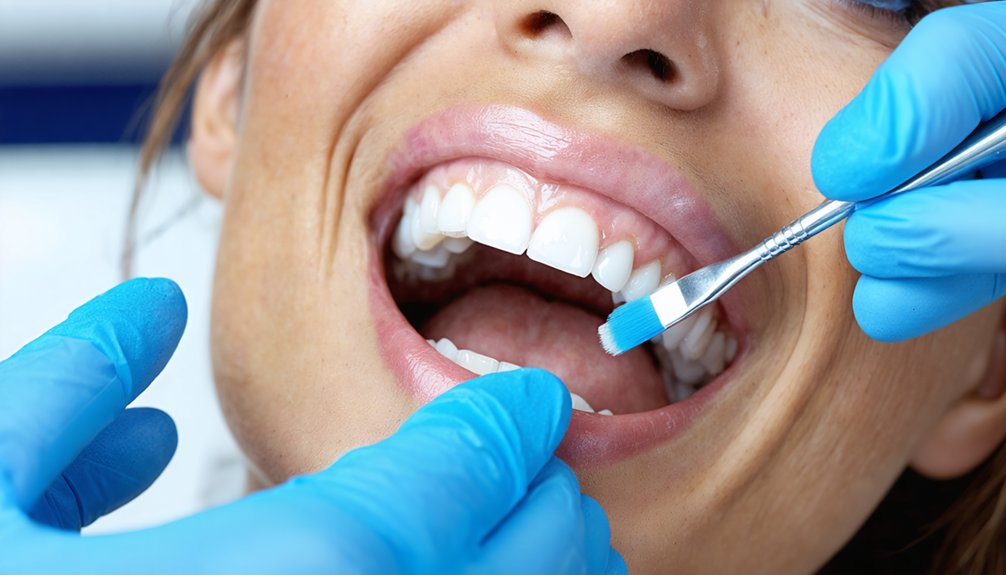
When treating genetic tooth staining, professional bleaching is the logical first step—cost-accessible, minimally invasive, and effective for cases where structural compromise is limited.
Genetic inheritance can affect how enamel responds to peroxide-based agents, so controlled clinical application gives you the strongest viable result before committing to restorative intervention.
Your dentist will assess enamel defects to determine bleaching candidacy. If eligible, expect a structured protocol:
- Shade mapping to establish your baseline discoloration depth
- In-office hydrogen peroxide application for accelerated penetration
- Custom tray fabrication for supervised at-home maintenance
- Follow-up evaluation to measure response and identify limits
If bleaching delivers incomplete correction—common with deeper enamel defects—you’ll have clear data to justify escalating to veneers or bonding with precision.
Dental Bonding for Moderate Intrinsic Staining
If professional bleaching fails to correct your intrinsic staining, dental bonding offers a conservative restorative path before committing to full veneers or crowns.
When genetic enamel defects or dentin discoloration affect your tooth’s underlying structure, composite resin can be layered directly over the compromised surface, masking discoloration while preserving maximum natural tooth structure.
Your dentist will shade-match the resin precisely to surrounding teeth, giving you aesthetic control over the final result. Bonding works best for moderate intrinsic staining where full coverage isn’t structurally necessary.
It’s faster and less invasive than porcelain alternatives, though it’s less durable for heavy discoloration cases.
You should factor in that bonding may require periodic replacement or touch-ups, making maintenance planning essential for long-term cosmetic success.
Enamel Microabrasion for Mild Genetic Discoloration
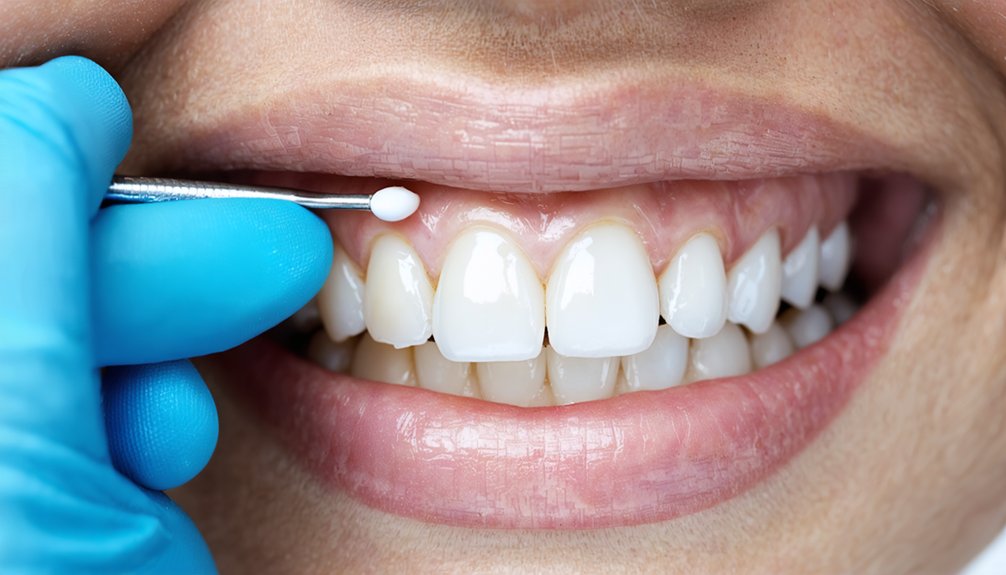
For cases where genetic discoloration is mild rather than moderate, a less invasive option than bonding may serve you better. The microabrasion technique strategically removes superficial enamel surface irregularities, revealing clearer underlying tooth structure. It’s best suited for contained, shallow discoloration rather than deep inherited defects.
Here’s what you should understand about this approach:
- It combines mild acid and abrasive agents to selectively reduce stained enamel
- It preserves more natural tooth structure than bonding or veneers
- It’s often paired with professional bleaching for enhanced results
- It’s ineffective against discoloration originating within the dentin layer
If your genetic staining is structurally deep, microabrasion won’t deliver the outcome you’re seeking—restorative masking becomes the more controlled, reliable path forward.
Porcelain Veneers for Deep Inherited Tooth Staining
When whitening fails to correct deep inherited discoloration, porcelain veneers offer a reliable masking solution by bonding a thin ceramic shell directly over the affected tooth surface.
Unlike bleaching agents, veneers don’t attempt to alter the underlying enamel or dentin—they conceal structural discoloration entirely, making them especially effective for conditions like dentinogenesis imperfecta or amelogenesis imperfecta.
Compared to bonding, veneers provide superior durability and a more precise aesthetic result, while remaining a less invasive alternative to full-coverage crowns when tooth structure is still largely intact.
Masking Deep Intrinsic Discoloration
Porcelain veneers stand out as one of the most effective solutions when genetic staining runs too deep for bleaching to correct. If your enamel inheritance has produced discoloration that no whitening agent can reach, veneers give you full cosmetic control. They work by masking rather than chemically altering compromised tooth structure.
Your veneer process typically follows this sequence:
- Your dentist evaluates stain depth and confirms bleaching won’t overcome your genetic predisposition.
- A thin enamel layer is removed to accommodate the veneer shell.
- Custom porcelain is fabricated to match your desired shade precisely.
- Veneers are bonded permanently, sealing discoloration beneath a flawless surface.
This approach delivers durable, aesthetic results where conservative treatments fail, restoring both appearance and confidence efficiently.
Veneers Versus Other Treatments
Choosing between veneers, bonding, crowns, and bleaching comes down to how deeply your genetics have affected tooth structure. When enamel inheritance has produced structural defects rather than surface discoloration, bleaching agents won’t penetrate effectively—your genetic predisposition determines what’s chemically possible.
Porcelain veneers offer the most precise aesthetic control for moderate-to-severe intrinsic staining. They mask discoloration completely while preserving more tooth structure than crowns require.
Bonding works faster and costs less, but composite resin can’t match porcelain’s durability or color stability against heavy inherited pigmentation.
Crowns become necessary when genetic staining accompanies structural compromise. If your tooth architecture remains intact, veneers deliver the superior cosmetic outcome.
Evaluate your options based on stain depth, structural integrity, and long-term maintenance expectations—not convenience alone.
Crowns as a Last Resort for Severe Structural Staining
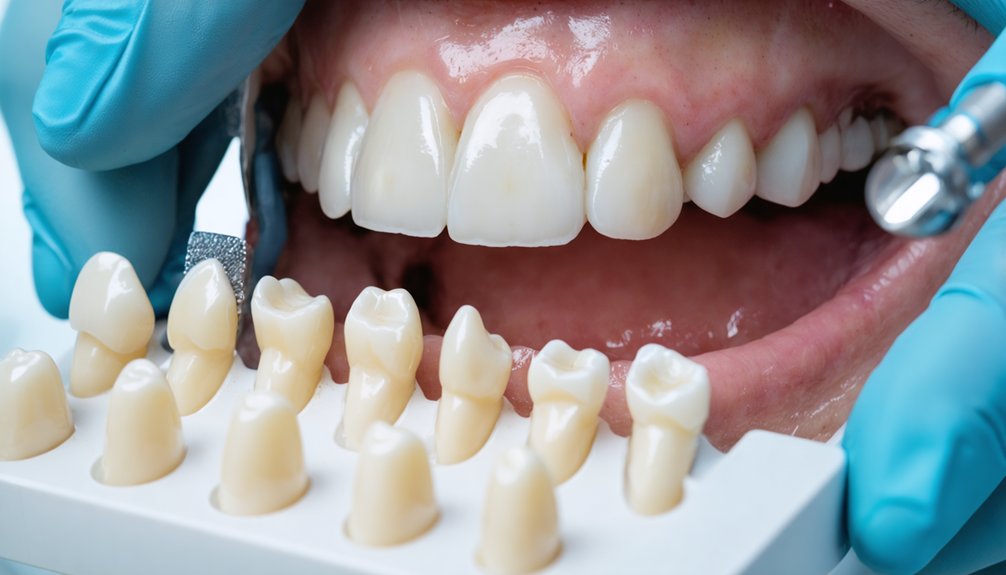
Dental crowns represent the most all-encompassing solution available for genetic staining so severe that it compromises both appearance and tooth structure. When genetic inheritance has fundamentally altered tooth color and enamel integrity, crowns give you complete control over the final aesthetic outcome.
Your dentist will recommend a crown when these conditions exist:
Your dentist will recommend a crown when specific clinical conditions make it the only viable treatment option.
- Bleaching agents have produced no measurable improvement
- Veneers can’t provide adequate coverage due to structural damage
- The tooth requires reinforcement beyond cosmetic correction
- Staining penetrates through both enamel and dentin layers
Crowns encase the entire visible tooth, eliminating discoloration entirely while restoring function. Modern porcelain or ceramic materials let you select precise shade, shape, and translucency.
Though invasive, crowns deliver the most definitive, long-lasting correction for structurally compromised, heavily stained teeth.
How to Slow Genetic Staining After Treatment
After treatment, you’ll want to limit your intake of coffee, tea, red wine, cola, and tobacco to prevent new surface stains from compounding your results.
Schedule regular professional cleanings to maintain the cosmetic outcome and catch any early discoloration before it progresses.
Daily brushing and flossing complete your maintenance routine, keeping external staining minimal even when genetic factors remain beyond your control.
Limit Staining Food Exposure
Once your treatment is complete, what you consume daily plays a direct role in how long your results last. Genetic inheritance already limits how naturally resistant your tooth color is to discoloration, so external staining compounds the problem considerably.
Take deliberate control by reducing exposure to these four primary culprits:
- Coffee and tea — both accelerate surface staining through tannin deposits
- Cola and dark sodas — acidic and chromogenic, they degrade enamel tone rapidly
- Red wine — deeply pigmented and erosive to treated surfaces
- Tobacco — produces stubborn, layered staining resistant to routine cleaning
When avoidance isn’t possible, rinse immediately with water. This simple habit limits contact time and preserves your cosmetic results between professional maintenance appointments.
Maintain Regular Dental Cleanings
Controlling what you consume reduces external buildup, but professional cleanings address what daily habits can’t fully reach. Even after restorative treatment, surface deposits accumulate over time, compromising your cosmetic results.
Scheduled cleanings remove calculus and extrinsic staining that brushing leaves behind, preserving the integrity of veneers, bonding, or bleaching outcomes. If enamel genetics have compromised your tooth structure, professional maintenance becomes even more critical — weakened enamel accumulates staining faster than healthy surfaces.
For patients who’ve pursued genetic testing to understand their inherited conditions, regular cleanings also allow your dentist to monitor structural changes and adjust your maintenance schedule accordingly.
Twice-yearly appointments represent the minimum; depending on your enamel genetics, your dentist may recommend quarterly visits to sustain your treatment investment long-term.
Daily Brushing And Flossing
Professional cleanings protect your long-term results, but what you do daily determines how quickly surface staining accumulates between appointments. Your dietary habits and home care routine directly influence how long your cosmetic investment holds.
Follow these four daily disciplines to slow staining progression:
- Brush twice daily with a whitening-compatible toothpaste to disrupt surface deposits before they bond.
- Floss once daily to eliminate stain-causing residue from interproximal zones your brush can’t reach.
- Rinse with water immediately after consuming coffee, tea, cola, or red wine.
- Limit high-pigment foods and tobacco, which accelerate discoloration on treated surfaces.
If your condition has a hereditary origin, genetic counseling can help you anticipate progression and plan maintenance timelines with greater precision.
How Long Results Last and When Staining Returns
The longevity of your results depends heavily on which treatment you’ve chosen and how deeply the genetic discoloration affects your tooth structure. When a genetic mutation alters enamel or dentin composition, bleaching results typically fade faster because the underlying tooth pigmentation remains structurally embedded.
Professional whitening may hold six months to two years with disciplined maintenance, while veneers and crowns offer decade-long masking when properly cared for. Bonding sits in between, requiring touch-ups every three to five years.
Staining returns sooner when you consume chromogenic foods frequently or skip routine professional cleanings. You maintain the most control by combining your chosen restorative solution with consistent preventive habits, reducing external stain accumulation layering over pre-existing genetic discoloration.
Frequently Asked Questions
Can Genetic Tooth Staining Affect Children and Teenagers Differently Than Adults?
Like saplings shaped by soil, yes, genetic factors affect children’s tooth enamel more intensely during development. You’ll notice discoloration emerges earlier, progresses faster, and often demands more aggressive intervention before permanent teeth fully mature.
Does Dental Insurance Typically Cover Cosmetic Treatments for Genetic Tooth Discoloration?
Most insurance coverage excludes cosmetic procedures like veneers or whitening for genetic discoloration. You’ll typically need to self-fund aesthetic solutions, though coverage may apply if structural damage is documented as medically necessary.
Are There Any Medications That Worsen Existing Genetic Tooth Staining Over Time?
Yes, certain medications can worsen your existing genetic tooth staining. Medication interactions and drug side effects—from tetracyclines, antihistamines, or antihypertensives—can deepen discoloration over time, compromising your aesthetic outcomes and reducing your control over long-term smile management.
Can Genetic Tooth Staining Be Detected or Predicted Before Visible Discoloration Appears?
Like ancient oracles of medicine, yes—you can detect genetic markers before visible changes emerge. Genetic testing enables tooth color prediction early, giving you proactive control to plan restorative strategies before discoloration visibly manifests.
Is Genetic Tooth Staining Linked to Other Inherited Health Conditions Beyond the Teeth?
Yes, genetic markers driving tooth pigmentation often link to broader inherited conditions like connective tissue disorders or skeletal dysplasias. You’ll find that syndromes affecting enamel frequently signal systemic involvement, empowering you to pursue thorough genetic evaluation proactively.
References
- https://my.clevelandclinic.org/health/symptoms/10958-tooth-discoloration
- https://pmc.ncbi.nlm.nih.gov/articles/PMC9790475/
- https://www.dentalartsofsouthjersey.com/blog/reasons-and-remedies-for-tooth-discoloration
- https://clubwhitesmile.com/top-solutions-for-genetic-tooth-stains/
- https://actascientific.com/ASDS/pdf/ASDS-02-0227.pdf
- https://www.ada.org/resources/ada-library/oral-health-topics/whitening
- https://www.interdent.com/smilekeepers/resources/5-fixes-for-stained-teeth/
- https://dentistofplanotexas.com/blog/professional-teeth-whitening-for-deep-stains/