To preserve enamel while whitening, you’ll need to prioritize controlled peroxide concentrations, avoid highly abrasive ingredients like charcoal, and skip acidic DIY methods like lemon juice that dissolve enamel’s mineral structure. Choose products carrying the ADA Seal of Acceptance, and incorporate protective agents like potassium nitrate and fluoride to buffer sensitivity. Monitoring signs of enamel compromise—like persistent sensitivity or visible translucency—helps you adjust safely. The techniques and ingredient standards ahead will sharpen your approach considerably.
Key Takeaways
- Low-concentration hydrogen peroxide whitens teeth gently without aggressively stripping enamel’s protective mineral structure when used as directed.
- Dentist-approved formulations with potassium nitrate and fluoride buffer sensitivity while reinforcing enamel resilience throughout the whitening process.
- Avoid charcoal powders and acidic DIY treatments like lemon juice, as both accelerate enamel erosion significantly.
- Choose products bearing the ADA Seal of Acceptance, confirming verified safety benchmarks and controlled abrasion standards.
- Wait 30–60 minutes after acidic foods before brushing, and use a soft-bristled brush with gentle circular motions.
Why Whitening Products Can Damage Enamel
Although whitening products can brighten your smile, they carry real risks to enamel when used incorrectly or too frequently. Overusing peroxide-based products strips the enamel’s mineral structure, triggering tooth sensitivity and progressively weakening your teeth’s outermost protective layer.
Abrasive agents found in charcoal powders physically wear down enamel surfaces, while acidic DIY methods like lemon juice accelerate erosion by demineralizing the tooth structure itself. Once enamel erodes considerably, you’re facing restorative intervention rather than simple cosmetic correction, since enamel restoration becomes necessary when natural remineralization can’t compensate for the damage.
Whitening products also can’t alter crowns, veneers, or bridges, making overuse particularly counterproductive. Understanding these mechanisms gives you the control needed to make informed decisions before beginning any whitening regimen.
What Actually Makes a Whitening Method Safe for Enamel?
When evaluating a whitening method’s safety, you should first examine its active ingredients and their concentrations, since these two factors largely determine how much stress is placed on enamel during treatment.
Dentist-approved formulations typically use controlled peroxide concentrations paired with protective agents like potassium nitrate or fluoride, which help buffer sensitivity and support enamel integrity.
You also need to review application duration and frequency, as even enamel-safe ingredients can cause erosion or irritation when exposure time or usage frequency exceeds recommended limits.
Enamel-Safe Ingredient Standards
Not every whitening ingredient treats enamel the same way, and understanding what separates safe formulations from damaging ones helps you make smarter choices.
Effective enamel preservation techniques rely on concentration control, pH balance, and exposure duration. Low-concentration hydrogen peroxide, when used as directed, whitens without aggressively stripping enamel structure.
Baking soda offers mild surface polishing without acid exposure. Products carrying the ADA Seal of Acceptance meet verified abrasivity and safety benchmarks, giving you a reliable filter when evaluating options.
Safe whitening practices also mean avoiding high-abrasion ingredients like charcoal and acidic agents like lemon juice, both of which compromise enamel integrity over time.
Potassium nitrate and fluoride additives further support enamel resilience by reducing sensitivity and reinforcing mineral density during the whitening process.
Controlled Concentration and Application
Knowing which ingredients are safe gets you halfway there—how those ingredients are applied determines whether whitening helps or harms your enamel.
Concentration effects are significant: higher-peroxide formulas accelerate results but increase sensitivity risk and enamel stress when exposure time isn’t carefully managed. Controlled application means matching concentration to your enamel’s current condition, limiting contact duration, and using properly fitted trays that prevent gel from reaching gum tissue.
Dentist-supervised protocols give you precise control over both variables—concentration and timing—reducing cumulative exposure while maintaining efficacy.
Even with lower-concentration take-home gels, you must follow recommended cycles rather than extending sessions to speed results. Overuse compounds damage gradually, making disciplined application as critical as ingredient selection.
Safety isn’t just what’s in the formula—it’s how precisely you deploy it.
Signs Your Enamel Is Too Compromised to Whiten Safely
Enamel that’s already considerably worn or thinned may not tolerate whitening agents safely, and recognizing the warning signs early can prevent further structural damage.
Tracking enamel sensitivity indicators helps you determine whether whitening frequency guidelines apply to your current dental condition or whether you need restorative intervention first.
Monitoring enamel sensitivity helps you decide if whitening is currently safe or if restoration should come first.
Watch for these compromise signals before proceeding:
- Persistent sharp sensitivity to temperature or pressure, suggesting structural thinning
- Visible translucency or chipping at tooth edges, indicating advanced enamel loss
- Chronic gum irritation or recession, which exposes dentin and increases chemical vulnerability
If you notice any of these signs, consult your dentist before attempting any whitening protocol.
Severe enamel loss typically requires restorative treatment, not further whitening.
How Professional In-Office Whitening Protects Enamel
When whitening under professional supervision, you benefit from higher-strength agents paired with targeted protective measures that over-the-counter products simply can’t replicate.
Your dentist applies gum barriers and calibrates both concentration and exposure time specifically to your enamel’s condition, reducing sensitivity risk while maximizing efficacy.
These controlled whitening techniques allow faster, more noticeable shade changes without the guesswork that often leads to overuse at home.
If your enamel is already thin or worn, your dentist tailors the protocol accordingly, prioritizing enamel preservation over speed.
Custom dosing also prevents the cumulative damage that results from unsupervised, repeated peroxide exposure.
You’re not just whitening—you’re doing it within parameters designed to protect your tooth structure, giving you measurable results without compromising long-term enamel integrity.
Custom Take-Home Trays Are Gentler Than You Think
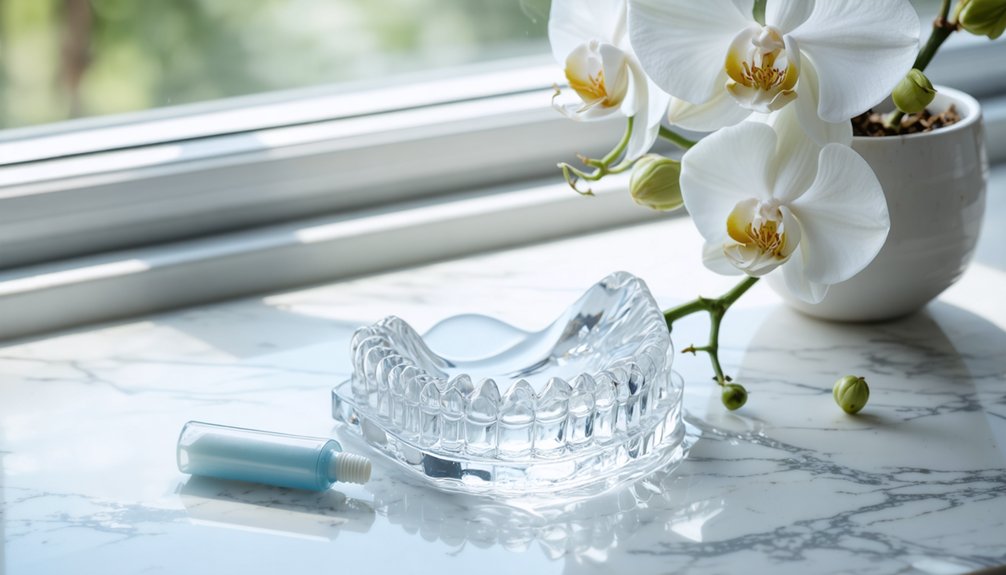
When your dentist designs a custom tray specifically for your teeth, the precise fit considerably reduces gel leakage onto your gums, ensuring that the whitening agent stays in contact with enamel rather than irritating soft tissue.
Because take-home kits use lower-concentration peroxide gels than in-office treatments, you’re able to whiten gradually over several days or weeks, which notably reduces the sensitivity that higher-strength formulas can trigger.
This controlled, incremental approach makes custom take-home trays a clinically sound option, particularly if your enamel is already thin or prone to discomfort.
Custom Trays Minimize Leakage
Custom-fitted trays offer 3 distinct advantages over generic whitening options: reduced gel leakage onto soft tissues, more even coverage across tooth surfaces, and better dose control throughout each whitening session.
These custom tray benefits directly support enamel protection by guaranteeing the whitening gel contacts teeth rather than irritating surrounding gum tissue. Leakage prevention also means you’re using the prescribed concentration efficiently, reducing unnecessary peroxide exposure.
- Precise fit eliminates gaps that allow gel migration toward gums and soft tissue
- Even gel distribution guarantees consistent contact across all tooth surfaces simultaneously
- Controlled dosing prevents overexposure by keeping whitening agents within the intended treatment zone
When leakage is minimized, you maintain greater control over treatment outcomes while greatly lowering sensitivity risks.
Gradual Whitening Reduces Sensitivity
Beyond minimizing leakage, custom take-home trays also work at a pace your enamel actually tolerates. Gradual application distributes peroxide exposure across multiple shorter sessions rather than concentrating intensity into a single treatment. This approach gives your enamel and surrounding tissue time to recover between uses, which directly supports sensitivity management.
Dentist-prescribed gels typically use lower peroxide concentrations than many over-the-counter alternatives, reducing the likelihood of nerve irritation or gum inflammation. Some formulations also include potassium nitrate or fluoride, which further buffer sensitivity while reinforcing enamel integrity.
Because you control the frequency and duration within professional guidelines, you can adjust the protocol if discomfort appears. That flexibility makes gradual whitening a technically sound strategy for maintaining enamel health while still achieving measurable shade improvement.
Whitening Toothpaste and Mouthwash That Won’t Damage Enamel
Whitening toothpaste and mouthwash are practical daily options for managing surface stains, but their safety depends largely on formulation and how you use them.
Separating whitening myths from evidence supports smarter enamel care decisions. These products target extrinsic stains only—they won’t alter intrinsic discoloration or change the color of restorations.
Key selection and usage criteria to control outcomes:
- Look for the ADA Seal of Acceptance to confirm the product meets abrasion and safety standards.
- Avoid gritty or harsh formulas—excessive abrasives gradually erode enamel with repeated use.
- Use whitening mouthwash as a complement, not a primary treatment; it delivers mild, slow stain reduction while supporting breath freshness.
Consistent, careful application maximizes benefit without compromising enamel integrity.
At-Home Whitening Ingredients That Are Gentle on Enamel
For at-home whitening, choosing ingredients with low abrasion potential and conservative application protocols helps you achieve stain reduction without compromising enamel integrity.
Baking soda benefits include mild polishing action that targets extrinsic stains without excessive mechanical wear, making it a clinically recognized option for occasional use. Low-concentration hydrogen peroxide also supports gentle whitening when applied sparingly and within recommended exposure limits.
Overuse of either agent increases sensitivity risk, so you’ll want to follow strict frequency guidelines. Oil pulling presents a non-acidic alternative that won’t chemically attack enamel, though its whitening efficacy remains limited.
Keep all home-based interventions conservative and time-controlled. If sensitivity develops or staining appears intrinsic rather than surface-level, shifting to professionally supervised protocols gives you more precise, safer outcomes.
Brushing, Flossing, and Timing Habits That Protect Enamel While Whitening
Protecting enamel during whitening depends as much on your daily habits as on the products you choose.
Brushing techniques matter—use a soft-bristled brush with gentle circular motions twice daily using fluoride toothpaste.
Soft bristles and gentle circular motions twice daily preserve enamel while keeping your whitening results on track.
Flossing frequency should be consistent; daily flossing removes plaque that traps stains and reveals early enamel wear.
Timing importance is often underestimated: wait 30–60 minutes after consuming acidic or sugary foods before brushing, as enamel softens temporarily and becomes vulnerable to abrasion.
- Brushing techniques: Soft bristles and circular strokes minimize mechanical enamel loss
- Flossing frequency: Daily flossing supports stain prevention and enamel monitoring
- Timing importance: Delayed post-meal brushing protects temporarily softened enamel
These controlled, precise habits reinforce enamel protection and optimize your whitening outcomes.
Whitening Methods That Put Enamel at Serious Risk
Not all whitening methods are created equal—some carry real risks of permanent enamel damage that no shade improvement justifies.
Charcoal powders rank among the most damaging whitening myths; their high abrasivity physically strips enamel with repeated use.
Lemon juice and similar acidic DIY treatments dissolve enamel’s mineral structure, accelerating erosion and increasing sensitivity.
Overusing peroxide-based products beyond recommended concentrations or durations compounds these risks considerably.
You should also know that whitening products don’t alter crowns, bridges, or veneers—misapplying them won’t produce results and may irritate surrounding tissue.
Enamel preservation depends on rejecting these approaches entirely.
When damage becomes severe, restorative intervention replaces whitening as the only viable option—an outcome proper method selection prevents from the start.
How to Tell When Your Enamel Needs a Break From Whitening
Knowing when to pause whitening is just as important as choosing the right method. Your enamel sends clear warning signals when whitening frequency has exceeded what it can safely tolerate. Recognizing these signs protects your long-term results and supports enamel recovery.
Knowing when to pause whitening is just as important as choosing the right method.
Watch for these indicators:
- Increased sensitivity to cold, heat, or pressure during or after whitening sessions
- Translucency at tooth edges, particularly near the tips, suggesting structural thinning
- Gum irritation or soreness that persists beyond 24 hours post-treatment
When these signs appear, stop whitening immediately and consult your dentist before resuming.
Allow adequate time for enamel recovery before reintroducing any peroxide-based product. Adjusting whitening frequency based on your enamel’s response keeps you in control of both safety and outcomes.
Frequently Asked Questions
Can Whitening Products Affect the Results of Existing Dental Restorations?
Whitening products won’t alter your crowns, bridges, or veneers. You must prioritize restoration compatibility when making your product selection, as treated teeth may lighten while restorations remain unchanged, creating visible color mismatches you’ll want to avoid.
Does Teeth Whitening Have Any Impact on Overall Gum Health Long-Term?
Studies show 78% of sensitivity cases resolve post-treatment. Whitening safety depends on proper use—overexposure irritates gums long-term. You’ll protect gum health by following dentist-supervised protocols, avoiding excessive peroxide contact, and spacing treatments appropriately.
Are There Specific Foods That Naturally Help Maintain Whitening Results Over Time?
Your dietary choices directly support natural whitening results. Crunchy vegetables like celery and apples mechanically remove surface stains, while dairy products strengthen enamel. You’ll also want to minimize coffee, tea, and red wine consumption.
How Does Age Affect the Effectiveness and Safety of Teeth Whitening Treatments?
Age doesn’t make whitening impossible—it requires smarter protocols. As you age, enamel thickness decreases and age-related sensitivity increases, so you’ll benefit most from lower-concentration gels and dentist-supervised treatments tailored to your changing dental profile.
Can Certain Medications Interfere With How Whitening Products Work on Teeth?
Yes, certain medications can affect your whitening efficacy. Tetracycline antibiotics cause intrinsic staining that resists peroxide treatments. Antihistamines and antihypertensives may trigger sensitivity. Understanding these medication interactions helps you and your dentist optimize your whitening protocol effectively.
References
- https://westoverdentalgroup.com/blog/teeth-whitening-strategies-that-wont-damage-enamel/
- https://aligner32.com/blogs/blog/teeth-whitening-and-enamel-protection-preserving-the-strength-of-your-teeth
- https://www.naplesvalleydental.com/blog/938073-the-secret-to-lifelong-teeth-whitening
- https://www.northeastdentalarts.com/blog/what-is-the-least-damaging-way-to-whiten-your-teeth/
- https://www.medicalnewstoday.com/articles/322421
- https://www.healthline.com/nutrition/whiten-teeth-naturally
- https://www.aarp.org/health/conditions-treatments/teeth-whitening/
- https://adcroundrock.com/blog/best-ways-to-whiten-without-damaging-your-enamel/
- https://arc32.com/best-practices-to-preserve-your-teeth-natural-white/
- https://www.jeffreyburns.com/safe-teeth-whitening-options/