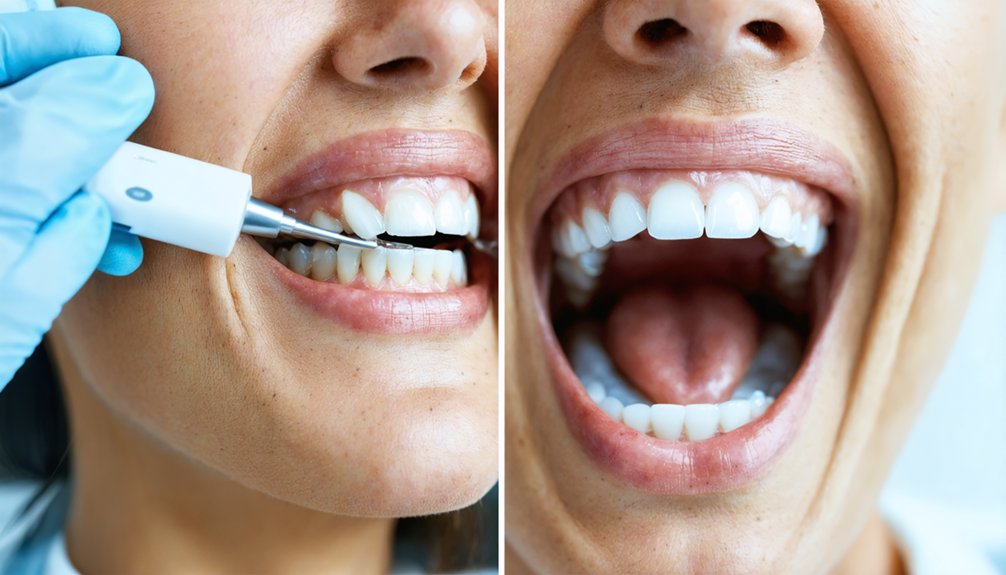
You can achieve noticeable whitening results within three to seven days by matching your method to your available time. LED kits require only 10–20 minutes per session, while strips demand 20–30 minutes daily. Trays offer flexibility, fitting sessions as short as 30 minutes or worn overnight. Hydrogen peroxide-based products work faster than carbamide peroxide alternatives. Consistency across one to three weeks determines your final outcome—and the details ahead will help you optimize every step.
Key Takeaways
- LED kits are the most time-efficient option, requiring only 10–20 minutes per session to deliver noticeable whitening results.
- Hydrogen peroxide-based strips and LED kits work faster than carbamide peroxide, accelerating shade improvement within fewer sessions.
- Anchoring whitening treatments to existing daily routines, like brushing, ensures consistency without adding significant time to your schedule.
- Whitening toothpaste integrates seamlessly into twice-daily brushing, passively maintaining results without requiring dedicated additional treatment time.
- Initial whitening changes appear within 3–7 days, meaning short, consistent daily sessions can deliver visible results quickly.
Which At-Home Whitening Method Fits Your Schedule?
Choosing the right at-home whitening method depends largely on how much time you can commit each day. Strips convenience makes them ideal if you’ve got 20–30 minutes during a commute or lunch break.
Choosing the right whitening method starts with one simple question: how much time can you realistically commit each day?
Gel flexibility suits those who prefer brushing product directly onto teeth once or twice daily, fitting seamlessly into existing routines.
LED kits require only 10–20 minutes per session, maximizing efficiency when time is limited.
Trays offer scalable commitment — wear them 30 minutes for stronger formulas or overnight for gentler concentrations.
Whitening toothpaste integrates effortlessly into twice-daily brushing with no additional time investment.
Matching the method to your actual schedule — not an ideal one — guarantees consistent application, which directly determines how effectively you’ll achieve measurable results within the expected 1–3 week timeframe.
How Long Does At-Home Whitening Actually Take?
How long at-home whitening actually takes depends on two distinct timelines: daily session length and total treatment duration. Understanding both lets you structure whitening around your schedule rather than sacrificing it.
Daily sessions vary by method. Strips and LED kits require 10–30 minutes. Trays with stronger gels run 30–60 minutes; moderate concentrations need 2–4 hours, while gentler formulas suit overnight use. Pens demand only brief twice-daily applications.
Total whitening duration typically spans 1–3 weeks with consistent application frequency. You’ll notice initial changes within 3–7 days, with full results appearing after 7–14 days of use. Heavily stained teeth may require 3–4 weeks.
Controlling both variables — session length and application frequency — determines how efficiently you achieve and sustain your target whitening duration.
Which Whitening Strength Gets Results Fastest?
Once you know how long each session takes, the next variable shaping your results is concentration — specifically, how much peroxide your chosen product delivers.
A whitening potency comparison across available options reveals a clear hierarchy: hydrogen peroxide acts faster, while carbamide peroxide offers greater stability, breaking down into hydrogen peroxide over time at 10–22% concentrations.
An effective ingredient analysis confirms that higher concentrations accelerate shade improvement but increase sensitivity risk. OTC products stay below 10% peroxide, reducing adverse effects while still delivering measurable results within one to three weeks.
If you’re prioritizing speed, hydrogen peroxide-based strips or LED kits outperform toothpastes and pens. For sensitivity-prone users, 10% carbamide peroxide used consistently over shorter daily sessions produces comparable outcomes without compromising comfort.
How Do You Build a Daily Whitening Routine That Lasts?
Building a consistent at-home whitening routine starts with pre-treatment preparation — brush and floss before each session, ideally following a professional cleaning, to guarantee the active ingredients contact clean enamel without interference from plaque or debris.
Anchor your daily habits to an existing behavior, like your morning or evening hygiene routine, to reinforce routine consistency without added effort.
Follow manufacturer protocols precisely — typically 20–30 minutes for strips or 30–60 minutes for stronger tray gels — for one to two weeks. If you experience sensitivity, shorten sessions initially, then increase duration gradually.
Schedule touch-ups every four to six months to preserve results. Structured, repeatable application beats sporadic use every time, so treat each session as a non-negotiable protocol step rather than an optional task.
How Do You Keep Your Whitening Results Going?
Maintaining whitening results depends less on what you did during treatment and more on what you do consistently afterward.
Schedule touch-ups every four to six months using your existing kit, and limit staining agents like coffee, tea, and red wine.
Whitening maintenance tips that actually work include integrating whitening toothpaste into your daily routine to manage surface accumulation before it sets.
Daily whitening toothpaste prevents surface buildup before it becomes the problem you’re trying to reverse.
For touch-up strategies, a single two-week treatment annually sustains most gains achieved during your initial protocol.
If you notice gradual regression, don’t restart a full regimen—shorter, targeted sessions with your tray or strips correct drift efficiently.
Consistency in post-treatment habits, not frequency of retreatment, determines how long your results hold.
You control the outcome through disciplined, structured maintenance behavior.
Frequently Asked Questions
Can At-Home Whitening Work Effectively on Crowns or Veneers?
Studies show restorations resist bleaching agents 100% of the time. At-home whitening won’t improve crowns whitening or veneers effectiveness — you’ll only lighten natural teeth, creating potential shade mismatches with your existing restorations.
Is It Safe to Whiten Teeth While Pregnant or Breastfeeding?
You shouldn’t use whitening options during pregnancy or breastfeeding, as safety data remains insufficient. To avoid tooth sensitivity risks and potential fetal exposure, consult your healthcare provider before resuming any peroxide-based treatments postpartum.
Does Eating Certain Foods Speed up or Slow Whitening Progress?
Yes, certain foods directly impact your progress. Whitening foods like crunchy vegetables scrub surface stains, while staining beverages like coffee and wine undo gains. You’ll protect results by timing consumption strategically around your whitening sessions.
Can Children or Teenagers Safely Use At-Home Whitening Products?
You shouldn’t let children use at-home whitening products, as children’s dental health is still developing. Teenage teeth sensitivity is heightened, making peroxide-based treatments risky. Consult your dentist before considering any whitening protocol for minors.
Should You Avoid Certain Medications Before Starting a Whitening Treatment?
You should consult your dentist about medication interactions before starting whitening treatment. Certain photosensitizing drugs affect your timing considerations, so you’ll want to review your current prescriptions to guarantee safe, effective treatment outcomes.
References
- https://wearefamdent.com/blog/in-office-vs-at-home-teeth-whitening-whats-the-difference/
- https://www.allinthefamilydental.com/blog/in-office-vs-take-home-whitening/
- https://www.yourdentistryguide.com/at-home-whitening/
- https://kaufmandentistry.com/2025/04/10/which-at-home-whitening-treatments-are-worth-it/
- https://www.veenstradental.com/blog/at-home-vs-professional-teeth-whiteningwhats-the-difference-
- https://healthcare.utah.edu/the-scope/health-library/all/2023/10/does-home-teeth-whitening-really-work
- https://pubmed.ncbi.nlm.nih.gov/39779067/
- https://www.healthline.com/nutrition/whiten-teeth-naturally