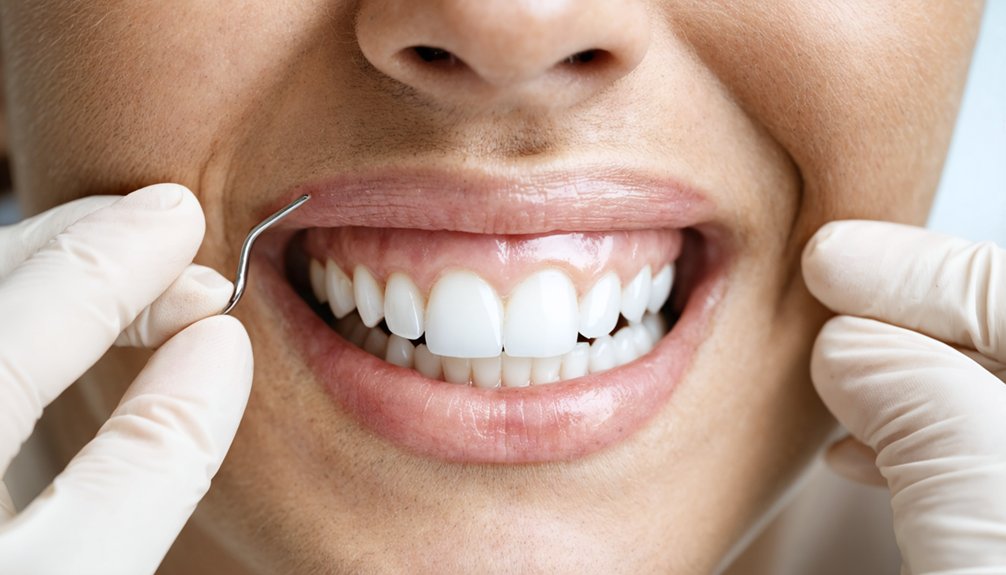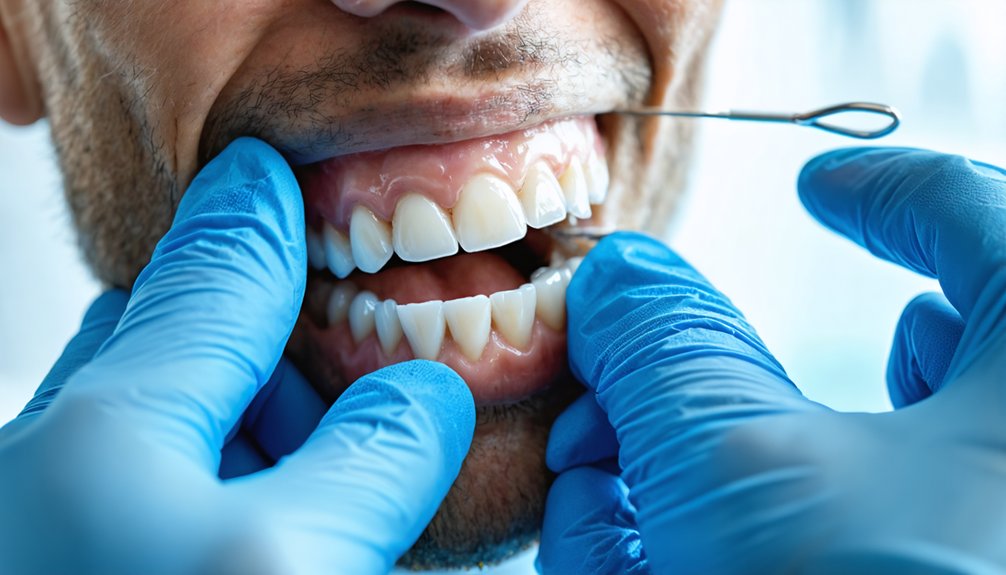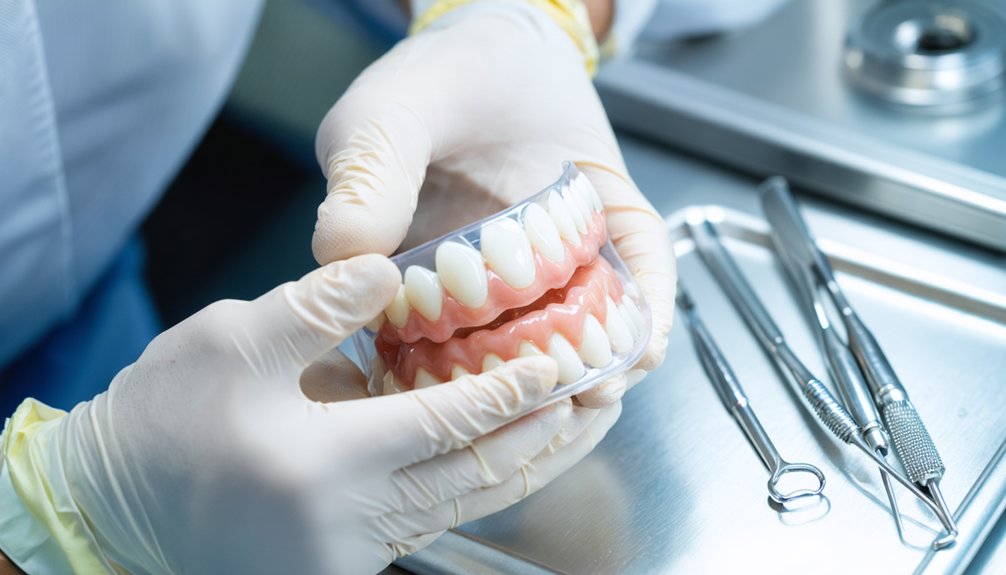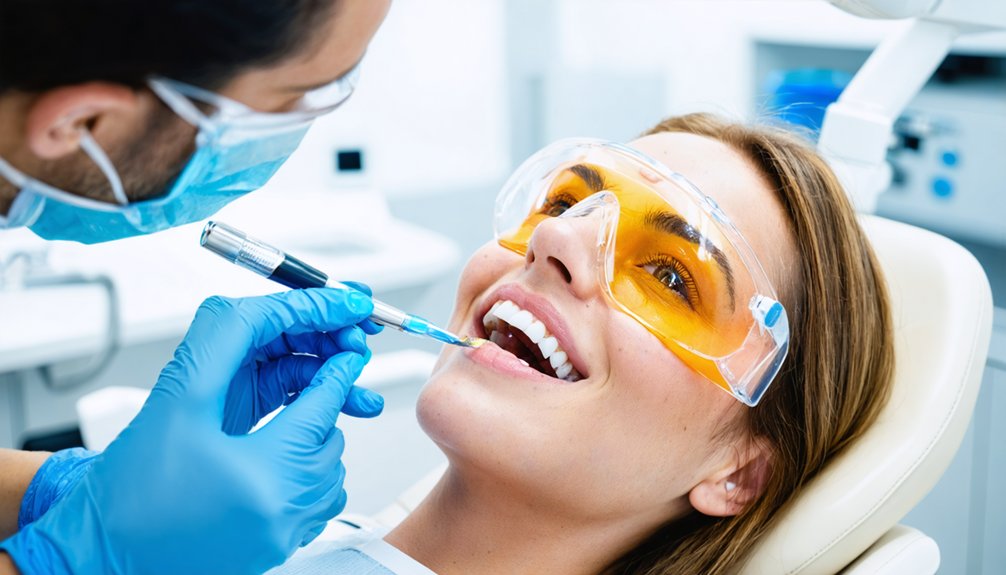
At your in-office whitening appointment, you can expect a thorough cleaning, gum protection, and professional-grade gel application—all within about an hour. Your dentist will apply hydrogen peroxide or carbamide peroxide gel in 3–4 short sessions, each lasting 15–20 minutes. You’ll leave with teeth that are noticeably brighter, often 2–8 shades lighter. Some mild sensitivity is normal afterward. Everything you need to know about each step is covered ahead.
Key Takeaways
- Your dentist will start with a professional cleaning and consultation to prepare your teeth and assess your suitability for whitening.
- A protective barrier is applied to your gums before treatment to prevent irritation from the whitening gel.
- A strong hydrogen peroxide or carbamide peroxide gel is evenly applied across all visible teeth for uniform results.
- The full appointment takes about one hour, including 3–4 gel sessions of 15–20 minutes each.
- Expect an immediate shade improvement of 2–8 shades, with mild sensitivity and gum tenderness lasting 1–2 days afterward.
How Your Dentist Prepares Your Teeth for Whitening
Before your whitening treatment begins, your dentist will give your teeth a professional cleaning to remove any plaque and tartar that could interfere with the results.
These preparation techniques guarantee the whitening gel makes direct contact with your enamel for maximum effectiveness.
Proper preparation ensures the whitening gel penetrates your enamel directly, maximizing the brilliance of your results.
After cleaning, your dentist uses polishing methods to buff your teeth with a pumice paste, exposing clean, smooth surfaces.
During your initial consultation, your dentist examines your teeth to confirm you’re a suitable candidate and sets realistic expectations for your outcome.
Once you’re in the chair, your dentist places cheek retractors to expose your visible teeth and inserts gauze to keep your mouth dry, giving you full control over a clean, optimized starting point.
How Dentists Keep Your Gums Safe During Treatment
Once your teeth are prepped and ready, your dentist shifts focus to protecting your soft tissues before any whitening gel touches your teeth.
These gum protection techniques guarantee the high-concentration bleaching agents only contact your enamel.
Your dentist uses proven dental barrier methods, including:
- Liquid rubber dam or hardening resin painted directly over your gum line, creating a sealed protective layer
- Protective shields applied to all surrounding soft tissues, including your lips and cheeks
- Targeted coverage between teeth where gums are most vulnerable to concentrated agents
These precautions give you full confidence that the procedure stays controlled and precise.
Once every barrier is secured and verified, your dentist proceeds to gel application, knowing your soft tissues are completely protected.
What the Whitening Gel Does Once It’s Applied
With all your soft tissues protected, your dentist applies the whitening gel directly to the front surfaces of your teeth.
The gel composition typically contains hydrogen peroxide or carbamide peroxide as its active ingredients. Once in contact with your enamel, these agents break down into oxygen molecules that penetrate the tooth’s surface and disrupt the chemical bonds of embedded stain particles.
Your dentist guarantees even application across all visible teeth, giving you uniform results rather than patchy whitening.
The high-concentration formula used in-office is considerably stronger than anything available over the counter, which is why professional supervision matters.
You’re not just getting a whiter smile—you’re getting a controlled, precise process designed to deliver predictable, measurable results.
How Long In-Office Teeth Whitening Takes
The entire in-office whitening procedure typically takes about one hour from start to finish. Understanding the appointment timeline helps you plan your day and know exactly what to expect during each phase of your whitening duration.
Your hour generally breaks down like this:
- Preparation and protection: Your dentist cleans your teeth, places retractors, and applies gum barriers before any gel touches your teeth.
- Gel application cycles: You’ll undergo 3–4 sessions of 15–20 minutes each, with gel removal between applications.
- Progress checks: Your dentist evaluates whitening between sessions to monitor results.
You’re in control of your schedule because the process runs efficiently and predictably. There’s no guesswork—just a structured, straightforward appointment with measurable results.
What to Expect During Your Whitening Appointment
During your whitening appointment, your dentist will apply a high-concentration hydrogen peroxide or carbamide peroxide gel to your teeth and activate it with a special light or laser in 15–20 minute sessions, repeated up to four times.
You’ll likely notice an immediate shade change of two to eight shades, though your teeth’s true color will settle over the following two to six weeks.
To protect your results, you’ll want to avoid staining foods and beverages for 48 hours and plan for touch-up treatments every six to twelve months.
The Whitening Process Explained
Once you’re settled in the chair, your dentist will place cheek retractors to expose your teeth and insert gauze to keep your mouth dry.
A protective barrier is then painted over your gums, shielding soft tissues from the high-concentration whitening gel.
Your dentist applies the hydrogen peroxide gel evenly across your teeth’s front surfaces.
A specialized light or laser then activates the gel, maximizing its bleaching effect. This cycle repeats 3-4 times, with each session lasting 15-20 minutes.
Understanding the procedure benefits helps dispel common whitening myths:
- Gel is suctioned off between applications, not left to irritate tissues
- The light causes slight warmth, not pain
- Results are monitored between sessions, keeping you in control of your outcome
Post-Treatment Care Tips
After your whitening session wraps up, your dentist will measure your shade change and give you a clear picture of what to expect in the days ahead.
Your teeth may appear 2–8 shades whiter immediately, though your true color settles within 2–6 weeks as rehydration occurs.
For sensitivity management, expect mild hot and cold sensitivity lasting 1–2 days. Some gum tenderness is normal, so avoid brushing irritated areas for a few days.
For dietary restrictions, skip staining foods and beverages—coffee, tea, red wine, and dark sauces—for at least 48 hours to protect your results.
You’re in control of how long your results last. Schedule touch-up appointments every 6–12 months to maintain the shade you’ve achieved.
How White Your Teeth Get and How to Protect the Results
Following your in-office whitening treatment, you can expect your teeth to brighten by 2 to 8 shades out of a possible 16.
Keep in mind that whitening expectations should account for initial results being partly due to dehydration—your true color stabilizes within 2 to 6 weeks.
To maximize results longevity, take control of these key factors:
Longevity is in your hands—the choices you make after treatment determine how long your results last.
- Diet: Avoid staining foods and beverages for at least 48 hours post-treatment.
- Sensitivity management: Expect mild hot/cold sensitivity lasting 1 to 2 days; it resolves naturally.
- Maintenance: Schedule touch-up treatments every 6 to 12 months to sustain your results.
Understanding these variables puts you in control of your outcome, helping you protect your investment and maintain a consistently brighter smile long-term.
Frequently Asked Questions
Can In-Office Whitening Work on Dental Crowns or Veneers?
Bleaching bypasses bonded dental materials—crowns and veneers won’t whiten. You’ll need replacements to match your newly brightened natural teeth. Protecting crown longevity means consulting your dentist about coordinating restorations with your whitening results effectively.
Is Teeth Whitening Safe During Pregnancy or Breastfeeding?
We recommend you avoid teeth whitening during pregnancy or breastfeeding due to safety concerns around peroxide exposure. You’ve got alternative options—wait until after breastfeeding, then schedule your in-office whitening treatment confidently and safely.
How Much Does a Professional Teeth Whitening Appointment Typically Cost?
Cost isn’t covered in our provided information, but knowing that treatment duration typically runs one hour can help you budget wisely. Various cost factors like location and dentist expertise influence pricing, so you’ll want to consult your dental provider directly.
Will Whitening Treatments Work on Teeth With Deep Intrinsic Stains?
Intrinsic stains can resist whitening treatment effectiveness, but you’ll still see improvement. During your consultation, your dentist will assess your teeth and set realistic goals, ensuring you understand what results you can actually achieve.
How Soon After Whitening Can I Resume Normal Oral Care Routines?
Wait just 48 hours before resuming your full routine. You’ll want to dodge staining foods while managing post-whitening sensitivity. Follow these oral hygiene tips: brush gently, avoid hot/cold triggers, and you’ll regain complete control quickly.
References
- https://enspiredental.com/2025/what-to-expect-after-in-office-teeth-whitening-treatment/
- https://www.yourdentistryguide.com/professional-whitening/
- https://www.suttonpda.com/in-office-teeth-whitening/
- https://allreddentistry.com/what-can-i-expect-before-during-and-after-my-in-office-whitening-treatment/
- https://www.lovelacefamilydentistry.com/does-in-office-teeth-whitening-work/
- https://icondentaldenver.com/what-to-expect-during-teeth-whitening-treatment/
- https://www.goldencoastdentalcare.com/blog/expect-inoffice-teeth-whitening-treatment/49967
- https://www.veenstradental.com/blog/what-to-expect-when-you-get-professional-teeth-whitening-done-right
- https://www.aspendental.com/dental-services/cosmetic-dentistry/teeth-whitening/