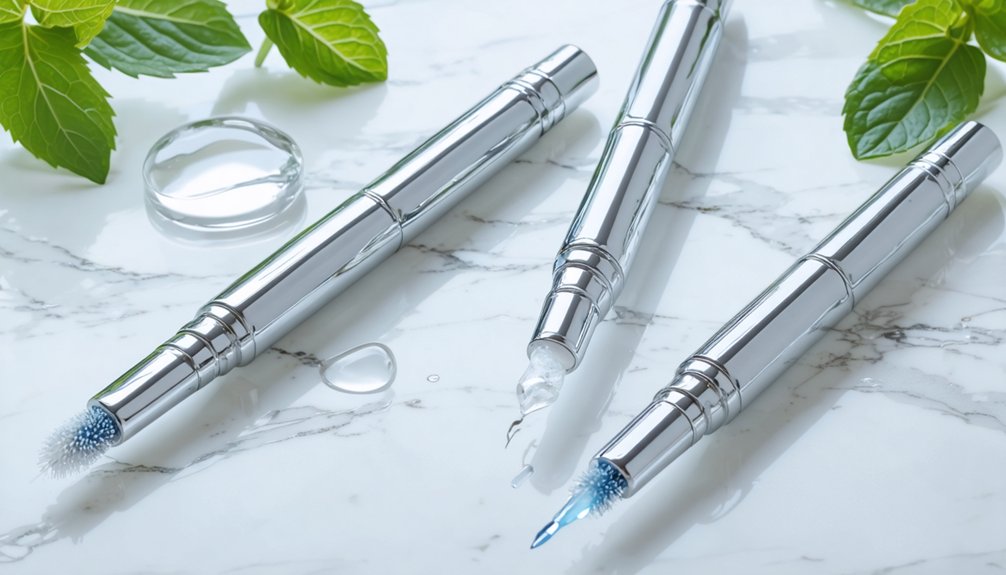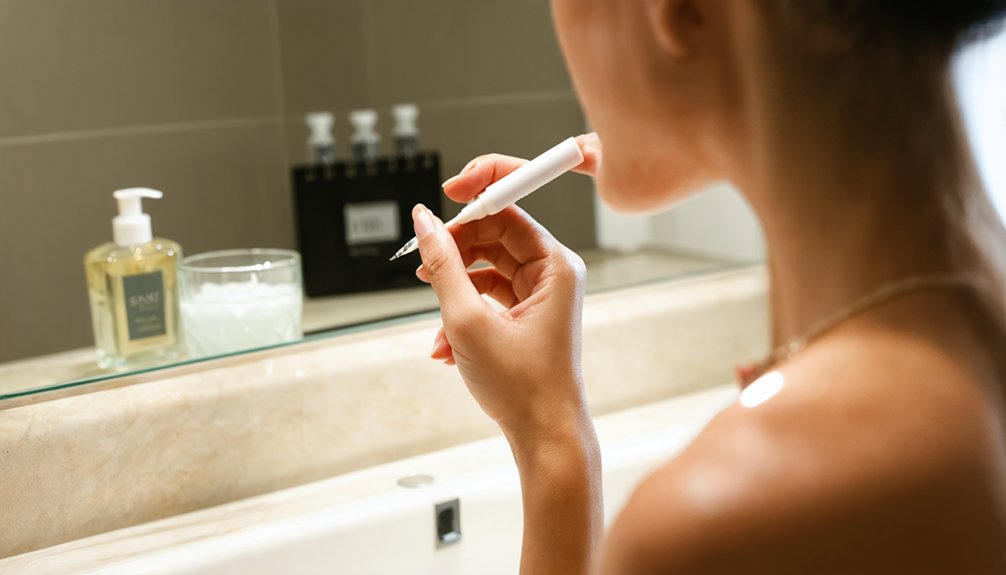
Most whitening pens work best when you use them twice daily for 10 to 14 days, but exceeding that schedule won’t accelerate your results — it’ll likely trigger sensitivity instead. You should start seeing measurable changes around day seven with consistent use. After reaching your target shade, you’ll scale back to one or two applications per week. The specifics of timing, technique, and brand variation matter more than most people realize.
Key Takeaways
- Most whitening pens recommend twice-daily use for an initial cycle lasting 10 to 14 days.
- Visible results typically appear within 7 to 10 days of consistent, uninterrupted use.
- After the initial cycle, reduce to one to two applications per week for maintenance.
- Brand guidelines vary; always follow product-specific instructions, as cycles range from 3 to 30 days.
- If sensitivity occurs, reduce frequency to once daily or every other day to protect enamel.
How Often Should You Use a Teeth Whitening Pen?
Most teeth whitening pens are designed for twice-daily use over a 10 to 14-day cycle. You apply the gel in the morning and evening, allowing consistent peroxide contact with enamel.
Despite common whitening myths, exceeding twice-daily use doesn’t accelerate results — it increases sensitivity and gum irritation risk without added benefit.
Following precise application tips matters. You should keep your lips pulled back for 60 seconds post-application and avoid eating or drinking for up to two hours afterward.
Visible results typically emerge within 7 to 10 days of consistent use.
Once you’ve completed the initial cycle, shift to maintenance mode — one to two applications per week sustains your shade without overexposing enamel to peroxide compounds.
What Is the Standard Twice-Daily Rule for Whitening Pens?
The standard twice-daily rule means you apply your whitening pen once in the morning and once in the evening, spacing applications roughly 8 to 12 hours apart.
This schedule maximizes whitening pen effectiveness by maintaining consistent peroxide contact with enamel across a 14-day cycle.
Your application techniques directly influence outcomes. Apply the gel in thin, even strokes across each tooth surface, keep your lips pulled back for 60 seconds, and avoid eating or drinking for at least 2 hours afterward.
Don’t over-apply — excess gel doesn’t accelerate results and increases sensitivity risk.
Most major brands, including Philips Sonicare and Moon, endorse this twice-daily framework.
Exceeding it won’t improve your shade but will compromise enamel integrity and gum health.
Does Every Brand Recommend the Same Schedule?
When you compare brand guidelines, you’ll quickly find that no universal frequency standard exists across the industry.
Moon allows twice-daily use for up to two weeks, while SmileDirectClub recommends just three consecutive days.
SNOW permits 21 to 30 days straight for stubborn stains.
You can’t assume one brand’s protocol applies to another, so you should always follow the specific instructions included with your product.
Brand Guidelines Vary Widely
Although teeth whitening pens share a common delivery mechanism, brand guidelines vary considerably in their recommended frequency and duration.
Brand comparisons reveal meaningful differences: Moon permits twice daily use for up to two weeks, while SmileDirectClub limits application to three consecutive days or occasional touch-ups.
SNOW extends its protocol to 21–30 days for stubborn stains, and Colgate quantifies volume for 35 treatments without specifying strict frequency limits.
These differences reflect varying peroxide concentrations, application techniques, and target demographics rather than arbitrary choices.
No universal consensus exists across manufacturers. You should treat each product’s guidelines as the authoritative protocol for that specific formula.
Following brand-specific instructions precisely reduces your sensitivity risk and optimizes efficacy within the concentration parameters your chosen pen delivers.
No Universal Frequency Standard
Brand variation in whitening pen guidelines directly reflects a broader reality: no universal frequency standard governs how often you should use these products. Effectiveness studies, product comparisons, and market trends confirm that consumer preferences and ingredient safety profiles drive each brand’s unique protocol.
You’re traversing a fragmented landscape where whitening evolution continues without regulatory consensus.
- Application techniques differ based on peroxide concentration and formula design
- User experiences vary depending on sensitivity levels and baseline tooth shade
- No governing body mandates a standardized frequency across manufacturers
- Ingredient safety thresholds influence whether brands recommend 14 or 30 days
- Product comparisons reveal conflicting schedules even among clinically tested options
Use each brand’s specific protocol as your baseline, then adjust based on your sensitivity response and target results.
How Long Should One Whitening Pen Cycle Last?
Most whitening pen cycles last 10 to 14 days when used twice daily, though some brands like SNOW extend this to 21 to 30 days for stubborn stains.
Your whitening pen lifespan typically covers 15 to 25 applications, making it well-suited for a standard two-week cycle at ideal application frequency.
After 14 consecutive days, continuing use without a break raises your sensitivity risk without delivering measurable additional whitening.
Once you’ve completed the initial cycle, shift to a maintenance phase of one to two applications per week to preserve your results.
Visible improvement usually appears within 7 to 10 days of consistent use.
Structuring your cycle this way lets you maximize efficacy while keeping enamel and gum health within safe parameters.
When Does a Teeth Whitening Pen Start Showing Results?
You’ll typically notice initial brightening within 7 to 10 days of consistent, twice-daily application.
Results don’t appear randomly—they accumulate in direct proportion to how reliably you follow the recommended schedule without skipping sessions.
Inconsistent use resets your progress, making consistency the single most controllable factor in how quickly visible whitening occurs.
Initial Results Timeline
Visible results typically appear within 7 to 10 days of consistent, twice-daily application. Set your initial expectations accordingly — surface stains respond faster than deeper discoloration.
Visible changes become measurable around day seven when you maintain the recommended protocol without skipping applications.
Key factors that influence your results timeline:
- Stain depth and origin (extrinsic vs. intrinsic) directly affect response speed
- Peroxide concentration determines how quickly oxidation breaks down discoloration
- Skipping applications resets progress and extends the timeline
- Dietary habits during the whitening cycle can slow visible changes
- Baseline tooth shade affects how dramatically results appear within 10 days
Completing the full 14-day cycle delivers the most significant outcome.
Partial cycles produce inconsistent results and reduce your ability to accurately assess the product’s effectiveness.
Consistency Drives Visibility
Consistency determines how quickly a teeth whitening pen delivers measurable results. Skipping applications disrupts the cumulative peroxide exposure your enamel requires to break down stain compounds effectively.
You’ll accelerate visibility improvements by adhering strictly to twice-daily applications without gaps.
The consistency benefits become measurable between days seven and ten, when surface stains respond noticeably to sustained peroxide contact. Missing even one or two sessions resets partial progress, forcing your treatment cycle to compensate for lost exposure time.
Treat each application as a non-negotiable protocol within your daily routine. Morning and evening applications, spaced consistently, compound their effect across the full fourteen-day cycle.
Controlled, uninterrupted adherence to the recommended schedule is the single most controllable variable determining how visible your results become.
What Happens If You Use It Too Often?
Overusing a whitening pen beyond the recommended twice-daily, two-week limit raises your risk of tooth sensitivity and gum irritation without improving your results.
Excessive application doesn’t accelerate whitening—it compromises enamel protection and undermines ingredient safety.
Watch for these adverse effects from overuse:
- Increased sensitivity risks: Nerve exposure from enamel erosion causes sharp, lasting discomfort.
- Gum irritation: Peroxide contact beyond safe limits inflames soft tissue.
- Diminishing returns: User experiences confirm no additional whitening beyond recommended cycles.
- Product longevity loss: Overuse depletes your pen faster, reducing cost efficiency.
- Skewed treatment expectations: Believing more applications accelerate results leads to harmful misuse.
Stick to manufacturer application tips.
Once you’ve hit your desired shade, switch to maintenance mode—one to two applications weekly.
Should You Use It Less Often If Your Teeth Feel Sensitive?
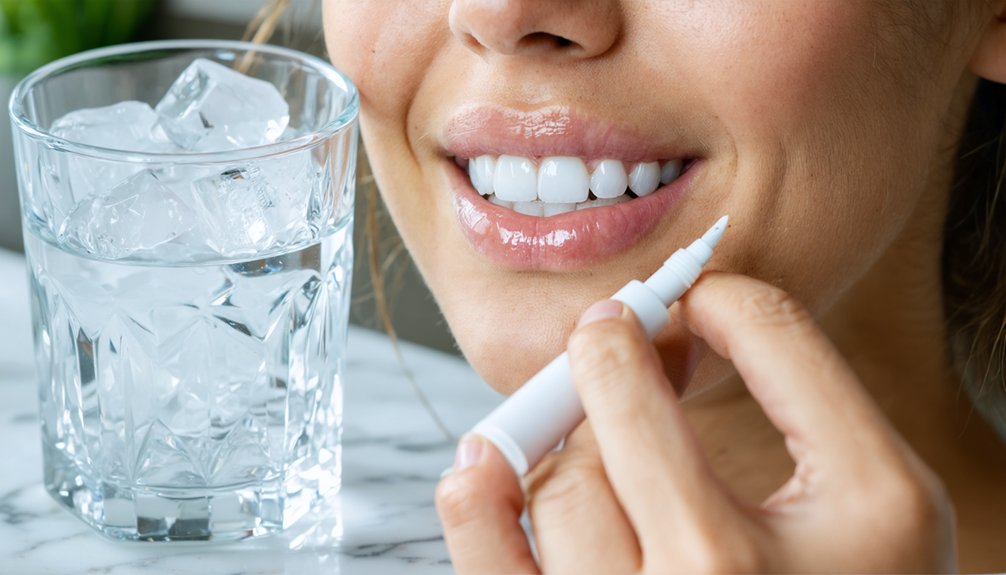
If your teeth feel sensitive during a whitening cycle, you should reduce application frequency to once daily or every other day rather than pushing through discomfort.
Sensitivity signals that your enamel and dentin are reacting to peroxide exposure, and continuing at full frequency increases the risk of lasting irritation.
Adjusting your schedule protects enamel integrity while still allowing the whitening process to progress at a safer pace.
Sensitivity Signals Reduced Frequency
Tooth sensitivity during a whitening cycle signals that you should reduce your application frequency immediately. Don’t ignore discomfort—it’s your enamel’s direct feedback. Adjust based on your comfort levels rather than pushing through pain.
Recognize these sensitivity signs and act accordingly:
- Switch from twice daily to once daily or every other day application timing
- Reduce gel quantity per session to minimize peroxide contact
- Extend whitening duration across more days to preserve results consistency
- Prioritize enamel protection over accelerating your timeline
- Stop use entirely for 48 hours if sharp pain occurs during frequency adjustment
Maintaining results consistency doesn’t require ignoring warning signals. A slower, adjusted protocol still delivers measurable whitening while protecting your enamel from irreversible damage caused by overexposure.
Adjusting Use For Comfort
Sensitivity during a whitening cycle is a direct signal to scale back your frequency, not push through it.
Comfort adjustments aren’t optional—they’re a clinical necessity when enamel or gum tissue responds with pain or prolonged discomfort.
Reduce applications to once daily or every other day if sensitivity develops mid-cycle. Sensitivity management at this stage protects enamel integrity while still allowing gradual whitening progress.
Discontinue use entirely if discomfort persists beyond 48 hours after your last application.
Lower peroxide concentrations also demand longer treatment windows, so switching to a gentler formula extends your cycle without sacrificing results.
You control the pace. Prioritizing comfort over speed produces safer, more sustainable outcomes and reduces the risk of irreversible enamel damage or chronic gum irritation.
Protecting Enamel During Whitening
Enamel responds to peroxide exposure through a process called dentinal tubule stimulation, which triggers the sharp, transient sensitivity you feel during or after whitening.
For enamel protection and whitening safety, you’ll need to modulate your frequency based on physiological feedback.
Reduce or pause application when you notice:
- Sharp sensitivity lasting beyond 24 hours post-application
- Gum blanching or tissue irritation along the gumline
- Increased reactivity to cold or hot temperatures
- Visible enamel translucency developing at tooth edges
- Discomfort during the 60-second post-application hold period
Dropping to once daily or every other day preserves enamel integrity without sacrificing cumulative results.
Sensitivity signals demineralization risk, not tolerance building. You control the pace — extend your whitening cycle rather than compressing it.
Are You Applying Too Much Gel Each Time?
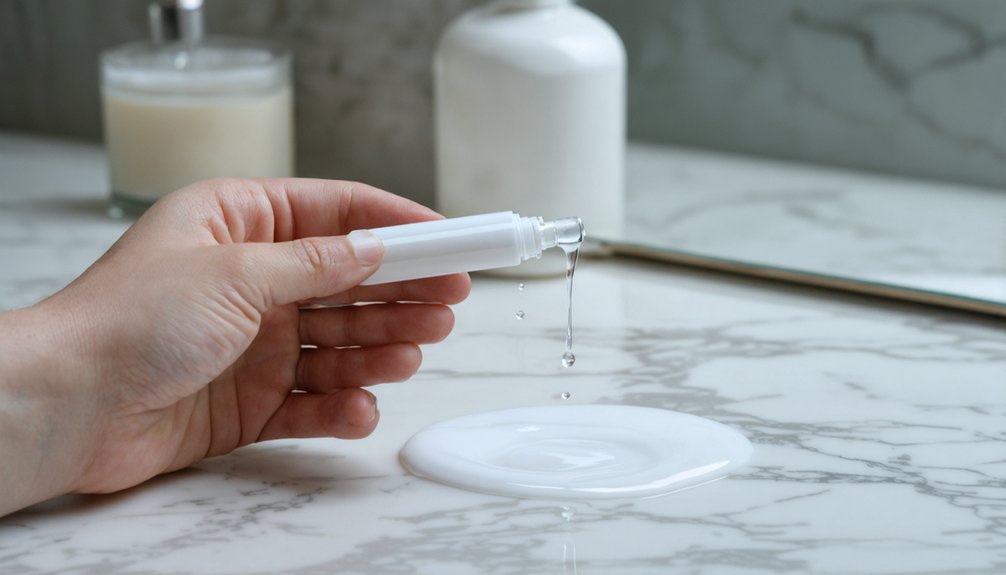
One thin layer of whitening gel applied evenly across the tooth surface is all you need per session. Excess gel doesn’t accelerate whitening or improve outcomes — it increases your risk of gum irritation and tooth sensitivity.
Mastering gel application techniques means controlling exactly how much product contacts the enamel, not estimating generously. Optimal gel amounts cover each tooth’s visible surface without pooling along the gumline.
When gel migrates onto soft tissue, peroxide concentration causes unnecessary inflammation. You’re wasting product and compromising comfort simultaneously.
Apply the pen with a single, deliberate stroke per tooth. If you notice overflow, you’ve dispensed too much.
Precision protects your enamel and extends your pen’s lifespan, giving you full control over each treatment cycle’s effectiveness.
When Should You Switch Your Whitening Pen to Maintenance Mode?
Shift to maintenance mode when you notice:
Shift to maintenance mode when your results speak for themselves — your smile is ready.
- Your target shade has been achieved and held for 2 to 3 days
- Sensitivity increases beyond mild discomfort
- You’ve completed the full 14-day active cycle
- No visible improvement has occurred in 3 consecutive days
- Gum irritation appears around application zones
In maintenance mode, apply your pen 1 to 2 times weekly.
This preserves results without compounding sensitivity risks.
How Do You Time Each Application for Best Results?
Timing each application correctly determines whether the whitening gel bonds effectively or gets washed away before it works.
For ideal results, apply the pen up to two hours before eating or drinking. After application, keep your lips pulled back for 60 seconds to allow the gel to set without disruption.
Leave the gel on your teeth for 10 to 30 minutes, depending on your product’s peroxide concentration — higher concentrations require shorter contact time.
Delay brushing for at least 30 minutes post-application to support enamel remineralization.
Precise application timing removes the variables that undermine efficacy. Skipping these steps doesn’t just reduce results — it wastes product and prolongs your whitening cycle unnecessarily.
Control the timing, and you control the outcome.
Frequently Asked Questions
How Many Total Applications Does One Whitening Pen Typically Contain?
While it varies by brand, you’ll typically get 15 to 25 applications per pen. High-volume options extend pen longevity to 35 treatments, giving you precise control over application frequency without compromising your whitening protocol.
Can You Use a Whitening Pen Right Before Bed?
Yes, you can use a whitening pen right before bed. Nighttime application fits well into your whitening routine since you’ll avoid eating or drinking, letting the gel work undisturbed for best results.
Does Storing a Whitening Pen Affect How Well It Works?
Ironically, a drawer’s warmth silently degrades your gel. You’ll extend your pen lifespan considerably by maintaining cool, dry storage conditions, preserving the peroxide’s integrity and ensuring every application delivers consistent, clinically effective whitening results you’re counting on.
Can Children or Teenagers Safely Use a Teeth Whitening Pen?
You shouldn’t let children use whitening pens due to serious safety concerns. Age restrictions typically exclude those under 18, as developing enamel faces higher sensitivity risks and peroxide exposure can cause irreversible dental damage without clinical supervision.
Should You Brush Your Teeth Before Applying the Whitening Pen?
Brushing beforehand optimizes teeth whitening results. Wait 30 minutes post-application before brushing again, protecting enamel remineralization. Your application technique matters: clean, dry teeth enhance gel adhesion, maximizing peroxide contact and delivering precise, controlled whitening outcomes efficiently.
References
- https://alignerco.com/blogs/aesthetic/teeth-whitening-pen-read-this-before-buying
- https://biancabright.com/pages/how-to-use-a-whitening-pen-complete-guide-for-maximum-results
- https://oralmega.com/blog/a-complete-guide-to-using-teeth-whitening-pens/
- https://www.cinoll.com/blog/how-to-use-a-teeth-whitening-pen/
- https://crest.com/en-us/oral-care-tips/faqs/pen
- https://www.youtube.com/watch?v=R7pW8us0p44
- https://www.qvc.com/footers/hb/pdf/A370742_Smileactives_FAQs_FINAL.pdf
- https://the-smile-bar.ph/how-to-use-teeth-whitening-pen/
- https://www.colgate.com.au/oral-health/teeth-whitening/how-does-a-teeth-whitening-pen-work
- https://www.longevitadental.com/blog/do-teeth-whitening-pens-work/