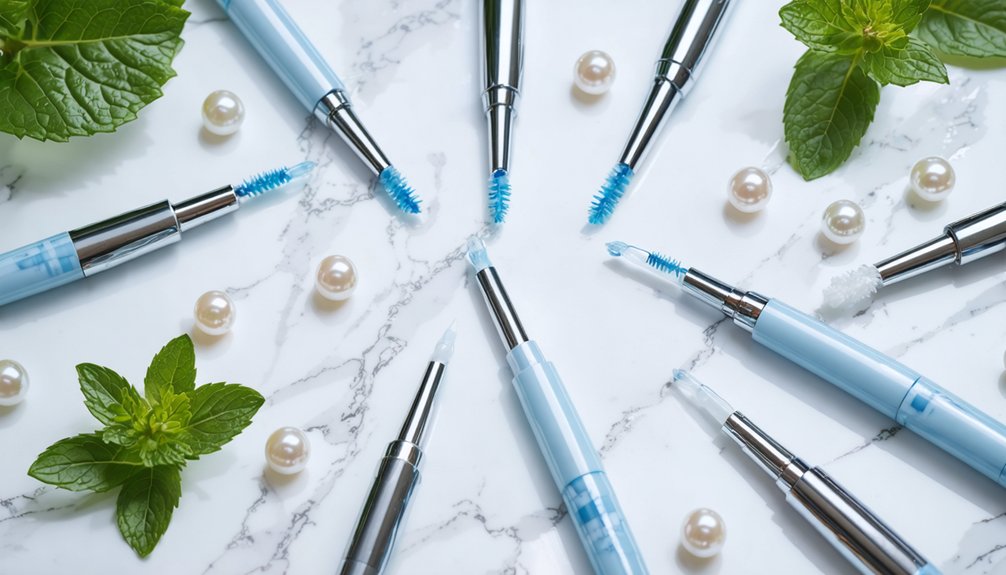
Fluoride stains form inside your enamel, making them resistant to standard whitening treatments. You’ll need pens with higher peroxide concentrations or slow-releasing carbamide peroxide formulas to target this intrinsic discoloration effectively. Top options include the Colgate Optic White Overnight Pen, Philips Zoom, and Crest 3D White Pen, each offering precision applicators for targeted treatment. Choosing the right formula depends on your fluorosis severity and sensitivity level — and there’s much more to weigh before making your decision.
Key Takeaways
- Fluoride stains are intrinsic, requiring specialized whitening pens with higher peroxide concentrations rather than standard surface-level whitening formulas.
- Top recommended pens include Colgate Optic White Overnight, Philips Zoom, Crest 3D White, BriteSmile To Go, and Dr. Song’s Carbamide Peroxide.
- Carbamide peroxide releases hydrogen peroxide slowly, making it more effective for deeper fluoride discoloration than standard hydrogen peroxide formulas.
- Apply pens to clean, dry teeth and avoid eating or drinking for at least 30 minutes after application.
- Consistent use delivers measurable results, with Crest 3D White removing up to 14 years of stains within four weeks.
Why Fluoride Stains Are So Hard to Whiten
Fluoride stains, clinically known as dental fluorosis, form within the enamel structure itself rather than on its surface, making them far more resistant to conventional whitening agents.
Unlike extrinsic stains from coffee or tobacco, fluorosis develops during tooth formation due to overexposure to fluoride sources—contaminated water, excessive supplementation, or prolonged fluoride ingestion in childhood.
Fluorosis isn’t a surface problem—it’s a structural one, built into the tooth during childhood development.
Because the discoloration is intrinsic, standard peroxide-based formulas can’t simply lift it off. You’re dealing with structural enamel damage, not surface buildup.
Stain prevention strategies become irrelevant once fluorosis is established—the damage is already embedded at the cellular level.
This is why selecting a high-penetration whitening pen matters. You need a formula engineered to reach deeper enamel layers, not just polish away what’s sitting on top.
How to Choose a Whitening Pen for Fluoride Stains
Before selecting a whitening pen for fluoride stains, you’ll need to identify whether your discoloration is surface-level or structural, as deeper fluorosis often resists standard hydrogen peroxide formulas.
Compare active ingredient concentrations across products—options like Crest 3D White’s 3% hydrogen peroxide or Dr. Song’s carbamide peroxide target tough stains more aggressively than gentler formulas.
You should also evaluate applicator precision, since fluoride stains often appear in localized spots that require targeted delivery, making pens like the BriteSmile To Go or Colgate Optic White Overnight Pen more effective than broad-coverage strips.
Identifying Your Stain Type
Choosing the right whitening pen starts with identifying whether your stains are intrinsic or extrinsic. Extrinsic stains sit on the enamel’s surface, typically caused by food, coffee, or tobacco. These respond well to hydrogen peroxide-based pens.
Intrinsic stains, like fluoride-induced discoloration, penetrate deeper into the dentin layer, requiring stronger formulas or prolonged treatment.
Accurate stain identification directly determines whitening effectiveness. Fluoride stains often appear as white spots, brown patches, or streaky discoloration—distinguishing them from surface staining is critical before selecting a product. If you’re unsure, consult a dentist for confirmation.
Once you’ve confirmed fluoride staining, you’ll want a pen with high-strength whitening agents and precise application. Targeting the right product to your specific stain type prevents wasted effort and optimizes your results.
Comparing Whitening Formulas
Once you’ve identified fluoride staining as the culprit, the next step is matching your stain type to the right whitening formula.
Whitening method comparisons reveal that hydrogen peroxide formulas, like Crest 3D White’s 3% concentration, penetrate enamel to oxidize intrinsic stains. Carbamide peroxide, found in Dr. Song’s formula, releases hydrogen peroxide more slowly, making it suitable for deeper discoloration.
Ingredient effectiveness varies by stain severity. Mild fluorosis responds well to daily-use pens like BriteSmile To Go. Moderate staining requires higher-concentration options like Philips Zoom.
If sensitivity accompanies your staining, MOON’s gentle formula reduces irritation without sacrificing results.
You’ll get better outcomes by selecting formulas that target intrinsic discoloration specifically, rather than defaulting to surface-level whitening agents designed for extrinsic stains.
Evaluating Applicator Precision
Applicator precision directly determines whether whitening gel contacts fluoride-affected enamel or misses the mark entirely.
When evaluating applicator design, you’ll want a brush tip that allows controlled, targeted stain application across irregular fluoride deposits rather than broad surface coverage.
The BriteSmile To Go and Colgate Optic White Overnight Pen both feature precise applicators engineered for spot treatment. This matters because fluoride stains often concentrate in specific enamel zones, requiring deliberate, localized contact rather than generalized coating.
Assess tip firmness, bristle density, and gel flow consistency before committing to a product. A poorly designed applicator wastes formula and reduces efficacy.
You need an applicator that deposits gel exactly where discoloration exists, giving you full control over treatment placement and maximizing contact time with stubborn fluoride stains.
Colgate Optic White Overnight Pen: Best for Targeted Fluoride Stains
When targeting fluoride stains precisely, the Colgate Optic White Overnight Pen stands out as a clinically practical option. Its overnight formula delivers concentrated whitening action while you sleep, maximizing stain prevention without disrupting your routine.
You’re applying a fluoride treatment-compatible solution directly to discolored areas, controlling exactly where the gel works.
Key advantages you’ll notice:
- Precision applicator targets isolated fluoride stains without affecting surrounding enamel.
- Overnight delivery fades yellow discoloration visibly within one week.
- ELLE-recognized formula confirms its effectiveness on stubborn, deep-set stains.
You gain measurable control over your whitening outcomes. The pen’s targeted design means you’re not wasting product—every application addresses your specific discoloration efficiently and deliberately.
MOON Whitening Pen: Best for Sensitive Teeth With Fluoride Stains
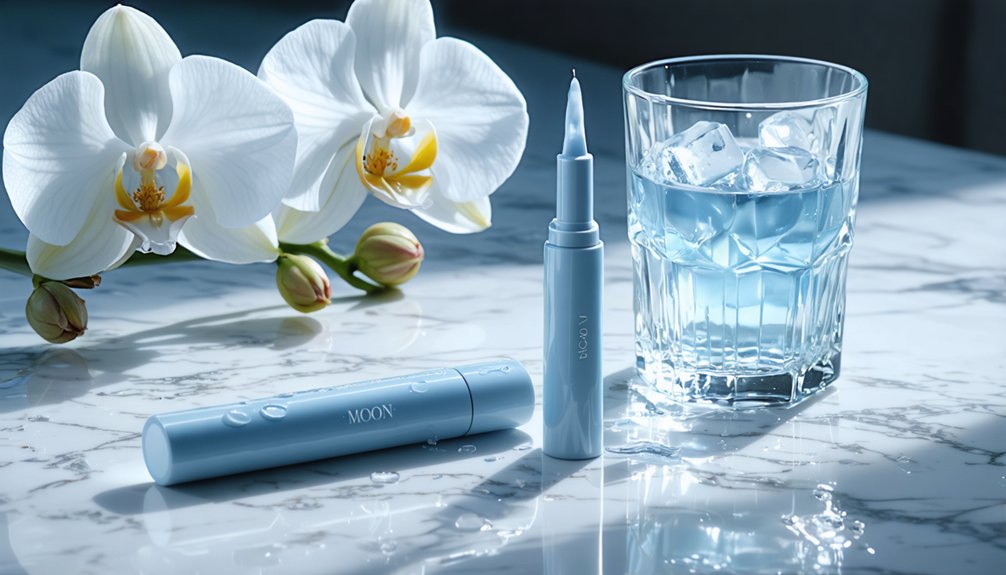
If you have sensitive teeth, the MOON Whitening Pen delivers effective fluoride stain removal without triggering irritation. Its gentle formula prioritizes ingredient safety, avoiding harsh concentrations that typically compromise enamel integrity or cause post-treatment discomfort.
You get targeted stain control without sacrificing sensitivity relief. The pen’s precision applicator lets you direct the whitening agent exactly where fluoride discoloration appears, giving you deliberate, controlled application.
Unlike aggressive formulas, MOON’s compound addresses stubborn stains progressively, reducing the risk of nerve exposure or gum sensitivity. Its portable design supports consistent daily use, which is critical for managing fluoride stains long-term.
If you’re managing both discoloration and dental sensitivity simultaneously, MOON provides a clinically considerate solution that doesn’t force you to choose between comfort and results.
Philips Zoom Whitening Pen: High-Strength Gel for Stubborn Stains
Philips Zoom Whitening Pen deploys a high-strength whitening gel that targets stubborn fluoride discoloration directly at the source. Its precision applicator delivers concentrated formula exactly where you need it, maximizing ingredient effectiveness without wasting product on unaffected areas.
The user experience centers on control and efficiency:
- Apply the high-strength gel directly onto fluoride-stained zones for targeted penetration.
- The active whitening compounds break down stubborn discoloration through consistent daily application.
- Compact design supports on-the-go touch-ups, maintaining your whitening regimen without interruption.
Ingredient effectiveness drives measurable results on even deeply set fluoride stains. You’re not relying on broad-coverage strips that dilute potency.
Instead, you’re directing pharmaceutical-grade whitening agents precisely where discoloration persists, producing faster, more controlled outcomes compared to conventional whitening methods.
BriteSmile To Go Pen: Best for Deep, Hard-to-Reach Stains
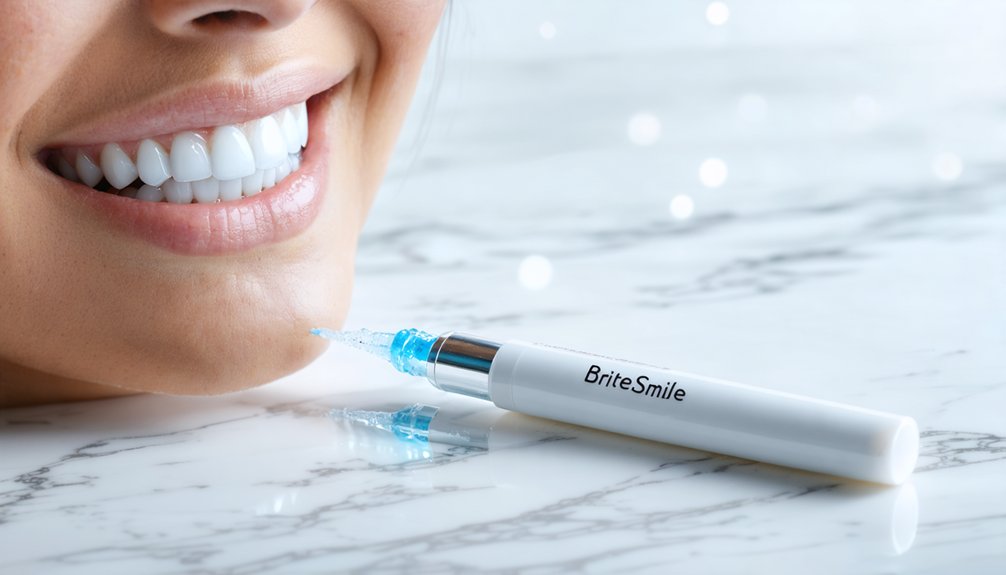
The BriteSmile To Go Pen’s precise applicator lets you target fluoride stains in hard-to-reach areas, such as between teeth and along the gumline, where broader whitening tools often fail.
Its portable design means you can apply the gel directly to stubborn discoloration wherever you are, without interrupting your routine.
Clinical evidence supports that targeted application of whitening agents to localized fluoride stains produces more effective results than generalized treatments.
Precision Applicator Benefits
Fluoride stains often develop in grooves, pits, and tight interdental spaces where broad applicators fail to deliver consistent gel contact. BriteSmile’s applicator design gives you targeted whitening accuracy where it matters most.
Three precision advantages you’ll leverage:
- Controlled gel deposit — You apply only what’s needed, minimizing unnecessary tissue exposure.
- Angled tip access — You reach posterior surfaces and interdental margins that standard brushes miss entirely.
- Reduced gel migration — You keep the formula on stained enamel, not surrounding soft tissue.
This level of applicator control isn’t cosmetic — it’s functional. When fluoride discoloration concentrates in specific enamel zones, broad-coverage tools dilute effectiveness.
The BriteSmile pen lets you treat the lesion precisely, maximizing hydrogen peroxide dwell time exactly where stubborn staining resists conventional whitening approaches.
Tackling Stubborn Stains
Stubborn fluoride stains resist conventional whitening because they penetrate deeper enamel layers and concentrate in anatomically complex zones. You need targeted whitening ingredients—like hydrogen peroxide or carbamide peroxide—delivered precisely where surface-level treatments can’t reach.
The BriteSmile To Go Pen’s precise applicator lets you control application directly onto discolored spots, maximizing contact time with the active formula. This targeted approach supports stain prevention by disrupting chromogen buildup before it compounds further.
You’re not guessing where the gel lands—you’re directing it with clinical accuracy. For fluoride-specific discoloration, which often appears as white spots or brown patches on enamel, this level of precision distinguishes effective treatment from generalized whitening.
You get measurable results because you control the process entirely.
Crest 3D White Pen: Professional-Grade Results at Home
Crest 3D White products deliver professional-grade whitening results you’d typically associate with clinical treatments. Their 3% hydrogen peroxide formula targets fluoride stains with measurable whitening pen effectiveness, removing up to 14 years of discoloration directly at home convenience.
Key performance benchmarks include:
- Stain removal capacity — eliminates up to 14 years of accumulated stains with consistent application.
- Accelerated results — delivers noticeable improvement within four weeks using professional-strength formulation.
- Precision application — targets specific discolored areas without affecting surrounding enamel unnecessarily.
You control the treatment timeline and intensity, applying the formula on your schedule. This structured approach gives you clinical outcomes without professional appointments, making it a practical, evidence-backed solution for persistent fluoride staining that resists standard whitening methods.
Zimba, Dr. Song, and LumiBrite: More Whitening Pens Worth Considering
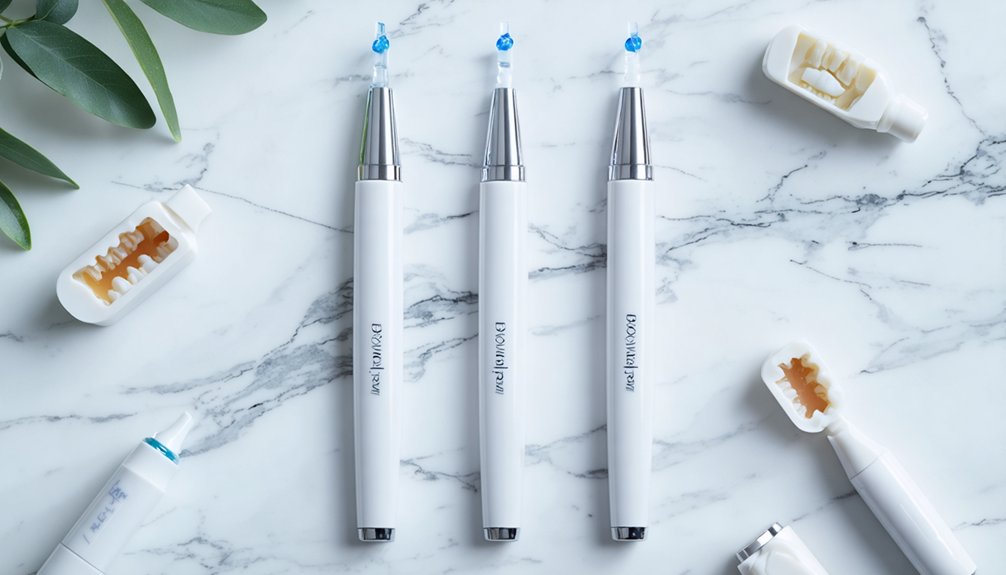
Beyond the top-rated options, Zimba strips, Dr. Song, and LumiBrite deliver targeted results worth your consideration. Zimba benefits include strong value without sacrificing efficacy, making it ideal if you’re managing fluoride stains on a budget.
Dr. Song effectiveness stems from its carbamide peroxide formula, which penetrates deep discoloration that standard whitening agents miss. LumiBrite longevity sets it apart—you’ll notice visible improvement within a few applications, with results that hold longer than many comparable formulas.
When conducting whitening pen comparisons, evaluate each option against your sensitivity threshold, stain severity, and lifestyle demands. Dr. Song suits persistent fluoride discoloration, LumiBrite suits those prioritizing durability, and Zimba suits cost-conscious users.
Each pen addresses distinct needs, so align your choice with your specific whitening goals.
How to Speed Up Whitening Results on Fluoride Stains
To speed up whitening results on fluoride stains, you should maximize overnight treatments by applying your whitening pen consistently before bed, allowing the active ingredients to work uninterrupted for hours.
You can target stubborn discoloration faster by using a precise applicator to concentrate the whitening gel directly on affected areas rather than applying it broadly.
Combining overnight application with strategic spot-targeting gives you the most efficient path to measurable results in the shortest time frame.
Maximize Overnight Whitening Treatments
Overnight whitening treatments accelerate results on fluoride stains by allowing active ingredients extended contact time with enamel discoloration. Following overnight regimen tips precisely maximizes your whitening efficiency and reduces treatment duration.
Implement these three strategies to optimize your overnight application:
- Brush and dry teeth thoroughly before applying your whitening pen, ensuring the gel adheres directly to stained enamel without moisture interference.
- Apply the Colgate Optic White Overnight Pen to targeted fluoride stain areas using controlled, precise strokes, avoiding gum contact.
- Avoid eating or drinking for at least 30 minutes post-application, allowing the active hydrogen peroxide formula uninterrupted contact with discoloration.
Consistent overnight application compounds treatment effectiveness, delivering measurable stain reduction within seven days on stubborn fluoride discoloration.
Target Stubborn Stains Faster
Stubborn fluoride stains resist standard whitening timelines, but combining the right tools and techniques accelerates measurable results.
Apply high-strength formulas like Philips Zoom or Dr. Song carbamide peroxide directly onto discolored zones twice daily. Pair your pen with dietary changes — eliminate coffee, tea, and red wine, which compound fluoride discoloration and slow active ingredients.
Avoid acidic home remedies like lemon juice, which erode enamel and counteract whitening agents. Instead, rinse with water after meals to maintain surface clarity.
Use GLO Brilliant’s heat-and-light activation alongside your pen for compounded penetration on dense stains.
Consistency matters more than intensity — apply precisely, let formulas set fully, and track progress weekly.
Controlled, layered protocols consistently outperform single-product approaches on resistant fluoride discoloration.
How Long Does It Actually Take to See Results?
When you start using a whitening pen for fluoride stains, results vary depending on the product’s active ingredients and concentration. Whitening duration differs across formulas, and stain persistence directly affects your timeline.
- One week: Colgate Optic White Overnight Pen visibly fades yellow stains within seven days of consistent overnight application.
- Five to ten days: Opalescence Go trays deliver measurable results within this window for moderate discoloration.
- Four weeks: Crest 3D White removes up to 14 years of stains with sustained daily use.
You’ll accelerate outcomes by applying precisely to affected areas and maintaining consistent usage schedules.
Higher hydrogen or carbamide peroxide concentrations, like Dr. Song’s formula, target stubborn fluoride discoloration faster than lower-strength alternatives.
Frequently Asked Questions
Can Whitening Pens Permanently Remove Fluoride Stains From Teeth?
No, whitening pens can’t permanently remove fluoride stains. They improve whitening pen effectiveness and reduce discoloration, but fluoride stain removal requires professional treatment. You’ll see results, you’ll maintain them, yet you won’t achieve complete elimination alone.
Are Whitening Pens Safe to Use During Pregnancy or Breastfeeding?
You shouldn’t use whitening pens during pregnancy or breastfeeding due to safety concerns around hydrogen peroxide absorption. Practice ingredient awareness by consulting your doctor before applying any whitening treatment to guarantee you’re protecting both yourself and your baby.
Do Whitening Pens Work on Dental Crowns, Veneers, or Implants?
Like ancient alchemists seeking transformation, you’ll find whitening pen effectiveness doesn’t extend to dental restoration compatibility — crowns, veneers, and implants resist peroxide-based formulas, as they’re crafted from synthetic materials that don’t respond to chemical whitening agents.
Can Children or Teenagers Safely Use Teeth Whitening Pens?
Most dentists don’t recommend whitening pens for children. You should follow strict age recommendations—typically 16 and older. Always consult your dentist first, as safety guidelines exist to protect developing enamel from potential chemical damage.
Should Whitening Pens Be Used Before or After Brushing Teeth?
Like a clean canvas primes paint, brush first. You’ll maximize whitening effectiveness by applying the pen post-brushing. These application tips guarantee the gel bonds directly to enamel, delivering precise, controlled results without interference from toothpaste residue.
References
- https://www.elle.com/beauty/g40957582/best-teeth-whitening-pens/
- https://luxxewhiteproducts.com/blogs/news/the-15-best-teeth-whiteners-to-tackle-tough-stains
- https://www.goodhousekeeping.com/health-products/g28723133/best-at-home-teeth-whitening-products/