If you have sensitive teeth, you’ll need to match the whitening agent to your sensitivity level. For mild sensitivity, hydrogen peroxide-based strips like Crest 3D Whitestrips Sensitive work well. For severe sensitivity, PAP-based formulas like Lumineux eliminate peroxide entirely. Activated charcoal is best avoided, as it accelerates enamel erosion. Sensodyne Repair and Protect addresses both whitening and enamel repair simultaneously. The right choice depends on clinical factors you’ll want to understand fully before starting treatment.
Key Takeaways
- Peroxide-free options like Lumineux PAP strips and Hismile PAP+ kit eliminate sensitivity risks while still delivering effective whitening results.
- Crest 3D Whitestrips Sensitive uses 5.25% hydrogen peroxide with a desensitizing agent, making it suitable for mild sensitivity cases.
- Opalescence Go trays contain potassium nitrate and fluoride alongside 15% hydrogen peroxide, controlling sensitivity during stronger whitening treatments.
- Sensodyne Repair and Protect Whitening Toothpaste seals dentin tubules with stannous fluoride, addressing both sensitivity and enamel degradation simultaneously.
- Avoid activated charcoal products, as their abrasive structure erodes enamel and worsens sensitivity over time.
Crest 3D Whitestrips Sensitive : Best Overall for Sensitive Teeth
Formulated with 5.25% hydrogen peroxide, Crest 3D Whitestrips Sensitive delivers effective stain removal while incorporating an FDA-approved desensitizing agent that minimizes gum irritation and nerve pain.
You’ll apply the strips for 30 minutes daily over 14 days, giving you a structured, controllable protocol for both sensitivity management and whitening effectiveness.
The desensitizing formula targets the root cause of discomfort by reducing nerve exposure during the bleaching process, allowing you to maintain treatment consistency without interruption.
Desensitizing agents reduce nerve exposure during bleaching, letting you stay consistent without painful interruptions derailing your progress.
Clinical validation backs its designation as the top-rated strip for sensitive teeth, meaning you’re not compromising results for comfort.
If surface stains are your primary concern and you need a proven, FDA-supported system, this product offers a measurable, evidence-backed solution worth prioritizing.
Lumineux Peroxide-Free Whitening Strips : Best Peroxide-Free Strip
Lumineux Peroxide-Free Whitening Strips use PAP (Phthalimidoperoxycaproic acid) as their active whitening agent, eliminating hydrogen peroxide entirely to prevent enamel erosion and nerve irritation.
A Lumineux ingredients analysis confirms certified organic components, including coconut oil and mint, which reduce gum inflammation without compromising whitening performance.
PAP efficacy research supports the compound’s ability to oxidize stain chromogens directly without penetrating enamel tubules, making it clinically appropriate for users managing receding gums or severe sensitivity.
You’ll apply the strips for 20 minutes daily over 7 days, giving you a shorter treatment window than peroxide-based alternatives.
If you need a whitening protocol that doesn’t compromise tissue integrity or trigger nerve responses, Lumineux delivers controlled, measurable results without the systemic risks tied to peroxide exposure.
Hismile PAP+ Whitening Kit : Best for Daily Use Without Irritation
The Hismile PAP+ Whitening Kit combines PAP with hydroxyapatite, a bioavailable calcium compound that actively remineralizes enamel during each treatment session.
The PAP agent benefits you by oxidizing stain molecules without generating free radicals that typically compromise enamel integrity. This peroxide-free mechanism eliminates the primary cause of post-whitening sensitivity, giving you consistent control over your treatment schedule.
Enamel strengthening occurs simultaneously with whitening because hydroxyapatite deposits directly into micro-abrasions on the tooth surface.
Potassium citrate further suppresses nerve receptor activity, reducing discomfort during application. You’ll wear the strips for only 10 minutes daily, and results become measurable within seven days.
This kit suits you if your sensitivity requires a non-negotiable daily routine without treatment interruptions.
Opalescence Go Pre-Filled Trays : Best for Fast, Professional Results
If daily low-intensity treatment doesn’t match your timeline, Opalescence Go Pre-Filled Trays deliver faster, dentist-grade results through a higher-concentration formula. Containing 15% hydrogen peroxide, these trays produce measurable whitening noticeably faster than peroxide-free alternatives.
What distinguishes this system is its pre-filled convenience — each tray arrives precisely loaded, eliminating inconsistent gel application that undermines results. You don’t measure, mix, or guess.
The formula also includes potassium nitrate and fluoride, which actively control sensitivity and reinforce enamel integrity throughout treatment.
You apply the trays for 30 to 45 minutes, adjusting duration based on your tolerance. This professional whitening system gives you clinical-level control over your results without requiring an in-office visit, making it a precise, time-efficient option for sensitivity-conscious individuals who prioritize speed.
Sensodyne Repair and Protect Whitening Toothpaste : Best for Enamel Repair
If you’re dealing with sensitive teeth, Sensodyne Repair and Protect Whitening Toothpaste addresses the root cause by using stannous fluoride to seal open dentin tubules while potassium nitrate calms nerve sensitivity.
You’ll notice clinically proven sensitivity reduction after just two weeks of consistent use, making it one of the more evidence-backed options available.
To achieve these results, you brush twice daily for two minutes each session, integrating enamel repair and gentle whitening into a single routine.
Enamel Repair Mechanism
Sensodyne Repair and Protect Whitening Toothpaste works through a dual-action mechanism that targets both sensitivity and enamel degradation simultaneously. Its stannous fluoride compound physically seals open dentin tubules, blocking nerve pathways that trigger discomfort during whitening.
You’re also benefiting from potassium nitrate, which actively calms nerve hypersensitivity at the cellular level.
The enamel remineralization benefits become measurable after two weeks of consistent twice-daily brushing. Stannous fluoride integrates into weakened enamel surfaces, reinforcing structural integrity through proven enamel strengthening techniques that rebuild compromised mineral layers.
Unlike abrasive whitening formulas, this toothpaste delivers whitening agents gently, preserving your enamel’s density while reducing discoloration. Clinical evidence confirms that you’ll experience a statistically significant reduction in sensitivity, giving you precise control over your whitening progress without sacrificing enamel health.
Sensitivity Reduction Benefits
Beyond enamel repair, the sensitivity reduction benefits of this toothpaste operate through mechanisms that directly address nerve hypersensitivity at its source. Unlike whitening alternatives relying solely on peroxide, Sensodyne targets multiple sensitivity triggers simultaneously:
- Potassium nitrate calms active nerve signals within dentin tubules
- Stannous fluoride blocks exposed tubule pathways, preventing external stimuli from reaching nerves
- Twice-daily application builds cumulative desensitization over a 14-day clinical window
- Clinically proven results confirm measurable sensitivity reduction after two weeks of consistent use
- Gentle abrasive system removes surface stains without compromising nerve-protective mineral layers
You gain progressive control over sensitivity responses while maintaining whitening progress. This dual-action approach positions Sensodyne as a precision tool, not merely a passive whitening alternative, for individuals managing chronic dental hypersensitivity.
Daily Usage Guidelines
Consistent daily application determines whether Sensodyne Repair and Protect delivers its full enamel-repairing and desensitizing benefits. You should brush twice daily, dedicating two full minutes each session to guarantee complete coverage across all tooth surfaces.
Integrating this product into your existing daily routines removes guesswork and reinforces adherence.
For precise application tips, apply a pea-sized amount directly onto a soft-bristled brush. Avoid rinsing immediately after brushing, as residual stannous fluoride and potassium nitrate require contact time to seal dentin tubules and suppress nerve activity effectively.
Clinical evidence confirms measurable sensitivity reduction after two weeks of consistent use. You control the outcome by maintaining strict scheduling—morning and evening brushing sessions without substitution or skipping maximize the product’s enamel-repair and whitening performance.
Do LED Whitening Kits Actually Work for Sensitive Teeth?
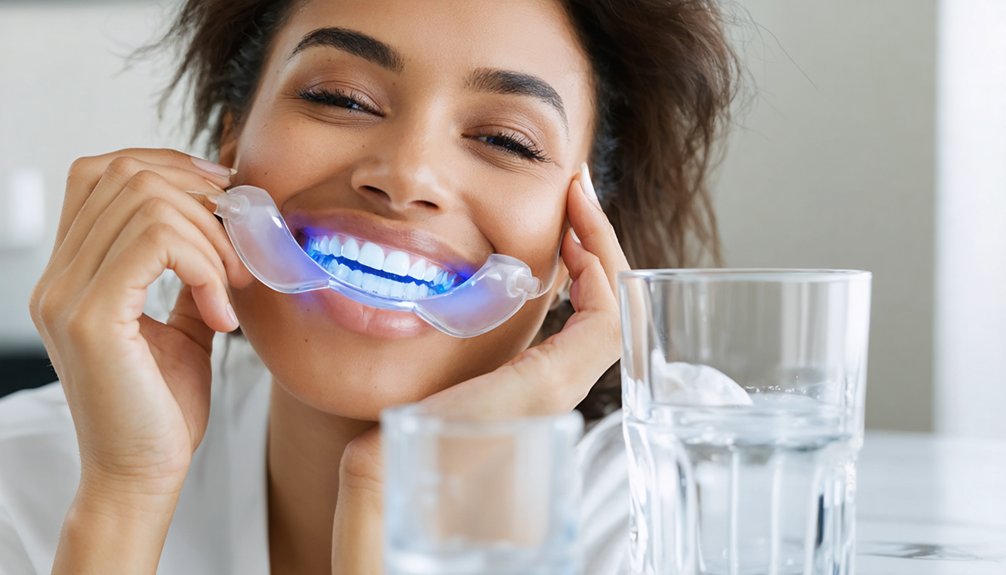
LED whitening kits have gained popularity, but their effectiveness for sensitive teeth depends largely on the whitening agent they’re paired with, not the light itself.
Understanding LED efficacy and dispelling sensitivity myths helps you make informed decisions.
Key facts to know before purchasing:
- LED light accelerates the whitening agent’s chemical reaction, not independently whiten teeth.
- Peroxide-free formulas like PAP+ reduce sensitivity risk considerably.
- Sensitivity myths often overstate LED’s role in causing nerve discomfort.
- Kits containing potassium nitrate or hydroxyapatite offer added enamel protection.
- Clinical evidence supporting LED enhancement remains limited without quality whitening agents.
You’re better off prioritizing the formula’s active ingredients over LED claims when managing sensitivity effectively.
Is Activated Charcoal Safe for Sensitive Enamel?
Activated charcoal may seem like a natural, gentle whitening alternative, but evidence suggests it’s poorly suited for sensitive enamel. While activated charcoal benefits include adsorbing surface stains and bacteria, these advantages don’t outweigh the documented charcoal risks for vulnerable teeth.
Activated charcoal may appear natural and gentle, but its risks to sensitive enamel outweigh its whitening benefits.
Its highly abrasive particle structure physically scrubs enamel, accelerating erosion over repeated use. Once enamel thins, underlying dentin becomes exposed, intensifying sensitivity and pain responses.
If you’re managing sensitive teeth, you need whitening agents that protect structure rather than degrade it. Unlike clinically validated options containing potassium nitrate, fluoride, or hydroxyapatite, charcoal products lack peer-reviewed safety data for enamel preservation.
You’re better positioned choosing evidence-backed alternatives that deliver measurable whitening results without compromising your enamel’s long-term integrity.
Oil Pulling: Gentle Maintenance or Whitening Myth?
Oil pulling has circulated as a natural oral care practice for centuries, but does it actually whiten teeth or simply maintain baseline hygiene?
Current evidence limits oil pulling effectiveness to antimicrobial and plaque-reduction benefits—not measurable whitening. You won’t find clinical data supporting significant shade changes from swishing oil alone.
Oil pulling benefits you can realistically expect include:
- Reduced oral bacteria when practiced consistently for 10–20 minutes
- Decreased plaque accumulation along the gumline
- Mild anti-inflammatory effects supporting gum health
- Fresher breath through microbial reduction
- Gentle maintenance between active whitening treatments
If you’re managing sensitivity, oil pulling won’t replace evidence-backed options like PAP-based strips or fluoride formulations.
Use it as a supplementary hygiene tool, not a primary whitening strategy.
When to Skip Home Kits and See a Dentist Instead
While supplementary habits like oil pulling support oral hygiene at the margins, some conditions place whitening entirely outside the scope of home kits.
If you have active cavities, cracked enamel, exposed dentin, or severe gum recession, applying peroxide or PAP agents at home risks accelerating damage rather than correcting it.
Schedule a dentist consultation when sensitivity persists beyond two weeks despite using desensitizing formulas, or when you notice sharp, spontaneous pain unrelated to application.
These signs indicate underlying pathology that whitening won’t resolve.
Your dentist can assess structural integrity before recommending treatment alternatives, including professionally monitored bleaching, bonding, or veneers tailored to your condition.
Taking that step first protects both your enamel and your investment in long-term results.
How to Choose the Right Whitening Method for Your Sensitivity Level
Choosing the right whitening method depends on accurately categorizing your sensitivity before selecting a product.
Use sensitivity assessment methods like cold-stimulus response tests or gum recession evaluation to establish your baseline. Then apply a whitening ingredients comparison to match your tolerance with formulation strength.
- Mild sensitivity: Crest 3D Whitestrips Sensitive (5.25% hydrogen peroxide, FDA-approved desensitizer)
- Moderate sensitivity: Opalescence Go (15% hydrogen peroxide with potassium nitrate and fluoride)
- Severe sensitivity: Lumineux Peroxide-Free Strips (PAP-based, certified organic, zero peroxide)
- Enamel repair priority: Sensodyne Repair and Protect (stannous fluoride, potassium nitrate)
- Daily maintenance: Hismile PAP+ Kit (hydroxyapatite, potassium citrate, peroxide-free)
Match your assessed sensitivity tier directly to the corresponding formulation. You control the outcome when you select precisely.
Frequently Asked Questions
Can Whitening Products Worsen Existing Cavities or Dental Restorations?
Over 30% of adults have untreated cavities. Yes, whitening products can worsen them. You should prioritize cavity treatment before pursuing whitening safety, as peroxides may penetrate exposed dentin, accelerating decay and compromising dental restorations irreversibly.
How Long Do Whitening Results Typically Last for Sensitive Teeth?
Your whitening results typically last 3–6 months. You’ll extend longevity by managing whitening frequency carefully and prioritizing sensitivity management with products like Sensodyne or PAP-based strips, which protect enamel while maintaining your achieved shade effectively.
Should Whitening Treatments Be Avoided During Pregnancy or Breastfeeding?
Ironically, you’re glowing—yet you should avoid whitening treatments during pregnancy or breastfeeding due to unresolved safety concerns. You’ll want to explore alternative treatments like fluoride toothpaste, ensuring you’re protecting both your smile and your baby effectively.
Can Children or Teenagers Safely Use Whitening Products for Sensitivity?
You shouldn’t use whitening products on children without consulting a dentist first. Teen guidelines recommend waiting until enamel matures. Child safety demands professional oversight before selecting any sensitivity-formulated product like PAP+ or peroxide-based strips.
Does Diet Affect How Quickly Teeth Restain After Whitening Treatments?
Yes, your diet directly impacts restaining speed. You’ll extend whitening results through diet modifications like avoiding coffee, wine, and dark sauces. Consistent stain prevention strategies, including rinsing after meals, keep your enamel noticeably brighter longer.
References
- https://www.forbes.com/sites/forbes-personal-shopper/article/best-whitening-product-for-sensitive-teeth/
- https://www.health.com/beauty/best-whitening-products-sensitive-teeth
- https://shopremi.com/blogs/night-mouth-guard-blog/teeth-whitening-for-sensitive-teeth
- https://thecommonmom.com/best-teeth-whitening-products-for-sensitive-teeth/
- https://www.forbes.com/sites/forbes-personal-shopper/article/best-whitening-products-for-sensitive-teeth/
- https://www.gentledental.com/resources/articles/teeth-whitening-products
- https://www.glamour.com/story/best-teeth-whitening-for-sensitive-teeth
- https://contrank.com/what-makes-a-whitening-product-sensitive-friendly/
- https://www.allure.com/gallery/best-teeth-whiteners-for-sensitive-teeth
- https://springhavendental.com/blog/teeth-whitening-for-sensitive-teeth/