Whitening tetracycline-stained teeth requires patience and a layered approach rather than a single aggressive treatment. Your best options include nightly tray bleaching, extended home bleaching, whitening strips, in-office power whitening, laser bleaching, combination strategies, and restorative solutions like veneers or bonding. Low-concentration, prolonged exposure typically outperforms high-strength quick fixes for these stubborn intrinsic stains. Each method targets different stain depths and severities, and understanding how they work together makes all the difference.
Key Takeaways
- Nightly tray bleaching with 10% carbamide peroxide is a safe, cost-effective first-line treatment, though severe cases may require up to 12 months.
- In-office hydrogen peroxide treatments (up to 37%), sometimes laser-assisted, target resistant stains like cervical banding with greater precision and speed.
- Combining home bleaching, in-office treatments, and whitening strips addresses stains at different depths for more uniform, effective results.
- Whitening strips containing 6.5% hydrogen peroxide serve as a low-sensitivity maintenance option to preserve results after intensive bleaching.
- When bleaching fails, dental bonding, porcelain veneers, or crowns provide durable, aesthetic masking for severe residual tetracycline stains.
Nightly Tray Bleaching: The First-Line Treatment for Tetracycline Stains
When dealing with tetracycline stains, nightly tray bleaching with 10% carbamide peroxide is your most conservative and cost-effective starting point. Custom trays maximize gel-to-enamel contact, allowing gradual intrinsic color change over an average of three to four months—though severe banding may require up to twelve.
You’ll also want to monitor dietary influences during treatment, since pigmented foods and acidic beverages can compromise both whitening progress and enamel remineralization. The 10% concentration offers the strongest safety profile among carbamide peroxide options, minimizing sensitivity while sustaining consistent results.
Lighter tetracycline stains respond most predictably, giving you measurable aesthetic control without immediate restorative intervention. Expect a methodical timeline—this isn’t a rapid fix, but a deliberate, evidence-based protocol designed to protect tooth structure while systematically improving color.
Extended Home Bleaching for Stubborn Tetracycline Stains
For cases where standard nightly tray bleaching plateaus before achieving your target shade, extended home bleaching protocols offer a more aggressive continuation strategy without stepping away from conservative care. You’ll maintain the same custom tray system but extend treatment duration to six months or longer, allowing carbamide peroxide to penetrate resistant chromogenic deposits gradually.
Genetic factors influence how deeply tetracycline integrates into dentin tubules, meaning your stain severity dictates protocol length. Dietary influences—particularly chromogenic foods and acidic beverages—can compromise progress, so controlling intake during treatment is non-negotiable.
Concentrations of 10%, 15%, and 20% carbamide peroxide all demonstrate efficacy, though 10% delivers the strongest safety profile with fewest side effects. Persistent cervical banding often requires the longest continued exposure before measurable improvement registers.
Whitening Strips as a Maintenance Option for Tetracycline Stains
Once you’ve achieved meaningful shade improvement through extended tray bleaching, whitening strips offer a practical, lower-intensity maintenance strategy to sustain those results. A randomized trial confirmed that 6.5% hydrogen peroxide strips matched carbamide peroxide systems over three months, validating their role in your long-term protocol.
Three reasons strips work as a maintenance tool:
- Consistency control – You can schedule applications around dietary habits that reintroduce chromogens, such as coffee or wine.
- Adjunct compatibility – Strips complement enamel microabrasion by preserving surface clarity between clinical visits.
- Measured intensity – Lower peroxide concentration reduces sensitivity risk during prolonged maintenance phases.
Strips won’t reverse severe banding independently, but strategically integrated into your regimen, they protect the shade investment you’ve already made.
In-Office Power Whitening for Tetracycline Stains
If you’re dealing with stubborn tetracycline staining that hasn’t responded adequately to at-home protocols, in-office power whitening offers a more aggressive intervention using high-concentration hydrogen peroxide—up to 37%—applied chairside under controlled conditions.
Your dentist can also use adjuncts like KTP or Nd:YAG laser activation to enhance the bleaching effect on deeply embedded chromogens.
Because tetracycline stains rarely resolve with a single in-office session, clinicians typically combine chairside treatment with continued home tray bleaching to maximize and sustain your results.
Power Whitening Process Explained
In-office power whitening follows a structured series of steps designed to deliver concentrated bleaching agents directly to deeply stained enamel.
- Tissue isolation — Your clinician protects soft tissue before applying 35–37% hydrogen peroxide, preventing chemical irritation during active treatment.
- Controlled activation — Light or laser energy accelerates the oxidation process, breaking down tetracycline chromogens embedded within compromised enamel layers.
- Enamel remineralization — A post-treatment fluoride or calcium phosphate agent supports enamel remineralization, counteracting sensitivity triggered by peroxide exposure.
You’ll maintain results longer by managing dietary influences carefully — avoiding chromogenic foods and beverages for 48 hours post-treatment. This phase is critical. Your enamel remains porous immediately after bleaching, making it especially vulnerable to restaining from coffee, wine, and acidic pigments.
Combining In-Office and Home Treatment
Combining in-office and at-home bleaching produces stronger outcomes than either approach alone — particularly for tetracycline stains, where chromogens are embedded deep within enamel and respond slowly to oxidative agents.
A structured protocol typically begins with power whitening to initiate oxidation, followed by nightly tray applications using 10% carbamide peroxide for several months. You’ll manage tooth sensitivity by spacing sessions appropriately and using desensitizing agents between treatments.
Adjusting dietary habits — eliminating chromogenic foods and beverages during active bleaching — reinforces your results by preventing competitive restaining.
Resistant cervical banding may require an additional in-office hydrogen peroxide session before achieving acceptable uniformity.
This sequential, layered strategy gives you precise control over treatment intensity while maximizing color improvement across all stain classifications.
Laser Bleaching Options for Tetracycline Stains
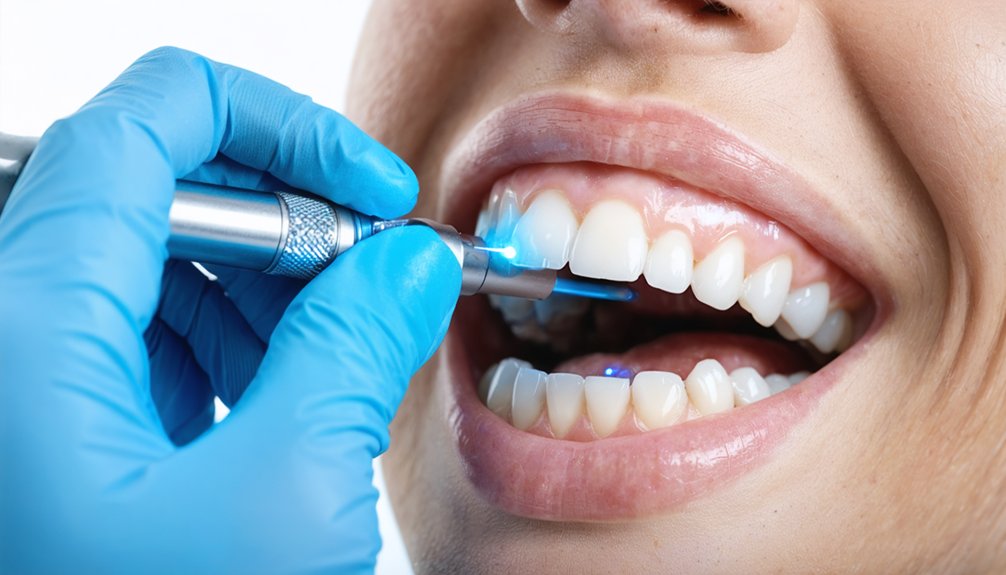
If you’re exploring more advanced options, KTP and Nd:YAG lasers offer targeted essential bleaching for tetracycline-stained teeth, with documented efficacy in clinical reports.
Each laser system activates the bleaching agent differently, but both aim to accelerate peroxide penetration into intrinsically discolored dentin.
You’ll typically achieve the strongest aesthetic outcomes by combining laser treatment with a structured home bleaching protocol rather than relying on a single chairside session.
KTP and Nd:YAG Lasers
Two laser systems have emerged as viable options for bleaching tetracycline-stained teeth: the KTP (potassium titanyl phosphate) laser and the Nd:YAG (neodymium-doped yttrium aluminum garnet) laser. Both deliver targeted energy to activate bleaching agents, accelerating oxidation within stained dentin. Proper patient preparation and laser safety protocols are non-negotiable before initiating treatment.
Key distinctions to understand:
- KTP laser operates at 532 nm, making it particularly effective at activating hydrogen peroxide and documenting measurable color change in tetracycline cases.
- Nd:YAG laser penetrates deeper into dentin, addressing stubborn intrinsic pigmentation that surface-level treatments can’t reach.
- Combination use — pairing either laser with home bleaching — consistently produces superior outcomes compared to laser treatment alone.
You retain greater control over final results by integrating laser sessions strategically within a broader whitening protocol.
Combining Laser With Home Bleaching
Laser sessions alone rarely produce the sustained color shift that tetracycline stains demand, which is why pairing them with structured home bleaching considerably strengthens your outcomes. Typically, you’d schedule in-office laser treatment first to destabilize deeper chromogens, then follow immediately with nightly 10% carbamide peroxide tray applications for several months.
This sequencing lets you maintain momentum between appointments while your dietary habits—minimizing staining agents like coffee and red wine—protect incremental gains. Monitor your gingival health throughout, since extended peroxide exposure can cause transient tissue sensitivity that compromises compliance.
When isolated cervical banding persists, a targeted in-office hydrogen peroxide session can address resistant zones before you resume home maintenance. This coordinated protocol gives you precise control over both the pace and the depth of your final result.
Combination Bleaching Strategies for Tetracycline Stains
Because tetracycline stains respond slowly and unevenly, combining bleaching modalities often produces better outcomes than relying on a single approach. Rather than pursuing alternative natural remedies or imprecise cosmetic color matching techniques, structured combination protocols give you measurable, controlled results.
A proven sequential framework includes:
- 6 months of nightly home bleaching with 10% carbamide peroxide to progressively lighten intrinsic staining
- One in-office hydrogen peroxide session targeting resistant cervical banding that home treatment couldn’t fully resolve
- Whitening strip maintenance using 6.5% hydrogen peroxide to preserve and stabilize your results long-term
Each phase builds on the previous one, addressing stain depth systematically. If isolated dark bands persist after completing this protocol, composite bonding or porcelain veneers become the logical next intervention for complete aesthetic correction.
Restorative Options for Severe Tetracycline Staining
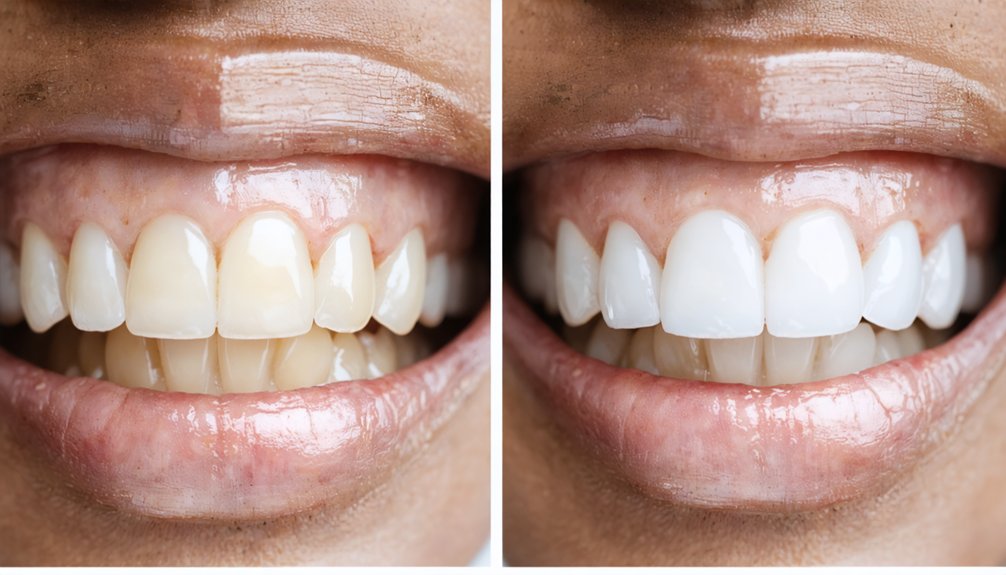
When bleaching reaches its limit—whether due to severe banding, deep intrinsic pigmentation, or insufficient shade change after months of treatment—restorative intervention becomes the appropriate next step. Your options range from conservative to extensive, depending on stain severity and residual tooth structure.
Sometimes bleaching simply isn’t enough—and that’s when restorative dentistry becomes the logical, appropriate next step.
Dental bonding offers a minimally invasive entry point, allowing composite resin to mask remaining discoloration without significant enamel reduction. It works best after bleaching has lightened the underlying tooth, improving color harmony beneath the restoration.
For more severe cases, porcelain laminate veneers or full-coverage crowns deliver predictable, long-term masking.
Regardless of the restoration chosen, prioritizing tooth remineralization before placement is essential. This step strengthens enamel, improves bond integrity, and supports long-term adhesion.
A two-week remineralization window post-bleaching is standard protocol before any bonded restoration is placed.
Frequently Asked Questions
Can Tetracycline Stains Return After Successful Whitening Treatment Is Completed?
Yes, they can—surprise! You’ll need long-term stain management through maintenance whitening to keep results. Explore alternative treatment options like veneers if staining rebounds, ensuring you’re always in control of your aesthetic outcome.
Are Tetracycline-Stained Teeth More Sensitive During Bleaching Than Normal Teeth?
Yes, you’ll likely experience heightened tooth sensitivity during bleaching effects on tetracycline-stained teeth, as extended treatment durations intensify exposure. Managing lower concentrations, like 10% carbamide peroxide, helps you control sensitivity while maintaining effective, aesthetically driven results.
Does the Age of the Patient Affect Tetracycline Stain Whitening Outcomes?
“Time waits for no one”—your age does affect outcomes. Age-related enamel changes increase stain penetration depth, making whitening harder. You’ll likely need extended protocols to achieve ideal aesthetic results with older, deeper tetracycline discoloration.
Can Children or Teenagers Undergo Whitening Treatment for Tetracycline Stains?
Whitening’s generally deferred in pediatric dental care until adulthood. Since tooth discoloration causes persist during development, you’d risk sensitivity and uneven results. Waiting guarantees your teeth are fully mature before pursuing effective bleaching protocols.
How Do Tetracycline Stains Differ From Other Types of Intrinsic Tooth Discoloration?
Like shadows embedded in stone, tetracycline stains penetrate dentin during tooth development—unlike surface discoloration or genetic factors affecting enamel thickness. You’re dealing with chemically bonded chromogens requiring prolonged bleaching protocols rather than simple external removal techniques.
References
- https://pocketdentistry.com/whitening-treatments-for-tetracycline-discoloration/
- https://pmc.ncbi.nlm.nih.gov/articles/PMC2741196/
- https://www.healthline.com/health/tetracycline-teeth
- https://www.taylorfrancis.com/chapters/edit/10.1201/9781315365503-13/whitening-treatments-tetracycline-discoloration-linda-greenwall-bruce-matis
- https://pubmed.ncbi.nlm.nih.gov/12666888/
- https://pmc.ncbi.nlm.nih.gov/articles/PMC5741855/
- https://pocketdentistry.com/management-of-tetracycline-discoloration/
- https://www.nature.com/articles/s41415-021-3121-x
- https://www.sciencedirect.com/science/article/abs/pii/S0300571217300982
- https://vegassmilesuite.com/how-to-whiten-teeth-with-tetracycline-stains/