Blue light teeth whitening works by activating hydrogen peroxide gel with a 456nm LED, breaking down stain-causing compounds and boosting bleaching rates by up to 187%. Your best results depend on matching the right method to your stain type and severity. Options range from professional in-office treatments to custom trays, OTC mouthpiece kits, whitening strips, and targeted pens. Each method has distinct advantages worth understanding before you choose.
Key Takeaways
- Blue light at 456nm activates hydrogen peroxide gel, breaking down stain-causing compounds and increasing the bleaching rate by up to 187%.
- Professional in-office treatments use high-concentration peroxide gel with blue light for the fastest, most dramatic whitening results.
- Custom at-home trays with blue light activation provide precise gel application, minimizing leakage while delivering consistent whitening over weeks.
- OTC blue light kits vary in effectiveness; prioritize clinically validated LED intensity near 456nm and adequate peroxide gel concentration.
- Whitening strips paired with LED mouthpieces offer moderate surface stain removal, with blue light boosting bleaching rates by up to 87%.
The Science Behind Blue Light Teeth Whitening
When you apply a hydrogen peroxide or carbamide peroxide gel to your teeth, blue LED light activates the formula and accelerates the chemical reaction that breaks down stains. The light supplies energy directly to chromogens, enhancing peroxide penetration into your enamel where staining compounds reside.
This process works through molecular restructuring, dismantling the chemical bonds responsible for discoloration from food, drinks, and smoking. Research confirms that blue light operating at 456nm increases the bleaching rate and final whiteness by up to 187% compared to gel alone.
While blue light can photobleach chromophores independently, it requires the peroxide gel to achieve clinically significant results.
Understanding this mechanism lets you make informed decisions about which whitening method delivers the level of control and outcome you’re targeting.
Professional Blue LED Whitening: What to Expect
When you choose professional blue LED whitening, you’ll move through three distinct phases: pre-treatment preparation, the in-office procedure, and post-treatment care.
Your dentist will protect your gums, polish and dry your teeth, then apply a high-concentration peroxide gel before activating the blue LED lamp in controlled 15–30 minute cycles.
Following your appointment, you’ll need to manage temporary sensitivity and follow specific care guidelines to maintain and extend your results.
Pre-Treatment Preparation Steps
Before your appointment begins, the dental team takes several important preparatory steps to guarantee both safety and ideal results.
First, they’ll perform a thorough teeth cleaning to remove surface plaque and debris, ensuring the whitening gel achieves direct, unobstructed contact with your enamel. Any residual buildup reduces gel penetration and compromises final results.
Next, they’ll apply a protective barrier for gum protection, typically a light-cured resin shield along your gumline. This prevents the high-concentration peroxide gel from irritating soft tissue or causing chemical burns.
Your teeth are then dried completely, as moisture dilutes gel efficacy.
These preparation steps aren’t optional formalities — they’re clinically validated protocols that directly influence how evenly and effectively the blue LED treatment performs during each subsequent activation cycle.
During Your Appointment
Once the preparation phase concludes, the appointment moves through 3 distinct stages: gel application, light activation, and rinse cycling. Each stage delivers measurable appointment benefits by systematically targeting chromogens embedded within your enamel.
During gel application, your dentist coats each tooth evenly with high-concentration hydrogen peroxide. The blue LED lamp then activates for 15–30 minute cycles, accelerating the peroxide’s molecular breakdown of stains.
Here’s what you’ll experience across each cycle:
- Gel application: High-concentration peroxide applied precisely to tooth surfaces
- Light activation: 456nm blue LED energizes chromogens, enhancing peroxide penetration
- Rinse cycling: Gel removed between rounds, allowing controlled shade progression
Your dentist monitors every cycle, adjusting exposure based on your target shade and sensitivity response.
Post-Treatment Care Tips
After your final rinse cycle wraps up, what you do in the hours and days that follow directly affects how long your results last.
Avoid chromogenic foods and drinks—coffee, red wine, berries, tomato-based sauces—for at least 48 hours while enamel pores remain open.
Post-treatment sensitivity management typically involves applying fluoride gel or a desensitizing toothpaste containing potassium nitrate immediately after your session. Use it consistently for two to three days to calm nerve response.
Maintain results through disciplined whitening gel maintenance with dentist-provided touch-up trays, applied monthly or as directed. Brush with a non-abrasive whitening toothpaste twice daily.
Without structured upkeep, staining compounds redeposit onto enamel within weeks, reversing the investment you’ve made in professional treatment.
How Custom Trays and Blue Light Work Together at Home
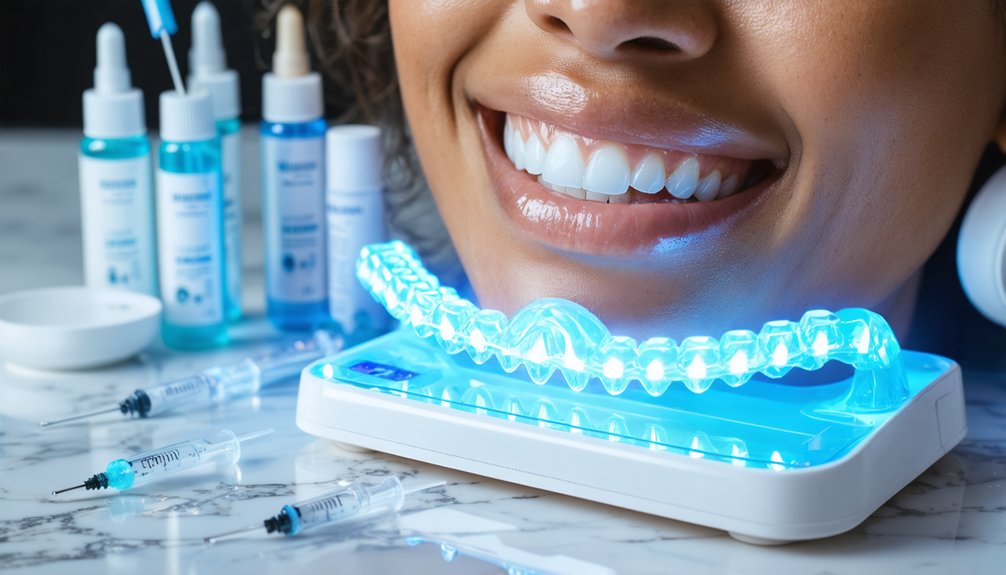
Custom trays and blue light devices combine two complementary mechanisms to enhance at-home whitening outcomes. Custom trays guarantee precise gel application, holding peroxide-based formulas flush against enamel surfaces for consistent contact.
The blue light then activates the gel, accelerating the chemical breakdown of chromogens within the enamel structure.
Here’s how you maximize this combined approach:
- Fit your custom trays snugly to minimize gel leakage and maximize peroxide dwell time against stained surfaces.
- Apply gel evenly across all tray reservoirs before inserting, ensuring uniform coverage.
- Activate your blue light device immediately after tray insertion for the full recommended cycle, typically 15–30 minutes.
This structured protocol delivers measurably faster and more uniform results than either method used independently.
OTC Blue LED Mouthpiece Kits Compared
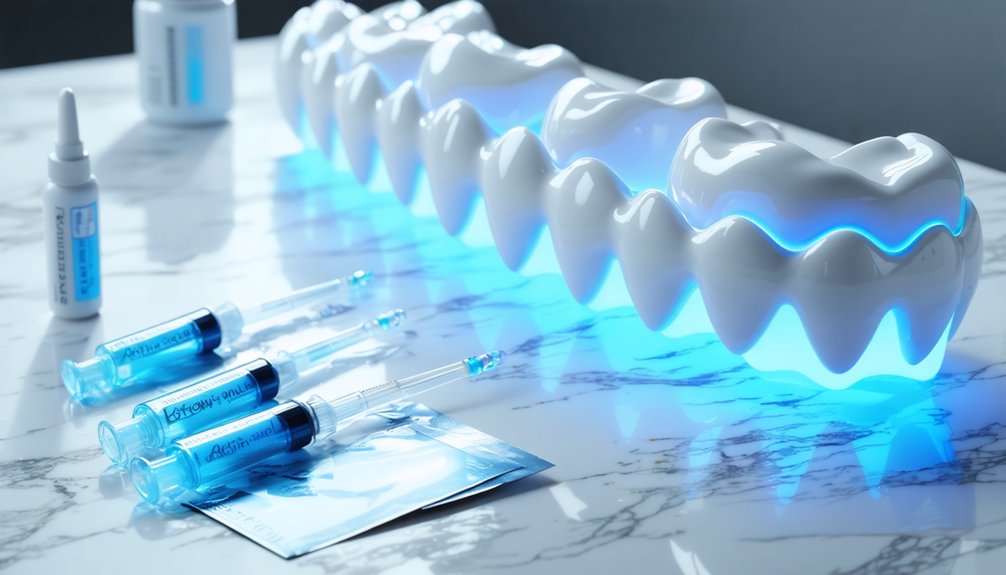
When shopping for OTC blue LED mouthpiece kits, you’ll encounter significant variation in LED intensity, gel concentration, and design quality that directly affect your results.
Kits with higher-output LEDs—typically operating near 456nm—accelerate peroxide activation more effectively than low-intensity alternatives, producing measurable whiteness gains rather than marginal shifts.
You should compare each kit’s light specifications alongside its included gel strength to determine whether the combination delivers clinically meaningful whitening or simply mimics the effect.
Top Kit Features Compared
Several key features separate effective OTC blue LED mouthpiece kits from those that underdeliver. When comparing kit features, you’ll want to prioritize specifications backed by clinical evidence rather than marketing claims.
User reviews consistently highlight three performance indicators worth evaluating:
- Light wavelength and intensity: Look for 456nm blue LED operating at adequate mW/cm² output, which research confirms enhances peroxide penetration.
- Gel concentration: Effective kits pair the mouthpiece with carbamide or hydrogen peroxide gel, not light alone.
- Treatment cycle control: Kits offering timed intervals with multiple cycles give you greater precision over shade targeting.
You’re investing in measurable results, so cross-reference user reviews with published specifications. Kits lacking gel inclusion or verified wavelength data typically underperform compared to those meeting evidence-based benchmarks.
LED Intensity And Results
LED intensity directly determines how effectively a blue light mouthpiece activates your whitening gel, making it one of the most critical specifications to evaluate.
Research confirms that 456nm light wavelength at 190 mW/cm² delivers measurable whitening efficacy, increasing bleaching rates by up to 187% compared to gel concentration alone. Higher-intensity devices shorten your treatment duration while amplifying peroxide penetration into enamel.
When reviewing OTC kits, you’ll notice significant variation in output power, directly impacting your user experience and final shade results.
Lower-intensity units may require extended sessions, reducing cost comparison advantages over professional treatments. Safety considerations remain manageable since LED systems operate at low temperatures, minimizing sensitivity risks.
Prioritize clinically validated intensity specifications over marketing claims to guarantee you’re selecting a device that actually performs.
Blue Light Teeth Whitening Strips: Do They Actually Work?
Blue light teeth whitening strips combine a peroxide-based adhesive strip with a small LED mouthpiece, but how well do they actually deliver on their whitening claims? Evidence suggests strips effectiveness depends heavily on peroxide concentration and contact time.
Consumer reviews indicate moderate results for surface stains, though outcomes vary considerably.
Consumer reviews point to moderate surface stain improvement, though individual results differ significantly based on usage and stain type.
Here’s what the research supports:
- Blue light accelerates peroxide activation, increasing bleaching rate up to 87% versus gel alone.
- Lower-concentration formulas in at-home strips produce gradual, incremental brightening rather than dramatic single-session results.
- Internal or deep discoloration responds poorly, limiting strips to external stain removal.
You’ll achieve the most controlled outcome by following application timing precisely and using strips consistently.
They’re a viable maintenance tool, not a replacement for professional treatment.
Blue Light Whitening Pens for Single-Tooth Stain Removal
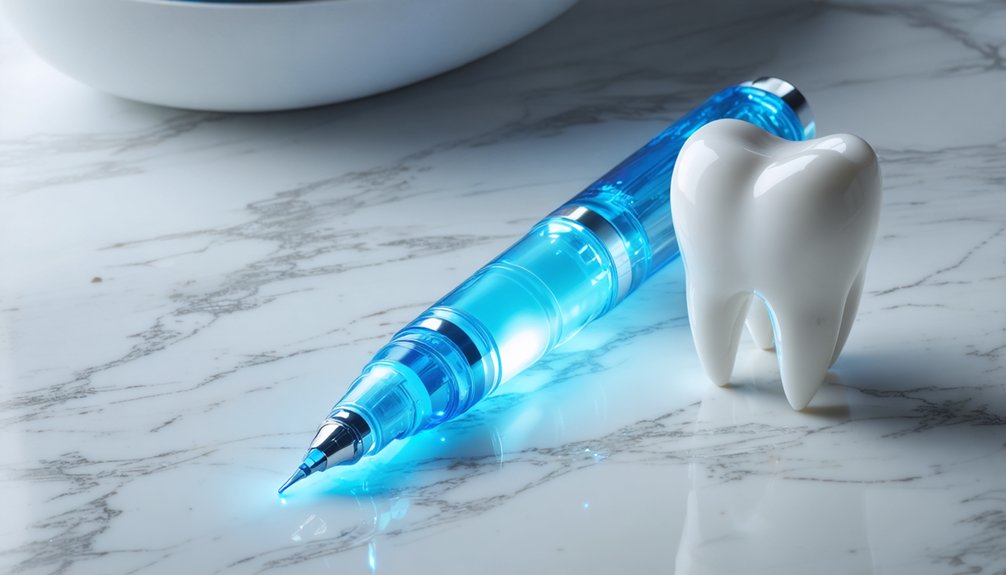
When a single tooth develops a stubborn surface stain, a blue light whitening pen offers a targeted alternative to full-arch treatments. You apply a thin layer of peroxide gel directly onto the discolored enamel using controlled pen application techniques, isolating treatment to one surface without exposing surrounding teeth unnecessarily.
After a brief drying period, you activate the compact LED over the stained area. These stain targeting methods concentrate photochemical activity where it’s actually needed, improving efficiency without wasting gel across unaffected teeth.
Evidence confirms blue light accelerates peroxide penetration into enamel chromogens, lifting external discoloration from food, beverages, or smoking.
However, you should recognize limitations: pens use lower-concentration formulas, delivering incremental results rather than dramatic single-session changes. Consistency across multiple applications produces the most measurable shade improvement.
Which Blue Light Whitening Method Should You Actually Use?
Choosing the right blue light whitening method depends on the severity of your stains, your timeline, and how much professional oversight you want. For deep or persistent discoloration, in-office treatment with high-concentration peroxide delivers measurable ΔE improvements faster than DIY techniques.
At-home options work for maintenance but require consistency over weeks.
Consider these factors before committing:
- Stain depth: Surface stains respond well to at-home kits; internal discoloration needs clinical intervention.
- Safety concerns: High-peroxide gels demand gum protection and controlled application to prevent enamel damage.
- Timeline: Single-visit professional sessions outperform gradual at-home protocols when speed matters.
You’re in control of the outcome, but matching the method to your specific condition guarantees you’re not wasting time or risking unnecessary sensitivity.
Frequently Asked Questions
Can Blue Light Whitening Worsen Existing Dental Restorations or Crowns?
Blue light whitening won’t damage your crowns, but you’ll notice restoration compatibility issues since peroxide won’t whiten artificial materials. You may experience crown sensitivity, leaving visible shade mismatches between treated natural teeth and existing restorations.
How Soon After Tooth Extraction Can Blue Light Whitening Be Used?
Coincidentally, your post extraction care timeline aligns with healing—you shouldn’t use blue light whitening for at least 4 weeks. You’ll prioritize pain management first, ensuring full tissue recovery before applying any peroxide-based whitening gel.
Does Blue Light Whitening Affect Orthodontic Brackets or Bonding Adhesives?
Blue light whitening can compromise bonding durability and increase bracket sensitivity, so you’ll want to avoid treatment while wearing orthodontic appliances. The peroxide gel may weaken adhesives, risking bracket detachment and uneven enamel exposure beneath bonds.
Can Pregnant Women Safely Undergo Blue Light Teeth Whitening Treatments?
You shouldn’t undergo blue light teeth whitening during pregnancy, as safety guidelines lack sufficient evidence for fetal safety. Consult your dentist about treatment alternatives, like professional polishing or fluoride treatments, to maintain your dental health safely.
How Does Diet Affect Whitening Results Immediately After Blue Light Treatment?
Like a medieval scribe’s ink staining parchment, your diet choices create immediate effects post-treatment. You’ll re-stain freshly whitened teeth if you consume coffee, wine, or acidic foods, so you must avoid pigmented items for 48 hours.
References
- https://www.healthline.com/health/dental-and-oral-health/blue-light-teeth-whitening
- https://valleycreekdentalcare.com/blog/is-blue-light-teeth-whitening-safe-for-regular-use-heres-what-you-need-to-kno
- https://pmc.ncbi.nlm.nih.gov/articles/PMC7881219/
- https://www.rsndental.com/dental-services/cosmetic/blog/blue-light-teeth-whitening-it-safe-and-does-it-work
- https://www.laserglowspa.com/blogs/news/the-pros-and-cons-of-blue-led-light-teeth-whitening
- https://enameldentistry.com/are-blue-light-kits-effective-your-2025-guide-from-enamel-dentistry/
- https://diestelandpartners.com/blue-light-teeth-whitening-guide/
- https://www.youtube.com/watch?v=wZ75M2BEw8M
- https://www.aarp.org/health/conditions-treatments/teeth-whitening/