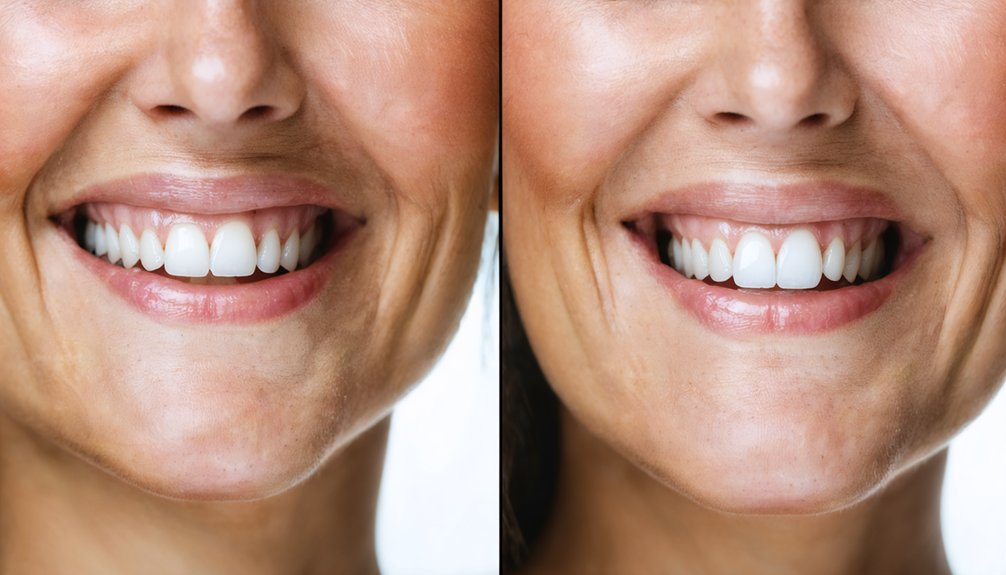
DIY whitening kits benefit your aging teeth by delivering carbamide peroxide formulations that penetrate thinning enamel to oxidize years of accumulated stains without the abrasiveness that compromises vulnerable surfaces. You’ll achieve results comparable to professional treatments while custom-fitted trays protect receding gums from gel exposure. These 10% concentration systems work gradually to minimize sensitivity in mature enamel, and they cost 85% less than in-office procedures. The following sections explain how active ingredients address age-specific discoloration and which application strategies maximize safety for your changing dental structure.
Key Takeaways
- DIY kits with 10% carbamide peroxide match professional results while costing significantly less than $300 in-office sessions.
- Gradual at-home application protects thinning mature enamel better than aggressive professional treatments that risk sensitivity.
- Custom-fitted trays prevent gum irritation, crucial for older patients experiencing gum recession and exposed dentin.
- Lower concentration formulas deliver office-equivalent brightness over two weeks while minimizing sensitivity in vulnerable aging teeth.
- At-home maintenance schedules combat accumulated stains from decades of coffee, tea, wine, and tobacco consumption cost-effectively.
How Aging Affects Tooth Color and Surface Stains
As you age, your teeth undergo structural changes that considerably impact their appearance and whitening potential. Your enamel progressively thins from decades of chewing, brushing, and acidic exposure, revealing the yellowish layer beneath.
Underlying dentin changes amplify this effect—the tissue naturally darkens and thickens over time, creating gray or yellow hues that penetrate through translucent enamel. Surface stains accumulate from coffee, tea, red wine, and tobacco use, building stubborn deposits that resist regular brushing.
Diminished saliva production compounds these issues by failing to neutralize acids and wash away staining particles effectively. Medications, genetics, and prior dental trauma further influence your tooth color. Clinical studies demonstrate that 80-90% of adults experience color shifts exceeding acceptability thresholds within a decade, making targeted whitening interventions increasingly necessary.
Active Ingredients That Target Age-Related Discoloration
Understanding these age-related color changes allows you to select DIY whitening products with ingredients scientifically proven to address both surface and deep-set discoloration. Hydrogen peroxide penetrates enamel to oxidize intrinsic stains from cumulative damage effects, while carbamide peroxide offers slower-release bleaching for extended tray wear with reduced sensitivity.
Calprox dissolves the protein pellicle layer harboring stains without abrasion, and sodium pyrophosphates prevent new discoloration by clinging to enamel surfaces. Baking soda neutralizes acids that accelerate enamel erosion while removing surface deposits. You’ll achieve ideal results by optimizing whitening frequency—lower-concentration formulas permit daily application, whereas higher-concentration treatments require spacing to protect enamel integrity.
Professional-grade kits combine these active ingredients to target both superficial and dentine-level discoloration that intensifies with age.
Proven Results From At-Home Whitening Applications
Clinical evidence demonstrates that at-home whitening applications produce measurable improvements across multiple product categories, with gel-filled trays delivering the fastest outcomes—lightening teeth within days of initial treatment. You’ll achieve accelerated whitening results through systematic protocols:
- 10% carbamide peroxide gel via tray matches 35% hydrogen peroxide in-office bleaching degree while producing less tooth sensitivity than professional methods.
- Visible results emerge within two weeks when you apply gels and strips with consistent daily use for 1-2 weeks.
- Combination approaches accelerate bleaching in the first week when you follow in-office treatment with monthly home touch-ups.
- Whitening solution durability extends over six months through this combined protocol.
Lower concentrations in at-home kits reduce sensitivity while delivering office-equivalent outcomes. FDA/ADA-approved 10% carbamide peroxide (equivalent to 3.6% hydrogen peroxide) provides effective whitening through controlled oxidation processes.
Safety Considerations for Mature Enamel
While at-home whitening delivers proven results, mature enamel requires heightened precautions due to structural changes that accompany aging. Thinner enamel and gum recession expose vulnerable dentin, increasing sensitivity risks during peroxide treatments. Proper dentist consultation identifies pre-existing decay, cracks, or compromised enamel before initiating whitening protocols. You’ll minimize damage by selecting ADA-approved products with controlled peroxide concentrations rather than high-potency formulations lacking regulatory oversight.
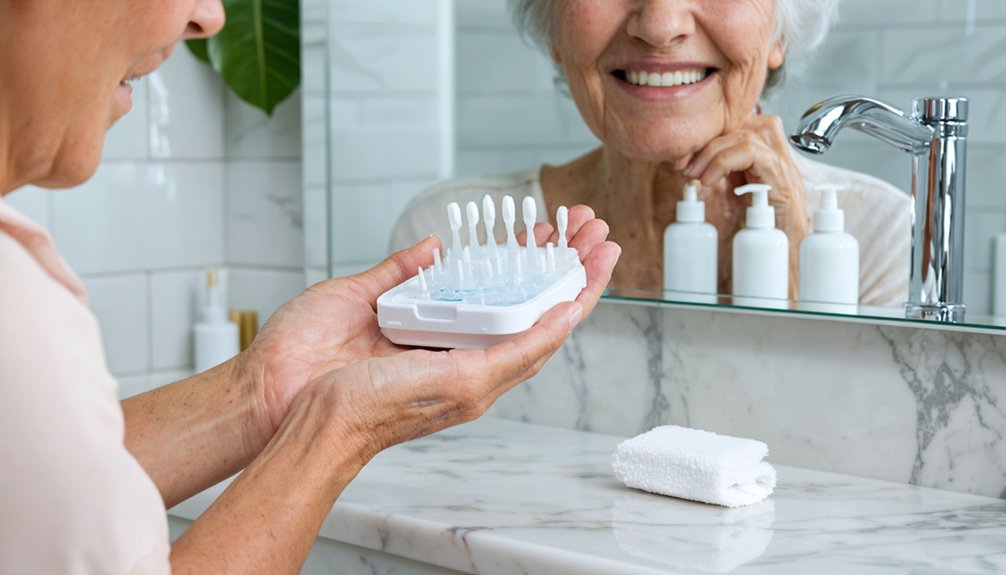
Gradual application strategies protect weakening enamel better than aggressive protocols. Extend treatment intervals if sensitivity develops, and incorporate remineralizing toothpaste to counter temporary mineral depletion. Custom-fitted trays prevent gel contact with gum tissue, reducing irritation from improper barriers. Monitor sensitivity duration—discomfort persisting beyond 72 hours signals treatment adjustment needs. Avoid acidic foods during rehydration phases, and maintain strict adherence to manufacturer instructions to prevent overuse and permanent structural weakening.
Cost-Effective Maintenance for Long-Term Brightness
Budget-conscious whitening strategies deliver sustained brightness through strategic product selection and consistent application protocols. You’ll maximize value by choosing carbamide peroxide 10% formulations, which demonstrate 172.9% greater whitening effectiveness than basic dentifrices while costing approximately $15 per treatment cycle.
Strategic carbamide peroxide selection maximizes whitening effectiveness at 172.9% improvement over standard options while maintaining budget-conscious treatment costs under $15 per cycle.
Cost-Optimization Protocol:
- Select CP10 products above $35 price points for superior cost-effectiveness curves
- Establish maintenance schedules addressing lifestyle factors affecting stains rather than reactive overcorrection
- Monitor potential risks of overuse through documented application intervals
- Calculate long-term savings: DIY maintenance ($10–$50 quarterly) versus professional retreatment ($300+ per session)
Your investment in at-home bleaching systems yields comparable brightness outcomes to in-office procedures when applied consistently over extended periods, eliminating repeated high-cost professional interventions while maintaining ideal aesthetic results through disciplined protocol adherence.
Frequently Asked Questions
How Do DIY Whitening Kits Compare to Professional Dental Whitening Procedures?
you’ll get faster, more dramatic results with professional whitening’s higher whitening agent concentration and protective protocols. DIY kits offer budget-friendly control but won’t transform stubborn stains as effectively, potentially compromising teeth enamel composition.
Can Whitening Kits Damage Dental Work Like Crowns, Veneers, or Fillings?
Yes, whitening kits pose potential harm to dental work. They won’t whiten crowns, veneers, or fillings, creating color mismatches. The impact on existing restorations includes peroxide seepage into cracks, accelerating damage and compromising your restoration’s integrity without professional supervision.
How Long Do Results From At-Home Whitening Kits Typically Last?
You’ll typically see results last 6 months to 1 year with at-home whitening kits, depending on your maintenance routine and whitening efficiency. Professional-grade systems offer superior duration, while touch-ups every 6-12 months optimize your outcomes and extend longevity.
Are Whitening Kits Safe for People With Sensitive Teeth or Gums?
You’ll navigate sensitivity like a pro when choosing specialized kits with lower peroxide concentrations. Custom-fitted trays guarantee gum irritation prevention, while potassium nitrate and fluoride deliver enamel protection. You’re controlling your comfort while achieving professional-grade whitening results safely.
What Should I Do if Whitening Causes Uneven Results or Spotting?
Consult your dentist immediately to identify underlying causes like enamel variations or pre-existing dental work. They’ll develop a targeted treatment plan and apply whitening touch-ups strategically to correct spotting, ensuring uniform results across your entire smile.