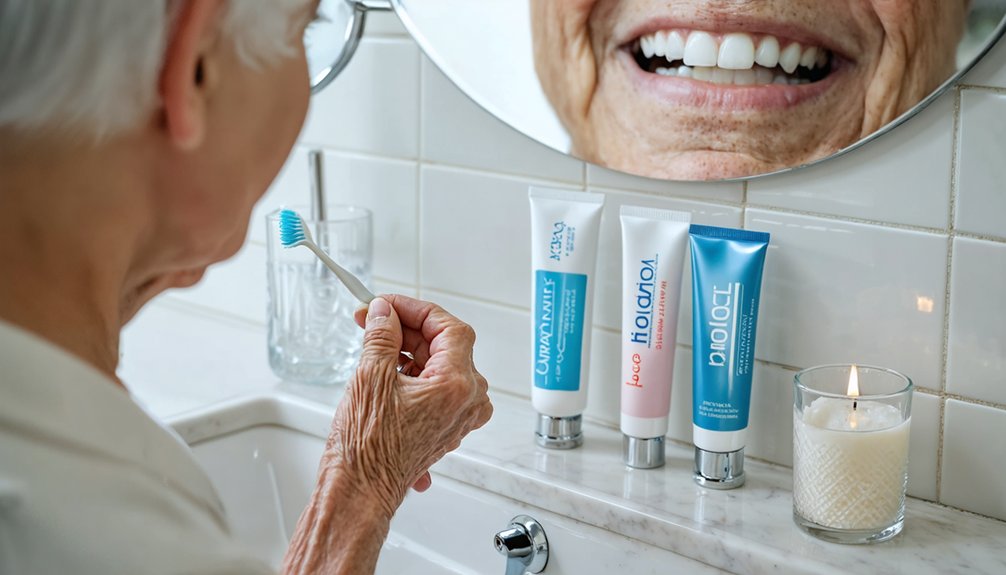
For age-related tooth discoloration, you’ll find the most effective results with toothpastes containing hydrogen peroxide (like Colgate Optic White) or stannous fluoride formulations, which achieve up to 70% stain reduction when combined with sodium hexametaphosphate. If you’re experiencing sensitivity, Sensodyne Pronamel offers abrasive cleaning with enamel protection, while PAP-based alternatives actually increase surface microhardness better than hydrogen peroxide. Proper twice-daily brushing technique matters as much as your toothpaste selection, and the sections below detail ideal combinations for your specific situation.
Key Takeaways
- Colgate Optic White with hydrogen peroxide breaks down intrinsic discoloration caused by age-related structural changes in tooth enamel.
- Crest 3D White Brilliance removes 95% of surface stains through a two-step protocol targeting extrinsic age-related discoloration.
- Stannous fluoride toothpastes achieve 35.6% stain removal at six weeks while strengthening thinning enamel and reducing sensitivity.
- PAP-based bleaching agents outperform 6% hydrogen peroxide while increasing surface microhardness in aging teeth without peroxide sensitivity.
- Sensodyne Pronamel combines abrasive stain removal with enamel protection, addressing both discoloration and age-related enamel erosion simultaneously.
Understanding Age-Related Tooth Discoloration and Surface Stains
Tooth discoloration intensifies as you age due to cumulative structural and chemical changes within dental tissues. Your enamel progressively thins from decades of mechanical wear, acidic erosion, and sustained chewing forces, exposing the underlying yellowish dentin layer.
This dentin naturally darkens as secondary dentin deposits increase and pigments accumulate at the dentin-enamel junction. Simultaneously, your enamel’s microscopic pores expand, facilitating deeper chromogen penetration from coffee, tea, wine, and tobacco products.
Extrinsic stains bind to plaque deposits and eroded enamel surfaces, while intrinsic discoloration stems from structural alterations you can’t reverse through surface cleaning alone. Age-related receding gums and reduced saliva production compound these effects.
Addressing both stain types requires targeted whitening agents, though dental hypersensitivity concerns may necessitate remineralization treatments before aggressive interventions.
Top Whitening Toothpastes for Mature Teeth
When selecting whitening toothpastes for mature teeth, you’ll find that formulations containing stannous fluoride consistently outperform hydrogen peroxide alternatives in balancing efficacy with enamel preservation. Crest 3D White Brilliance removes 95% of surface stains through its two-step protocol, offering dentist-ranked value for sensitive enamel.
Sensodyne Pronamel provides suitable abrasive levels with silica-based stain removal while delivering 24-hour sensitivity relief through potassium nitrate. For smokers requiring deep stain penetration, Colgate Optic White‘s hydrogen peroxide formulation breaks down intrinsic discoloration effectively.
Parodontax Active Gum Repair targets bacterial accumulation at the gumline while whitening, essential for mature users with compromised periodontal integrity. Opalescence‘s low-abrasiveness formula represents professional-grade whitening at $10.99, making it ideal for establishing a controlled whitening timeline without accelerating enamel erosion.
Key Ingredients That Combat Stubborn Staining
Understanding which active compounds target age-related discoloration enables you to select formulations aligned with your enamel condition and staining severity. Baking soda elevates oral pH to prevent demineralization while mechanically polishing surface deposits, whereas stannous fluoride simultaneously removes chromogens and fortifies enamel structure.
You’ll need to distinguish between abrasive particles like hydrated silica that physically lift stains and chemical agents such as hydrogen peroxide that penetrate enamel to oxidize embedded pigmentation.
Baking Soda’s Stain Power
As a mild abrasive compound, baking soda mechanically scrubs surface stains from tooth enamel while simultaneously disrupting the dental biofilms that harbor discoloration. Baking soda’s stain dissolution occurs through low-abrasivity polishing action that outperforms certain higher-abrasivity dentifrices without risking enamel damage. Clinical studies published in the Journal of the American Dental Association confirm visible whitening within two weeks of consistent application.
Baking soda’s pH buffering action elevates oral acidity levels, creating an alkaline environment that inhibits acid-producing bacteria responsible for stain accumulation and decay. You’ll achieve superior results on coffee, tea, and tobacco stains compared to non-peroxide alternatives. While less penetrating than hydrogen peroxide for intrinsic discoloration, it provides controlled maintenance whitening suitable for daily use with manual toothbrushes, offering you predictable stain management without professional intervention.
Fluoride Strengthens While Whitening
Stannous fluoride formulations deliver dual-action oral care by simultaneously removing extrinsic stains and fortifying enamel structure through remineralization. You’ll achieve 24.4% stain removal at three weeks and 35.6% at six weeks with 0.454% stannous fluoride stabilized by nitrates and phosphates—that’s 39.1% superior performance versus regular fluoride dentifrices.
The remineralization benefits extend beyond sodium fluoride equivalents, actively restoring hydroxyapatite tooth mineral while combating caries-induced enamel loss. Tubule occlusion properties reduce hypersensitivity as stannous ions block exposed dentinal pathways, preventing stain accumulation simultaneously.
When combined with sodium hexametaphosphate, you’ll obtain 70% median interproximal stain reduction at two weeks. Clinical trials confirm statistical significance (P<0.001) for sustained whitening over six weeks. However, effectiveness remains limited to extrinsic surface discoloration—intrinsic age-related stains beneath enamel require professional intervention.
Abrasives Vs Whitening Agents
Two distinct mechanisms address stubborn age-related staining on tooth enamel: mechanical abrasion through silica-based compounds and chemical prevention via antideposition agents. You’ll find that silica at 10% concentration physically removes surface discoloration through direct contact action, targeting areas your toothbrush can’t effectively reach. This mechanical approach demonstrates statistically significant improvements (P < 0.001) in Lobene stain scoring.
Chemical stain prevention strategies employ sodium pyrophosphate and sodium phytate at 0.5% concentrations to prevent reaccumulation. These agents bind stain molecules, blocking reattachment to enamel surfaces. Mechanical versus chemical approaches show enhanced efficacy when combined—eight-week clinical trials (NCT04238429) confirm that dual-mechanism formulations reduce both stain area and intensity more effectively than abrasives alone, without requiring excessive abrasive loads that could compromise enamel integrity.
Balancing Effectiveness With Enamel Safety for Aging Teeth
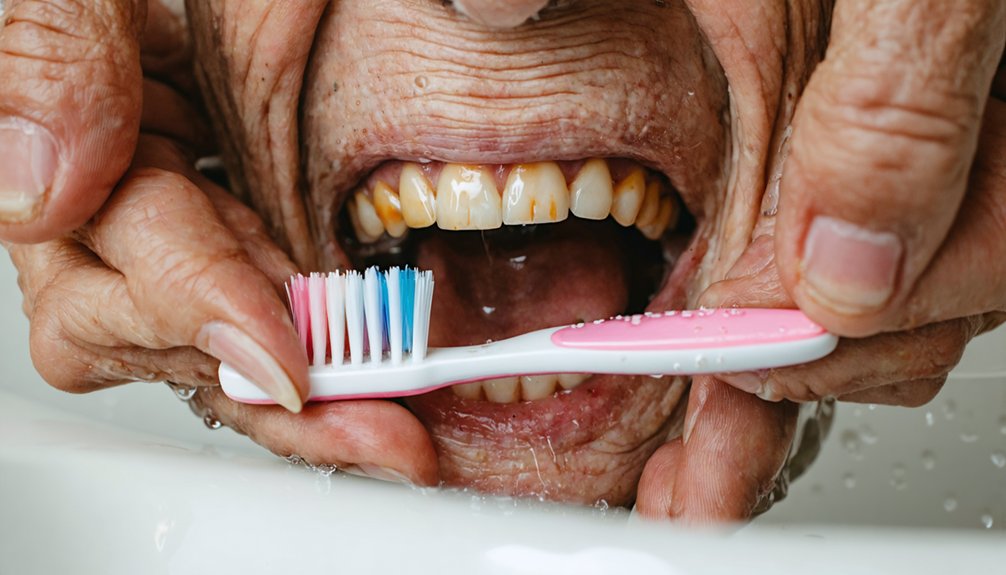
Your aging enamel requires whitening formulations that prioritize structural preservation alongside stain removal efficacy. Hydrogen peroxide remains the gold standard for penetrating deep-set discoloration, yet peroxide-free alternatives utilizing micro-polishing silica and enzymatic cleaners offer viable options for compromised enamel.
Concurrent fluoride or nano-hydroxyapatite inclusion actively remineralizes thinned enamel surfaces while whitening agents target accumulated chromogens from decades of staining exposure.
Gentle Whitening Agents Matter
Aging teeth break down differently under whitening treatments compared to younger enamel, making agent selection critical for safe results. Bromelain delivers the only non-cytotoxic whitening option, reducing artificial stains without surface alterations—ideal for regular use in sensitive aging dentition.
PAP similarly minimizes enamel damage while addressing discoloration. Hydrogen peroxide remains most effective but requires professional monitoring requirements due to interprismatic enamel dissolution and 43-80% sensitivity rates. You’ll achieve preferred outcomes through customized whitening approaches that match agent concentration to your enamel integrity.
Desensitizing products containing potassium nitrate and fluoride mitigate discomfort when used before and after treatment. Avoid abrasive agents like baking soda and charcoal that accelerate enamel erosion. Products bearing the ADA Seal of Acceptance guarantee validated safety standards for aging teeth requiring gentler formulations.
Fluoride Strengthens Aging Enamel
While whitening agents address surface discoloration, fluoride fortifies the structural foundation of aging enamel through remineralization—a process where fluoride ions bond with calcium and phosphate to form fluorapatite, a crystalline structure more resistant to acid dissolution than the hydroxyapatite it replaces. This mechanism becomes critical as you age, when enamel thins and demineralization outpaces natural repair.
Fluoride remineralizes aging enamel by reversing early decay and strengthening areas weakened by decades of acid exposure. Additionally, fluoride reduces sensitivity in aging teeth by occluding exposed dentin tubules from gum recession, decreasing neural stimulation that causes discomfort. Clinical evidence demonstrates 25-40% cavity reduction with consistent use. Daily application through 1450 ppm fluoride toothpaste delivers therapeutic benefits without systemic risks, providing measurable protection for compromised enamel integrity in older adults.
Hydrogen Peroxide-Free Options
Four hydrogen peroxide-free categories deliver effective stain removal while preserving enamel integrity in aging teeth: PAP-based bleaching agents, nano-hydroxyapatite remineralizers, natural abrasive formulations, and plant extract blends.
PAP+ formulations increase surface microhardness by 12.9 ± 11.7 VHN while outperforming 6% hydrogen peroxide by 8.13 ± 2.82 VITA shades without causing erosion.
Nano-hydroxyapatite toothpastes provide pro enamel remineralization, strengthening weakened structures while simultaneously whitening—products like Davids Sensitive + Whitening demonstrate this dual action.
Natural whitening alternatives utilizing baking soda, hydrated silica, and mica offer gentle abrasion for extrinsic stain removal.
Plant extract blends containing cranberry, tea extracts, and antioxidant complexes target surface discoloration while supporting oral health.
These hydrogen peroxide-free options prioritize long-term enamel preservation over rapid bleaching, making them ideal for compromised aging dentition requiring controlled stain management.
Expected Timeline for Visible Whitening Results
Whitening toothpaste requires consistent application over multiple weeks before producing visible results on age-related dental stains. Yellowish discoloration from natural aging typically responds within two to six weeks of dedicated twice-daily brushing.
However, stubborn age-related stains often extend beyond this timeframe, potentially requiring months for partial improvement or professional intervention when embedded deeply within enamel structure.
Maintaining consistent product use proves critical, as sporadic application delays observable outcomes. Formulations containing blue covarine deliver immediate optical brightening effects, though these remain temporary and non-therapeutic.
Managing patient expectations becomes essential—intrinsic discoloration demonstrates minimal response to over-the-counter abrasive formulas alone. Active ingredients, stain severity, and lifestyle factors collectively influence individual timelines.
Surface extrinsic stains clear faster than age-related intrinsic discoloration, which necessitates extended treatment protocols or alternative clinical whitening modalities for satisfactory aesthetic correction.
Daily Brushing Habits to Maximize Stain Removal
Achieving ideal whitening outcomes depends substantially on establishing proper daily oral hygiene protocols that facilitate stain removal while preserving enamel integrity.
You’ll maximize results by brushing twice daily with fluoride toothpaste—morning after breakfast and evening before bed. Employ proper brushing technique: position your soft-bristled brush at a 45-degree angle against gums, utilizing short circular strokes for two full minutes per session. Clean all tooth surfaces, including areas between teeth and under the gum line.
Frequent flossing habits complement brushing by dislodging debris before bristles engage tooth surfaces. After brushing, don’t rinse immediately—allow residual toothpaste to remain for enhanced fluoride and whitening agent efficacy. If you’ve consumed acidic beverages, wait thirty minutes before brushing to prevent enamel erosion during demineralization.
Frequently Asked Questions
Can Whitening Toothpaste Damage Dental Work Like Crowns or Veneers?
Yes, whitening toothpaste can cause potential damage to dental work through abrasive particles that scratch crown and veneer surfaces, creating dullness and discomfort during use. You’ll preserve restorations better by choosing non-abrasive, fluoride formulations for daily oral hygiene.
Should I Switch Toothpastes Periodically or Stick With One Brand?
Periodic toothpaste switching optimizes outcomes better than sticking with one brand. You’ll target surface stains, sensitivity, and remineralization thoroughly by alternating formulas with varied active ingredients like stannous fluoride, sodium bicarbonate, and different abrasives within safe RDA limits.
Do Electric Toothbrushes Enhance Whitening Toothpaste Effectiveness?
Electric toothbrushes don’t enhance whitening toothpaste effectiveness beyond manual brushing. Your whitening results depend on toothpaste formulation, not brush type. However, you’ll achieve preferred stain removal by selecting appropriate brush bristle hardness and toothbrush head size for thorough coverage.
Are There Foods to Avoid While Using Whitening Toothpaste?
Yes, you’ll need to minimize foods high in acidity like citrus and vinegar, which compromise enamel permeability. Also limit foods containing dyes including berries, dark sauces, and beverages with chromogens that penetrate weakened enamel during active whitening treatment.
Can Whitening Toothpaste Help With Stains From Medications?
Whitening toothpaste won’t touch medication-induced intrinsic stains—they’re embedded deep within your tooth structure. You’ll risk teeth sensitivity issues and excessive abrasiveness concerns while achieving minimal results. Professional bleaching or veneers offer the control you need for effective treatment.