Whitening tetracycline stains requires a different approach than standard discoloration because these stains are embedded deep within your dentin. You’ll need extended professional protocols, with mild cases responding to prolonged whitening treatments and moderate stains often requiring systems like KöR Whitening. Severe cases typically need cosmetic solutions like veneers or bonding to fully mask discoloration. Matching your treatment to your stain’s severity is the key to realistic, lasting results — and each option has far more to contemplate.
Key Takeaways
- Tetracycline stains are intrinsic and embedded in dentin, making standard over-the-counter whitening products largely ineffective for meaningful results.
- Classify your stain severity first; mild, moderate, and severe cases each require different treatment approaches for optimal outcomes.
- KöR Whitening uses refrigerated high-potency gels with custom-sealed trays, offering effective results for mild-to-moderate tetracycline stains.
- Extended treatment duration improves results, with mild cases needing six weeks and moderate-to-severe cases requiring up to twelve months.
- For severe stains, combining pre-whitening treatments with porcelain veneers ensures complete coverage and natural-looking, long-lasting results.
Why Tetracycline Stains Are So Hard to Whiten
Unlike surface stains from coffee or wine, tetracycline stains form deep within the dentin during tooth development, making them intrinsic rather than extrinsic. This distinction defines the core of tetracycline discoloration challenges — standard whitening agents can’t penetrate deeply enough to target the embedded pigmentation effectively.
Intrinsic stain characteristics vary by severity, ranging from mild yellow-gray hues to pronounced brown or banded discoloration. The timing and duration of antibiotic exposure during childhood or pregnancy directly determines how deeply the stain embeds.
Because the discoloration resides within the tooth’s structure rather than on its surface, you’re dealing with a fundamentally different problem than typical whitening addresses. Recognizing this distinction helps you set realistic expectations and pursue treatments with the appropriate strength and penetration capability.
How Severe Are Your Tetracycline Stains?
Your tetracycline stains likely fall into one of three categories: mild light yellow or gray discoloration, moderate deeper gray banding, or severe brown and gray striping.
Identifying where your stains fall on this spectrum directly determines which treatments will work for you and what results you can realistically expect.
Because tetracycline embeds into dentin at varying depths, the deeper the stain, the more resistant it becomes to conventional whitening methods.
Identifying Your Stain Severity
Knowing where your tetracycline stains fall on the severity spectrum directly shapes which treatments will work for you.
Stain classification typically follows three tiers. Mild stains appear as light yellow or gray uniform discoloration and respond well to extended professional whitening protocols.
Moderate stains present as deeper gray tones or faint banding, requiring stronger systems like KöR whitening.
Severe stains display pronounced brown or gray bands that resist most whitening approaches entirely, making cosmetic coverage your most reliable treatment option.
Your stain’s original hue, the timing of antibiotic exposure during development, and how deeply the pigment penetrated your dentin all influence which treatment options are realistic for you.
A cosmetic dentistry specialist can assess your specific classification and build a protocol around your actual condition.
Mild Versus Severe Stains
Tetracycline stains span a wide spectrum, and where yours fall determines everything from which treatments are viable to how much improvement you can realistically expect.
Mild stains appear as light yellow or gray discoloration and respond well to extended professional whitening protocols. That widens your treatment options considerably.
Moderate stains present deeper gray tones or visible banding, requiring stronger approaches like KöR whitening for meaningful results.
Severe cases—dark brown or gray bands—resist most whitening efforts entirely, making cosmetic coverage your most reliable path forward.
A stain comparison against clinical severity benchmarks helps you set accurate expectations before committing to any protocol.
Understanding exactly where your stains fall lets you pursue the right solution strategically rather than wasting time and money on treatments unlikely to deliver acceptable outcomes.
Depth Determines Treatment Success
How deeply tetracycline has penetrated your dentin directly dictates which treatments can work and how much improvement you’ll actually see.
Stain penetration determines whether whitening agents can reach the discoloration or whether cosmetic coverage becomes your most practical option.
Shallow treatment depth means bleaching agents can effectively diffuse through enamel into affected dentin, producing meaningful lightening.
Deeper staining requires aggressive protocols like KöR Whitening or internal bleaching to achieve noticeable results.
Your dentist evaluates penetration severity by examining your stain’s color, banding pattern, and timing of tetracycline exposure during development.
This assessment drives every treatment decision you’ll make.
Severe cases may respond minimally to whitening alone, making veneers or bonding the stronger path toward the outcome you’re targeting.
Professional Whitening Protocols for Tetracycline Stains
If your tetracycline stains resist conventional whitening, the KöR Whitening System offers a clinically proven alternative through refrigerated, high-potency gels that penetrate deeply into dentin.
You’ll wear custom-sealed trays for six to eight hours nightly, which block saliva from degrading the bleaching agents and maximize their effectiveness.
This combined in-office and extended at-home protocol can require several months of consistent treatment, but it delivers measurably greater results than standard whitening systems for moderate to severe tetracycline discoloration.
KöR Whitening Deep Penetration
When standard whitening protocols fall short, KöR Whitening offers a clinically advanced solution engineered specifically for tetracycline stains. Its KöR advantages stem from refrigerated gel formulations that preserve peroxide potency, delivering deep penetration directly into compromised dentin layers where stains originate.
You’ll wear custom-sealed trays for six to eight hours nightly, eliminating saliva contamination that typically degrades whitening agents. This controlled environment maximizes gel efficacy throughout extended treatment periods.
The protocol combines in-office sessions with months-long home application, allowing you to systematically address severe discoloration that resists conventional methods.
Sensitivity management protocols are integrated, so you maintain treatment consistency without interruption.
Expect a commitment of several months, but KöR’s targeted approach delivers measurable lightening results that standard over-the-counter systems simply can’t achieve.
Extended Treatment Protocol Benefits
Extended professional whitening protocols deliver results that shorter treatment cycles simply can’t achieve with tetracycline stains.
Treatment duration directly impacts outcomes — mild cases typically require six weeks of overnight tray use, while moderate-to-severe staining demands up to twelve months of consistent application.
You’re working against deeply embedded dentin discoloration, so compressing the timeline undermines expected outcomes.
Extended protocols allow the bleaching agents to penetrate progressively through multiple dentin layers, gradually breaking down chromogens that standard cycles never reach.
KöR’s refrigerated gels maintain chemical potency throughout prolonged wear, maximizing each session’s effectiveness.
By committing to the full recommended duration, you control how notably your results improve.
Partial lightening is achievable and often dramatic — but only when you respect the protocol’s timeline completely.
Is KöR Whitening Worth It for Tetracycline Stains?
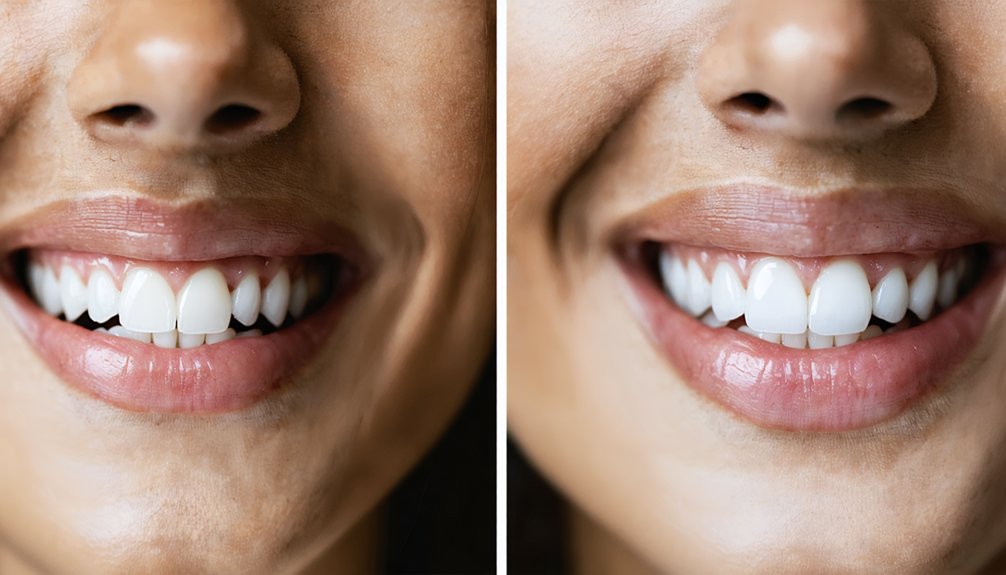
For those battling tetracycline stains, KöR Whitening stands out as one of the most effective professional options available. Its refrigerated gel and custom trays maximize penetration into deeply stained dentin, delivering results that standard systems can’t match.
When evaluating KöR effectiveness and treatment costs, weigh these key advantages:
- Deep Penetration: Refrigerated gel maintains potency, targeting intrinsic dentin stains directly
- Extended Protocol: Nightly 6-8 hour wear over several months produces measurable lightening
- Sensitivity Management: Built-in protocols minimize discomfort throughout treatment
- Combined Approach: Pairs in-office sessions with home use for ideal results
- Superior Performance: Outperforms conventional whitening systems on stubborn tetracycline cases
While treatment costs run higher than standard options, the clinical outcomes justify the investment for moderate-to-severe cases.
Should You Get Veneers or Bonding for Tetracycline Stains?
While KöR Whitening delivers strong results for moderate cases, severe tetracycline stains often resist even the most aggressive bleaching protocols—and that’s where cosmetic coverage options like veneers and bonding become worth considering.
Porcelain veneers advantages include complete stain masking, precise shade matching, and long-term resistance to future discoloration. They also correct chips and gaps simultaneously, giving you thorough aesthetic control.
However, they require irreversible enamel removal and carry higher costs.
Dental bonding offers a faster, less invasive alternative using composite resin shaped directly onto the tooth.
Bonding limitations include lower durability, susceptibility to staining, and a shorter lifespan compared to veneers.
Your severity level determines the better option. Consult a cosmetic dentistry specialist to assess which approach aligns with your stain depth and long-term goals.
Combining Whitening and Veneers for Severe Tetracycline Stains
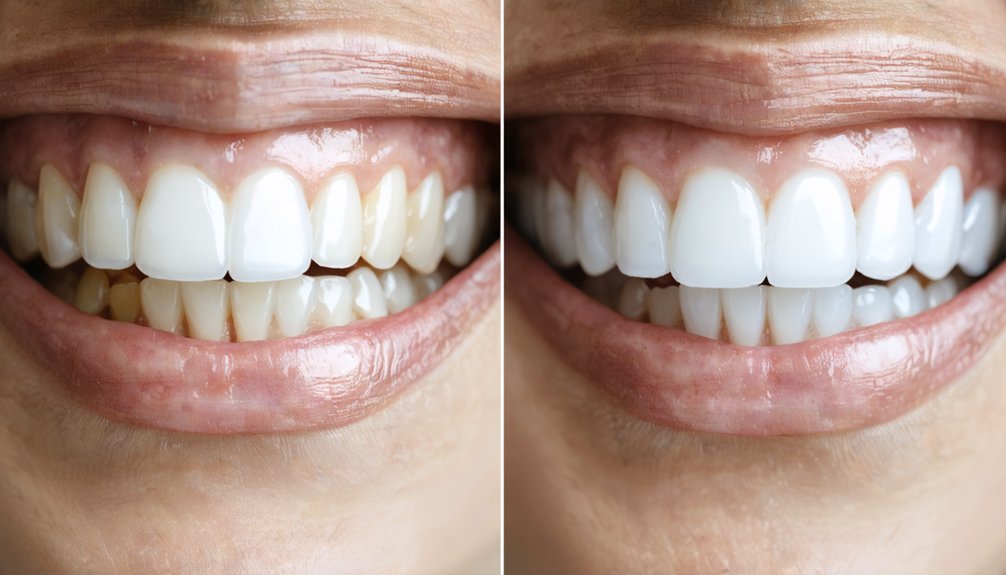
Severe tetracycline stains often demand a two-phase strategy that combines whitening and veneers to achieve the best possible outcome.
Applying whitening techniques first lightens the underlying dentin, reducing the contrast beneath your veneer options and producing more natural-looking results.
Consider these key points before proceeding:
- Extended KöR whitening pre-treats dentin before veneer placement
- Lighter dentin prevents dark undertones from showing through porcelain
- Fewer veneer layers are needed when underlying stains are reduced
- Your dentist customizes shade selection after whitening stabilizes
- Combining both approaches addresses gaps, chips, and discoloration simultaneously
This coordinated protocol gives you precise control over your final result.
Without pre-whitening, even quality veneers may appear gray-tinted.
Consulting a cosmetic specialist guarantees proper sequencing and maximizes your investment in both treatments.
How Much Can Tetracycline Stains Actually Be Lightened?
Although tetracycline stains can’t be eliminated entirely, the degree of lightening you can realistically achieve depends heavily on stain severity, depth, and the treatment protocol you pursue.
Mild yellow-gray stains respond well to extended professional whitening, often achieving significant improvement. Moderate cases with deeper gray banding require aggressive stain management strategies like KöR whitening, which penetrates dentin more effectively than standard systems.
Severe brown or dark gray stains resist most whitening treatment options, making veneers or bonding more appropriate solutions.
Expect partial lightening rather than complete removal. Extended protocols spanning 6–12 months produce measurable results in cases that shorter treatments can’t address.
Your outcome depends on when tetracycline exposure occurred, which dentin layers were affected, and how consistently you follow your prescribed treatment plan.
Frequently Asked Questions
Can Tetracycline Stains Affect Children’s Permanent Teeth After Antibiotic Treatment?
Yes, tetracycline can affect your child’s permanent teeth if taken during critical tooth development stages. The antibiotic timing matters greatly—exposure before age eight risks embedding deep stains into developing dentin permanently.
Does Dental Insurance Typically Cover Whitening Treatments for Tetracycline-Stained Teeth?
Like a locked door, insurance options rarely open for cosmetic whitening. Most plans won’t cover tetracycline treatment costs, as they’re deemed aesthetic. You’ll need to explore financing or out-of-pocket payment plans instead.
Are Tetracycline Stains Hereditary or Passed From Parent to Child?
Tetracycline stains aren’t hereditary—they’re not linked to genetic factors. They develop when you’re exposed to the antibiotic during tooth formation. Your dental health is affected by environmental exposure, not inherited traits passed from parent to child.
Can Pregnant Women Safely Undergo Professional Whitening for Tetracycline Stains?
You shouldn’t undergo professional whitening during pregnancy due to dental safety concerns. Instead, explore whitening alternatives post-delivery, when stronger protocols like KöR become viable options for effectively addressing your tetracycline stains without compromising maternal or fetal health.
How Long Do Whitening Results Last Before Tetracycline Stains Reappear?
Like a fading echo, whitening longevity varies—you’ll typically maintain results for 1–3 years before stain reappearance occurs. You’ll need periodic touch-ups, especially with KöR protocols, to sustain your improvement effectively.
References
- https://vegassmilesuite.com/how-to-whiten-teeth-with-tetracycline-stains/
- https://goldstardentalstation.com/can-teeth-whitening-fix-tetracycline-stains/
- https://myserenitydental.com/remove-tetracycline-stains-from-teeth/
- https://www.dorsetstreetdental.com/tetracycline-stains-fighting-back-for-a-brighter-whiter-smile/
- https://www.healthline.com/health/tetracycline-teeth
- https://bethanyfamilydental.com/remove-tetracycline-stains-with-cosmetic-dentistry/
- https://www.scrippsdentalcare.com/cosmetic-dentistry/how-can-i-get-rid-of-tetracycline-stains/
- https://www.korwhitening.com/6-things-know-treating-tetracycline-patient-kor-whitening-products/
- https://www.stanleysmiles.com/blog/how-can-i-whiten-my-tetracycline-stains