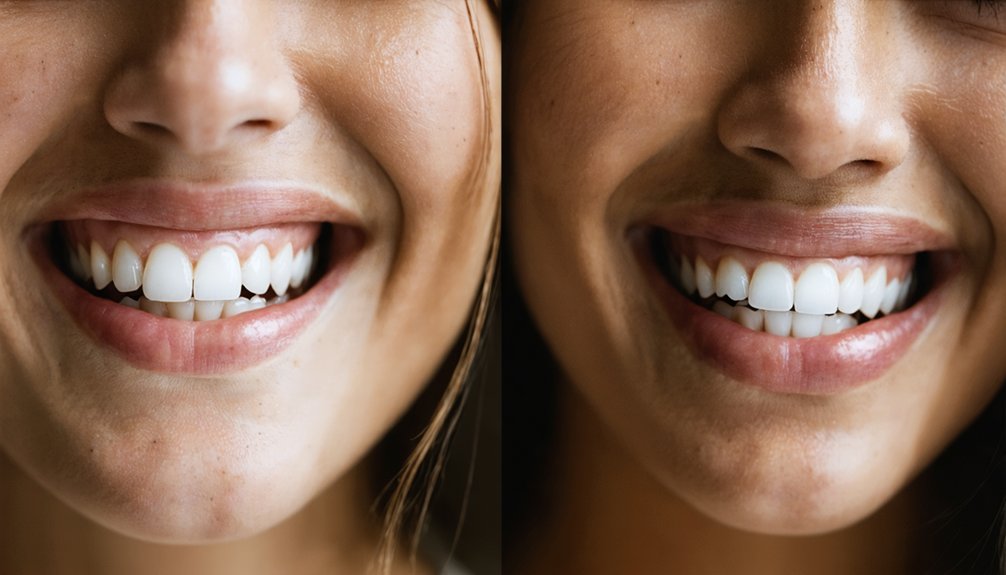
You can realistically expect professional whitening to lighten your teeth 2-8 shades, with in-office treatments delivering the most dramatic results in a single 30-60 minute session. Your outcomes depend considerably on your age—teens achieve superior results due to thicker enamel, while older adults face limitations from dentin yellowing and decades of staining. About 54-67% of users experience temporary sensitivity that resolves within two weeks. Results typically last 6 months to 3 years depending on your chosen method, though you’ll need touch-ups every 9-12 months to maintain brightness and understand the biological factors affecting your unique situation.
Key Takeaways
- Professional treatments typically lighten teeth 7-8 shades in one session, while at-home kits produce 2-3 shades over several weeks.
- Results last 6 months to 3 years for in-office procedures, depending on lifestyle habits and maintenance routines.
- Sensitivity affects 54-67% of users, peaking within 24 hours but typically resolving within 1-2 weeks.
- Younger patients achieve better results due to thicker enamel, while older adults face limitations from thinning enamel and deeper staining.
- Whitening agents don’t work on exposed roots, existing restorations, or certain types of intrinsic discoloration.
How Much Whiter Your Teeth Can Actually Get
When you undergo professional teeth whitening, the actual degree of color change can be quantified through ΔE measurements—a standardized metric that captures the difference between your teeth’s pre-treatment and post-treatment shades. In-office treatments using 35-40% hydrogen peroxide typically produce immediate ΔE values of 5.28-5.92, translating to approximately 4-8 shades lighter.
You’ll notice treatment limitations exist: while most patients achieve 2-5 shades of improvement, only a small percentage reaches 10-15 shades. Individual variations greatly affect outcomes—teens aged 14-16 obtain ideal results due to enamel characteristics, whereas older adults experience less dramatic changes from cumulative staining and existing restorations.
Your results depend on baseline tooth color, enamel thickness, and age-related factors that determine your whitening ceiling.
How Long Your Whitening Results Will Last
Professional teeth whitening doesn’t deliver permanent results—your newly brightened smile will gradually fade over time, with longevity ranging from a few weeks to three years depending on the treatment method you select. In-office procedures using concentrated hydrogen peroxide typically maintain visible brightness for 6 months to 3 years, while dentist-prescribed take-home trays last 6 months to 1 year. Over-the-counter whitening strips deliver results lasting 3-6 months, whereas whitening toothpaste maintains brightness for only 1-3 months.
The impact of diet and habits directly determines how quickly your results fade. Consuming staining beverages like coffee and tea accelerates color relapse, as does tobacco use. Ongoing maintenance requirements include consistent oral hygiene practices and periodic touch-up treatments to sustain your preferred shade year-round.
Sensitivity and Side Effects You Might Experience
Tooth sensitivity represents the most common side effect of whitening treatments, affecting approximately 54% of patients using carbamide peroxide products and two-thirds of those using over-the-counter formulations. The severity correlates directly with peroxide concentration—40% hydrogen peroxide increases sensitivity scores from 1.4 to 6.2 within one day post-treatment, while 10% carbamide peroxide produces minimal elevation from 1.7 to 2.2.
You’ll find symptoms peak within 24 hours of application and typically resolve within one to two weeks, with proper management strategies considerably reducing your discomfort throughout the whitening process.
How Common Is Sensitivity?
Sensitivity ranks as the most commonly reported side effect of teeth whitening, affecting approximately half of all patients who use at-home treatments. With 15% carbamide peroxide, 54% of patients experience mild sensitivity, 10% moderate, and 4% severe. The level of sensitivity correlates directly with treatment concentration—40% hydrogen peroxide produces the highest intensity (mean score 6.2), while 10% carbamide peroxide generates the lowest.
Risk factors for sensitivity include gingival recession and baseline tooth sensitivity. In-office treatments using 6% hydrogen peroxide carry a 33.3% absolute risk during application. You’ll typically experience peak sensitivity one day post-treatment, with most cases resolving within two weeks. Severe sensitivity diminishes by week two, while moderate symptoms resolve by week four.
Managing Discomfort During Treatment
While teeth whitening delivers aesthetic benefits, you’ll likely encounter discomfort that requires proactive management. Reducing gum irritation starts with applying protective barriers—professional treatments utilize dams or gels to prevent peroxide contact, whereas home applications demand precise tray placement. If chemical burns occur, discontinue treatment immediately.
For minimizing nerve irritation, incorporate desensitizing toothpastes containing potassium nitrate or apply prescribed fluoride gels before bleaching sessions. Select lower peroxide concentrations (10% carbamide versus 35% hydrogen peroxide) when sensitivity develops. Space treatment sessions adequately—allowing 48-72 hours between applications prevents cumulative pulp inflammation.
Avoid acidic beverages and extreme temperatures during your whitening course. If discomfort persists beyond several days or intensifies with each session, consult your dentist to assess for underlying enamel cracks, exposed dentin, or compromised restorations requiring intervention.
Why Age Matters for Whitening Outcomes
As the years pass, your teeth undergo structural changes that greatly impact how well whitening treatments work. Enamel density changes occur naturally—your enamel thins and becomes more translucent, revealing the yellowish dentin beneath.
This dentin discoloration impact intensifies as the underlying layer darkens through cellular maturation and increased mineralization. You’ll find that younger teeth with thicker enamel reflect light more effectively, producing superior whitening results.
Decades of stain accumulation from coffee, wine, and tobacco create deeper discoloration that’s resistant to treatment. Additionally, age-related conditions like gum recession expose tooth roots that won’t respond to whitening agents.
These structural limitations mean you can’t expect the same dramatic results older teeth once achieved in youth. Understanding these biological factors helps you set realistic goals and choose appropriate treatment intensity.
Professional Treatments vs. At-Home Methods
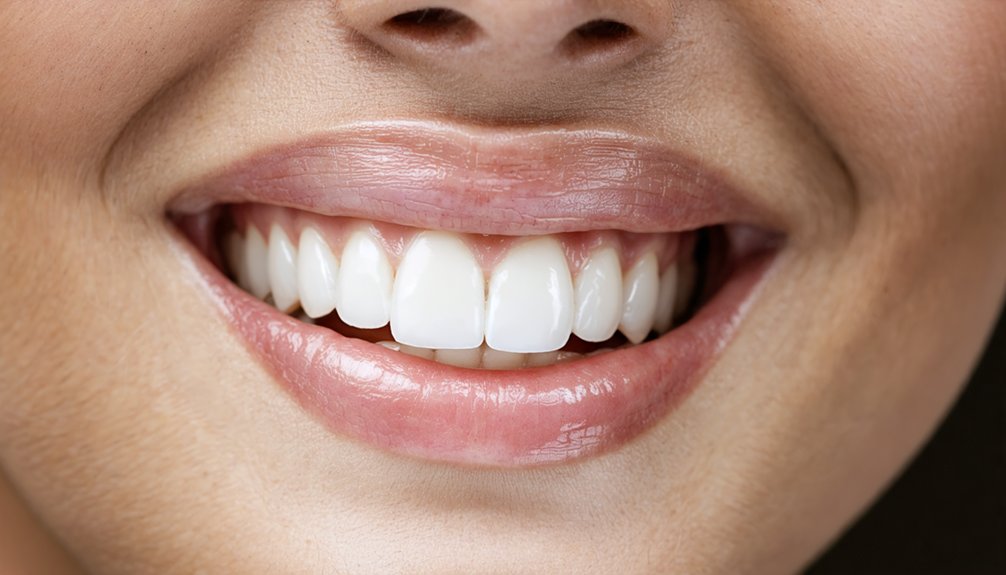
When comparing professional and at-home whitening methods, you’ll find significant differences in both effectiveness and longevity of results.
Professional in-office treatments achieve 7-8 shades lighter on average within a single 30-60 minute session, while at-home kits typically deliver only 2-3 shades of improvement over several weeks of application.
Professional treatments also maintain their whitening effects for several months to up to 3 years, whereas at-home methods require more frequent reapplication due to their shorter duration and lower bleaching agent concentrations.
Effectiveness and Color Changes
Professional in-office whitening treatments deliver immediate, dramatic color changes through high-concentration hydrogen peroxide (HP) formulations ranging from 35-45%. You’ll observe ΔE values of 5.92 initially with HP35%, increasing to 7.20 at six months, demonstrating sustained stain removal effectiveness. These prescription-grade agents target extrinsic stains from coffee, tea, wine, and smoking with measurable spectrophotometer-verified results.
At-home systems use lower concentrations (6-10% HP), yet you’ll achieve comparable ΔE value fluctuations. While 10% HP applied for 30 minutes daily matches 10% carbamide peroxide used 8 hours daily, you’ll notice more gradual improvements. Studies show at-home methods sometimes outperform in-office treatments immediately post-treatment (p<0.05). However, professional treatments provide faster visible changes and custom-fit delivery systems that minimize uneven results you might experience with over-the-counter options.
Duration of Whitening Results
Following your in-office whitening session, you’ll maintain peak brightness for 1 to 3 years when you adhere to recommended care protocols. Your teeth will reach maximum whiteness within 3 to 6 months post-treatment, with 4 to 6 shades of improvement remaining visible at the one-year mark.
Professional at-home kits using custom trays deliver comparable recall duration—up to 1 year or longer with diligent maintenance. Conversely, over-the-counter strips and gels provide results lasting only a few weeks to several months, while whitening toothpaste extends effects up to 3 to 4 months.
For maintaining whiteness between treatments, schedule touch-ups every 9 to 12 months. Complement professional sessions with custom tray applications using lower-concentration gel. Your dietary choices, smoking status, and oral hygiene practices directly determine longevity.
Timeline: When You’ll Start Seeing Changes
Most patients notice their first whitening changes within hours to weeks, depending entirely on which treatment method they’ve chosen. In-office professional treatments deliver 2 to 8 shades of improvement within 60 to 90 minutes using highly-concentrated peroxide formulas. Dentist-supervised take-home trays produce visible results in 1 to 2 weeks with daily 1 to 2 hour applications.
Over-the-counter strips require at least one month of nightly use before noticeable effects appear. Whitening toothpaste demands 2 to 6 weeks of twice-daily application for visible changes.
Your desired timeline should guide your treatment selection. Week one brings the fastest visible change as surface stains lift first. Week two shows deeper pigment fading with improved light reflection. By week three, shade change stabilizes. Your expected timeframe depends on stain severity and peroxide concentration used.
Frequently Asked Questions
Can Whitening Damage My Tooth Enamel Permanently?
Professional whitening won’t permanently damage your enamel when you follow expert guidelines, but improper DIY products create real enamel erosion risks. You’ll avoid sensitivity concerns by choosing dentist-supervised treatments that protect your tooth structure through controlled application.
Will Whitening Work on Crowns, Veneers, or Fillings?
Unfortunately, whitening won’t touch these restorations—they’re color-locked. Due to veneer limitations and crown durability, their non-porous materials resist bleaching agents completely. You’ll need to whiten natural teeth first, then replace restorations to match your new shade perfectly.
How Much Does Professional Teeth Whitening Typically Cost?
Typical costs range from $400 to $1,500 for in-office treatments and $150 to $600 for take-home kits. Dental insurance coverage rarely applies since whitening’s considered cosmetic, so you’ll likely pay out-of-pocket.
Are Natural Whitening Remedies Effective Compared to Commercial Products?
Natural whiteners versus chemical whiteners show limited effectiveness—homemade whitening remedies like charcoal and strawberries don’t reach perceptibility thresholds, while commercial products consistently surpass acceptability standards. You’ll achieve better control over results using evidence-based professional formulations.
Can I Whiten My Teeth if I Have Braces?
You’ll want to pump the brakes—braces compatibility limits your bleaching method options. Over-the-counter strips don’t fit brackets properly, causing uneven results. You’re better off waiting until removal or consulting your dentist for custom-fitted trays.