You’ll need professional-grade carbamide peroxide (10-16%) in custom trays worn nightly for 6-12 months—not OTC products that can’t penetrate tetracycline’s calcium-bound discoloration. Your stain classification determines realistic expectations: first-degree yellow-gray stains improve 3-4 shades, while severe blue-gray banding requires veneers. Don’t stop when you see dramatic early whitening; that’s temporary oxygen bubbles, not genuine structural change. Persistent cervical bands respond well to targeted cosmetic bonding after bleaching. The following evidence-based protocols explain exactly how each approach tackles your specific tetracycline challenge.
Key Takeaways
- Professional assessment determines tetracycline stain degree, guiding treatment choice between bleaching, bonding, or veneers for optimal results.
- Custom-tray bleaching with 10-16% carbamide peroxide requires nightly application for 6-12 months to penetrate deep intrinsic discoloration effectively.
- First-week whitening results are temporary oxygen bubbles; genuine color change develops only after sustained months-long treatment commitment.
- Use desensitizing agents with potassium nitrate and fluoride before bleaching to minimize tooth sensitivity during extended treatment protocols.
- Severe third- and fourth-degree stains require porcelain veneers since bleaching proves ineffective for blue-gray banding and black discoloration.
Choose Professional In-Office Treatments Over Over-The-Counter Products
Professional in-office whitening treatments deliver measurably superior results for tetracycline-stained teeth compared to over-the-counter products. You’ll achieve 75% efficacy with nightguard critical bleaching under professional oversight versus zero improvement from OTC brands that can’t penetrate dentin-bound stains.
Advanced in-office techniques target intrinsic discoloration beyond enamel using higher concentrations like 16% carbamide peroxide, delivering shade progressions from C2 to A1 within 3-4 months.
OTC products lack the customization your stain severity demands. They’re formulated for surface stains, not tetracycline’s calcium-binding complexity. You’ll waste two years testing multiple brands with no results.
Professional assessment determines treatment significance upfront through exams and x-rays, creating tailored plans that account for stain location and oral health while minimized risks like hypersensitivity through direct supervision.
Commit To Extended At-Home Bleaching With Custom Trays For At Least Six Months
You’ll need to select the right carbamide peroxide concentration—typically 10% to 16%—and apply it nightly through custom-fitted trays for a minimum of six months to achieve meaningful results with tetracycline-stained teeth.
This extended timeline matters because tetracycline discoloration requires 2-12 months of treatment compared to just 2 weeks for normal tooth stains, with the most dramatic improvements occurring during the first month before gradual lightening continues.
Understanding this commitment upfront prevents you from stopping treatment prematurely when initial progress seems slow, which would waste your investment and leave you with the optical illusion of darker-looking teeth against partially whitened areas.
Optimal Carbamide Peroxide Concentrations
Choosing the right carbamide peroxide concentration determines both your treatment timeline and comfort level throughout the whitening process. For tetracycline staining, you’ll need strategic concentration selection based on severity and sensitivity tolerance.
Concentration Guidelines for Tetracycline Cases:
- 10% carbamide peroxide: Reduces sensitivity risk by 67% compared to higher concentrations while achieving comparable results over extended treatment intervals
- 16% carbamide peroxide: Delivers preferred balance for sensitive teeth with moderate staining, producing effective whitening with minimal side effects
- 20-22% carbamide peroxide: Demonstrates 83.4% probability of maximum effectiveness according to clinical meta-analysis, ideal for severe tetracycline discoloration
- Treatment monitoring: Track whitening progression monitoring every two weeks—all concentrations achieve 12+ shade improvements within 14 days when properly applied
Higher concentrations accelerate results but don’t necessarily improve final outcomes for patient-centered care.
Preventing Optical Illusion Reversal
When tetracycline-stained teeth appear whiter after initial bleaching sessions only to darken again weeks later, you’re experiencing optical illusion reversal—a phenomenon where temporary surface effects fade before genuine structural whitening occurs. Short-term treatments rely on optical enhancers like Blue Covarine that wash away, leaving deep stains unchanged.
You’ll prevent this reversal by committing to custom-tray bleaching for at least six months. This extended protocol guarantees peroxide penetrates beyond enamel into discolored dentin, achieving structural color change rather than surface tricks. Custom trays maintain consistent gel contact while minimizing saliva interference that dilutes active agents. Wear your trays nightly for 4-8 hours, avoiding interruption in treatment to stop pellicle reformation that blocks peroxide absorption. Track progress with shade guides—authentic whitening remains stable, confirming you’ve moved past optical illusions to permanent results.
Understand Your Specific Stain Pattern To Set Realistic Whitening Goals
Before selecting a whitening approach, identifying your tetracycline stain classification determines which treatments will work and which will disappoint. You must analyze underlying tooth structure to establish baseline expectations.
Your stain pattern reveals treatment potential:
- First-degree (yellow-gray, uniform): Bleaching achieves 3-4 shade improvement within 8-12 weeks
- Second-degree (yellow-brown, uniform): Extended bleaching protocols yield 2-3 shade gains over 12-16 weeks
- Third-degree (blue-gray with banding): Limited bleaching response; veneers recommended for predictable results
- Fourth-degree (severe black banding): Bleaching ineffective; restorative treatment required
Monitor hydration levels during assessment—dehydrated enamel appears lighter, creating false improvement readings. Uniform staining responds more consistently than banded patterns. Document your classification now to prevent pursuing ineffective protocols that waste time and resources.
Continue Treatment Beyond Initial Results To Avoid The Oxygen Bubble Illusion
You’ll notice dramatic whitening within the first week, but this initial brightness is an optical illusion created by millions of oxygen-filled bubbles trapped in your enamel. These bubbles reflect light back to create temporary whiteness that fades within 5-10 days as they exit your tooth structure, revealing that true whitening hasn’t yet occurred.
If you stop treatment during this deceptive phase, you’ll lose most of the apparent results and miss the genuine color change that only develops after sustained whitening beyond the bubble effect.
Understanding Temporary Whitening Effects
Millions of microscopic oxygen bubbles form within weakened enamel cells during treatment, reflecting light to create immediate whiteness. However, this represents an optical illusion rather than actual stain removal:
- Initial whitening appears within days as reactive oxygen species fill damaged ameloblast cells
- Bubbles persist 5-10 days before gradually exiting tooth structure
- Noticeable darkening occurs during bubble dissipation, causing short-term regression
- True whitening emerges only after complete bubble exit from enamel
The color restoration timeline requires patience—premature treatment cessation causes bubble loss and reversal of visible improvements.
Maintaining Long-Term Color Stability
Pressing forward with treatment after those first encouraging results separates lasting transformation from disappointing regression. Tetracycline chromophores create strong bonds requiring extended protocols—stopping at surface improvement allows deep stains to resurface.
You’ll need 6-12 months of consistent overnight application with 10-15% carbamide peroxide, even after visible changes appear. Custom tray design guarantees precise gel delivery throughout this marathon process.
Your maintenance strategy determines whether you retain over 65% of whitening after five years. Schedule regular touch-ups using your custom trays, practice disciplined oral hygiene, and implement lifestyle modifications immediately.
Eliminate coffee, red wine, and tobacco while prioritizing fluoride treatments. The KöR protocol specifically prevents regression in tetracycline cases by extending treatment beyond early whitening illusions. Control your outcome by committing to the full timeline—partial compliance produces temporary results.
Start With Lower Concentration Bleaching Agents To Minimize Tooth Sensitivity
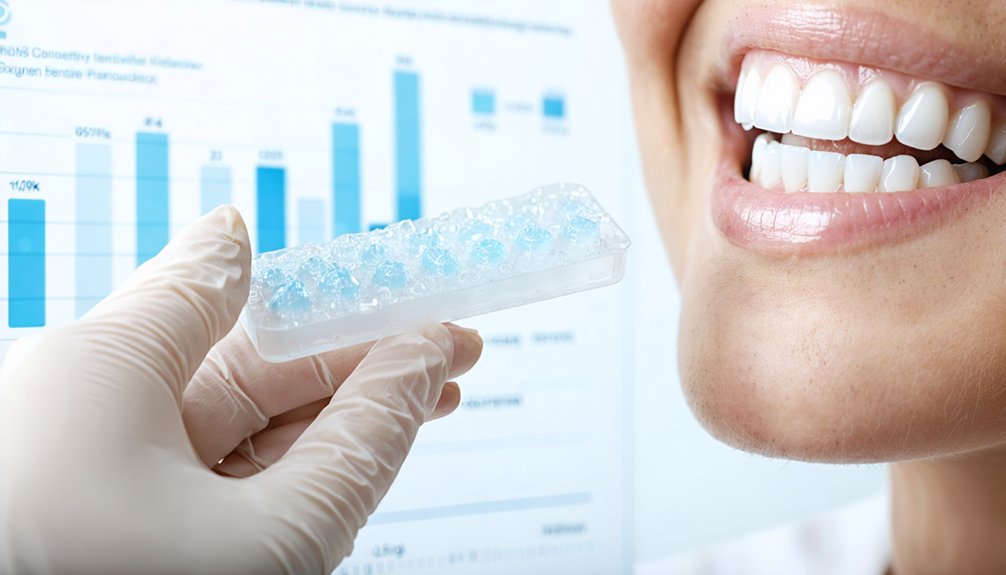
When treating tetracycline-stained teeth, starting with 10% carbamide peroxide in overnight tray bleaching substantially reduces your risk of tooth sensitivity compared to higher-concentration agents. This concentration allows extended contact time—critical for penetrating deep tetracycline discoloration—while maintaining comfort throughout your months-long treatment.
To optimize your whitening protocol:
- Select formulations with potassium nitrate (0.5%) and fluoride ions (0.11%) like Opalescence PF for built-in sensitivity protection
- Utilize complementary desensitizing agents such as CPP-ACPF (GC Tooth Mousse Plus) applied in your tray for 30 minutes before bleaching
- Implement customized application protocols with nonscalloped trays extending 1-2mm onto gingiva to reach challenging cervical areas
- Reserve 16% carbamide peroxide strictly for severe cases requiring accelerated results
This conservative approach delivers predictable color change without compromising your daily activities.
Combine Whitening With Targeted Cosmetic Bonding For Stubborn Cervical Bands
Despite achieving significant lightening through extended bleaching protocols, your tetracycline-stained teeth will likely retain persistent dark cervical bands that resist complete elimination. You’ll need a strategic combination approach: bleach first to maximize intrinsic stain reduction, then apply targeted cosmetic bonding to conceal residual discoloration. This dual method achieves visual symmetry enhancement across your smile.
The bonding procedure involves precise residual color matching—your dentist applies tooth-colored composite resin over stubborn cervical areas after whitening plateaus. The resin adheres through enamel etching, then gets shaped and polished for seamless integration. Clinical data shows 85-91% patient satisfaction and 90% professional ratings of excellent outcomes. You’ll accomplish in one session what bleaching alone can’t deliver: uniform appearance that masks deep dentin chromophores while maintaining a non-invasive, cost-effective solution compared to full veneers.
Consider Porcelain Veneers For Severe Discoloration That Resists Bleaching
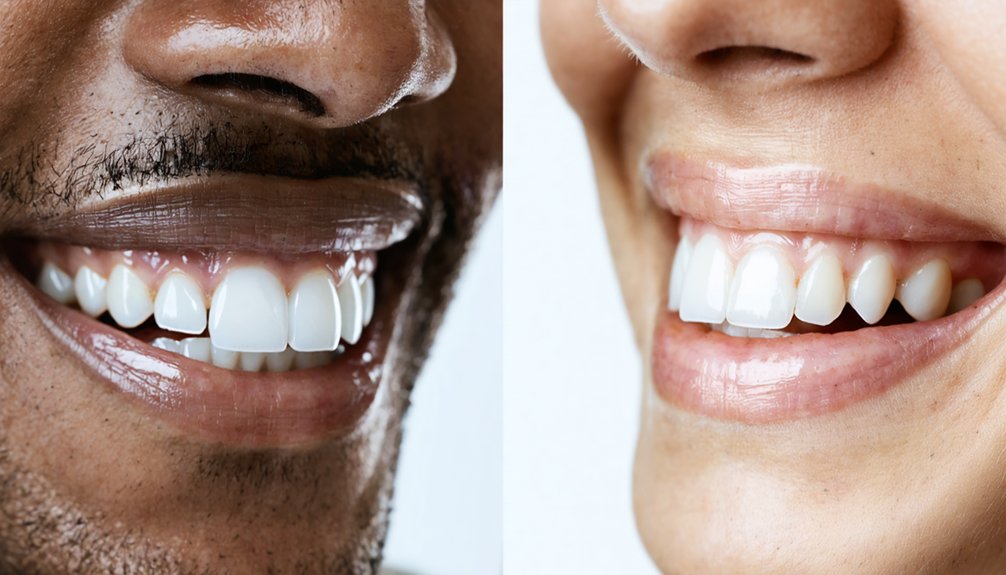
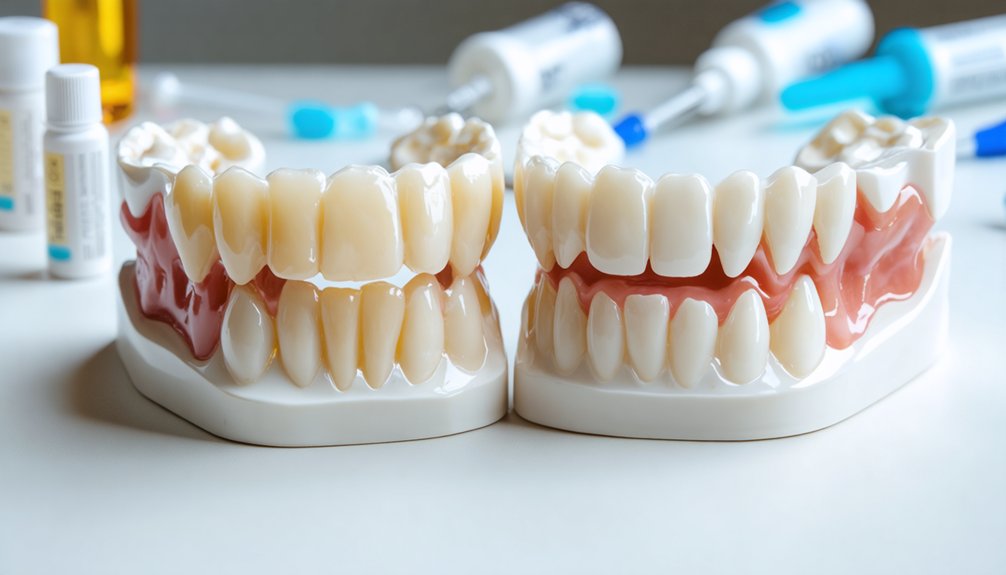
Porcelain veneers represent your definitive solution when tetracycline stains prove too severe for bleaching and bonding protocols. These custom shells instantly mask deep intrinsic discoloration that’s penetrated your enamel structure, delivering predictable aesthetic transformation in 2-3 appointments.
Your treatment success hinges on strategic porcelain veneer material selection and porcelain veneer thickness optimization:
- Vita Suprinity requires 1.2mm thickness to completely mask tetracycline-stained dentin
- Celtra Duo needs 1.6mm for full concealment of dark substrates
- Monolithic lithium disilicate achieves reliable masking for severe cases
- Ultra-thin 3D printed zirconia (120μm) preserves 100% natural tooth structure with no-prep application
You’ll achieve 10-15+ years of stain-resistant, color-stable results. Unlike bonding, veneers won’t chip or discolor over time, granting you permanent control over your smile’s appearance.
Frequently Asked Questions
Can Tetracycline Stains Come Back After Successful Whitening Treatment?
Yes, they’ll absolutely return if you stop treatment too soon. Temporary oxygen bubbles create false whiteness that vanishes within days. Long-term effectiveness demands 8+ weeks of consistent whitening and ongoing maintenance to guarantee patient satisfaction and lasting control over discoloration.
How Much Does Professional Whitening for Tetracycline Stains Typically Cost?
You’ll typically spend $500–$1,000 for KoR Whitening or $800–$3,500 for Deep Bleaching treatments. Procedural considerations like stain severity affect pricing, while whitening effectiveness depends on choosing specialized systems designed specifically for tetracycline discoloration.
Are There Any Foods to Avoid During Tetracycline Teeth Whitening?
Ironically, achieving your brightest smile means temporarily avoiding your favorite colorful foods. You’ll need strict dietary restrictions throughout your whitening duration—eliminating coffee, red wine, berries, and dark sauces protects your investment and maximizes results.
Can Children or Teenagers With Tetracycline Stains Undergo Whitening Treatments?
You’ll need to assess pediatric suitability first—professional whitening isn’t recommended before age 14-16 due to enamel sensitivity. For younger children, explore alternative cosmetic options like veneers or bonding that deliver controlled results without risking developing teeth.
How Long Do Porcelain Veneers Last for Tetracycline Discoloration?
With proper dental hygiene maintenance, your porcelain veneers will typically last 10–15 years or longer. Among long term treatment options for tetracycline discoloration, they offer superior durability, with clinical studies showing over 90% survival rates at ten years.