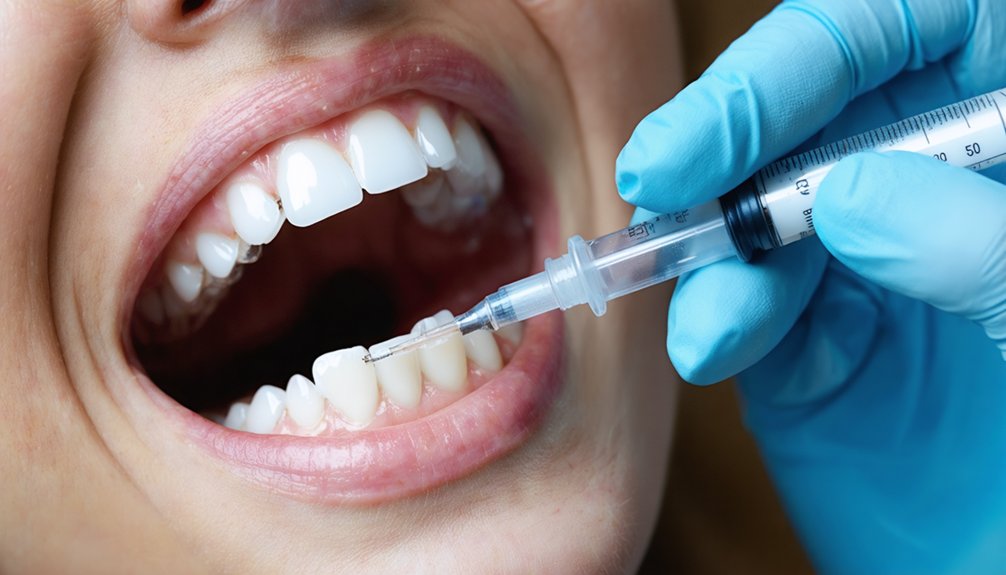
Your dental professional will typically use hydrogen peroxide concentrations between 15% and 40% for in-office whitening, with 35% serving as the clinical standard that delivers an immediate 3.68-shade improvement. Alternatively, they may apply 20-44% carbamide peroxide, which breaks down more slowly but remains active for up to eight hours. These professional-grade concentrations vastly exceed the 3-10% peroxide found in at-home products, requiring licensed supervision to manage sensitivity risks and guarantee safe application protocols tailored to your specific dental condition.
Key Takeaways
- Professional dental offices use hydrogen peroxide concentrations ranging from 15% to 40%, with 35% and 38% being standard protocols.
- Carbamide peroxide for clinical bleaching ranges from 20% to 44%, with 37% serving as the in-office treatment standard.
- Higher concentrations like 35% hydrogen peroxide achieve faster results, producing 3.68 shade improvement immediately after application.
- Treatments exceeding 6% hydrogen peroxide require patients to be at least 18 years old and administered by licensed dental practitioners.
- Lower concentrations of 24-30% hydrogen peroxide can achieve equivalent results to 35% formulations with reduced tooth sensitivity.
Understanding Hydrogen Peroxide Concentrations in Professional Settings
Professional teeth bleaching relies on carefully calibrated hydrogen peroxide concentrations that differ markedly between at-home and clinical applications. In dental offices, you’ll encounter solutions ranging from 15% to 40%, with 35% and 38% being standard protocols. These high-strength formulations deliver immediate results—a 35% application produces a 3.68 shade improvement post-treatment.
Your dentist controls application techniques, often diluting solutions with baking soda to protect enamel and gums during 20-minute sessions. Conversely, at-home products contain 3% to 10% peroxide, requiring extended use—typically 30 minutes daily for two weeks. The FDA caps over-the-counter gels at 6% hydrogen peroxide equivalent.
Patient suitability assessments are critical; concentrations above 10% necessitate professional supervision, as strengths exceeding 30% pose serious health risks, including chemical burns and systemic toxicity.
Carbamide Peroxide Strengths for Clinical Bleaching Applications
While hydrogen peroxide dominates in-office bleaching protocols, carbamide peroxide offers distinct advantages through its slower release mechanism and extended contact time. You’ll find professional applications ranging from 20-44% carbamide peroxide, with 37% serving as the clinical standard for in-office treatments.
These concentrations break down steadily—10% carbamide peroxide releases approximately 3.5% hydrogen peroxide—enabling deeper penetration into tooth structure. Research demonstrates that 30% carbamide peroxide achieves 13 shade guide units within five days, optimizing treatment duration without compromising efficacy.
Custom tray delivery systems maximize contact time while enhancing enamel protection through controlled peroxide release. You’ll achieve ΔE* values exceeding 13.0 regardless of concentration selection. However, strengths above 20% require professional supervision to manage sensitivity risks and guarantee proper application protocols.
Comparing Treatment Speed and Effectiveness Between Peroxide Types
Although both peroxide types achieve comparable final whitening outcomes, hydrogen peroxide delivers measurably faster initial results through its rapid oxygen release mechanism. You’ll observe 6% hydrogen peroxide producing 2.37 shade improvement immediately post-treatment, while 35% hydrogen peroxide achieves 3.68 shades right after application. Carbamide peroxide releases 50% of its agent within two hours but remains active up to eight hours total, requiring longer exposure for equivalent speed.
For user experience considerations, hydrogen peroxide’s 30-60 minute breakdown suits in-office protocols, whereas carbamide’s gradual release accommodates overnight home treatments. Your cost benefit analysis should weigh hydrogen peroxide’s faster chair time against carbamide’s extended wear requirements. Both demonstrate equal six-month retention (1.95 versus 1.70 shades), confirming concentration-adjusted equivalence in long-term effectiveness despite differing treatment timelines.
Managing Tooth Sensitivity During Professional Whitening Procedures
When peroxide agents penetrate enamel during whitening procedures, they’ll temporarily irritate your tooth’s nerve tissue by reaching the underlying dentin layer. This chemical exposure causes pulp inflammation that typically resolves within 24-48 hours. You can proactively manage discomfort by using sensitivity-formulated toothpaste before treatment and requesting topical fluoride application afterward to strengthen enamel barriers. Desensitizing sealants provide additional protection by blocking dentin tubules that transmit pain signals.
Your risk increases with preexisting sensitivity, thin enamel, or untreated cavities. To minimize intensity, you’ll want properly fitted trays that prevent gum contact and consideration of graduated at-home protocols rather than high-concentration in-office treatments. Avoid temperature extremes and acidic foods post-procedure. If discomfort persists beyond several days, consult your dentist for anti-sensitivity medications or treatment modifications.
Safety Standards and Choosing the Right Treatment Protocol
Several critical regulatory frameworks govern professional teeth whitening to protect patient safety while maintaining treatment effectiveness. You must be at least 18 years old to receive treatments exceeding 6% hydrogen peroxide, which can only be administered by or under direct supervision of licensed dental practitioners.
Your dentist’s first assessment determines appropriate protocols by targeting individualized peroxide concentrations based on your tooth sensitivity, staining severity, and desired results. Professional-grade formulations ranging from 24-35% hydrogen peroxide deliver excellent whitening while minimizing enamel damage risk when properly applied.
Studies confirm that 24-30% hydrogen peroxide liquid formulations achieve results equivalent to 35% concentrations with reduced discomfort. Your practitioner must evaluate contraindications and monitor treatment progression, ensuring compliance with regulatory standards throughout your whitening journey.
Frequently Asked Questions
How Much Does Professional Teeth Bleaching Typically Cost?
Professional teeth bleaching typically costs $400-$1,000 for in-office treatments and $100-$600 for take-home kits. You’ll find many practices offer payment plans and financing options to help manage these costs based on your budget and treatment preferences.
How Long Do Professional Teeth Whitening Results Last?
Professional whitening results last 1-3 years, coinciding with your commitment to maintenance recommendations. You’ll control longevity through factors affecting duration: diet choices, oral hygiene, and periodic touch-ups every 6-12 months to preserve your investment.
Can Pregnant or Breastfeeding Women Undergo Professional Teeth Bleaching?
Dental recommendations advise against professional teeth bleaching during pregnancy and breastfeeding due to insufficient safety data on peroxide exposure. You should postpone elective whitening treatments until postpartum, following established safety precautions that prioritize maternal and fetal health.
Will Professional Bleaching Work on Crowns, Veneers, or Fillings?
Professional bleaching won’t change the color of crowns, veneers, or fillings since bleaching effectiveness on restorations is limited to natural tooth structure. The bleaching impact on existing dental work may create color mismatches you’ll need to address through replacement.
How White Can My Teeth Become With Professional Treatment?
Like apothecaries of old, you’ll achieve up to eight shades lighter in one session. Whitening effectiveness depends on your baseline tooth color and stain type, while sensitivity considerations may require treatment modifications to optimize your results.