You’ll face significant hidden expenses beyond the initial treatment cost, including mandatory consultations ($50-$350), professional cleanings, and follow-up monitoring sessions. Your enamel loses 1.2-2 nanometers of hardness per treatment, while protein content drops up to 50%, increasing demineralization risks. Two-thirds of patients experience sensitivity requiring desensitizing treatments ($50-$100). Results fade within 6-12 months, demanding touch-ups ($400-$800) and maintenance products, with total five-year costs reaching $2,000-$5,000—expenses insurance won’t cover since whitening’s classified as cosmetic. Understanding these financial and physiological implications helps you make informed decisions.
Key Takeaways
- Mandatory pre-treatment consultations ($50-$350) and professional cleanings are often required but not covered by insurance.
- Touch-up sessions cost $400-$800 every 6-12 months, with annual maintenance expenses frequently exceeding $1,000 for sustained results.
- Two-thirds of patients need desensitizing treatments ($50-$100) to manage temporary tooth sensitivity after whitening procedures.
- Custom tray systems require $100-$600 upfront, plus $15 per gel syringe for ongoing prescription-strength refills.
- Five-year maintenance totals $2,000-$5,000, excluding consultation fees, sensitivity products, and emergency treatments for chemical burns.
Mandatory Consultation and Pre-Treatment Expenses
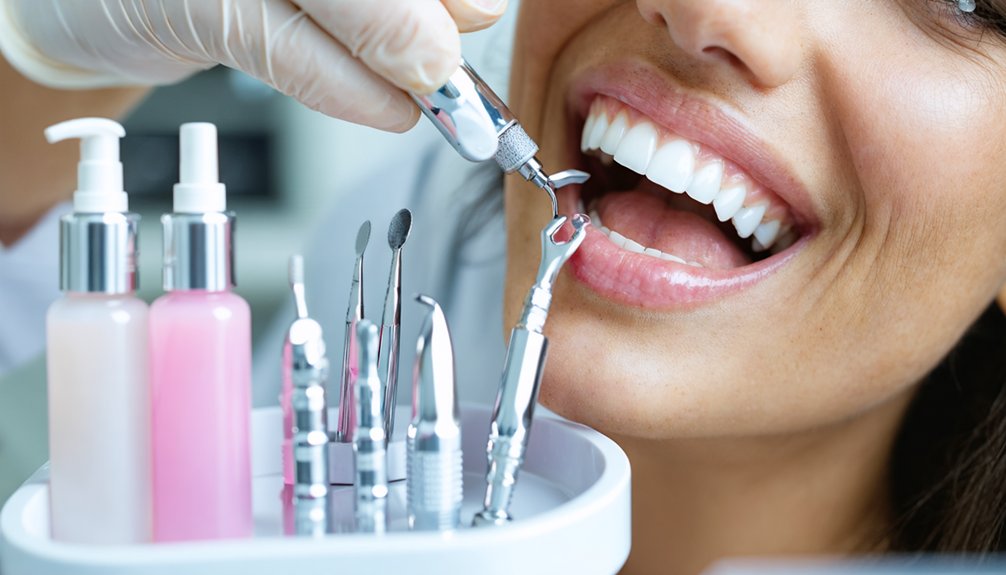
Before undergoing any teeth whitening procedure, you’ll encounter several mandatory pre-treatment expenses that extend beyond the actual whitening cost. Your dentist must evaluate your oral health through an initial consultation, which may require a separate appointment with associated fees ranging widely by provider and location. This consultation assesses your suitability for whitening and establishes a customized treatment plan.
Pre-treatment professional cleaning is required to guarantee ideal results, adding another expense to your total. While some practices bundle consultations with routine checkups, others charge separately, creating reduced appointment accessibility and limited treatment windows. Insurance typically doesn’t cover cosmetic consultations or whitening-specific cleanings, leaving you responsible for out-of-pocket costs. Follow-up visits and monitoring sessions further increase your financial commitment throughout the whitening process.
The Toll on Tooth Enamel From Repeated Whitening
While teeth whitening delivers cosmetic benefits, repeated treatments progressively compromise your enamel’s structural integrity. Each bleaching session reduces hardness by 1.2-2 nanometres and decreases protein content by up to 50%. This protein loss allows peroxide to penetrate deeper into your tooth structure, creating microscopic pores that increase demineralization risk.
High-concentration treatments—particularly 35% carbamide peroxide—can cause pulp cell mortality while free radicals attack enamel crystals directly.
Frequent exposure amplifies these effects: you’ll experience heightened surface roughness, reduced elastic modulus, and increased enamel vulnerability to acid attacks. Home-based treatments pose greater risks than professional applications, as they produce considerably more mineral density loss after demineralization.
Understanding these cumulative structural changes helps you make informed decisions about treatment frequency and concentration levels.
Persistent Sensitivity That Disrupts Daily Life
Two-thirds of patients using over-the-counter whitening products experience transient mild to moderate sensitivity that disrupts routine activities like eating and drinking. You’ll notice this discomfort when bleaching agents penetrate your enamel and dentin, reaching pulp nerve endings. Hot or cold temperatures intensify these sensations, particularly affecting upper lateral incisors during high-concentration treatments.
Your sensitivity typically resolves within 1-2 days, though it can persist longer with pre-existing dental conditions. Implementing pain management strategies proves essential—apply desensitizing toothpaste containing potassium nitrate before treatment to block nerve reactions. Consider tooth health precautions by choosing home-based methods over in-office procedures, as they generate less intense sensitivity. Custom-fit trays guarantee even application, reducing irritation risk. Consult your dentist if discomfort exceeds several days.
Gum Damage From Bleaching Chemicals
When bleaching agents contact your gum tissue, hydrogen peroxide and carbamide peroxide can cause mild chemical burns that manifest as redness, inflammation, and stinging sensations. You’ll notice white patches where gel lingers on soft tissue, particularly with ill-fitting trays that allow leakage.
Your increased risk tolerance when using high-concentration DIY kits or overusing products intensifies burn severity. Professional treatments minimize this damage through gum barriers and custom-fitted trays that prevent bleaching agent migration.
Most burns heal within one week after discontinuing treatment. You can accelerate recovery with saltwater rinses while maintaining adequate oral hygiene. Wipe excess gel from gums immediately during application, follow product instructions precisely, and avoid whitening if you have sensitive gums.
Persistent irritation requires professional evaluation for prescription-strength oral gels.
Zero Insurance Coverage for Cosmetic Procedures
You’ll receive no insurance reimbursement for teeth whitening because insurers classify it as a cosmetic procedure rather than a medically necessary treatment. This classification means you’re responsible for 100% of the costs, as dental plans exclude coverage for procedures that improve appearance without addressing disease, damage, or functional impairment.
You’ll need to explore alternative payment options such as payment plans, dental savings programs, or credit financing to manage the out-of-pocket expense.
Cosmetic Classification Excludes Reimbursement
Insurance carriers uniformly classify teeth whitening as a cosmetic procedure, which automatically disqualifies it from reimbursement under standard dental plans. This classification hinges on the primary purpose test: treatments addressing disease, function, or structural damage receive coverage, while purely aesthetic enhancements don’t.
You’ll find classification nuances matter considerably—the same bonding technique receives reimbursement when repairing decay but zero coverage when closing cosmetic gaps. Understanding these insurance loopholes requires examining your policy’s specific language around medical necessity.
Even premium-tier plans rarely deviate from this exclusion standard. You’ll need preauthorization documentation proving functional impairment to override cosmetic classification. Without demonstrable health consequences, you’ll assume full financial responsibility for whitening treatments, regardless of your plan’s coverage levels for restorative procedures.
Alternative Payment Options Needed
Since dental insurance excludes cosmetic whitening, you’re responsible for the full treatment cost through alternative payment methods. You’ll need to evaluate financing options that align with your budget and treatment timeline.
Consider these structured payment approaches:
- Third-party healthcare credit cards offer promotional 0% APR periods (typically 6-24 months) for treatments exceeding $200, enabling cost distribution without interest if paid within the promotional window
- In-house payment plans through dental practices allow monthly installments directly with your provider, eliminating credit checks but requiring transparent fee structures
- Health savings accounts (HSAs) or flexible spending accounts (FSAs) provide pre-tax payment advantages, reducing effective treatment costs by your marginal tax rate
Compare total repayment amounts, interest rates, and payment terms before committing. Calculate whether promotional financing periods accommodate your full balance payoff to avoid deferred interest charges.
Hidden Costs of Follow-Up Sessions and Touch-Ups
You’ll encounter recurring costs beyond your initial teeth whitening investment, as professional results typically require touch-up sessions every 6 months to 3 years at $100-$300 per visit.
These maintenance appointments can add $200-$600 annually to your whitening expenses, potentially doubling your total investment over three years.
Your individual touch-up frequency depends on lifestyle factors including dietary habits, tobacco use, and oral hygiene practices—with heavy coffee consumption or smoking accelerating the need for reapplication.
Maintenance Session Frequency Costs
How often will you need maintenance sessions to preserve your whitened smile? Your frequency fluctuations depend directly on your habits and lifestyle changes. Coffee, tea, and tobacco users require touch-ups every 6 months, while those with minimal staining habits may extend maintenance to 12-24 months.
Consider these critical frequency-driven costs:
- In-office sessions: $300-$1,500 every 6-12 months, with Zoom whitening averaging $500-$583 per follow-up
- Take-home kit refills: $100-$600 annually for custom tray gel replacements, requiring 1-3 hours daily over 10-14 days
- Annual maintenance totals: $450-$2,050 including periodic dental consultations ($50-$350) and desensitizing treatments ($50-$100)
You’ll control costs by tracking your staining patterns and scheduling strategically, though professional supervision averaged $508 per touch-up in 2022.
Unexpected Reapplication Expenses
While initial whitening costs appear straightforward, reapplication expenses create financial burdens that most patients don’t anticipate. Professional touch-ups range from $400 to $800 per session, with consultation fees adding $75 to $200. You’ll face these costs every few months due to lack of durability in whitening results.
At-home kit refills run $150 to $400 per course, while OTC strips require repurchasing at $30 to $70 for each 10-20 strip package. The unknown budget impact becomes considerable when you calculate annual expenses exceeding $1,000 for sustained results.
Deep stains from smoking or beverages incur higher charges, and severe discoloration demands additional treatments. You’re fundamentally committing to recurring outlays that providers rarely disclose upfront, making true costs substantially higher than advertised.
Long-Term Treatment Investment
Beyond periodic reapplication, the complete financial picture includes structured maintenance protocols that guarantee your initial investment substantially. Professional whitening requires systematic follow-up every 6-12 months, with in-office sessions costing $400-$1,368 and take-home refills ranging $150-$600 per cycle.
Your ongoing cost trends depend on three critical factors:
- Consumption patterns: Coffee, tea, and tobacco users require more frequent touch-ups, accelerating your compounded annual spend
- Treatment modality: Laser whitening averaging $792 per session versus custom tray refills at $438 creates significant variance
- Professional oversight: Dentist-supervised maintenance ($500-$650 annually) ensures efficacy but increases total expenditure
National data shows average professional whitening costs $508 per intervention. Over five years, you’ll invest $2,000-$5,000 depending on your lifestyle factors and chosen maintenance frequency, excluding consultation fees and specialized aftercare products.
Custom Tray Fees and Maintenance Products
When selecting professional teeth whitening, you’ll encounter custom tray systems that range from $100 to $600, with most dentist-prescribed kits averaging $375 to $500. This base price typically includes your initial consultation, dental impressions, and prescription-strength peroxide gel.
However, you’ll face additional gel volume expenses at approximately $15 per syringe for extended treatments beyond the initial supply. High-performance systems like Kor, costing $500 to $1,000, require refrigerated gel storage to maintain potency.
You must budget for custom tray adjustments if damage occurs, though replacement costs aren’t standardized. Sensitivity management products increase your per-session investment. While over-the-counter alternatives exist at $10-$50, they compromise precision fitting.
Professional custom trays deliver superior whitening through accurate fabrication from your dental impressions, justifying the higher upfront investment for controlled, even results.
Brief Results That Demand Constant Reinvestment
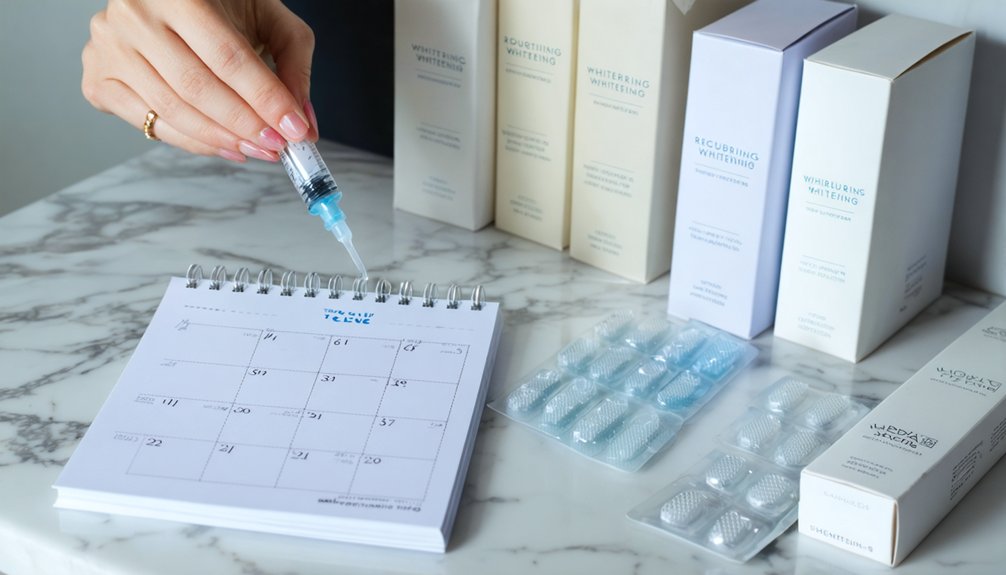
Although professional teeth whitening delivers immediate aesthetic improvements, you’ll face recurring costs that substantially increase your lifetime investment. Professional treatments last only 6 months to 3 years, while at-home kits fade within 4 to 6 months. This limited treatment session sustainability creates a cycle of maintenance spending that demands recurrent cost management.
Professional whitening’s short 6-month to 3-year lifespan creates an expensive maintenance cycle that significantly increases your total lifetime investment.
Your projected expenses include:
- Touch-up sessions: $100–$300 every 6 months to 3 years, with Zoom! treatments starting at $397
- Cumulative costs: Multiple sessions compound when the $575 average in-office whitening requires repeated applications
- Lifestyle-dependent frequency: Diet and oral hygiene habits directly impact how often you’ll need retreatment
Without systematic budgeting for these ongoing interventions, you’ll spend thousands maintaining your initial shade improvement of 5–8 shades over several years.
Frequently Asked Questions
Can Teeth Whitening Damage Existing Dental Work Like Crowns or Veneers?
Whitening won’t damage your crowns or veneers since they’re non-porous, but it’ll create color mismatches. Your natural teeth’s porosity increase enables whitening while restorations stay unchanged, potentially requiring costly replacements. You’ll also face sensitivity risks during treatment.
Are There Natural Alternatives That Reduce Whitening Costs and Side Effects?
You’re in the driver’s seat with natural alternatives like baking soda and oil pulling, offering safer ingredients and reduced sensitivity compared to commercial treatments. These evidence-based options let you control whitening intensity while minimizing enamel damage and inflammation.
Does Whitening Effectiveness Vary Based on Original Tooth Stain Type?
Yes, whitening effectiveness varies appreciably by stain type. You’ll experience better results with extrinsic stains, though enamel integrity and tooth sensitivity variations affect outcomes. Intrinsic stains require stronger treatments, potentially increasing costs and discomfort you’ll need to manage.
How Do Diet Restrictions After Whitening Impact Daily Lifestyle Costs?
You’ll incur elevated costs through food preparation adjustments requiring specialized white-diet ingredients and increased cooking time. Social event attendance challenges emerge when avoiding pigmented beverages and meals, potentially necessitating declined invitations or bringing compliant alternatives during the critical 48-72 hour restriction period.
Can Combining Multiple Whitening Methods Accelerate Enamel Damage Risks?
Yes, you’ll accelerate damage by combining methods. Cumulative peroxide exposure causes gradual enamel thinning and increased sensitivity risks without recovery intervals. You’re preventing remineralization, heightening demineralization, and risking permanent structural weakening that professional monitoring could prevent.