Maximizing peroxide whitening gel for stubborn stains requires matching concentration to stain depth and extending contact time for deeper penetration. Surface stains respond to lower concentrations like 10% carbamide peroxide, while intrinsic discoloration from aging, tetracycline, or fluorosis demands 16–35% hydrogen peroxide with prolonged exposure. A well-fitted custom tray reduces saliva dilution and improves gel contact. You can’t bleach what peroxide can’t reach—and everything below breaks down exactly how to make that happen.
Key Takeaways
- Intrinsic stains from aging, tetracycline, or fluorosis require 16–35% hydrogen peroxide concentrations to penetrate deep enough for effective results.
- Extended overnight wear outperforms short, high-intensity sessions by allowing peroxide to diffuse deeper into enamel and dentin.
- Custom-fitted trays maximize gel contact by reducing saliva dilution, significantly improving peroxide penetration compared to store-bought alternatives.
- Matching peroxide concentration to stain depth improves whitening efficiency while minimizing unnecessary sensitivity and enamel stress.
- Intrinsic stains typically require 3–6 months of consistent nightly treatment; track shade changes every two weeks to monitor progress.
Why Stubborn Stains Resist Standard Whitening Gels
Standard whitening gels struggle with stubborn stains because oxidation has to reach compounds embedded deep within enamel and dentin—not just on the surface. Surface buildup from coffee, tea, or tobacco responds relatively quickly to low-concentration peroxide.
Intrinsic discoloration from aging, medications, trauma, or fluorosis doesn’t. You’re dealing with stain molecules bonded within the tooth’s structural layers, and standard over-the-counter formulas often lack the concentration or contact time to penetrate that far.
Hydrogen peroxide can reach the pulp within 15 minutes, but enamel penetration sufficient to break down deep chromogens requires either higher peroxide strength, extended exposure, or both. Low-strength gels target surface buildup effectively—they’re not engineered for the deeper discoloration you’re trying to eliminate.
How Peroxide Actually Breaks Down Deep Stains
When peroxide contacts tooth structure, it breaks apart into unstable free radicals that attack the carbon-based bonds holding chromogen molecules together. This oxidation process targets stain composition directly, dismantling the organic compounds responsible for discoloration rather than abrading the surface.
Enamel permeability determines how deeply this reaction penetrates. Higher permeability allows free radicals to reach dentin-level stains where surface gels fail entirely.
Concentration and contact time both control oxidation depth. A 35% hydrogen peroxide solution can achieve in one application what a 5% solution requires twelve treatments to match.
For intrinsic discoloration, you need sustained exposure, not just a stronger gel. Overnight tray protocols leverage extended contact to drive oxidation progressively deeper, making them more effective against embedded staining than short, high-intensity sessions.
Concentration vs. Contact Time: Which One Drives Results?
When you choose a whitening gel, concentration directly determines how quickly peroxide oxidizes stain compounds—research shows that 35% hydrogen peroxide can achieve results in a single application that 5% hydrogen peroxide requires 12 treatments to match.
Contact time, however, counters the limits of lower concentrations by allowing peroxide to penetrate deeper into enamel and dentin over extended wear periods.
Clinical evidence confirms that 10% carbamide peroxide worn overnight can outperform 28% carbamide peroxide used for only 20 minutes, meaning you can’t evaluate either variable in isolation.
Concentration’s Role In Whitening
Both concentration and contact time drive whitening results, but they don’t work in isolation—each compensates for the other’s limitations. Concentration determines how aggressively peroxide oxidizes stain compounds, while contact time controls how deeply it penetrates enamel and dentin.
Research confirms this tradeoff precisely: 35% hydrogen peroxide required one application to achieve results demanding 12 treatments at 5%. Higher concentration accelerates oxidation, but peroxide stability decreases as strength increases, meaning the active agent degrades faster once applied.
Gel viscosity also matters—thicker formulations maintain better tooth contact and slow dilution from saliva, extending effective exposure.
You can’t treat concentration as a standalone variable. A high-concentration gel worn briefly may underperform a moderate-concentration gel worn overnight, particularly against intrinsic or medication-induced staining.
Contact Time’s Impact
Concentration sets the ceiling for how aggressively peroxide oxidizes stain compounds, but contact time determines whether that oxidation reaches the stain layer that matters. Enamel permeability governs how deeply the active agent diffuses, and that diffusion requires time.
Clinical evidence confirms that 10% carbamide peroxide worn overnight outperforms 28% carbamide peroxide used for only 20 minutes. The higher concentration loses its advantage when exposure ends before peroxide penetrates beyond the surface.
For intrinsic stains, you need sustained gel contact—typically six to eight hours—to drive stain oxidation through enamel and into dentin. Short, high-intensity sessions favor surface discoloration.
If you’re targeting deep or stubborn staining, prioritize protocol duration alongside concentration rather than defaulting to the strongest gel available.
Professional vs. At-Home Whitening Gels: Which Do You Actually Need?
When you’re choosing between professional and at-home whitening gels, concentration is the first meaningful difference: in-office systems typically run 35% to 40% hydrogen peroxide, while most store-bought strips or trays stay well below 10%.
Custom-fitted trays improve on over-the-counter options by limiting saliva dilution and holding gel consistently against the tooth surface, which directly affects how well the active agent penetrates enamel.
If you’re dealing with intrinsic staining from aging, medications, or trauma, professional treatment—either in-office sessions, supervised tray protocols, or a combination—gives you a stronger case for meaningful results than OTC products can reliably deliver.
Concentration Differences Matter
Whether you choose a drugstore strip or a dentist-prescribed tray, the peroxide concentration in that gel determines how quickly and deeply it works. OTC strips typically deliver 3%–10% hydrogen peroxide, limiting color penetration to surface layers.
Prescription trays use 10%–22% carbamide peroxide or higher hydrogen peroxide formulas, reaching deeper enamel stains more effectively.
Research confirms the gap: 35% hydrogen peroxide required one application to achieve results that 5% hydrogen peroxide needed twelve treatments to match.
Your application techniques also affect outcomes—higher-concentration gels demand precise, minimal dosing to reduce gum contact without sacrificing efficacy.
If your stains originate below the enamel surface, a low-concentration OTC product won’t give you meaningful results.
Concentration is your starting point for building the right protocol.
Custom Trays Versus Store-Bought
Knowing the right concentration gets you halfway there—but how that gel stays against your teeth determines whether it actually works. Custom trays seal closely against your enamel, limiting saliva dilution and keeping the peroxide in consistent contact throughout your wear session. That contact time directly drives penetration depth—critical for intrinsic stains.
Store-bought trays can’t replicate that fit. Generic one-size strips and trays leave gaps, allowing saliva to dilute the gel and reducing effective exposure. You’re also locked into lower concentrations by design.
Custom trays paired with prescription-strength gel give you control over both variables: concentration and contact time. For stubborn discoloration, that combination outperforms anything store-bought can offer. If your staining runs deep, the tray fit isn’t a minor detail—it’s decisive.
When Professional Treatment Wins
Custom trays close the gap between at-home and professional results—but some staining won’t respond to tray whitening alone, no matter how well the tray fits. Stain composition determines what’s actually required. Tetracycline bands, fluorosis, and trauma-related discoloration involve structural changes deep within dentin, where enamel permeability limits how far low-concentration gel can reach within a practical timeframe.
In-office systems using 35–40% hydrogen peroxide penetrate those deeper layers faster than any OTC or prescription tray product can. For severe cases, a combined protocol—one or more professional sessions followed by supervised tray whitening—produces greater shade change than either approach alone.
If you’ve run two or more complete tray cycles without meaningful improvement, professional intervention isn’t optional. It’s the clinically appropriate next step.
Choose the Right Peroxide Strength for Your Stain Type
Matching peroxide strength to your stain type directly affects how efficiently you’ll see results. Surface stains from coffee or tea typically respond to lower concentrations—around 10% carbamide peroxide—where gel viscosity keeps the formula stable against enamel long enough for oxidation to work.
Intrinsic stains from aging, tetracycline, or fluorosis require higher hydrogen peroxide concentrations, often 16% to 35%, to penetrate dentin layers where discoloration originates. One study found 35% hydrogen peroxide achieved results in a single application that required 12 sessions at 5%.
pH balance matters here too—gels formulated within an ideal pH range preserve enamel integrity while maintaining oxidative activity. Matching concentration to stain depth isn’t preference; it’s efficiency. Choosing incorrectly wastes time and increases sensitivity without delivering measurable improvement.
How to Apply Whitening Gel for Maximum Penetration
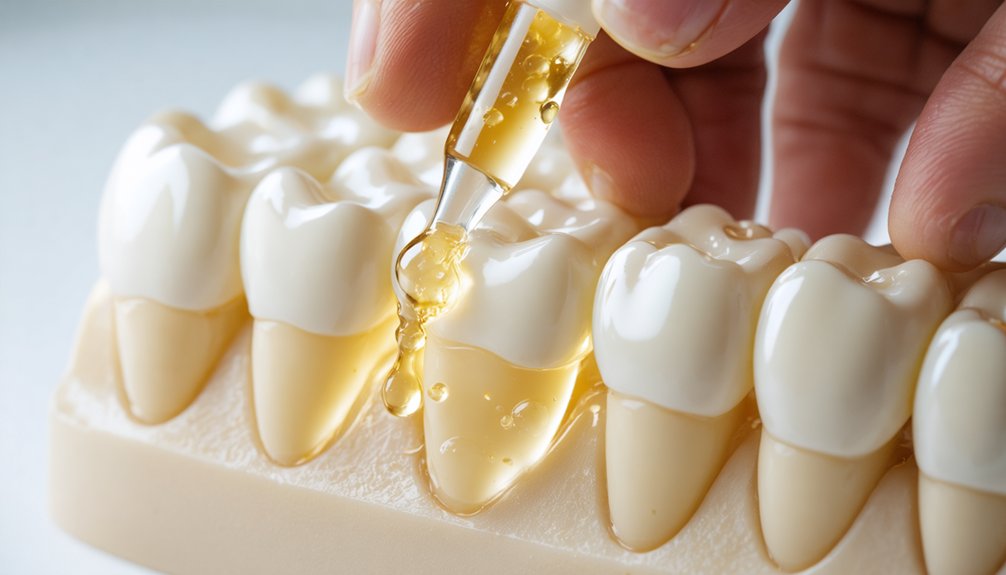
Even the strongest gel underperforms if you apply it incorrectly. Stain morphology determines where peroxide needs to reach, so isolate each tooth surface before loading your tray. Dry your enamel thoroughly — saliva dilutes gel and disrupts enzyme activation, slowing the oxidation process that breaks down stubborn chromogens.
Apply a small, precise bead along each tooth compartment. Excess gel migrates onto gingival tissue, increasing irritation without improving penetration depth. Seat the tray firmly to minimize air pockets and maximize gel-to-enamel contact.
Wear duration matters as much as concentration. For intrinsic stains, extended overnight contact outperforms short, high-intensity sessions. Remove the tray at the first sign of sharp sensitivity, rinse thoroughly, and document your session length to refine your next application systematically.
How Long Whitening Really Takes for Stubborn Stains
Stubborn stains don’t respond on a single timeline, and knowing what drives that variation helps you set realistic expectations. Stain composition is the primary variable. Surface discoloration from coffee or tea may respond within one to two weeks of nightly tray use.
Deeper intrinsic stains from aging, fluorosis, or tetracycline can require three to six months of consistent treatment.
Enamel permeability also affects how quickly peroxide reaches the stain layer. Denser enamel slows diffusion, extending the treatment window regardless of concentration.
Clinical data supports overnight tray protocols over short high-intensity sessions for intrinsic discoloration. Ten percent carbamide peroxide worn eight hours nightly can outperform stronger gels used briefly.
Tracking shade changes every two weeks lets you assess progress and adjust protocol accordingly.
Manage Sensitivity Without Sacrificing Whitening Results
Sensitivity doesn’t have to mean stopping treatment. It signals that you need to adjust, not quit. Start with shorter wear sessions and build duration gradually as your teeth adapt. Use a sensitivity toothpaste containing potassium nitrate or fluoride before and after each session to buffer nerve response.
Gel consistency affects how evenly the peroxide contacts enamel. Thinner formulas spread more readily but may migrate onto gum tissue, increasing irritation. Use only a small dot per tooth to minimize gingival exposure.
Application temperature also matters. Cold gel straight from refrigeration can temporarily heighten sensitivity in already reactive teeth. Allow the gel to reach room temperature before loading your tray.
These adjustments let you maintain treatment momentum without compromising your whitening outcome.
How to Keep Your Whitening Results From Fading
Whitening results fade when newly brightened teeth meet the same habits that caused staining in the first place. Your first 24–48 hours post-treatment are critical—teeth are more porous and absorb pigment faster. Controlling dietary habits and maintaining strict oral hygiene preserves your investment.
- Avoid staining agents immediately. Eliminate coffee, tea, red wine, berries, and tobacco for at least 48 hours after each whitening session.
- Reinforce oral hygiene daily. Brush twice daily, floss consistently, and schedule professional cleanings every six months to prevent surface deposit accumulation.
- Use touch-up treatments strategically. Brief maintenance sessions every 4–6 months using your custom tray prevent significant shade regression without requiring full retreatment cycles.
Consistency between sessions determines how long your results last.
Frequently Asked Questions
Can Whitening Gel Damage Existing Dental Crowns, Veneers, or Fillings?
Whitening gel won’t damage your restorations, but it won’t lighten them either. Dental crown compatibility and veneer stain resistance mean these materials hold their original shade, potentially creating visible color mismatches with your newly whitened natural teeth.
Is Whitening Gel Safe to Use During Pregnancy or Breastfeeding?
Like a storm cloud over your plans, safety concerns and hormonal effects make whitening gel a risk you shouldn’t take during pregnancy or breastfeeding. You’ll want to pause treatment until after this period.
Does Teeth Whitening Gel Expire, and Does Old Gel Still Work?
Yes, whitening gel expires. Its gel shelf life typically runs one to two years; after that, peroxide degrades, reducing teeth stain removal effectiveness. You’ll get weaker oxidation, meaning stubborn stains won’t break down as efficiently with expired product.
Can Children or Teenagers Safely Use Peroxide Whitening Gels?
Pediatric safety concerns make peroxide gels unsuitable for children. Teen usage isn’t recommended until permanent teeth fully erupt, typically around 14–16. You should consult a dentist before initiating any whitening protocol for adolescents.
Will Whitening Gel Interact With Any Common Medications or Supplements?
Ever picture chemicals clashing silently? Direct drug interactions with whitening gel are rare, but you should verify supplement safety with your dentist, especially if you’re taking photosensitizing medications or blood thinners before starting treatment.
References
- https://dentistofplanotexas.com/blog/professional-teeth-whitening-for-deep-stains/
- https://envydental.net/best-professional-teeth-whitening-treatment-for-stubborn-stains/
- https://suezakifamilydentistry.com/articles/19175/professional-teeth-whitening-for-deep-stains/
- https://clubwhitesmile.com/overnight-whitening-trays-do-they-work-better/
- https://www.sciencedirect.com/science/article/abs/pii/S0300571204000119
- https://www.gq.com/story/how-to-whiten-teeth-at-home
- https://www.laserglowspa.com/blogs/news/tips-16-percent-hydrogen-peroxide-whitening-gel
- https://www.ada.org/resources/ada-library/oral-health-topics/whitening