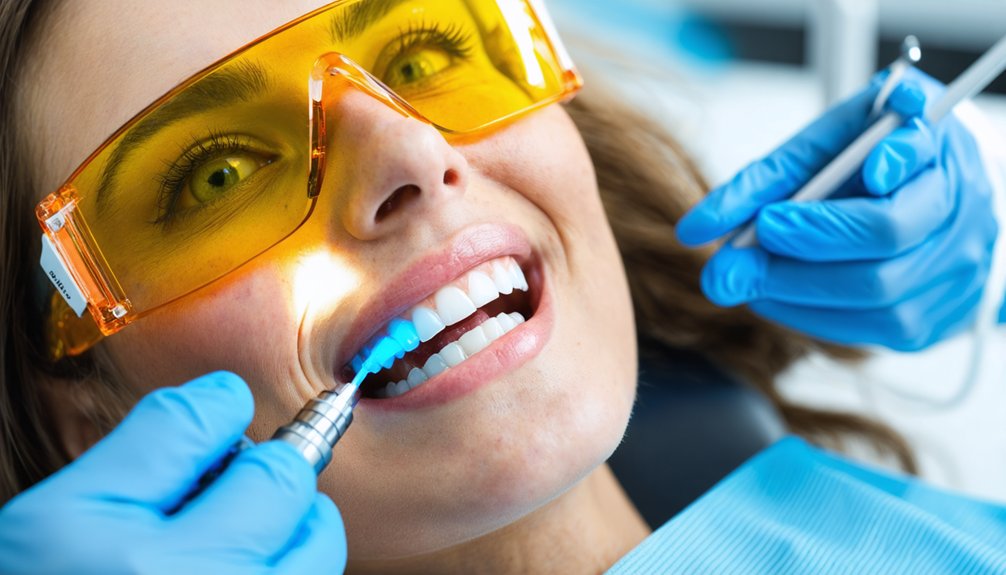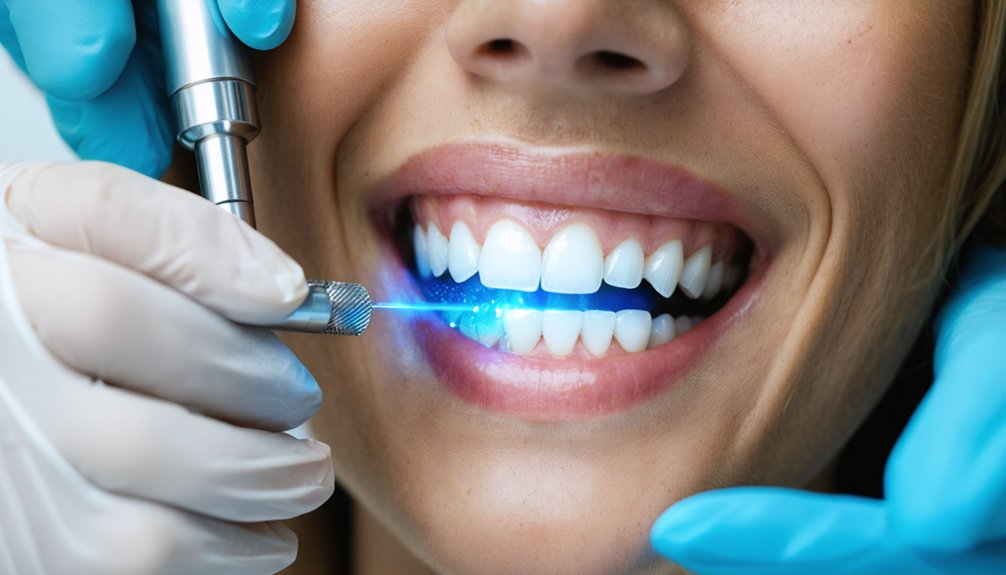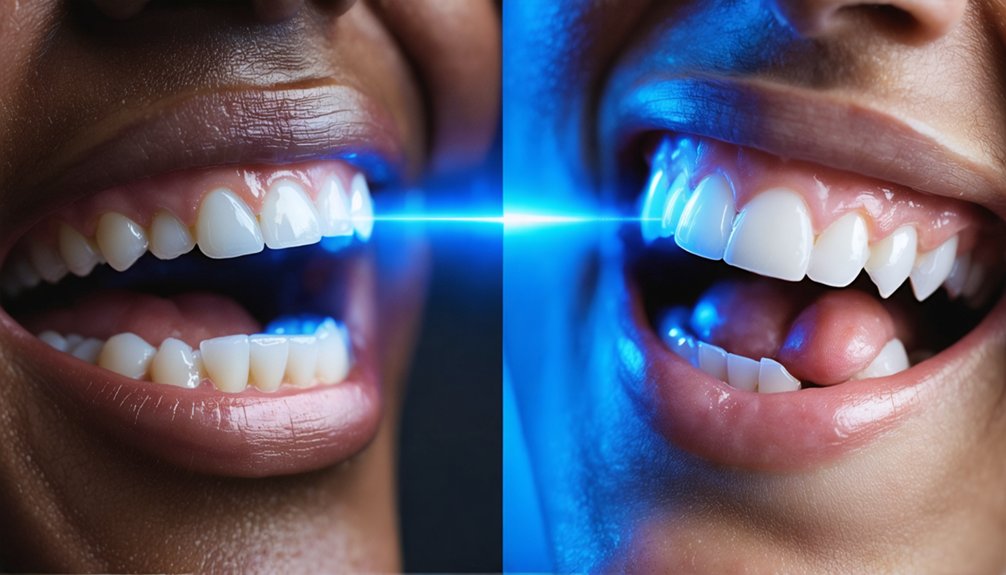
Laser whitening uses concentrated coherent light to deliver up to 60 times more energy than LED, achieving deeper enamel penetration and measurably superior stain removal—particularly for intrinsic discoloration from tobacco or medications. LED systems emit lower-energy incoherent blue light, making them better suited for mild-to-moderate surface stains over multiple sessions. Your choice depends on stain severity, budget, and how quickly you need results. Everything you need to make that clinical decision is covered below.
Key Takeaways
- Laser whitening uses coherent light delivering 20–60 times more energy than LED, enabling deeper enamel penetration and superior results for intrinsic stains.
- LED whitening emits incoherent blue light at lower energy levels, making it effective for mild-to-moderate surface staining but less reliable for deep discoloration.
- Laser whitening typically requires one 15–20 minute session, while LED whitening demands multiple sessions spanning several weeks.
- Laser treatments cost approximately $1,000 per session, whereas LED options are more budget-friendly, though cumulative LED costs can approach laser pricing.
- Deep or resistant stains respond better to laser treatment, while mild-to-moderate discoloration can be adequately addressed with professional LED whitening.
How Laser and LED Whitening Work Differently
When choosing between laser and LED whitening, understanding the underlying mechanism of each technology helps clarify why their results differ so substantially.
Laser whitening uses coherent light at wavelengths between 790–980nm or 450–460nm, delivering 20–60 times more energy per cm² than LED. This accelerates free radical release within the bleaching gel, driving deeper enamel penetration and superior treatment effectiveness.
LED whitening emits incoherent blue light at approximately 450nm with power densities ranging from 30–800 mW/cm². Without phase alignment, light distribution remains less uniform, limiting how consistently the whitening technology activates the peroxide gel across all tooth surfaces.
You’re fundamentally choosing between a precise, high-energy catalyst and a broader, lower-intensity activator—a distinction that directly determines how aggressively your staining can be addressed.
Which One Actually Removes Deeper Stains?
Those mechanical differences in light energy translate directly into measurable clinical outcomes when the target is deep, stubborn discoloration.
When you’re evaluating deeper stain removal, the data favors laser consistently. Clinical studies show laser bleaching increases whiteness 1.88 times more than LED-activated power bleaching, with a ΔE decrease of 3.05 versus 1.67. That gap reflects laser’s capacity to drive free radicals deeper into enamel, addressing intrinsic staining from tobacco, coffee, medications, and tetracycline exposure more effectively.
LED’s whitening effectiveness remains clinically valid for mild-to-moderate surface staining, but it struggles where structural discoloration exists.
If you’re dealing with severe or longstanding discoloration, LED systems frequently require repeated sessions without achieving comparable results. Laser delivers that outcome in a single visit.
Laser Whitening Takes One Visit: LED Takes Weeks. Here’s Why
When you choose laser whitening, you can expect results in a single 15-to-20-minute session, as the high-energy beam activates 25–40% hydrogen peroxide gel rapidly and efficiently.
LED treatments, by contrast, require multiple sessions spanning several weeks because the lower-intensity light drives slower peroxide activation at concentrations of only 6–35%.
Understanding this timeline difference helps you weigh the clinical tradeoffs between immediate, single-visit results and a more gradual, lower-intensity approach.
Laser’s Single-Session Speed
One visit to the dental chair is all laser whitening typically requires, and the science behind that efficiency comes down to how coherent light interacts with bleaching gel.
Laser efficiency stems from concentrated wavelengths between 790–980nm, which accelerate free radical release and drive peroxide deeper into enamel. That activation raises peroxide utilization to 25–40%, greatly compressing treatment time to 15–20 minutes per session.
You’re not waiting weeks for cumulative results—immediate results emerge within a single appointment. For patients who value treatment convenience, that distinction matters considerably. You control your schedule rather than committing to repeated visits.
Clinical data supports this patient preference, showing laser’s ΔE reduction of 3.05 versus 1.67 for LED-based methods, confirming that speed here doesn’t compromise outcome quality.
LED’s Multi-Week Timeline
Where laser whitening compresses results into a single 15–20 minute appointment, LED technology operates on an entirely different timeline—one measured in weeks rather than minutes.
LED duration typically spans 30–90 minutes per session, with multiple visits required before you achieve noticeable changes. The lower peroxide concentrations—ranging from 6–35%—demand extended light exposure to activate the bleaching gel adequately.
LED effectiveness depends heavily on consistency and repetition. You’re not getting accelerated free radical release or deep enamel penetration; you’re accumulating incremental improvements across several sessions.
For mild-to-moderate staining, this graduated approach delivers acceptable outcomes. However, if you’re managing severe discoloration, the multi-week commitment may yield insufficient results.
Understanding this timeline upfront lets you align your treatment choice with your actual whitening goals.
Laser vs LED Side Effects: Sensitivity, Heat, and Gum Risk
Although both laser and LED whitening are considered safe, they carry distinct side effect profiles you should weigh before choosing a treatment.
Both laser and LED whitening are safe — but their side effect profiles are worlds apart.
Laser systems use higher peroxide concentrations (35–44%), which can trigger short-term sensitivity concerns, though gel application actively controls pulpal temperature elevation.
Diode lasers, however, are clinically linked to less post-treatment sensitivity than non-activated agents when properly managed.
LED systems generate minimal heat and carry a lower sensitivity risk due to reduced peroxide concentrations (6–35%).
That said, prolonged exposure during multiple sessions increases cumulative gum irritation risk.
Your choice hinges on tolerance and stain severity.
Laser demands professional oversight to mitigate thermal and chemical risks, while LED offers a gentler profile suited for patients prioritizing comfort over speed.
What Does Laser Teeth Whitening Cost vs LED?
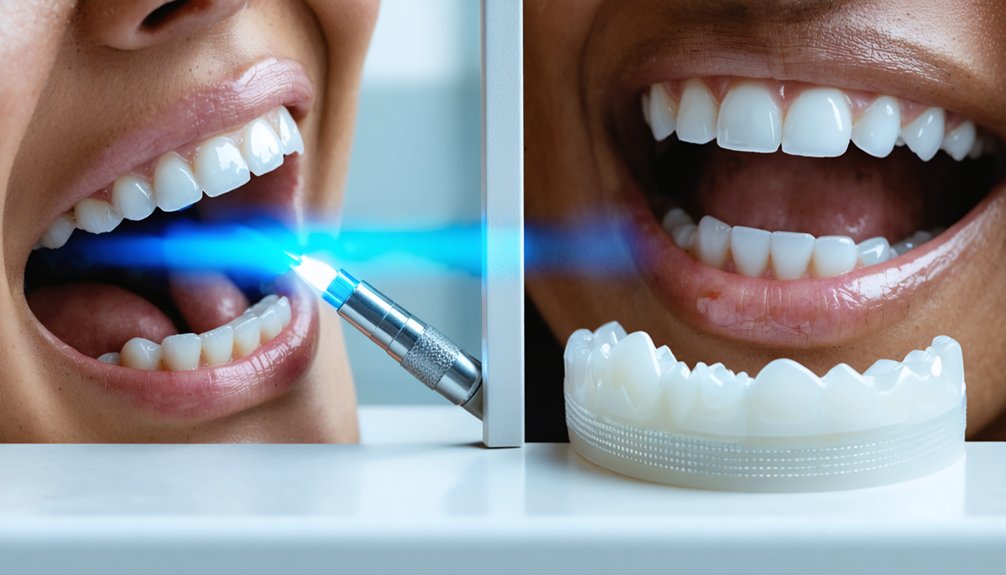
When choosing between laser and LED teeth whitening, you’ll find a significant cost difference between the two options.
Laser treatment typically runs about $1,000 per session, with annual maintenance costs adding to the long-term investment.
On the other hand, LED options offer more budget-friendly alternatives through at-home kits or non-certified clinic visits.
Your stain severity and desired results should guide which expenditure makes clinical sense for your situation.
Laser Treatment Session Costs
Cost is one of the most decisive factors when choosing between laser and LED teeth whitening. Laser treatment pricing typically runs around $1,000 per session, reflecting the specialized equipment, professional certification requirements, and clinical overhead involved.
You’re investing in a single-visit procedure where session duration averages just 15–20 minutes, delivering measurable results immediately. That efficiency justifies the higher upfront cost for patients targeting deep, stubborn stains requiring dramatic correction.
Annual maintenance sessions may add to long-term expenses, but the extended durability of laser whitening offsets recurring treatment costs over time.
If you’re weighing value against outcome, laser whitening’s precision and speed compress your overall treatment timeline considerably — making the per-session cost more defensible than it may initially appear on your budget.
LED Whitening Budget Options
LED whitening sits at a fraction of laser’s $1,000 per-session price point, making it the default choice for budget-conscious patients managing mild-to-moderate discoloration.
Budget-friendly alternatives range from professional in-office LED sessions to certified at-home kits, giving you flexibility based on staining severity and financial constraints.
Professional LED sessions typically cost considerably less than laser treatments, while lower-intensity LED whitening options are available without requiring dental certification, further reducing overhead costs.
At-home kits utilizing 6-35% peroxide concentrations let you control treatment timing and frequency across multiple sessions.
However, you should factor in cumulative session costs.
Repeated LED treatments addressing persistent discoloration can approach laser pricing over time, potentially diminishing the initial cost advantage if your staining requires sustained intervention.
Deep Stains, Tobacco, and Medications: When Laser Whitening Wins
Stubborn intrinsic stains from tobacco, coffee, tea, and tetracycline medications resist conventional bleaching because the chromogens penetrate deep into dentin tubules, far beyond the reach of low-energy light activation.
These stain types demand a more aggressive clinical approach. Laser’s coherent beam delivers 20–60 times higher energy per cm² than LED, accelerating free radical release within 35–44% hydrogen peroxide gel for deeper enamel and dentin penetration.
Clinical evidence confirms laser bleaching achieves a ΔE of 3.05 versus LED’s 1.67, producing 1.88 times greater whiteness improvement.
You’ll also gain superior treatment longevity, reducing the frequency of retreatment cycles.
When your staining is severe and time matters, laser whitening gives you measurable, evidence-backed control over outcomes LED simply can’t match.
When Professional LED Whitening Is the Smarter Choice
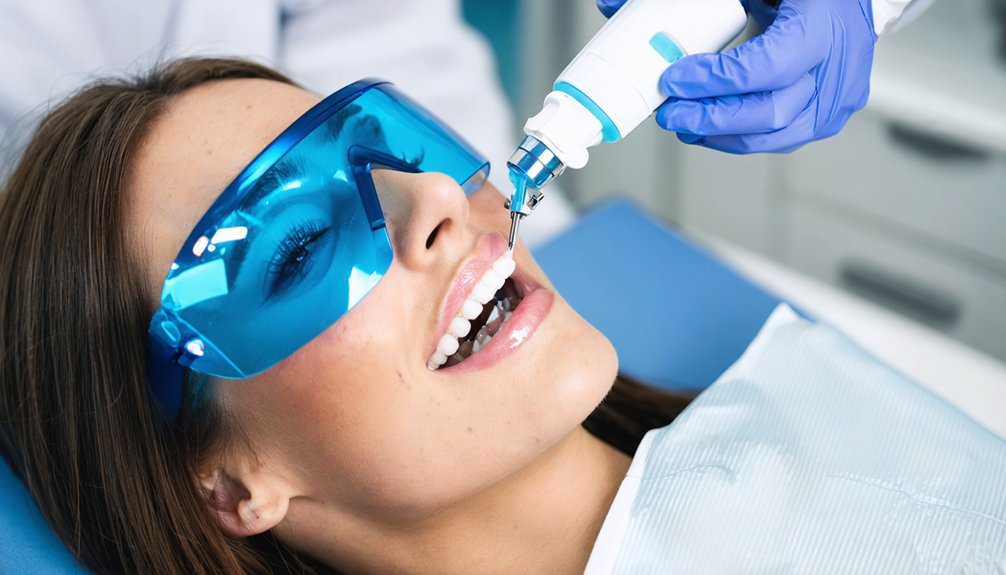
When your staining is mild to moderate and cost efficiency matters, professional LED whitening delivers clinically adequate results without the overhead of laser technology.
The LED benefits extend beyond affordability—treatment convenience is a measurable advantage, with sessions adaptable to clinic or home options using lower-concentration peroxide formulations. You maintain control over frequency and intensity without requiring specialized dental certification or single-visit commitment.
Customer satisfaction data supports LED’s effectiveness for surface-level discoloration, particularly when you’re managing expectations across multiple shorter sessions.
High-power professional LED units increasingly close the performance gap with laser systems for appropriate candidates. If your staining profile doesn’t demand aggressive intervention, LED whitening represents a clinically sound, economically rational decision that aligns with your treatment goals and timeline.
Can High-Power LED Compete With Laser on Results?
High-power professional LED units have narrowed the performance gap with laser systems, but the clinical data still favors laser for demanding cases.
LED advancements in power density, now reaching up to 800 mW/cm², have improved high power efficiency markedly, enabling faster peroxide activation and reducing treatment time.
In controlled settings, professional high-power LED can approximate laser speed and deliver acceptable results on mild-to-moderate staining.
However, laser still produces a ΔE of 3.05 compared to LED’s 1.67, a measurable difference you can’t ignore when targeting deep or resistant discoloration.
If your staining is severe, laser’s coherent light and superior enamel penetration give you outcomes that high-power LED simply can’t consistently replicate.
Choose your technology based on your clinical objective, not equipment availability.
How to Choose Between Laser and LED Based on Stain Type and Budget
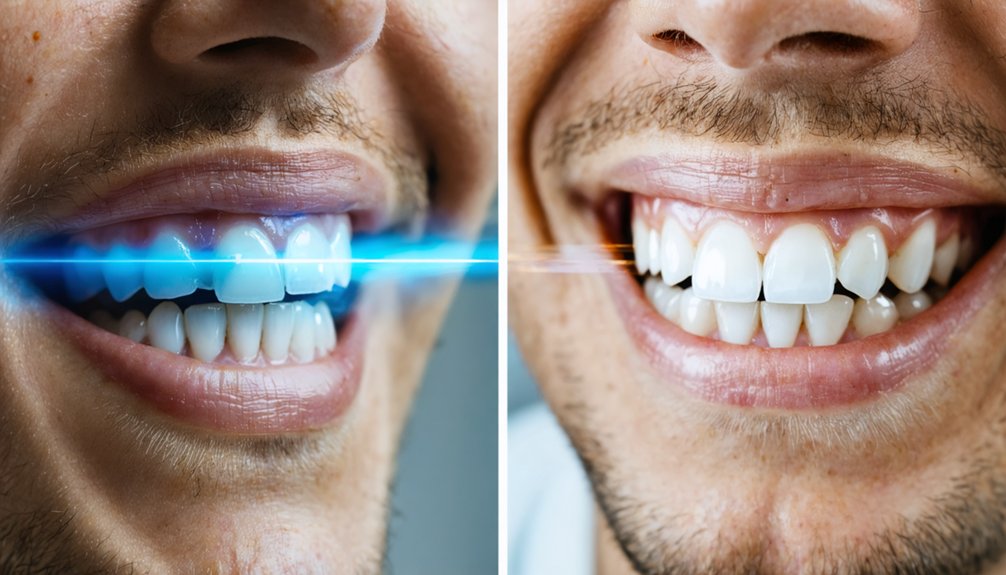
Matching the right whitening technology to your stain type and budget removes the guesswork from treatment planning.
Start with stain assessment: deep discoloration from tobacco, coffee, or medications responds considerably better to laser, which delivers 1.88 times greater whitening than LED. Mild-to-moderate surface stains respond adequately to LED-based treatment across multiple sessions.
Deep stains from tobacco or medications demand laser precision. Surface stains yield to LED across sessions.
Budget considerations are equally decisive. Laser sessions cost approximately $1,000 with annual maintenance, while LED options remain accessible through lower-cost clinical or at-home formats.
If you need dramatic, single-visit results and can absorb the cost, laser is clinically justified. If your staining is superficial and you’re managing expenses, professional LED treatment delivers measurable improvement.
Align your choice with objective stain severity and financial parameters rather than preference alone.
Frequently Asked Questions
How Long Do Laser Teeth Whitening Results Typically Last Before Fading?
Your laser whitening results typically last one to three years before fading. You’ll maintain treatment longevity by avoiding staining foods and managing teeth sensitivity post-procedure, ensuring you’re actively preserving your investment with regular professional maintenance.
Can Laser Whitening Be Combined With At-Home LED Maintenance Kits?
Yes, you can combine laser whitening with at-home LED maintenance kits. This treatment synergy extends your results effectively. At-home effectiveness improves when you follow professional laser sessions with low-intensity LED kits, preserving deeper enamel whitening between clinical visits.
Is Laser Whitening Safe for Patients With Dental Crowns or Veneers?
Laser whitening won’t alter your crowns or veneers, but you should note crown safety concerns since restorations don’t bleach. Veneer sensitivity may increase with high-peroxide laser gels, so consult your dentist before proceeding.
How Many Shades Whiter Can Teeth Realistically Become After Treatment?
You can transform your smile dramatically! Laser whitening delivers roughly 2x better shade improvement than LED, with realistic treatment expectations of 3-5 shades whiter, while LED typically achieves 1-3 shades across multiple sessions.
Does Teeth Whitening With Laser or LED Require Special Aftercare Diet Restrictions?
Both treatments require aftercare guidelines. You’ll need to follow dietary suggestions, avoiding staining foods like coffee, tea, and tobacco for 48 hours post-treatment. This maximizes your results and maintains the whitening effect achieved.
References
- https://pmc.ncbi.nlm.nih.gov/articles/PMC5410669/
- https://www.fletcherfamilydentistry.com/laser-teeth-whitening-vs-other-methods/
- https://www.hollywoodwhitening.com/blog/led-vs-laser-teeth-whitening/
- https://www.thegalleryofsmiles.com/blog/laser-teeth-whitening-compared-to-other-whitening-treatments/
- https://www.pioon.com/en/events/blogs/laser-light-teeth-whitening-difference-between-diode-laser-and-led.html
- https://kitsapdental.com/laser-teeth-whitening-vs-professional-teeth-whitening-trays/
- https://www.fernwhiteningsupplies.ca/blogs/news/understanding-teeth-whitening-led-vs-laser