You should use teeth whitening strips once daily for 7–14 days, depending on the peroxide concentration of your chosen product. Mild strips (6–10% peroxide) allow up to 14 days of use, while moderate-strength strips (10–14% peroxide) should be limited to 7–10 days. Exceeding these guidelines increases your risk of tooth sensitivity and enamel damage. One to two full whitening courses per year is considered safe for most people. Everything you need to use strips correctly and safely is covered ahead.
Key Takeaways
- Most whitening strips are designed for once-daily use over 7–14 days, with one to two full courses recommended annually.
- Mild strips (6–10% peroxide) allow daily use for up to 14 days, while moderate strips (10–14%) should be limited to 7–10 days.
- Touch-up applications using lower-peroxide strips are permissible every few months to maintain whitening results.
- Always follow manufacturer instructions and space applications every 48 hours to allow adequate enamel recovery between uses.
- Discontinue use immediately and consult a dentist if sensitivity, gum irritation, or uneven whitening develops.
How Often Should You Use Teeth Whitening Strips?
Most teeth whitening strips are designed for once-daily application over a 7–14 day period, with annual or semi-annual cycles being the safest long-term approach.
Whitening frequency directly impacts strip effectiveness and your enamel’s long-term integrity. Exceeding recommended daily use increases sensitivity, gum irritation, and enamel erosion risks.
For maintenance, touch-ups every couple of months remain a viable option, provided you monitor sensitivity carefully.
Peroxide concentration determines your ideal schedule — mild formulas (6–10%) tolerate 14-day cycles, while moderate strengths (10–14%) require shorter 7–10 day windows.
You should treat each cycle as controlled intervention, not a routine daily habit.
Follow package instructions precisely, select ADA-approved products, and allow adequate recovery time between cycles to protect your oral health without sacrificing results.
How Often to Use Strips Based on Their Strength
Peroxide concentration directly dictates how frequently you can safely apply whitening strips without compromising enamel integrity. Use this strength comparison to calibrate your schedule precisely.
Mild strips containing 6–10% peroxide permit daily application for up to 14 days. Moderate strips at 10–14% peroxide require you to limit use to once daily across 7–10 days. Sensitivity-formulated strips with ≤6% peroxide accommodate users with reactive enamel, demanding even more conservative scheduling.
Key application tips apply across all strengths: brush 30 minutes before applying, never exceed the recommended wear time, and discontinue immediately if irritation develops.
Higher concentrations yield faster results but narrow your error margin considerably. Matching strip strength to your sensitivity level gives you precise control over whitening outcomes and long-term enamel health.
How Many Times a Year Can You Safely Use Whitening Strips?
You can safely complete one to two full whitening strip courses per year, with touch-up sessions every few months for maintenance.
Exceeding this frequency risks enamel erosion, heightened tooth sensitivity, and gum irritation that compounds with repeated overuse.
To protect your long-term oral health, track your annual usage and consult your dentist before scheduling additional courses.
Annual Usage Recommendations
If you’re managing minor discoloration between cycles, limited touch-ups every couple of months are permissible—provided you’re using lower-peroxide, sensitivity-formulated strips.
You shouldn’t exceed this without consulting a dental professional, particularly if you’ve experienced enamel sensitivity or gum irritation previously.
Pairing your at-home regimen with professional whitening every 6–12 months optimizes results while maintaining oral health.
Prioritize ADA-approved products and track your response after each cycle to calibrate future use responsibly.
Overuse Health Risks
While staying within annual usage guidelines protects your results, pushing beyond those boundaries carries measurable consequences for your oral health.
Overusing whitening strips elevates sensitivity levels, causing sharp discomfort during eating and drinking. Repeated peroxide exposure compromises enamel protection by thinning the mineralized layer that shields your dentin. Once enamel erodes, the damage is irreversible.
Exceeding recommended frequency also triggers gum irritation, producing redness, tenderness, and uneven tissue response along the gumline.
You may also experience inconsistent whitening, where overexposed areas appear blotchy rather than uniformly bright.
Stripping away enamel accelerates long-term staining because exposed dentin absorbs discoloration faster.
Controlling your usage schedule isn’t just about safety — it’s about preserving the structural integrity that makes whitening results sustainable and your teeth functionally sound.
Maintaining Long-Term Results
Protecting your whitening results long-term requires disciplined scheduling rather than reactive touch-ups. Limit full treatment cycles to one or two times annually, with brief maintenance sessions every two to three months using lower-peroxide strips. This cadence preserves enamel integrity while sustaining visible brightness.
Apply these whitening maintenance tips consistently: avoid staining beverages immediately post-treatment, schedule touch-ups before significant events rather than impulsively, and monitor sensitivity patterns between cycles. If sensitivity increases, extend the interval between sessions.
Proper strip storage methods also matter. Store unused strips in a cool, dry location away from direct sunlight and heat, which degrade peroxide concentration. Compromised strips deliver uneven results and waste treatment cycles.
Following manufacturer expiration dates guarantees each application delivers consistent, clinically reliable whitening outcomes.
How Long Until You See Real Results?
You’ll typically notice a visible difference within one to two weeks of consistent use, with results emerging as early as a few days for surface stains.
Over a full treatment cycle, you can expect your teeth to lighten by two to four shades, depending on the peroxide concentration in your chosen strips.
Your individual results will vary based on factors such as your natural tooth color, the type and depth of staining, and how strictly you follow the application guidelines.
Timeline for Visible Whitening
Patience is a practical requirement when using whitening strips—most users notice a visible difference within one to two weeks of consistent use.
Whitening strip effectiveness depends directly on peroxide concentration and application time.
You can expect:
- 1 week: Initial brightening, particularly on surface stains
- 2 weeks: 2–4 shades lighter with daily, consistent use
- 4 weeks (3x weekly): Pronounced, measurable results on deeper discoloration
Individual results vary based on stain type, enamel density, and product strength.
Moderate-peroxide strips typically outperform mild formulas when you maintain the recommended application time precisely.
Skipping sessions or shortening wear time directly reduces outcomes.
Track your progress against a shade guide to objectively measure change and adjust your regimen accordingly.
Shades Lighter Over Time
When you commit to a consistent whitening strip regimen, measurable shade changes typically emerge within one to two weeks. Clinical data supports achieving two to four shades lighter through regular application, contingent on your stain type and baseline tooth color.
Standardized whitening techniques — applying strips once daily for seven to fourteen days — produce the most predictable outcomes.
Color stability depends on your dietary habits and maintenance frequency; avoiding staining agents like coffee and tobacco preserves results longer.
Touch-up sessions every two to three months sustain your achieved shade without compromising enamel integrity.
You control the outcome by selecting the appropriate peroxide concentration and adhering strictly to product-specific timelines, maximizing whitening efficacy while minimizing sensitivity risk.
Factors Affecting Your Results
Though most users notice a visible shift within one to two weeks, how quickly you see real results depends on several converging factors: your baseline tooth color, the type and depth of staining, the peroxide concentration in your chosen strips, and how consistently you apply them.
Individual variability means outcomes aren’t uniform. Key variables include:
- Stain type: Extrinsic stains from coffee or tobacco respond faster than intrinsic discoloration.
- Enamel health and sensitivity levels: Compromised enamel limits safe peroxide exposure, affecting product selection.
- Lifestyle habits and application method: Smoking, diet, and inconsistent wear directly reduce efficacy.
Controlling these factors strategically—not passively—determines your whitening trajectory. Precision in execution separates moderate results from measurable ones.
Signs You’re Overusing Whitening Strips
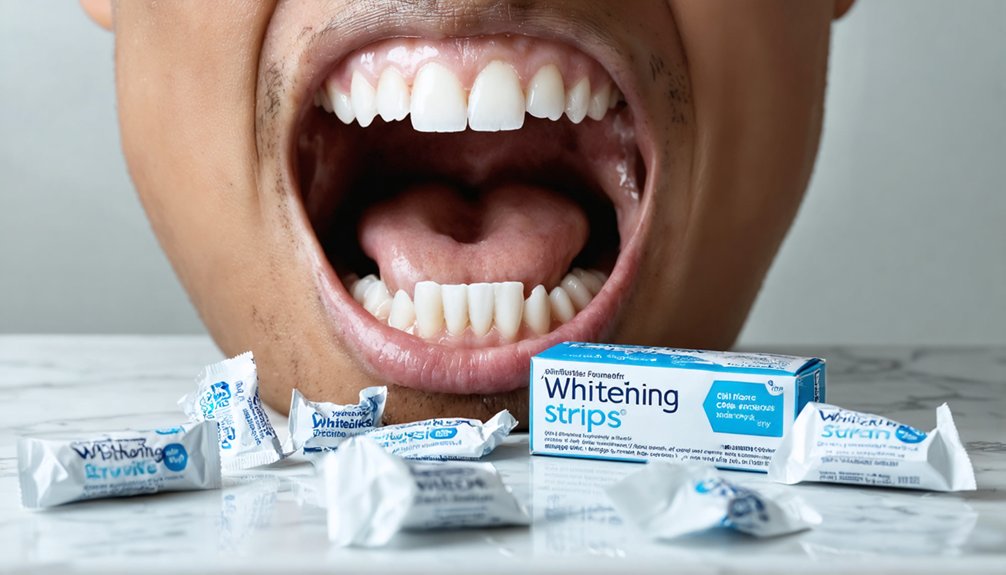
Overusing whitening strips produces several recognizable warning signs that signal you should scale back or stop treatment.
Sensitivity signs appear first — sharp, shooting pain during temperature changes indicates enamel compromise. If cold water or air triggers discomfort, you’ve likely exceeded safe usage frequency.
Sharp, shooting tooth sensitivity during temperature changes is your first warning sign of enamel compromise from overuse.
Gum irritation manifests as redness, swelling, or a burning sensation along the gumline. This occurs when peroxide contacts soft tissue repeatedly without adequate recovery time.
Uneven whitening — where some teeth appear noticeably lighter than others — signals application inconsistency compounded by overuse.
Translucency along tooth edges indicates enamel thinning, a serious, potentially irreversible consequence.
If you notice any combination of these signs, discontinue use immediately and consult your dentist before resuming treatment.
How to Apply Whitening Strips Without Damaging Enamel
Applying whitening strips correctly protects enamel while still delivering effective results. Following precise application tips minimizes sensitivity and maximizes enamel protection throughout your whitening regimen.
Key practices to follow:
- Wait 30 minutes after brushing before applying strips, since freshly brushed enamel is temporarily more porous and vulnerable to peroxide penetration.
- Never exceed the recommended wear time—leaving strips on longer doesn’t accelerate whitening; it accelerates enamel erosion.
- Select ADA-approved, enamel-safe formulas with peroxide concentrations matched to your sensitivity level, ideally ≤10% if you’re prone to discomfort.
Position strips precisely along your gumline without overlapping gum tissue.
Consistent, controlled application following manufacturer guidelines gives you predictable results without compromising your enamel’s structural integrity.
How Often Should You Use Whitening Strips If You Have Sensitive Teeth?
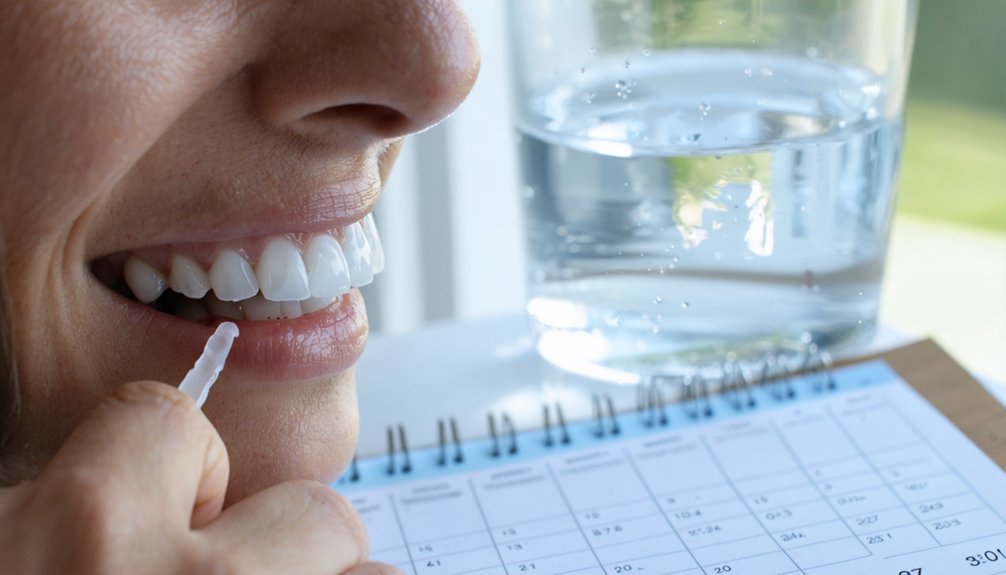
Sensitive teeth require a more conservative whitening schedule than standard recommendations suggest. If you experience discomfort, opt for sensitivity-specific strips containing ≤6% peroxide and apply them every other day rather than daily.
Effective sensitivity management means limiting each session to 30 minutes maximum and completing no more than one treatment cycle every six months. You should discontinue use immediately if pain intensifies between sessions.
Limit whitening sessions to 30 minutes and stop immediately if pain increases between treatments.
For alternative methods, consider remineralizing toothpaste containing potassium nitrate between whitening cycles to strengthen enamel and reduce nerve response. Spacing applications every 48 hours gives your enamel adequate recovery time.
Always select ADA-approved formulations and consult your dentist before beginning any whitening protocol if your sensitivity is chronic or severe.
Frequently Asked Questions
Can Whitening Strips Be Used Alongside Other Whitening Products Simultaneously?
Like a double dose of sun, simultaneous product use risks burns. You shouldn’t combine whitening strip compatibility with other whitening products—you’ll heighten sensitivity and enamel erosion. Control your regimen; use one product at a time.
Do Whitening Strips Expire, and Does Expiration Affect Their Effectiveness?
Yes, whitening strips do expire. You’ll notice expiration signs like reduced peroxide potency, which directly impacts effectiveness factors—meaning you won’t achieve peak whitening results. Always check the expiration date before use to maintain treatment efficacy.
Can Whitening Strips Whiten Dental Crowns, Veneers, or Bonded Teeth?
Whitening strips won’t lighten crown whitening targets, veneers, or bonded restorations—they’re unresponsive to peroxide. You’ll risk veneer sensitivity without achieving color change. Consult your dentist for replacement or professional options matching your natural tooth shade.
Should Whitening Strips Be Avoided Before or After Dental Procedures?
Walk on eggshells around dental procedures — you should avoid whitening strips before and after. Pre-treatment consultation guarantees timing safety, while post-treatment sensitivity demands a healing pause to protect your enamel and gum integrity effectively.
Are Whitening Strips Safe to Use During Pregnancy or Breastfeeding?
You should avoid whitening strips due to pregnancy concerns, as whitening safety data remains insufficient. Peroxide absorption risks aren’t fully studied for developing babies or breast milk, so consult your dentist before proceeding with any whitening treatment.
References
- https://crest.com/en-us/oral-care-tips/teeth-whitening/how-often-should-i-use-teeth-whitening-strips
- https://azdentistry.com/blog/how-often-teeth-whitening-at-the-dentist/
- https://dentalanddentistry.com/at-home-teeth-whitening-strips-how-often-should-you-use-them/
- https://mysmilesteeth.com/blogs/mysmiles-blog/how-often-to-use-teeth-whitening-strip
- https://alignerco.com/blogs/aesthetic/whitening-teeth-strips-usage
- https://xpresswhitening.com/whitening-strips-how-often-should-they-be-used/
- https://www.novadentaloffice.com/post/how-often-should-you-use-whitening-strips