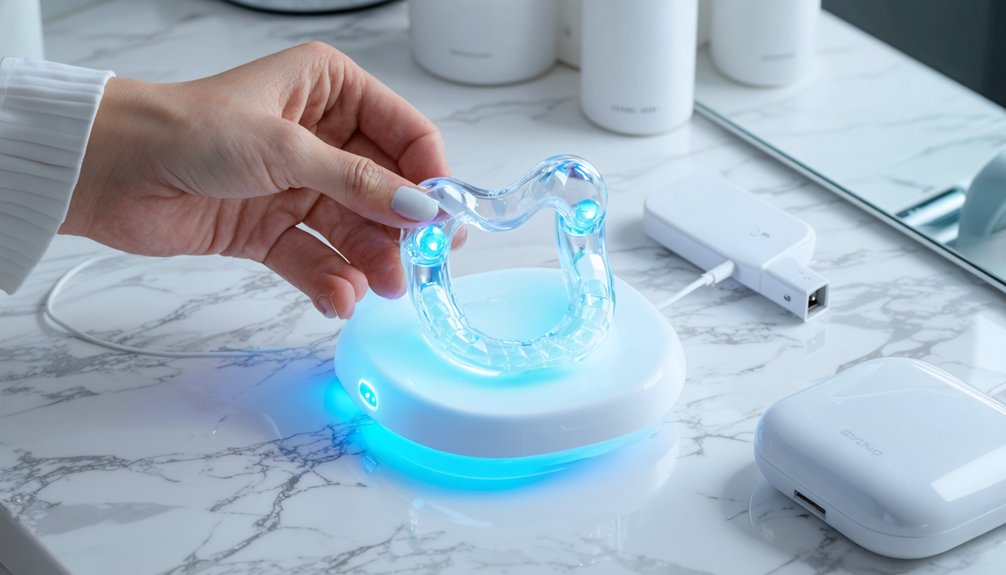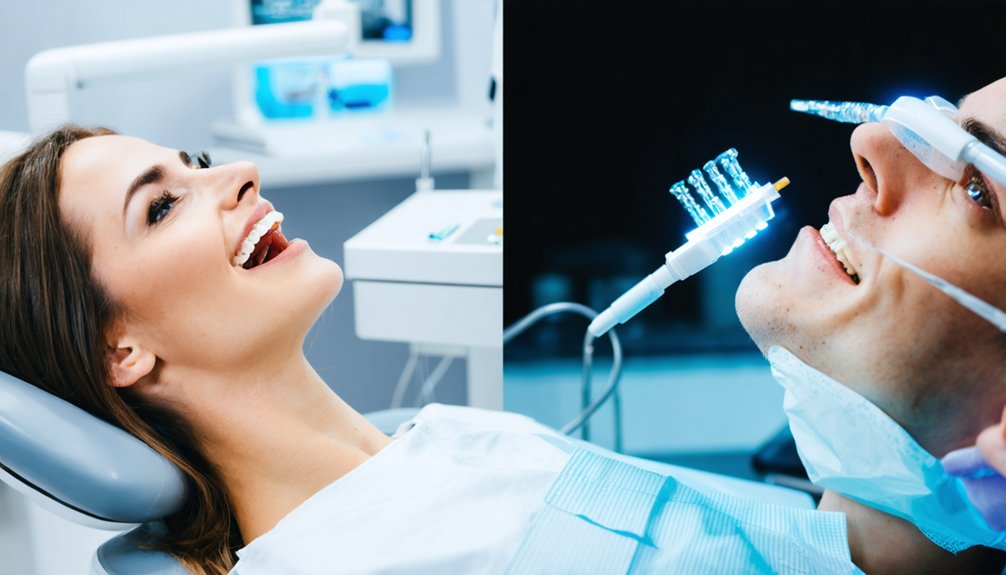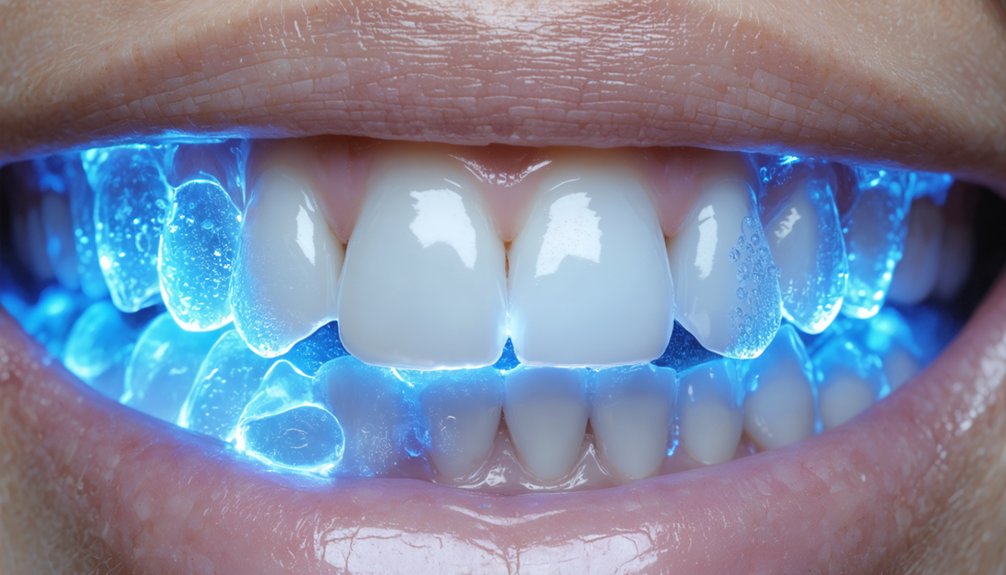
When you use LED light with whitening gel, you’re triggering a photochemical reaction that breaks down hydrogen peroxide at approximately twice the speed of gel alone. Blue LED wavelengths (430-520 nanometers) catalyze peroxide breakdown, producing oxygen and perhydroxy free radicals that penetrate deeper to reach discolored compounds in your enamel. This photocatalytic process creates electron-hole pairs with oxidizing potential exceeding +2.00 V, enabling continuous oxidation of chromophores. Understanding the specific mechanisms and wavelength differences can help you select the most effective whitening approach for your needs.
Key Takeaways
- LED light triggers photochemical breakdown of hydrogen peroxide in whitening gel, releasing oxygen and perhydroxy free radicals that penetrate tooth enamel.
- Blue LEDs operating at 450-460 nanometers accelerate peroxide decomposition at approximately twice the speed compared to gel alone.
- Light activation creates electron-hole pairs that generate superoxide radicals, enabling continuous oxidation of discolored compounds within teeth.
- LED systems achieve visible whitening within 20-60 minutes, significantly faster than gel-only protocols requiring extended application times.
- Professional LED treatments deliver 10 shades whiter in 60-90 minutes, while at-home devices produce 2-3 shades over 1-2 weeks.
The Science Behind LED Light and Peroxide Molecule Breakdown
When you apply LED light-activated whitening gel to your teeth, a sophisticated photochemical process begins that transforms how bleaching agents interact with dental stains. The blue LED wavelength catalyzes hydrogen peroxide breakdown, producing oxygen and perhydroxy free radicals that attack chromophores within your enamel structure.
This photon penetration levels enable reactive oxygen species to reach deeper discolored compounds, disrupting electron systems in stain molecules and converting them to colorless compounds. You’ll experience approximately twice the breakdown speed compared to gel alone.
Advanced systems incorporate temperature regulation optimization, combining controlled heat with LED activation to maximize oxidation while preventing enamel damage. This dual-action approach—direct photobleaching paired with photon-assisted oxidation—gives you accelerated results by simultaneously targeting all chromophore fractions throughout treatment.
Understanding Wavelength Ranges: Blue vs. Violet LED Technology
LED teeth whitening systems employ two distinct wavelength ranges that interact differently with whitening gels and tooth enamel. Blue LED technology operates at 430-520 nanometers to accelerate peroxide breakdown and penetrate deeper into your tooth structure.
Violet LED functions at approximately 405 nanometers to target surface stains through direct photolytic decomposition. Understanding these wavelength differences helps you make informed decisions about which LED whitening approach best addresses your specific discoloration patterns and sensitivity concerns.
Blue LED Spectrum Properties
Understanding the wavelength specifications of blue LED technology breaks down into two distinct categories that directly impact whitening effectiveness. Standard blue LEDs operate within 450–460 nm, specifically targeting hydrogen peroxide’s absorption spectrum for ideal photocatalytic activation.
You’ll find professional systems utilizing broader 430–480 nm ranges, delivering incoherent light waves that scatter across multiple chromophore depths without thermal energy production.
The led spectral distribution matters greatly—devices emitting at 456 nm generate approximately 190 mW/cm², accelerating bleaching rates by 39–187% compared to gel alone. This controlled light exposure triggers reactive oxygen species formation, breaking down stain molecules through oxidation rather than heat.
Blue-green spectrum devices (400–500 nm) offer portable convenience while maintaining safety parameters, as they avoid UV wavelengths below 380 nm that risk enamel damage during repeated treatments.
Violet LED Photolytic Effects
Operating at 405–410 nm, violet LEDs deliver higher-energy photons that directly target chromophore molecules adhered to your enamel surface through photolytic breakdown. This photochemical stain degradation process excites organic compounds, fragmenting pigment macromolecules into colorless particles without generating heat.
The shorter wavelength matches absorption peaks of extrinsic stains more precisely than blue light, enabling efficient decomposition while maintaining minimal tissue penetration.
You’ll benefit from violet LED’s surface-focused action, which confines photodegradation to enamel-bound pigments rather than penetrating deeper structures. Clinical data demonstrates violet light enhances carbamide peroxide effectiveness by 31.2% in yellowness reduction while presenting lower sensitivity risks compared to blue LED’s photothermal effects. This mechanism gives you comparable whitening results to hydrogen peroxide protocols with greatly reduced discomfort potential across treatment sessions.
Wavelength Impact on Activation
When selecting light-activated whitening treatments, the wavelength your device employs fundamentally determines both activation efficiency and clinical outcomes. Blue LED technology operating at 430-520 nanometers—particularly at 456 nm—targets peroxide bonding sites with precision, catalyzing hydrogen peroxide decomposition into free radicals that penetrate enamel and dentin tubules.
This wavelength optimization delivers measurably superior results: you’ll achieve 187% greater color change with 6% hydrogen peroxide compared to gel alone, while 25% formulations show 39-112% improvement. Violet wavelengths offer alternative photolytic action but lack blue’s specific resonance with peroxide molecular structures. Unlike UV or halogen systems that generate excessive heat, blue LED provides controlled energy transfer without thermal damage.
Your treatment selection should prioritize devices emitting within this validated spectrum to maximize stain breakdown while maintaining enamel integrity and minimizing sensitivity.
How Photocatalysis Accelerates Oxidation Reactions
LED-activated photocatalysts initiate oxidation through a precise electronic mechanism where absorbed photons generate electron-hole pairs within semiconductor materials like titanium dioxide (TiO2). Photogenerated carrier dynamics determine your whitening efficiency: valence band holes (h+) exhibit oxidizing potential exceeding +2.00 V, while conduction band electrons (e−) reduce molecular oxygen to superoxide radicals (O2−•).
You’ll observe that surface-trapped holes directly oxidize peroxide molecules through surface species adsorption, not bulk hydroxyl radical formation—rates demonstrate 10³-fold higher oxidation versus •OH production. The electrons simultaneously reduce ambient O2, preventing recombination and sustaining the catalytic cycle. This charge separation mechanism enables continuous oxidation of chromophores on your enamel surface, accelerating whitening beyond traditional peroxide-only formulations while maintaining controlled reactivity at the gel-tooth interface.
The Role of Photosensitizing Agents in Enhanced Whitening
Beyond semiconductor photocatalysts, specialized photosensitizing agents offer an alternative pathway for light-activated whitening through direct reactive oxygen species (ROS) generation. When you choose photosensitizers like chlorin e6 or ZnPc(Lys)₅, you’ll access high quantum yields of singlet oxygen that break carbon double bonds in tooth chromophores—achieving bleaching effects comparable to 10-30% hydrogen peroxide without the sensitivity risks.
You’ll benefit from precise control: ROS generation activates only during light exposure, with rapid ROS elimination once illumination stops. Penetration depth measurements demonstrate effective tissue reach at 5.0-8.0 mm, ensuring interstitial efficacy. These agents preserve dentin collagen and morphology while delivering measurable results—lightness increases exceeding 10 units and 0.5 VITA tone shifts per procedure. You’re selecting targeted chromogen oxidation without structural compromise.
LED Light Combined With Heat for Maximum Efficacy
Frequently overlooked in whitening protocols, the strategic combination of LED light and controlled heat delivers accelerated results that rival high-concentration peroxides while minimizing sensitivity risks. Blue LED wavelengths (400-500nm) energize peroxide molecules while mild heat—maintained below 128°F—catalyzes molecular movement for rapid gel penetration. This synergy enhances free radical formation, enabling pronounced stain removal without enamel compromise.
You’ll achieve noticeable improvements in 7-14 days with at-home systems, while in-office treatments lighten several shades within 30-60 minutes. Studies demonstrate that 6% hydrogen peroxide with LED/heat produces stable results comparable to 35% concentrations over two years. The calibrated thermal output prevents pulp damage while breaking down intrinsic and extrinsic discoloration efficiently. Your enamel’s calcium-phosphate ratio remains unchanged, and sensitivity intensity stays lower than traditional high-concentration approaches.
LED Safety Advantages Over UV and Halogen Light Sources
You’ll find LED light systems offer distinct safety advantages over UV and halogen alternatives, particularly regarding radiation exposure and tissue health. UV light sources have raised concerns about potential cellular damage and increased sensitivity, while halogen bulbs generate excessive heat that may compromise gum tissue.
LED technology eliminates these risks by operating without radiation emission and maintaining cooler temperatures, preserving your enamel integrity and minimizing soft tissue irritation throughout the whitening process.
UV Health Risk Concerns
While LED technology has revolutionized teeth whitening safety, older UV and halogen light systems pose significant health risks that you should understand. UV light radiation emits wavelengths similar to tanning beds, potentially causing gum irritation, increased tooth sensitivity, and soft tissue damage when protective barriers fail.
Studies link prolonged UV exposure to eye and skin complications, with higher-energy wavelengths causing more severe tissue damage than LED alternatives. The heat generated by UV systems increases your risk of soft tissue burns and sensitivity.
Research has connected UV teeth whitening to serious long term oral effects, including potential cancer risks and cellular damage. Professional settings now restrict UV use for these safety concerns, while LED systems provide effective whitening without radiation exposure or significant heat generation, protecting your oral health.
LED Enamel Preservation Benefits
LED technology protects your tooth enamel through targeted photochemical activation that breaks down stain molecules without altering the tooth’s structural integrity. Unlike UV and halogen sources that generate excessive heat, violet LED wavelengths at 405 nm penetrate enamel without affecting its mineral content preservation. Studies confirm no changes in your enamel’s calcium-to-phosphorus ratio across LED protocols, while thermal methods risk structural damage from heat stress.
You’ll benefit from LED’s non-thermal activation process, which preserves enamel structure during treatment. The controlled wavelengths activate bleaching agents efficiently without dehydration or mineral loss—complications associated with heat-producing alternatives. Clinical evidence demonstrates maintained enamel structural integrity through multiple sessions, with in vitro studies confirming preservation post-treatment. This photochemical approach delivers up to 8 shades of whitening while safeguarding your tooth’s fundamental composition.
Clinical Evidence: Measurable Shade Improvements With LED Activation
Multiple clinical trials demonstrate measurable color improvements when LED activation accompanies whitening gels. You’ll find violet LED systems with carbamide peroxide achieve ΔE values of 4.05 after 12 months, compared to 2.66 without gel activation. LED-activated 35% hydrogen peroxide produces 4.8 shade guide units versus 3.8 for non-activated applications, delivering consistent clinical outcomes you can measure spectrophotometrically.
Studies confirm LED systems generate primary color changes within 20-60 minutes, considerably faster than gel-only protocols. The BriteWhite LED achieved 1.8 ΔE units immediately, with minimal additional gain from extended home use. This enhanced safety profile stems from reduced treatment duration and lower sensitivity scores. Research shows light activation proves most effective with lower peroxide concentrations, giving you controlled whitening without compromising enamel integrity.
Professional Systems vs. At-Home LED Whitening Devices
Understanding these clinical outcomes helps you evaluate which LED whitening approach fits your needs and budget. Professional systems deliver dramatic results—up to 10 shades whiter in a single 60-90 minute session—but cost $200-600 with required dental visits. KöR’s refrigerated gel consistency tackles stubborn tetracycline stains that challenge at-home options.
At-home LED devices ($50-150) offer flexibility with treatment duration spanning 9-30 minutes daily over one to two weeks. Crest’s LED kit achieves 2.6 shades in 19 days without sensitivity, while Oralgen produces 2.1 shades weekly. You control scheduling and avoid appointment constraints.
Custom professional trays guarantee precise gel application and longer-lasting outcomes. At-home prefilled trays eliminate mess but may require extended treatment duration. Your choice depends on desired speed, budget allocation, and convenience priorities.
Frequently Asked Questions
How Long Does Led-Activated Whitening Last Compared to Gel-Only Treatments?
LED-activated whitening delivers improved shade longevity lasting several months with professional treatments, while gel-only methods require longer application periods. You’ll achieve consistent whitening outcomes when you maintain proper habits, though both approaches experience gradual fade from staining foods and beverages.
Can LED Light Whiten Dental Restorations Like Crowns or Veneers?
No, LED light won’t whiten your crowns or veneers—despite marketing promises. Dental material compatibility prevents restorative material changes because porcelain and composite lack organic structures that peroxide penetrates. You’ll need replacement restorations if natural teeth shade drastically/markedly/considerably lightens.
Does LED Whitening Work on Tetracycline Stains or Fluorosis Discoloration?
LED whitening provides limited results on tetracycline stains and fluorosis discoloration. You’ll see modest improvement on mild-to-moderate cases, but these intrinsic stains resist complete removal. Professional treatments require multiple sessions, with severe cases often needing veneers instead.
How Many LED Whitening Sessions Are Needed for Optimal Results?
You’ll access dramatically brighter teeth with 2-3 LED whitening sessions for ideal results. Timing of whitening sessions matters—spacing treatments appropriately guarantees consistent whitening effects while protecting enamel. Your desired shade and staining severity determine your customized treatment plan.
Will LED Whitening Cause Permanent Tooth Sensitivity or Enamel Damage?
LED whitening won’t cause permanent damage when properly supervised. You’ll experience temporary tooth sensitivity lasting 24-48 hours, not permanent effects. There’s no potential for enamel damage with professional treatments, though overuse of high-concentration products increases risks you can control.