Maximize your whitening results by selecting a kit that matches your sensitivity threshold and scheduling a pre-treatment dental consultation to assess enamel health. Apply precisely 0.5ml of gel per arch using custom-fitted trays, targeting your front 6-8 teeth while avoiding gum contact. Start with lower concentrations (10-16% carbamide peroxide) if you’re prone to sensitivity, and maintain 30-45 minute sessions for high-concentration formulas. Avoid staining beverages for 48 hours post-treatment, and the detailed protocols below will help you achieve uniform, long-lasting shade improvement.
Key Takeaways
- Use custom-fitted trays with precise 0.5ml gel application per arch to ensure even distribution and prevent gum irritation.
- Schedule a dental consultation beforehand to assess enamel health and establish optimal peroxide concentration for your sensitivity threshold.
- Apply sensitivity toothpaste two weeks before treatment and alternate whitening sessions with 48-hour breaks to minimize discomfort.
- Avoid staining foods, beverages, and smoking for 48 hours post-treatment to maximize and maintain whitening results.
- Follow prescribed treatment duration: 30-45 minutes for high-concentration formulas or 2-4 hours for lower-concentration products.
Selecting the Right Whitening Kit for Your Needs
Several factors determine which whitening system delivers ideal results for your specific dental needs. First, assess your sensitivity threshold—if you’ve experienced dental discomfort previously, select products like Rembrandt 1 Week Kit that demonstrated zero irritation in clinical testing.
Next, evaluate the duration of treatment against your schedule constraints. LED kits require 15-30 minute sessions, while strips demand 45 minutes daily for 20 days. Custom tray systems necessitate longer treatment times but provide superior longevity.
Your budget greatly influences selection. Cost effective options include Zimba Strips at the entry level, whitening toothpastes with 5% hydrogen peroxide formulations, and mid-range LED systems ($50-150). Professional-grade custom trays ($200-600) deliver excellent results but require substantial investment. Match your financial parameters with expected shade improvement—typically 2-4 shades across most systems.
Preparing Your Teeth Before Treatment
Proper preparation maximizes whitening efficacy while protecting your dental health from potential complications. Schedule a consultation with your dentist to assess enamel condition and receive a prescription-strength kit containing 10-35% carbamide peroxide with customized trays.
Professional dental assessment and prescription-strength carbamide peroxide treatments with custom trays deliver optimal whitening outcomes while safeguarding enamel integrity.
Establish a rigorous dental hygiene routine by brushing thoroughly to remove plaque before gel application, ensuring even contact with enamel surfaces. Maintain periodontal health maintenance through professional evaluation of gum integrity prior to treatment.
Discontinue consumption of coffee, wine, soda, and smoking 24-48 hours before whitening to prevent interference with carbamide peroxide effectiveness. Select formulas containing fluoride and desensitizing agents to minimize sensitivity risks during treatment.
Clinical studies confirm these preparation protocols reduce irritation while delivering ideal results on healthy enamel, caps, crowns, and veneers.
Proper Application Methods for Even Whitening
Achieving uniform whitening results depends on precise gel placement and correct tray positioning across all targeted tooth surfaces. You’ll need to apply a controlled amount of gel—typically 0.5 ml per arch—distributed evenly in the tray compartments corresponding to your front 6-8 teeth.
Proper positioning of the tray guarantees continuous gel-to-enamel contact throughout the treatment duration while preventing gum exposure to the whitening agent.
Precise Gel Application Coverage
When applying whitening gel to home trays, you’ll need approximately 0.5ml per arch—equivalent to a half pea-size amount distributed across the front 6-8 teeth. Place small drops of 1/4 to 1/5 cc per tooth halfway up the inner front surface of your tray, creating a small bubble in the center. This precise dosing prevents gum exposure while guaranteeing adequate coverage on visible teeth surfaces.
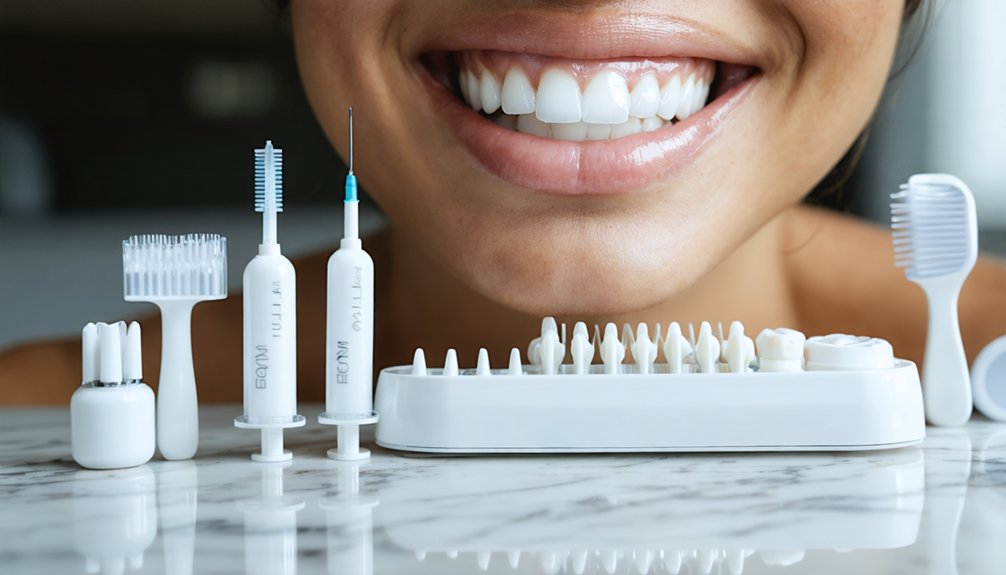
Ideal tray customization through your dentist enhances control over gel placement and contact time. Custom-fitted trays maximize gel efficiency by maintaining ideal positioning without excess material. Line your tray systematically with a syringe rather than spreading manually—this confirms even distribution across target surfaces.
Focus gel application exclusively on anterior teeth where whitening results matter most, avoiding overfilling that compromises safety and effectiveness.
Tray and Strip Placement
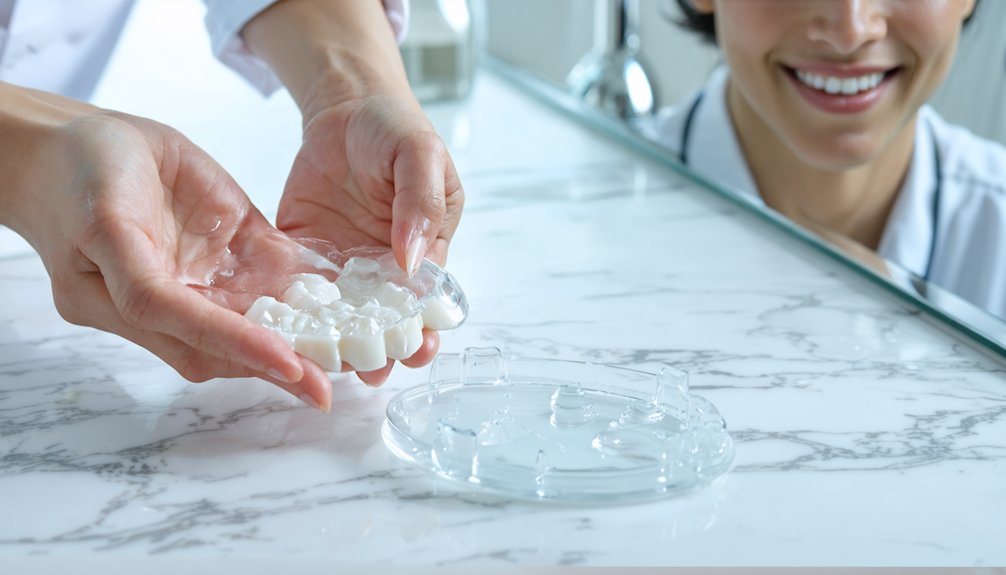
Successful whitening outcomes depend on precise tray positioning that maintains consistent gel contact with enamel surfaces throughout the treatment duration. Insert trays starting from posterior teeth, moving forward to guarantee complete seating. Press firmly on biting surfaces circumferentially, then compress lateral aspects with your fingers to eliminate air pockets and prevent shifting.
This technique optimizes gel distribution across targeted anterior teeth while minimizing gingival exposure.
For strip-based systems, apply peroxide-containing strips directly to tooth surfaces, ensuring complete adherence without gaps. Monitor your comfort level during wear—properly seated trays shouldn’t cause significant pressure or movement. Remove excess gel immediately using a tissue to prevent soft tissue irritation.
Maintain the prescribed treatment duration based on concentration: 35% formulations require 30-40 minutes, while 10% products allow overnight application under professional guidance.
Managing Tooth Sensitivity During Treatment
You’ll likely experience some degree of tooth sensitivity during home whitening treatment, as peroxide agents penetrate enamel to reach the dentin and pulp. Understanding the primary triggers—such as high peroxide concentrations, extended application times, and pre-existing gingival recession—enables you to make informed adjustments to your protocol.
Recognize Common Sensitivity Triggers
Understanding what triggers sensitivity during home whitening treatments enables you to take proactive measures before discomfort occurs. Peroxide-based agents penetrate enamel and dentin, creating microscopic pathways that expose dentinal tubules and temporarily irritate tooth nerves. Higher concentrations and longer application times amplify this response.
Your individual anatomy profoundly influences sensitivity risk. Genetic factors affecting sensitivity include naturally thin enamel and porous tooth structure, which allow deeper peroxide penetration. Existing gum recession concerns present particularly elevated risk, as receded tissue exposes vulnerable dentin directly to bleaching agents. Clinical data shows 54% of users experience mild sensitivity, with recession patients reporting noticeably higher rates.
Temperature extremes activate exposed nerves post-treatment. Cold beverages and hot foods trigger sharp pain through microscopic channels. Products containing 5-6% peroxide concentrations with potassium nitrate additives demonstrably reduce nerve irritation.
Adjust Treatment Frequency Safely
Beyond identifying sensitivity triggers, modifying your treatment schedule represents the most effective intervention for managing discomfort. You’ll maintain whitening efficacy while minimizing adverse reactions through strategic timing adjustments.
Evidence-Based Frequency Modifications:
- Implement gradual whitening protocols using lower peroxide concentrations (10-16%) over extended treatment periods rather than aggressive high-concentration applications.
- Alternate whitening sessions with 48-hour intervals instead of consecutive daily use, allowing dentin tubules time to recover between exposures.
- Break treatment periods into manageable segments—research demonstrates sensitivity decreases over time, with no severe cases reported after two weeks and no moderate cases after four weeks.
- Reduce session duration from manufacturer recommendations if experiencing discomfort; custom trays enable precise application time control without compromising results.
This approach gives you complete oversight of your treatment intensity.
Choose Lower Concentration Products
When selecting whitening products for sensitivity-prone teeth, peroxide concentration directly correlates with both efficacy and discomfort intensity. You’ll achieve optimal results with formulations containing 5-10% hydrogen peroxide or 10-16% carbamide peroxide, which provide enhanced enamel protection compared to professional-grade concentrations of 25-45%. These lower-strength products deliver comparable whitening outcomes through extended treatment protocols while minimizing dentin tubule exposure that triggers nerve irritation.
Choose products like Crest 3D Whitestrips Sensitive (5.25% peroxide) or Hydra Pearl 6% HP Gel for reduced irritation potential. You’ll benefit from formulations incorporating 5% potassium nitrate, which blocks pain signal transmission without compromising whitening efficacy. Limit application times to 15-60 minutes to prevent enamel demineralization and transient pulp inflammation. Custom-fitted trays guarantee precise gel placement, reducing gingival contact and controlling peroxide distribution.
Following Instructions for Safe and Effective Use
Achieving ideal whitening results while minimizing adverse effects requires strict adherence to manufacturer protocols and professional guidelines. Success depends on selecting appropriate products matched to your sensitivity threshold and following evidence-based application techniques.
Essential Protocol Steps:
- Pre-treatment preparation: Apply sensitivity toothpaste two weeks before starting, ensuring trays fit properly without gel interference.
- Precise gel application: Use 0.5ml per arch, targeting front 6-8 teeth with small drops in each compartment to prevent gum contact.
- Controlled wear time: Maintain 30-45 minutes for high-concentration formulas (35%), extending to 2-4 hours for lower concentrations (20%).
- Post-treatment care: Rinse immediately, brush teeth, and avoid staining agents for 48 hours.
Avoiding excessive use prevents enamel damage and sensitivity. Discontinue treatment if adverse reactions develop.
Maintaining Your Whiter Smile Long-Term
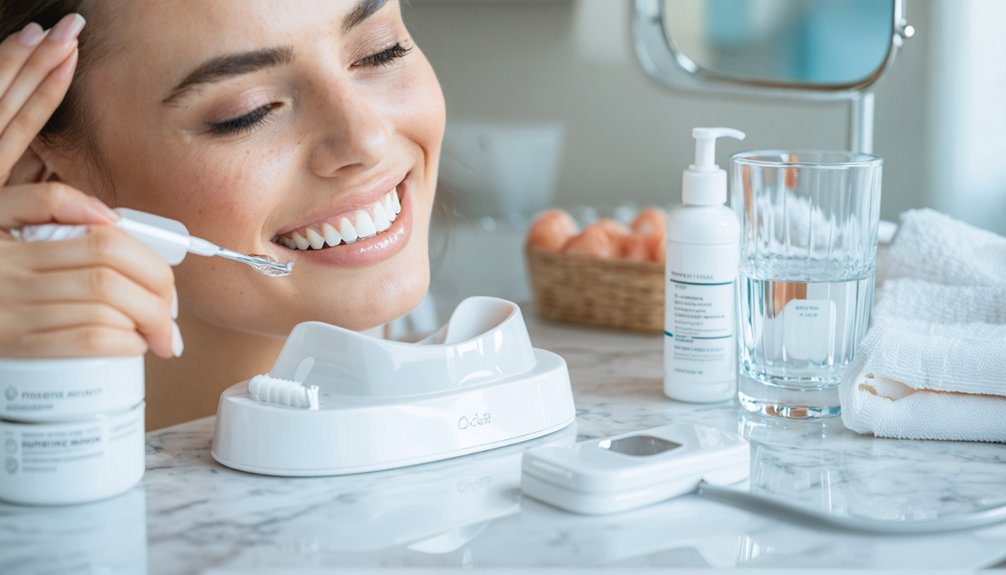
Sustaining whitening outcomes requires implementing evidence-based maintenance protocols that address both intrinsic and extrinsic staining factors. You’ll need consistent oral hygiene practices—brushing twice daily with fluoride toothpaste, flossing to remove interdental debris, and using soft-bristle brushes to prevent enamel abrasion.
Lifestyle modifications prove essential: rinse immediately after consuming chromogenic beverages like coffee or red wine, use straws to minimize tooth contact, and wait 30 minutes post-acidic foods before brushing to protect temporarily demineralized enamel. Schedule professional cleanings every six months to remove calculus deposits beyond home care reach.
Implement periodic touch-up treatments every few months based on dietary habits and observed shade regression. Incorporate whitening toothpastes containing low-concentration peroxide formulations weekly, alternating with standard fluoride varieties to maintain results without inducing sensitivity or compromising enamel integrity.
Frequently Asked Questions
Can I Use Whitening Kits if I Have Dental Crowns or Veneers?
You can use whitening kits, but they won’t affect your restorations. Porcelain crowns compatibility with bleaching agents is zero, and veneer whitening effectiveness is nonexistent. You’ll lighten natural teeth only, potentially creating mismatched shades requiring restoration replacement.
What Foods Should I Avoid During My Whitening Treatment Period?
Avoid acidic foods that compromise enamel integrity and limit consumption of dark colored beverages during treatment. You’ll protect your results by excluding coffee, wine, berries, and tomato-based products. This evidence-based approach guarantees ideal whitening outcomes you control.
Will Whitening Kits Work on Stains From Medications Like Tetracycline?
Professional at-home whitening kits demonstrate proven effectiveness of whitening on medication stains like tetracycline, though results vary by severity. You’ll need custom trays with 10% carbamide peroxide and extended treatment duration, with proper safety considerations for whitening with medication stains through professional supervision.
Can Pregnant or Breastfeeding Women Safely Use Home Whitening Kits?
Most dentists recommend you postpone home whitening kits until after pregnancy and breastfeeding due to limited safety data on peroxide absorption. You can maintain oral hygiene precautions using ADA-approved toothpastes for possible whitening effects while minimizing chemical exposure risks.
How Do Home Whitening Results Compare to Professional Dental Office Treatments?
Like marathon versus sprint training, you’ll achieve 1-2 shades gradually at home versus 8 shades professionally. Whitening duration expectations differ markedly—weeks versus one hour—while tooth sensitivity considerations remain comparable when you follow evidence-based protocols correctly.