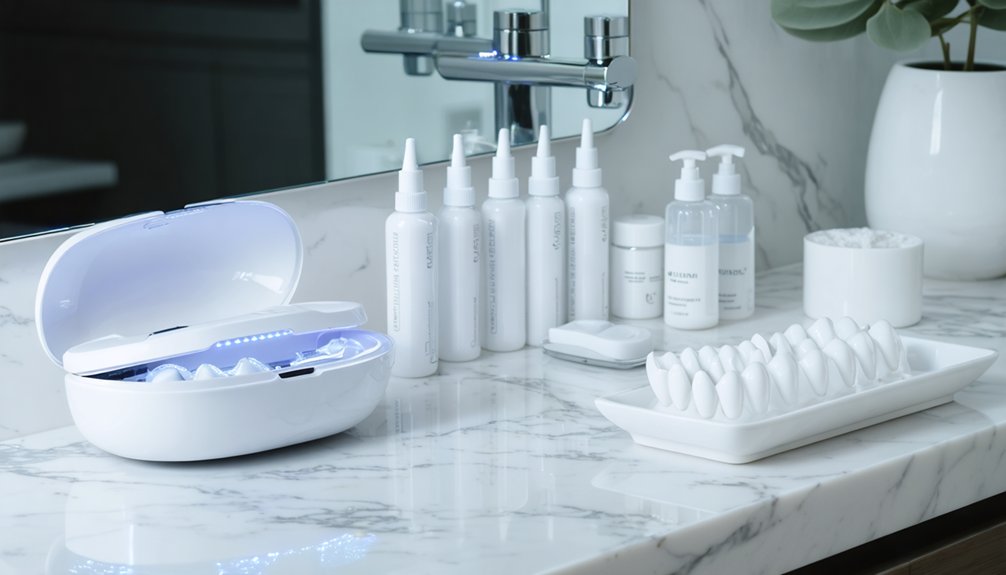
Home teeth whitening kits can deliver near-professional results when they contain 10–16% carbamide peroxide—particularly formulas with fluoride, which research shows can match stronger clinical agents in shade improvement. At-home treatments typically reach a ΔE of 2.0, while in-office treatments achieve 3.3, but both methods produce comparable outcomes at the one-month mark. Your concentration choice, tray fit, and consistency all determine how close you’ll get to the dentist’s chair—and there’s more to unpack on each factor.
Key Takeaways
- At-home kits with 15% carbamide peroxide and fluoride can match professional-grade shade improvements without requiring an in-office visit.
- Both at-home and professional treatments produce similar whitening outcomes when measured at the one-month mark.
- Fitted trays ensure even peroxide distribution, improving at-home results and reducing gingival irritation for more professional-like coverage.
- Staying within the 10–16% carbamide peroxide range delivers effective whitening while protecting enamel from unnecessary damage.
- Professional treatments offer greater long-term color stability, so at-home maintenance is essential to preserve whitening results.
Why Peroxide Concentration Determines Your Whitening Results
Peroxide concentration drives whitening outcomes more than any other variable in tooth bleaching. In-office formulas use 35–40% hydrogen peroxide, delivering ΔE values of 3.3, while at-home carbamide peroxide kits range from 10–16%, achieving ΔE values of 2.0. That gap reflects peroxide potency directly dictating oxidation depth and stain breakdown speed.
Your application techniques also matter—two 20-minute applications of 38% hydrogen peroxide produce equivalent whitening to a single 40-minute session, demonstrating that controlled exposure timing amplifies concentration efficiency.
At-home kits compensate for lower concentration through prolonged use, achieving comparable long-term whiteness. Fluoride-containing 15% carbamide peroxide matches higher-concentration formulas in shade improvement, confirming that optimized application techniques can offset concentration differences when you’re strategic about treatment duration and consistency.
Do At-Home Whitening Kits Actually Match Professional Treatment?
When comparing at-home whitening kits to professional treatment, the answer depends on your timeline and expectations. At-home effectiveness is real but slower—lower concentrations require prolonged use to achieve comparable results. Research confirms both methods reach similar bleaching outcomes at the one-month mark, giving you measurable control over your whitening trajectory.
At-home whitening works—it just takes longer. Both methods deliver comparable results within a month.
The professional comparison shifts, however, when evaluating speed and consistency. In-office treatments using 35-40% hydrogen peroxide deliver faster, more uniform coverage with predictable shade changes.
At-home kits struggle with deep stains and even distribution. Professional results also demonstrate stronger color stability over time, whereas OTC outcomes fade quicker.
If your priority is long-term whiteness with controlled progress, at-home kits are clinically viable—provided you use them correctly and consistently.
At-Home vs. In-Office: What the Clinical Numbers Show
When you compare whitening methods by clinical output, in-office 40% hydrogen peroxide achieves a ΔE of 3.3, while at-home 10–16% carbamide peroxide reaches only 2.0.
Sensitivity rates tell a similar story—you’re looking at 30% to over 78% of patients experiencing mild-to-moderate discomfort across both methods, though professional supervision demonstrably reduces that risk.
Long-term results, however, narrow the gap: at-home lower-concentration protocols can match in-office whiteness at the one-month mark, though professional treatments maintain greater color stability over time.
Whitening Effectiveness By Numbers
Clinical studies measure whitening outcomes using ΔE values, a standardized metric that quantifies color change in teeth. In-office 40% hydrogen peroxide delivers a ΔE of 3.3, while at-home 10–16% carbamide peroxide reaches 2.0.
Understanding these numbers helps you match color expectations to realistic outcomes rather than falling for whitening myths. DIY techniques and natural remedies consistently underperform against professional-grade agents in controlled studies.
Application tips matter too—improper use of OTC kits reduces ingredient safety and uniform coverage. User experiences often reflect this variability, with inconsistent stain prevention and poor color matching across dental surfaces.
At-home carbamide peroxide at 37% shows faster results within one to three weeks, though both concentrations converge at thirty days, confirming that concentration and technique drive outcomes.
Sensitivity Rates Compared
Tooth sensitivity affects anywhere from 30% to over 78% of patients undergoing whitening treatment, making it the most commonly reported side effect across both delivery methods.
Sensitivity comparisons between at-home and in-office protocols reveal that concentration alone doesn’t determine patient experiences.
Clinical data shows:
- 10% vs. 37% carbamide peroxide produces no significant sensitivity differences despite the concentration gap
- LED-assisted treatments register gingival sensitivity scores of 0.57 post-treatment, dropping to 0.32 after 14 days
- OTC improper use increases sensitivity risk due to unmonitored application and poor-fitting trays
- Professional supervision measurably reduces adverse responses through controlled exposure and customized protection
You’re not powerless here—choosing supervised treatment gives you predictable, manageable outcomes rather than guesswork.
Long-Term Results Diverge
Although at-home kits require prolonged use, clinical evidence shows they can achieve comparable long-term whiteness to in-office treatments—but the trajectory diverges sharply depending on the method.
Both approaches show similar bleaching outcomes at one month post-treatment; however, whitening consistency breaks down after that point.
LED-assisted in-office results have been shown to relapse to baseline following a 14-day at-home follow-up, indicating that without structured long-term maintenance, even professional treatments fade.
At-home regimens using lower carbamide peroxide concentrations, while slower, tend to sustain results more predictably when you follow a consistent protocol.
Professional treatments deliver stronger color stability overall, but your adherence to a maintenance routine ultimately determines whether either method holds.
You control the outcome more than the delivery system does.
Which Home Whitening Kits Come Closest to Professional Results?
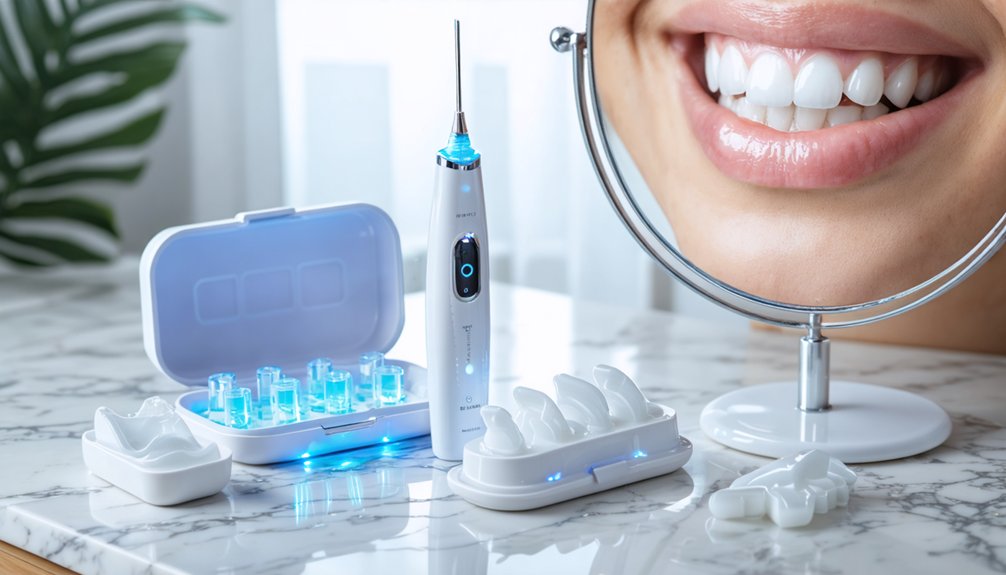
When selecting a home whitening kit that most closely mirrors professional outcomes, you’ll want to focus on the active ingredient and its concentration.
Kits containing 10–16% carbamide peroxide—the same class of agent used in dentist-dispensed at-home protocols—consistently outperform lower-concentration OTC alternatives on standardized shade metrics.
Research confirms that fluoride-containing 15% carbamide peroxide formulations match other professional-grade agents in measurable shade improvement, narrowing the clinical gap between pharmacy shelves and the dental chair.
Top Performing Kit Ingredients
While no at-home kit fully replicates professional-grade outcomes, the closest results come from kits formulated with 10–16% carbamide peroxide—the same class of agent used in dentist-dispensed take-home systems.
User experiences consistently favor these formulations over kits relying solely on natural ingredients like activated charcoal or baking soda, which lack clinical efficacy data.
Key ingredients that drive measurable whitening:
- 10–16% carbamide peroxide – delivers controlled oxidation comparable to supervised take-home protocols
- Fluoride additives – 15% carbamide peroxide with fluoride matches non-fluoride formulas in shade improvement
- Hydrogen peroxide derivatives – faster-acting but require precise application
- Potassium nitrate – reduces sensitivity incidence, supporting longer, more consistent treatment adherence
Prioritize peroxide concentration over branding—enamel protection and whitening efficacy depend on chemistry, not marketing.
Closing The Results Gap
The gap between at-home and professional whitening results is measurable but narrowing. Research confirms that lower concentrations used consistently over time produce comparable long-term outcomes to in-office treatments.
Patient experiences with 10–16% carbamide peroxide systems show whiteness levels matching professional results at the 30-day mark, despite slower initial progress.
Dismissing whitening myths matters here—higher concentration doesn’t always mean superior long-term results. Fluoride-containing 15% carbamide peroxide formulas achieve shade improvements equivalent to stronger alternatives.
What actually closes the gap is consistency, proper tray fit, and treatment duration. You control these variables directly.
At-home kits fall short primarily on deep staining and uniform coverage, but when you select evidence-backed concentrations and follow structured protocols, the performance difference becomes clinically negligible.
How to Use Home Whitening Kits Without Wrecking Your Enamel
Using home whitening kits safely hinges on one critical variable: peroxide concentration. Enamel protection depends on concentration levels, not branding. OTC misuse risks enamel weakening and patchy results. Precise application techniques minimize those risks considerably.
Follow these evidence-based protocols:
- Limit application frequency — exceed recommended wear time and you accelerate enamel erosion.
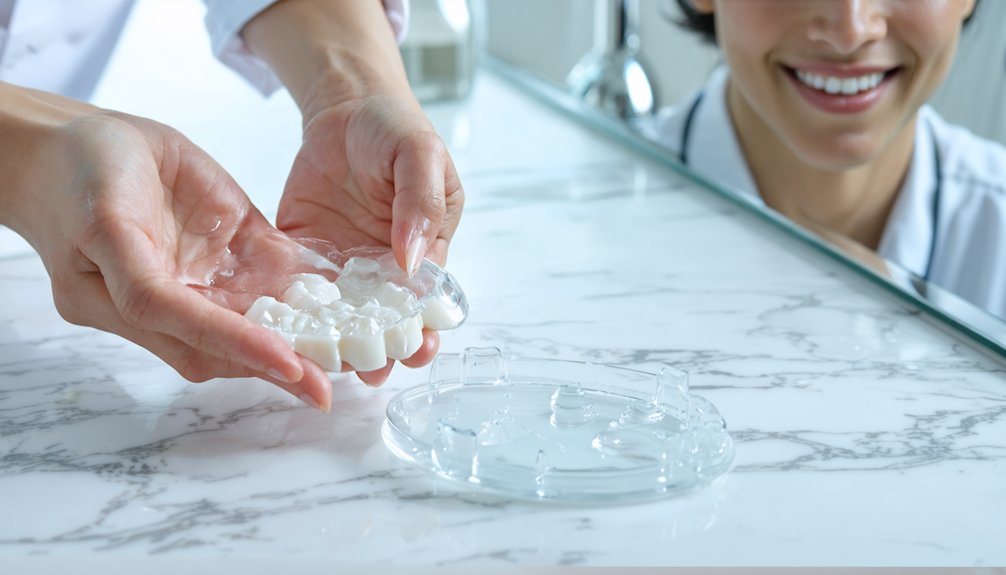
- Use fitted trays — ill-fitting trays cause uneven peroxide distribution and gingival irritation.
- Stay within 10-16% carbamide peroxide — higher concentrations require professional supervision.
- Avoid acidic foods post-treatment — enamel remains temporarily vulnerable after whitening sessions.
Sensitivity affects up to 78% of users but resolves within days when you follow proper protocols. You control the outcome by controlling the variables.
How Common Is Sensitivity With Home Whitening Kits?
Sensitivity is one of the most reported side effects of home whitening kits, affecting anywhere from 30% to over 78% of users. Your individual sensitivity factors—peroxide concentration, application frequency, and existing enamel integrity—determine where you fall within that range.
Research shows no significant sensitivity differences between 10% and 37% carbamide peroxide formulations, meaning concentration alone doesn’t predict your patient experience. Most sensitivity presents as mild to moderate and resolves within days of stopping treatment.
Improper OTC use, however, elevates your risk considerably. Overextending tray wear time or applying kits too frequently bypasses your enamel’s tolerance threshold.
Professional supervision reduces this risk by calibrating treatment to your dental profile, giving you predictable outcomes without unnecessary tissue compromise.
How Long Before Home Whitening Kit Results Fade?
Results from home whitening kits don’t last indefinitely, and understanding the timeline helps you set realistic expectations.
At-home treatments using 10–16% carbamide peroxide can achieve comparable long-term whiteness to professional procedures, though maintaining brightness requires strategic upkeep.
Key fading timeline factors you should monitor:
- Relapse rate: LED-assisted whitening returns to baseline within 14 days without follow-up maintenance
- Concentration impact: Lower peroxide concentrations extend treatment duration but don’t necessarily accelerate fading
- Color stability: Professional-grade results demonstrate superior long-term stability compared to OTC alternatives
- Lifestyle variables: Dietary pigments and tobacco directly accelerate color regression
Both in-office and at-home methods show similar bleaching outcomes at one month post-treatment, confirming that disciplined at-home protocols can sustain results effectively when you follow concentration-appropriate maintenance schedules.
When Home Whitening Kits Fall Short and You Need a Dentist
While home whitening kits offer a convenient and cost-effective entry point, they don’t deliver predictable outcomes across all clinical scenarios.
Home kit limitations become apparent with deep intrinsic stains, tetracycline discoloration, or uneven enamel surfaces where lower peroxide concentrations simply can’t penetrate adequately.
If you’re managing restorations, crowns, or veneers, at-home agents won’t alter those surfaces—creating mismatched results.
Similarly, if sensitivity persists beyond a few days or gingival irritation develops from improper tray fit, you need clinical intervention.
Professional alternatives offer prescription-grade concentrations—up to 40% hydrogen peroxide—with custom trays and supervised protocols that target your specific stain etiology.
When your case exceeds what OTC formulations can address, escalating to professional treatment isn’t a setback—it’s the precise, controlled decision.
Frequently Asked Questions
Can Teeth Whitening Kits Work on Dental Crowns or Veneers?
Whitening kits won’t alter crowns effectiveness, as peroxide doesn’t bleach ceramic or porcelain restorations. You’ll also find veneers sensitivity may increase with prolonged peroxide exposure, so you’re risking irritation without achieving any color change.
Does Diet Affect How Long Home Whitening Kit Results Last?
Like a canvas exposed to rain, your results fade faster with staining foods. Diet impact directly drives whitening longevity—you’ll extend results by avoiding coffee, red wine, and chromogenic foods post-treatment.
Are Home Whitening Kits Safe to Use During Pregnancy or Breastfeeding?
You should avoid home whitening kits during pregnancy or breastfeeding due to unresolved safety concerns. Practice ingredient awareness—peroxide compounds lack sufficient safety data for these periods, so consult your dentist before proceeding with any whitening protocol.
How Soon After Tooth Extraction Can You Use Whitening Kits?
Wait at least 2–4 weeks after extraction before using whitening kits. You’ll risk heightened tooth sensitivity and disrupt the healing process if you apply peroxide agents to unhealed tissue prematurely.
Can You Use Home Whitening Kits With Braces or Aligners?
You shouldn’t use whitening kits with braces, as braces impact uneven coverage, leaving unbleached spots. With aligners, effectiveness improves since you can remove them, letting the whitening agent work uniformly across your teeth.
References
- https://www.loudfamilydentistry.com/blog/teeth-whitening-related-statistics-on-effectiveness-and-sensitivity-incidence
- https://pmc.ncbi.nlm.nih.gov/articles/PMC11672885/
- https://www.primedentaltricities.com/blog/professional-teeth-whitening-vs-at-home-kits?p=rJZNpF3J3K8vcpbQt
- https://agdfrisco.com/professional-teeth-whitening-vs-at-home-kits-pros-and-cons-for-dental-care-from-the-school-of-dentistry/
- https://pmc.ncbi.nlm.nih.gov/articles/PMC3466022/
- https://precisiondentalus.com/how-effective-is-professional-teeth-whitening-from-a-dentist/
- https://www.suttonpda.com/teeth-whitening-results/
- https://www.ada.org/resources/ada-library/oral-health-topics/whitening