Professional whitening uses 25–40% hydrogen peroxide to penetrate the dentin where tetracycline stains are permanently bound, while DIY products cap out at 10–20% carbamide peroxide, limiting their biochemical reach. You’ll see up to 8 shades of improvement in a single professional session versus weeks of gradual, inconsistent results with OTC methods. Professional treatments also include desensitizers and custom-fitted trays that reduce safety risks. There’s considerably more to evaluate before choosing your approach.
Key Takeaways
- Tetracycline stains are deeply embedded in dentin, making them highly resistant to topical treatments and difficult to address with standard DIY products.
- Professional whitening uses 25–40% hydrogen peroxide, far exceeding OTC products’ 10–20% carbamide peroxide limit, enabling deeper penetration and more effective stain removal.
- Professional treatments can deliver up to 8 shades of improvement in one hour, while DIY methods require weeks of consistent daily application.
- DIY products carry risks of enamel erosion and gum irritation, particularly without professional supervision to ensure proper tray fit and concentration control.
- Professional treatments start at $300 but offer superior longevity and effectiveness for stubborn tetracycline stains compared to cheaper, inconsistent DIY alternatives.
Why Tetracycline Stains Are So Hard to Whiten
Tetracycline stains are among the most resistant discolorations in dentistry because the antibiotic binds directly to calcium ions within developing dentin, forming stable tetracycline-calcium orthophosphate complexes deep within the tooth structure.
Understanding tetracycline origins clarifies why surface treatments fail—the pigmentation isn’t superficial but embedded within mineralized tissue formed during childhood antibiotic exposure.
Tetracycline pigmentation isn’t surface-level—it’s locked within mineralized tissue, making topical treatments fundamentally inadequate.
Stain persistence stems from these complexes oxidizing over time, shifting from yellow to dark gray or brown bands that penetrate multiple dentin layers.
You’re not dealing with coffee or tobacco residue that sits on enamel; you’re targeting intrinsic discoloration that standard short-term whitening can’t adequately reach.
This structural depth demands extended treatment durations, higher-concentration agents, or professional customization to produce meaningful, measurable color improvement.
What’s Actually Inside Professional vs. DIY Whitening Products?
When you compare professional and DIY whitening products, the most critical difference lies in peroxide concentration.
Professional treatments use 25–40% hydrogen peroxide or high-concentration carbamide peroxide, while OTC strips and trays top out at 10–20% carbamide peroxide—a ceiling that greatly limits their effectiveness against deep tetracycline staining.
Beyond concentration, professional formulations are custom-tailored to your specific staining severity and sensitivity levels, giving them a clinical precision that standardized OTC gels simply can’t replicate.
Professional Whitening Agent Concentrations
Whether you’re sitting in a dental chair or browsing the pharmacy aisle, the concentration of whitening agents in your product makes a significant clinical difference—especially for tetracycline-stained teeth.
Professional treatments use 25–40% hydrogen peroxide or equivalent high-concentration carbamide peroxide, delivering concentration efficacy that penetrates deep intrinsic staining more aggressively.
Peroxide stability at these levels requires controlled application under direct supervision to minimize enamel and soft tissue risk.
OTC products are legally capped at 3–20% peroxide, limiting their biochemical impact on stubborn tetracycline chromogens.
You’re working with a fundamentally weaker chemical reaction, which translates directly to slower, less predictable outcomes.
Understanding this distinction lets you make an informed, evidence-based decision about which product concentration genuinely matches the severity of your staining.
DIY Product Ingredient Limitations
Concentration alone doesn’t tell the full story—what’s actually formulated alongside the active peroxide compound matters just as much.
DIY products face strict regulatory ceilings on ingredient efficacy, limiting what manufacturers can legally include.
Here’s what constrains over-the-counter formulations:
- Peroxide caps restrict hydrogen peroxide to 3–10%, carbamide peroxide to 20% maximum.
- Stabilizers and thickeners in strips dilute active ingredient contact time with enamel.
- Generic gel viscosity prevents uniform adhesion across tetracycline-stained surfaces.
- No adjunct desensitizers customized to your sensitivity threshold.
Product accessibility makes DIY options convenient, but accessible doesn’t mean equivalent.
Professional formulations incorporate buffering agents, custom viscosities, and prescription-strength actives that OTC packaging simply can’t legally replicate.
Custom Gel Formulation Differences
Beyond peroxide concentration, the gel matrix itself determines how effectively an agent penetrates tetracycline-banded enamel and sustains contact long enough to produce measurable lightening.
Professional formulations incorporate viscosity agents, desensitizers like potassium nitrate, and fluoride compounds that stabilize the peroxide while protecting exposed dentin. These custom gel benefits aren’t available in standardized OTC products, which use fixed formulas regardless of your staining severity or sensitivity profile.
Personalized whitening gels your dentist prescribes are calibrated specifically to your case—adjusting pH, carrier consistency, and active concentration to match your banding depth.
DIY gels apply one formula universally, sacrificing precision for convenience. When you’re targeting stubborn tetracycline discoloration, that precision isn’t optional—it’s what separates measurable, sustained results from inconsistent, surface-level change.
Which Method Works Better on Tetracycline Stains?
When comparing professional and DIY whitening methods for tetracycline stains, the evidence clearly favors professional treatment. Your treatment preferences should align with proven outcomes:
- Effectiveness: Professional methods achieve up to 8 shades of whitening in a single session, while DIY kits produce modest, inconsistent results.
- Concentration: Professional agents use 25-40% hydrogen peroxide, far exceeding OTC limitations of 3-20%.
- Long-term effects: Professional results last longer, reducing frequent reapplication and minimizing cumulative enamel exposure.
- Satisfaction rates: 91% of patients using 10-20% carbamide peroxide reported satisfaction at 3 months, though professional customization outperforms standard OTC formulations.
You’ll achieve more predictable, controlled outcomes by choosing professional supervision over DIY alternatives when managing stubborn tetracycline discoloration.
How Fast Does Each Method Whiten Tetracycline Stains?
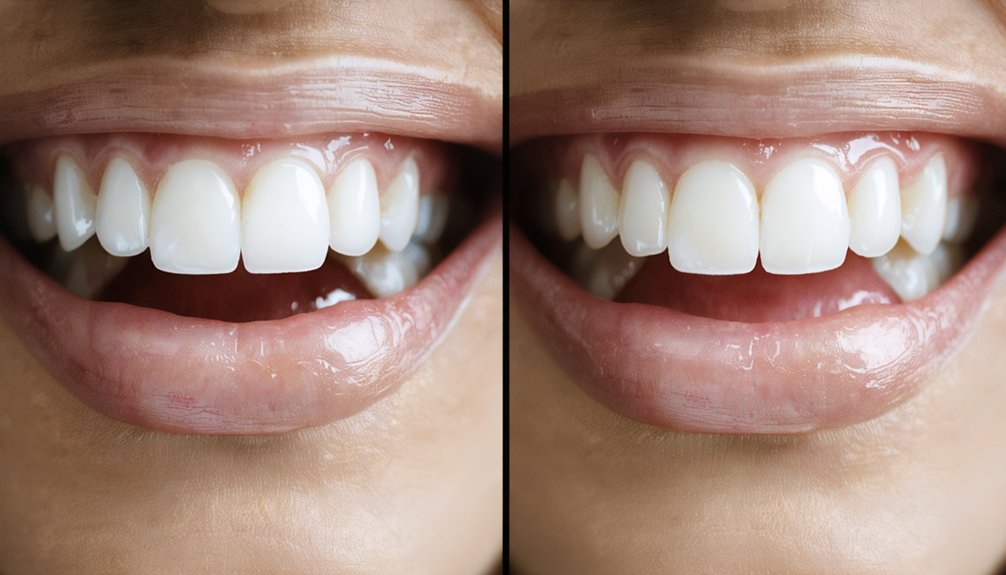
When you choose professional in-office treatment, you can achieve noticeable whitening in a single one-hour session, whereas DIY strips and trays require one to two weeks of daily application for gradual change.
If you opt for at-home bleaching with carbamide peroxide concentrations between 10-20%, you’ll see the most rapid progress within the first month of consistent use.
Your choice of method directly determines how quickly you’ll see results on tetracycline stains, with professional treatments offering an immediate advantage in speed and efficiency.
Professional Speed And Efficiency
Professional in-office whitening delivers the fastest results for tetracycline stains, achieving up to 8 shades of improvement in a single one-hour session.
Clinical advancements in high-concentration peroxide formulations, ranging from 25–40%, give you measurable control over your outcomes. Patient experiences confirm that professional supervision accelerates progress while minimizing complications.
Here’s what you can expect from professional speed and efficiency:
- Single-session results of up to 8 shades of whitening
- High-concentration agents (25–40% hydrogen peroxide) that penetrate deep staining
- Dentist-monitored application that reduces treatment errors
- Longer-lasting outcomes that reduce your need for frequent retreatment
You’ll achieve significant color change faster than any DIY alternative, making professional treatment the most time-efficient option for managing stubborn tetracycline discoloration.
DIY Gradual Whitening Timeline
Unlike the immediate results of in-office treatment, DIY whitening methods require weeks to months before you’ll notice substantial improvement in tetracycline stains.
Gradual results expectations must guide your approach, since strips applied 30–60 minutes daily for one to two weeks yield only modest initial changes.
Application consistency tips matter greatly here—missing sessions compounds DIY whitening challenges and delays measurable progress.
Clinical data shows 10–20% carbamide peroxide produces substantial lightening over three months, with 91% of users satisfied at that benchmark.
Common user complaints include uneven coverage and sensitivity above 10% concentrations.
Natural remedy effectiveness remains unproven, and ingredient safety concerns make charcoal-based products inadvisable.
For long-term maintenance strategies, maintaining daily application schedules while monitoring sensitivity gives you the most controlled, evidence-supported path forward.
First Month Progress Comparison
Within the first month, the two whitening approaches diverge sharply in measurable outcomes.
Managing your treatment expectations means confronting whitening myths early—speed doesn’t guarantee permanence, and gradual change often outperforms aggressive intervention for tetracycline stains.
Here’s what clinical evidence shows within the first 30 days:
- Professional in-office treatment delivers up to 8 shades of lightening in a single session.
- DIY carbamide peroxide strips produce gradual, modest improvement over 2–4 weeks of consistent use.
- At-home bleaching with 10–20% carbamide peroxide shows its most rapid progress during this initial month.
- Natural remedies like charcoal yield no clinically measurable change.
You’re in control when you choose methods backed by evidence rather than marketing claims.
How Long Do Tetracycline Whitening Results Actually Last?
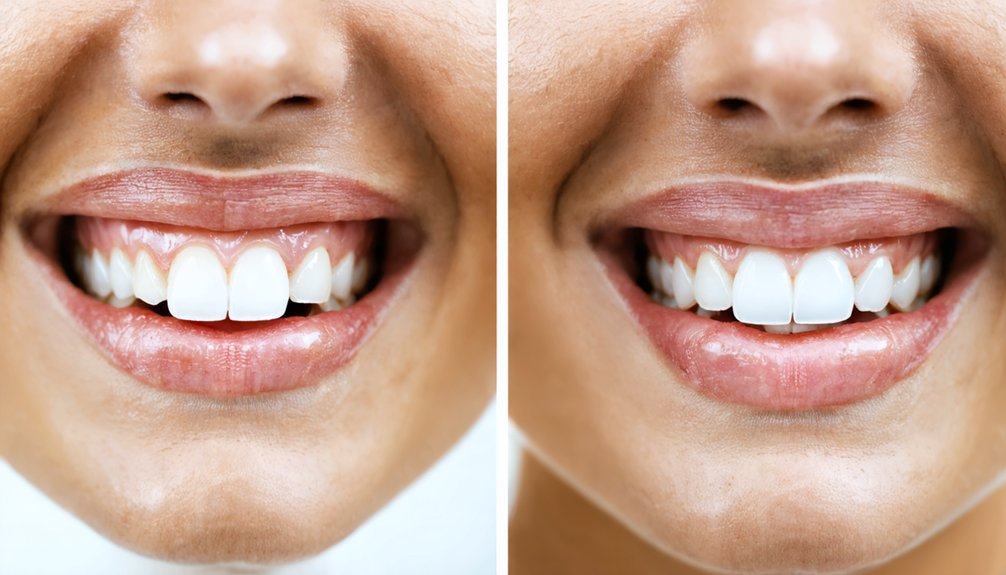
How long your tetracycline whitening results last depends largely on the treatment method you’ve chosen.
Professional in-office treatments deliver superior whitening longevity, reducing your need for frequent reapplication. Higher peroxide concentrations penetrate deeper staining layers, extending how long your results hold.
Professional in-office whitening penetrates deeper, lasts longer, and reduces how often you need to retreat.
DIY strips and trays, using lower concentrations, fade faster and demand consistent treatment maintenance to preserve any gains.
For tetracycline stains specifically, at-home carbamide peroxide trays at 10-20% concentrations show sustained results when you maintain a disciplined reapplication schedule.
Professional custom trays offer a middle ground, combining stronger formulations with controlled usage.
Regardless of your method, lifestyle factors like diet, tobacco use, and oral hygiene directly influence how long your whitening outcomes remain visible.
You control these variables.
Tetracycline Whitening Safety Risks: Enamel, Gums, and Sensitivity
When you pursue tetracycline whitening, safety risks vary considerably depending on concentration levels and supervision. Understanding these risks helps you make informed, controlled decisions.
Key safety considerations include:
- Enamel erosion — Higher DIY concentrations without professional supervision increase enamel abrasion risk, permanently weakening tooth structure.
- Gum irritation — Ill-fitting trays cause direct peroxide contact with gingival tissue, triggering inflammation and discomfort.
- Sensitivity levels — 10% carbamide peroxide produces the least tooth sensitivity; 15–20% concentrations measurably increase sensitivity during treatment.
- Product safety — Professional supervision guarantees concentration-appropriate application, minimizing cumulative damage across extended tetracycline treatment timelines.
Research confirms no significant gingival sensitivity differences exist across 10–20% concentrations, but enamel integrity and proper tray fit remain critical variables you must manage.
What Tetracycline Whitening Treatments Actually Cost
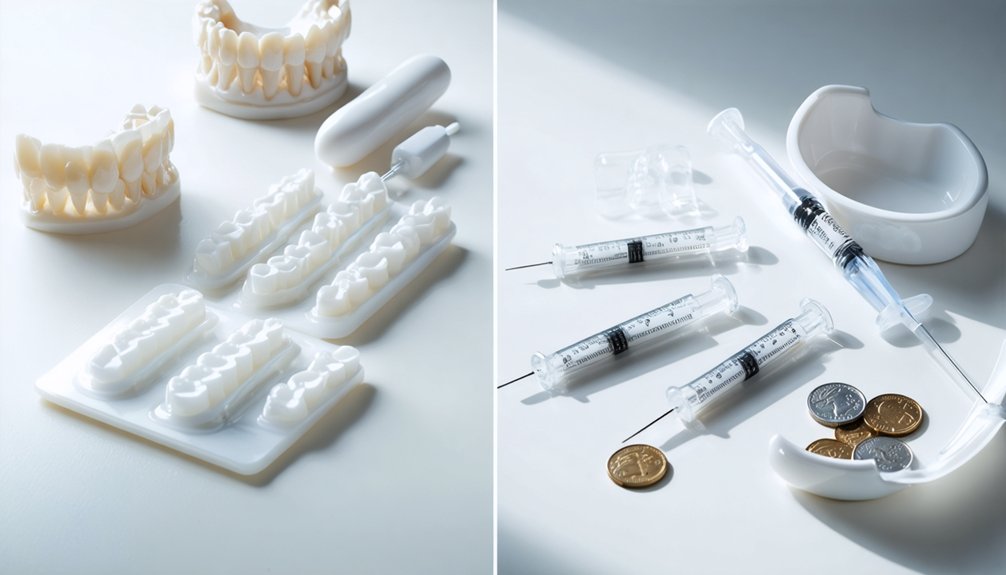
Safety considerations naturally shape which whitening path you’ll pursue, but cost often becomes the deciding factor in long-term treatment planning for tetracycline stains.
Professional in-office treatments start at $300 or more, delivering up to eight shades of improvement in a single session. That upfront investment reflects superior whitening effectiveness and longer-lasting results, reducing your need for frequent reapplication.
Custom professional trays offer a middle-ground option, achieving significant outcomes at lower ongoing cost.
DIY strips and trays are available at drugstores for considerably less, but treatment affordability here comes with trade-offs—inconsistent results, repeated purchases, and slower progress over weeks.
When you calculate cumulative spending against outcomes, professional treatment frequently delivers stronger value for managing stubborn tetracycline discoloration over time.
Stain Severity, Budget, and Timeline: Choosing the Right Method
Choosing the right whitening method for tetracycline stains depends on three converging factors: stain severity, your budget, and your acceptable timeline for results. A structured stain assessment guides your product selection effectively.
- Severity: Mild-to-moderate stains respond to 10–20% carbamide peroxide at home; severe cases require professional-concentration agents.
- Cost analysis: DIY strips cost less upfront but demand frequent repurchase; professional treatments offer longer-lasting value.
- Treatment expectations: In-office whitening delivers up to 8 shades in one session; at-home methods require weeks to months.
- Sensitivity concerns: 10% carbamide peroxide minimizes discomfort while remaining effective, making it a clinically sound starting point.
Match your method to these variables rather than defaulting to convenience, and you’ll achieve measurable, controlled outcomes.
Frequently Asked Questions
Can Tetracycline Whitening Treatments Be Combined for Faster or Better Results?
Yes, you can combine professional and DIY treatments for better treatment effectiveness. Combined approaches, like in-office sessions followed by at-home carbamide peroxide trays, accelerate your results and maintain whitening gains on stubborn tetracycline stains.
Are Tetracycline Stains in Children Treated Differently Than in Adults?
Ironically, childhood treatment focuses on prevention since whitening’s unsafe for developing teeth. You’ll find adult treatment opens the door to professional and DIY peroxide options, letting you actively target those stubborn tetracycline stains effectively.
Does Dental Insurance Ever Cover Whitening Treatments for Tetracycline Staining?
Most insurers don’t cover whitening, classifying it as cosmetic. However, you’ll want to verify your treatment eligibility by reviewing your policy’s coverage limitations, as some plans may partially cover whitening when tetracycline staining causes documented functional or psychological concerns.
Can Veneers or Bonding Be Alternatives When Whitening Fails on Tetracycline Stains?
When whitening hits a wall, veneers effectiveness shines as your strongest alternative, masking deep tetracycline stains completely. You’ll also find bonding longevity offers a cost-effective solution, though it requires periodic replacement to maintain ideal aesthetic results.
Do Tetracycline Stains Return Faster Than Normal Stains After Whitening?
Tetracycline stains don’t return faster, but their stain persistence means you’ll need consistent maintenance. Professional whitening longevity outlasts DIY results, so you’ll benefit more from supervised treatments to sustain your color improvements effectively.
References
- https://margiewilliamsdds.com/why-professional-teeth-whitening-works-better-than-diy-treatments/
- https://www.mychicodentist.com/articles/professional-vs-diy-teeth-whitening
- https://pubmed.ncbi.nlm.nih.gov/12666888/
- https://www.johnogradydmd.com/blog/443540-professional-teeth-whitening-vs-over-the-counter-methods
- https://www.aestheticoralarts.net/teeth-whitening-professional-vs-diy-methods-compared/
- https://www.youtube.com/watch?v=S-TQeElIsAg
- https://bluedotdental.com/blog/teeth-whitening-professional-vs-diy-methods-compared/
- https://www.espositofamilydental.com/section-of-6-blog-posts/teeth-whitening-diy-methods-vs-professional-treatments