For tetracycline stains, you’ll need specialized treatments since the discoloration penetrates deep into your dentin layer. KöR Whitening’s dual-activated system can lighten severe stains by 6-16 shades through combined at-home and in-office protocols. If your staining is exceptionally dark, porcelain veneers offer instant transformation by bonding custom-crafted shells over your natural teeth, lasting 10-15 years. The right solution depends on your stain severity, budget, and desired timeline—each option addresses these intrinsic discolorations differently with varying longevity and aesthetic outcomes.
Key Takeaways
- KöR Whitening Deep Bleaching uses dual-activated peroxide in multi-step treatments, achieving 6-16 shade improvements for moderate to severe tetracycline stains.
- Porcelain veneers provide instant transformation by bonding custom-crafted shells over discolored teeth, lasting 10-15 years with proper care.
- Professional in-office bleaching with high-concentration agents and laser activation penetrates intrinsic dentin stains more effectively than home treatments.
- Treatment timelines vary: veneers offer immediate results, while at-home bleaching requires 2-6 months for complete tetracycline stain removal.
- Internal bleaching targets dentin-level discoloration directly, making it effective for deep stains that surface treatments cannot adequately address.
Understanding Tetracycline Stains and Their Unique Challenges
When tetracycline antibiotics enter your system during tooth development, they create one of dentistry’s most stubborn discoloration challenges. The medication binds with calcium ions during mineralization, embedding deep within your dentin layer—not just surface enamel. You’ll initially notice fluorescent yellow teeth, but oxidation transforms this to persistent brown, gray, or bluish tones over time.
Understanding patient expectations starts with recognizing these aren’t surface stains removable through standard whitening. The discoloration penetrates your tooth structure completely, making conventional treatments ineffective. Your anterior teeth typically show the most visible darkening due to light exposure, while molars remain comparatively lighter.
Managing long term outcomes requires specialized approaches that address intrinsic staining. You’re dealing with permanent discoloration that won’t fade naturally, demanding targeted interventions beyond typical cosmetic procedures.
Professional In-Office Teeth Whitening Solutions
Because tetracycline stains resist conventional whitening methods, you’ll need professional in-office treatments that deliver concentrated bleaching agents deep into your tooth structure. Your dentist will customize bleaching gel formulations using high-strength hydrogen peroxide or carbamide peroxide to penetrate intrinsic discoloration that over-the-counter products can’t reach.
Tetracycline staining requires professional-strength bleaching agents that penetrate deep tooth layers—something standard whitening products simply cannot achieve.
Advanced laser whitening accelerates results through precise laser power adjustments—typically KTP lasers at 532 nm wavelength and 1 watt power activate gels for enhanced stain breakdown. For severe cases, internal bleaching addresses discoloration from within your dentin after accessing the tooth’s interior.
Expect multiple sessions with these proven approaches:
- High-concentration professional agents targeting deep-set stains
- Laser-activated treatments for faster penetration
- Internal bleaching for dentin-level discoloration
- Gradual peroxide concentration increases over months
- Combination protocols pairing whitening with cosmetic masking
Your treatment plan depends on stain severity and desired brightness restoration.
KöR Whitening: A Powerful Deep-Stain Treatment
KöR Whitening employs a multi-step protocol specifically designed to penetrate deep tetracycline staining that standard whitening can’t reach. You’ll combine customized at-home tray treatments with in-office sessions, allowing the specially formulated gel to break down stubborn chromophores embedded within your tooth structure.
This systematic approach delivers dramatic shade improvements on even the darkest banding—transforming teeth that other systems leave unchanged.
Multi-Step Treatment Protocol
The multi-step KöR Whitening protocol transforms even the most resistant tetracycline stains through a systematic combination of at-home and in-office treatments. Your personalized whitening approach begins with customized tray fabrication from precise impressions, ensuring ideal gel delivery while protecting your gums.
You’ll follow the KöR Ultra-T protocol for 6-8 weeks of nighttime whitening with refrigerated gels that maintain maximum potency.
Your treatment progression includes:
- Initial dental cleaning and custom tray creation
- KöR Jumpstart in-office conditioning session
- Minimum 14 consecutive nights wearing gel-filled trays during sleep
- Desensitizer application first two nights and each morning after whitening
- Final in-office treatment with 45-minute gel activation under specialized light
You’ll maintain your results permanently through periodic maintenance whitening—just a few nights monthly—while avoiding staining foods during active phases.
Effectiveness on Deep Stains
Deep tetracycline stains that once seemed permanent now respond dramatically to KöR Whitening’s advanced oxygen-delivery system. You’ll see exceptional results as the treatment penetrates dentin layers where traditional methods fail, breaking down stain molecules at their source.
Through proper stain depth assessment, your dentist determines whether you need KöR ULTRA-T for severe tetracycline cases or KöR MAX for moderate discoloration. The stain removal effectiveness delivers 6-16 shade improvements, with some patients achieving transformations dentists previously considered impossible.
The dual-activated peroxide system targets intrinsic discoloration that resists surface treatments, providing consistent whitening across even the most stubborn banding patterns. You’re gaining access to clinically proven technology that thousands of dentists trust for deep stain removal—results that last months or years with appropriate maintenance protocols.
Porcelain Veneers for Severe Discoloration
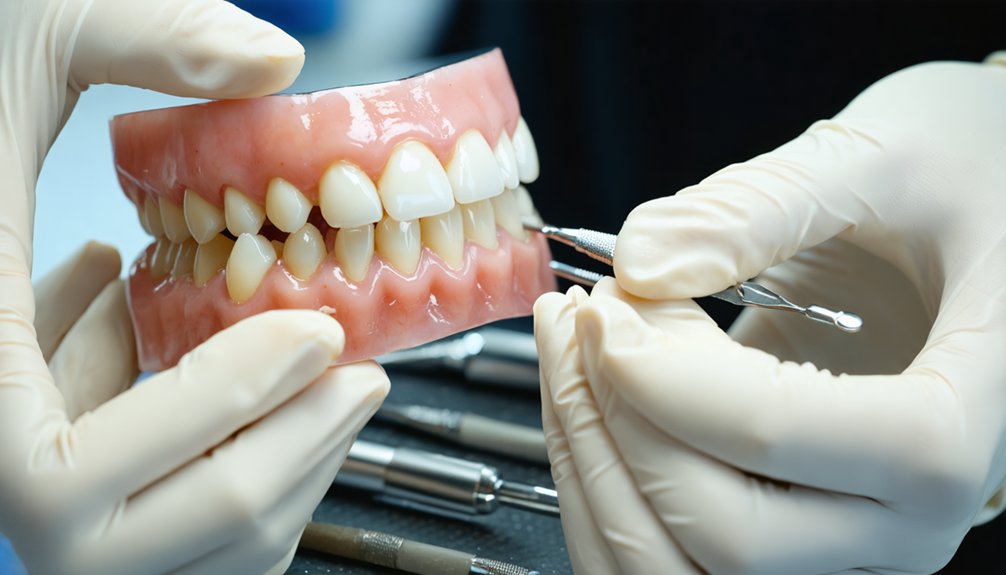
When KöR whitening can’t eliminate your severe tetracycline stains, porcelain veneers offer a transformative solution that conceals deep discoloration behind custom-crafted shells. Your dentist bonds these ultra-thin porcelain layers directly to your tooth surfaces, typically requiring minimal enamel preparation while delivering natural-looking brightness that lasts 10–15 years or more.
You’ll achieve a flawless smile through precise shade matching and advanced blockout techniques that permanently mask even the darkest gray-brown banding.
Custom Porcelain Shell Application
For severe tetracycline staining that resists traditional whitening methods, porcelain veneers deliver the most reliable and dramatic aesthetic transformation. These thin porcelain shells bond directly to your front tooth surfaces, masking deep discoloration that penetrates the dentin layer where enamel-only treatments can’t reach.
The custom application process involves minimal tooth alteration while achieving a natural appearance through precise shade-matching:
- Blockout techniques opacify dark bands with light composite resin
- Class V preparations address severe middle-third banding in the dentin
- Custom shading guarantees symmetry and authentic brightness
- Temporary veneers protect prepared teeth until permanent placement
- Expert ceramist skills prevent opacity or stain show-through
Your veneers remain color-stable and stain-resistant for 10–15 years, outperforming bonding and bleaching alternatives. This premier solution addresses shape, size, and chips beyond discoloration correction.
Enamel Preparation Requirements Explained
Successfully transforming severe tetracycline stains with porcelain veneers depends on precise enamel preparation that balances aesthetic coverage with tooth preservation. Your dentist will employ enamel assessment techniques including thickness mapping and demineralization detection to guarantee adequate structure remains. These measurements determine your specific preparation depth.
For severe tetracycline discoloration, you’ll typically require aggressive preparation of 1.0-1.5mm—necessary to mask deep staining while maintaining 70-90% of original enamel. Preparation measurement guidelines dictate chamfer margins at or below the gum line with rounded edges for ideal bonding.
Your dentist will use diagnostic wax-ups to plan this irreversible procedure, then apply local anesthesia for comfort during removal. Temporary veneers protect your prepared teeth while custom porcelain shells are crafted, ensuring both function and appearance throughout treatment.
Durability and Longevity Benefits
Beyond the immediate transformation, porcelain veneers deliver exceptional longevity that safeguards your investment in treating severe tetracycline stains. You’ll achieve predictable lifelong performance with proper maintenance, as clinical data demonstrates 95% survival at 10 years and 83% at 20 years. The exceptional stain resistance preserves your aesthetic results remain pristine throughout decades of daily use.
Your veneers provide measurable durability advantages:
- 10-15 year average lifespan with potential to exceed 20 years under ideal conditions
- 96% functionality maintained after 5 years across multiple clinical studies
- Superior to composite alternatives that require replacement every 5-7 years
- Resistance to discoloration from coffee, wine, and other staining agents
- Withstand daily stresses while maintaining natural translucency and appearance
Regular dental visits and excellent oral hygiene maximize your veneer longevity, making them the definitive solution for permanent tetracycline stain correction.
Dental Bonding as an Affordable Alternative
Dental bonding delivers immediate aesthetic results for tetracycline-stained teeth without the financial burden of porcelain veneers. You’ll complete this single-visit procedure at a fraction of veneer costs, as your cosmetic dentist applies tooth-colored composite resin directly over stubborn stains. The cost effectiveness stems from lower material expenses, reduced labor time, and eliminated laboratory fees that veneers require.
You’re choosing a minimally invasive treatment that preserves your natural tooth structure while concealing discoloration resistant to bleaching. Your dentist shapes the resin to match surrounding teeth, creating uniform smile aesthetics immediately.
However, maintenance requirements include periodic polishing and eventual replacement as bonding gradually discolors and chips. You can’t whiten bonded areas independently—replacement becomes necessary when color mismatches develop. This solution works best when you’re seeking budget-friendly, immediate coverage over long-term permanence.
When Dental Crowns Are the Best Option
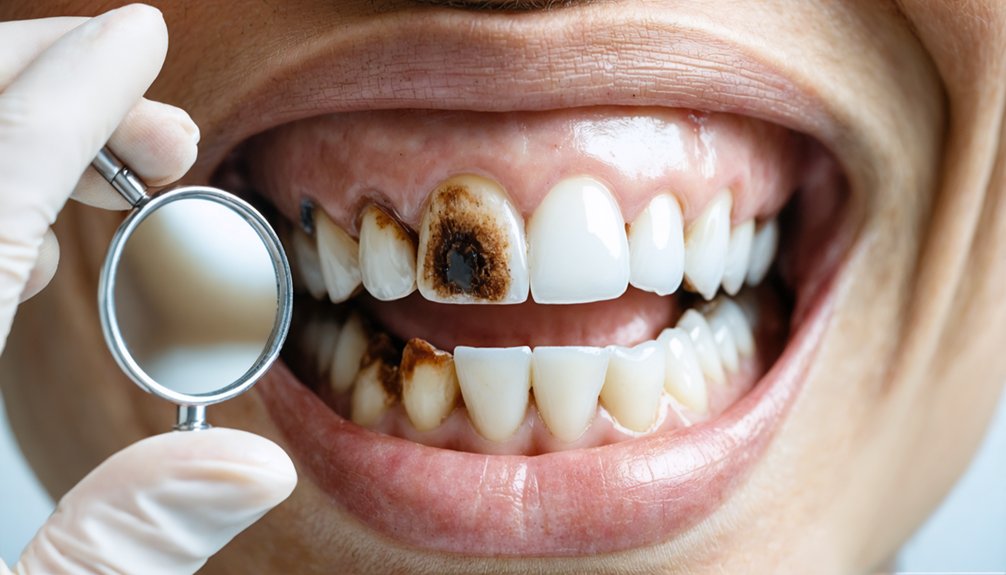
While bonding offers an economical solution for moderate discoloration, it can’t address the most challenging tetracycline cases where darkness penetrates deep into tooth structure.
Crowns become your definitive option when structural integrity concerns overlap with cosmetic considerations. They provide complete tooth coverage that veneers and bonding simply can’t achieve, preventing dark underlying stains from showing through while reinforcing weakened enamel.
You’ll want crowns specifically when:
- Grade IV tetracycline stains prove too severe for translucent veneers to mask successfully
- Teeth show compromised structural integrity requiring full coverage restoration
- Previous bleaching and polishing attempts have failed completely
- You’re targeting all visible anterior teeth for guaranteed uniform results
- Advanced porcelain-fused-to-zirconia materials guarantee both strength and superior stain masking
Your dentist will use specialized opaque cements and layering techniques to block even exceptionally dark discoloration permanently.
Comparing Treatment Timelines and Expected Results
Your timeline expectations shift dramatically depending on which tetracycline treatment you choose, with results ranging from immediate cosmetic coverage to gradual stain reduction over months. Porcelain veneers deliver instant transformation in a single appointment, masking severe stains permanently with custom shells.
Laser whitening offers faster penetration than standard bleaching but retains some discoloration in severe cases. At-home tray bleaching demands 2-6 weeks for moderate stains, extending to 2-6 months nightly for complete tetracycline removal. In-office bleaching requires multiple sessions with continued whitening observed over weeks.
Dental bonding provides quick coverage but lacks longevity. Understanding these timetable expectations helps you align suitability considerations with your aesthetic goals—whether you’re prioritizing immediate results or gradual, natural lightening through persistent treatment protocols.
Protecting Your Teeth From Future Staining
Once you’ve achieved your desired shade through treatment, maintaining those results requires strategic prevention measures that address both intrinsic and extrinsic staining mechanisms. You’ll need to implement a multi-layered approach that controls environmental factors while monitoring fluoride exposure to prevent additional discoloration.
Your prevention protocol should include:
- Brush twice daily with ADA-approved whitening toothpaste using soft bristles to remove surface stains without damaging enamel
- Limit dark beverages like coffee, tea, and red wine by consuming them through straws and rinsing immediately afterward
- Schedule professional cleanings every six months to maintain brightness and remove calculus before staining occurs
- Avoid smoking entirely, as tobacco accelerates discoloration and compromises treatment outcomes
- Request antibiotic alternatives from your healthcare provider, particularly avoiding additional staining factors like prolonged tetracycline or minocycline courses
This disciplined approach preserves your aesthetic investment long-term.
Frequently Asked Questions
Can Tetracycline Stains Return After Successful Whitening Treatment?
Residual tetracycline stains can re-emerge over time, compromising long-term effectiveness. You’ll need accelerated maintenance whitening every 6-8 weeks to control stain recurrence potential, as deep dentin discoloration gradually re-darkens without consistent professional treatment intervention.
Are Tetracycline Stain Treatments Covered by Dental Insurance Plans?
You’ll face dental coverage limitations since insurers classify tetracycline stain removal as cosmetic, not medical. However, you can explore treatment plan alternatives like crowns over veneers, or demonstrate functional necessity to potentially secure partial reimbursement for your desired results.
What Age Is Safest to Begin Treating Tetracycline Stains?
You should wait until age 18 to treat tetracycline stains, ensuring your permanent teeth have fully developed. Despite early childhood exposure causing permanent discoloration, delaying treatment allows your dentist to implement the most efficacious cosmetic solutions for ideal results.
Do Whitening Treatments Cause Increased Tooth Sensitivity With Tetracycline Stains?
Yes, you’ll experience temporary sensitivity during the first two weeks, but whitening sensitivity factors like desensitizing agents and gradual protocols effectively manage discomfort. Following treatment compliance considerations guarantees you’ll achieve ideal aesthetic results without progressive sensitivity worsening.
Can Pregnant Women Undergo Tetracycline Stain Removal Procedures?
You’ll need to postpone treatment until after delivery and nursing, as pregnancy safety data doesn’t exist for these procedures. Schedule a patient consultation addressing hormonal considerations and aesthetic goals once you’re no longer pregnant for ideal results.