You’ll find three standout LED teeth whitening devices: Pola Light 9.5% delivers professional-grade results within 5 days using hydrogen peroxide gel, though at a premium price; Crest 3D White Whitestrips achieve visible improvements in 60 minutes with AdvancedSEAL™ technology; and Snow’s tri-spectrum system provides up to 8 shades of whitening over 21 days using 18% carbamide peroxide. Each leverages photocatalytic activation in the 400-500nm wavelength range to accelerate peroxide breakdown while minimizing sensitivity. The thorough analysis below explores efficacy metrics, session protocols, and cost-effectiveness comparisons.
Key Takeaways
- LED teeth whitening devices use 400-500nm wavelengths to accelerate peroxide gel breakdown, delivering 5-10 shade improvements in 20-90 minutes.
- Pola Light combines rechargeable LED mouthpiece with 9.5% hydrogen peroxide gel, achieving noticeable results within 5 days at premium pricing.
- Crest 3D Whitestrips with LED Light removes 20-25 years of stains in 60 minutes using AdvancedSEAL™ technology and professional-grade ingredients.
- Snow Teeth Whitening Kit delivers up to 8 shades improvement in 21 days with 18% carbamide peroxide and tri-spectrum LED.
- Professional treatments cost $300-800 but last 12-24 months, while at-home kits ($50-150) require repeated applications over weeks.
What Are Blue Light Teeth Whitening Devices and How Do They Work?
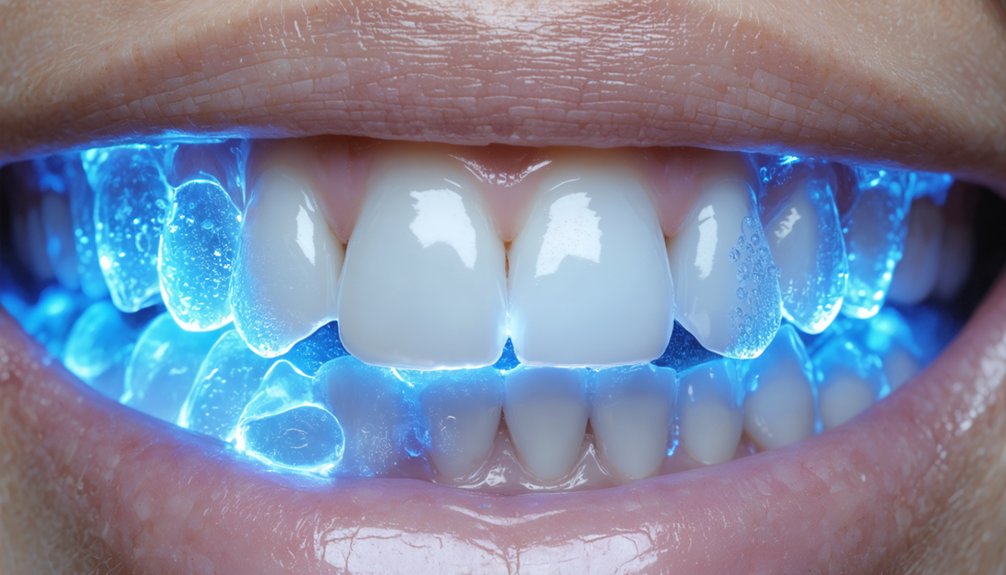
Blue light teeth whitening devices employ LED technology that emits specific wavelengths in the 400-500 nanometer range to accelerate the chemical breakdown of dental staining agents. You’ll apply hydrogen peroxide or carbamide peroxide gel to your teeth, then position the LED mouthpiece to activate oxidation.
The light catalyzes peroxide decomposition, generating oxygen molecules that penetrate enamel and oxidize chromophores causing discoloration. This photon-assisted process achieves teeth enamel protection through controlled low-heat operation, unlike traditional UV systems.
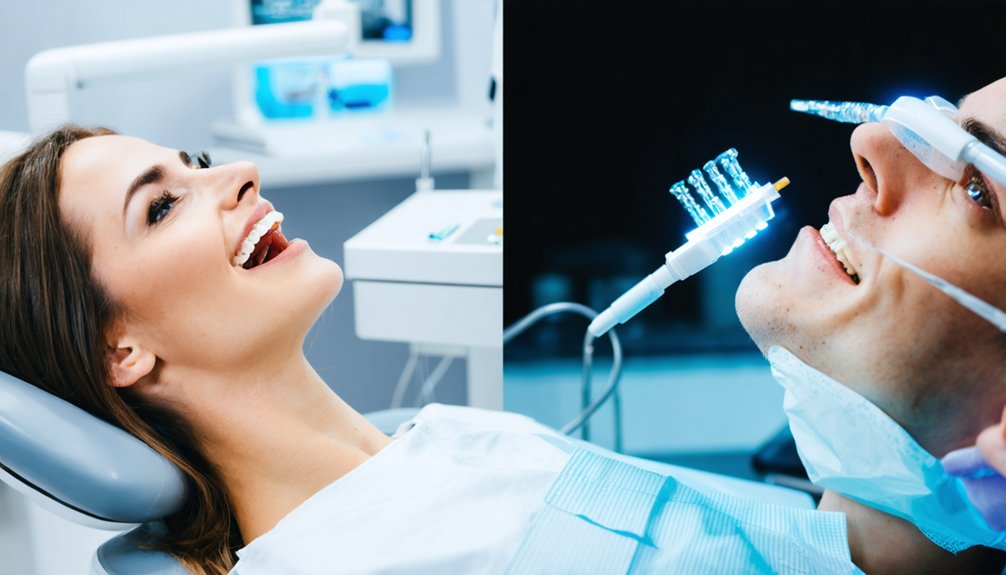
Professional treatments utilize higher-concentration gels with supervised light exposure, while at-home kits offer regulated formulations for gum irritation minimization. You’ll control treatment duration and frequency based on manufacturer protocols, typically requiring 10-30 minute sessions.
The blue wavelength specifically targets stain molecules without directly bleaching, functioning purely as a catalytic accelerant.
Top Benefits of Using LED Technology for Teeth Whitening
When evaluating LED-based whitening systems, you’ll discover that these devices deliver clinically significant shade improvements of 5-10 levels within 20-90 minutes through enhanced photocatalytic activation. You’ll control the oxidation process with light outputs reaching 2000 mW/cm², accelerating peroxide breakdown at twice the rate of gel-alone applications.
These systems eliminate UV radiation and excessive heat generation, establishing safe usage protocols that protect enamel integrity and minimize gingival irritation. You’ll experience reduced tooth sensitivity compared to traditional methods, particularly when utilizing red light wavelengths that support periodontal health.
Treatment efficiency replaces weeks-long regimens with single-session protocols, while convenient maintenance extends results 6-24 months. You’ll achieve uniform whitening across visible surfaces through precise intensity modulation and controlled exposure duration, maximizing the gel’s 24-hour active window.
Pola Light 9.5% LED Teeth Whitening System Kit Review
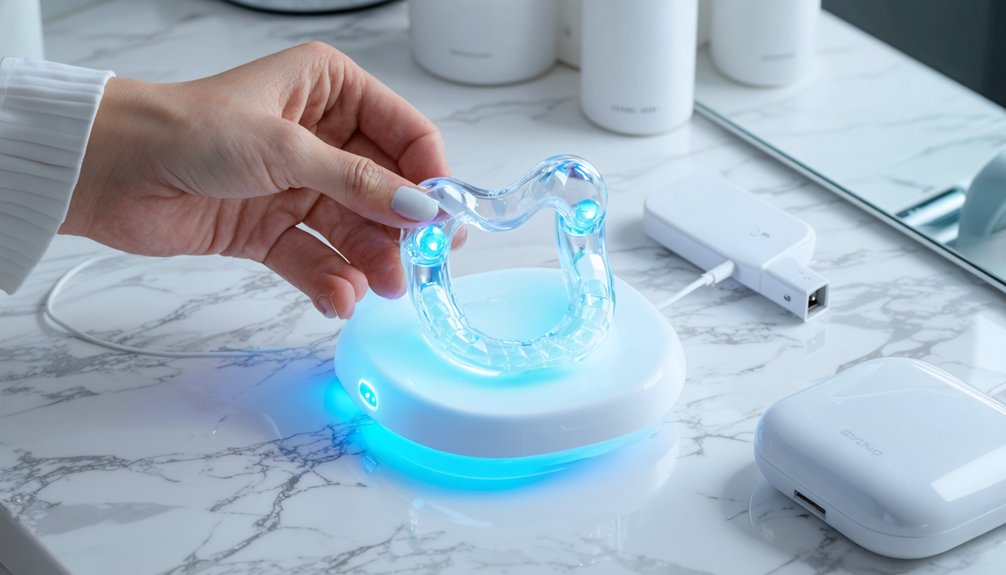
Although marketed as an innovation in at-home whitening technology, the Pola Light 9.5% LED Teeth Whitening System Kit combines a rechargeable LED mouthpiece with hydrogen peroxide gel syringes to deliver professional-grade results without custom tray fabrication. The universal tray design eliminates chair time but introduces overfill risk, potentially causing soft tissue irritation you’ll need to monitor.
You’ll achieve noticeable whitening within 5 days using the high-viscosity, neutral pH formulation containing fluoride for remineralization and desensitizers to mitigate sensitivity. Real world application reveals inconsistent mandibular whitening compared to maxillary results, while the LED component functions primarily as a timer rather than active whitening catalyst.
The premium price point exceeds conventional custom tray systems, though the rechargeable mouthpiece provides treatment flexibility across multiple sessions.
Crest 3D White Whitestrips With LED Light Review
Crest’s 3D White Whitestrips with LED Light system represents a departure from tray-based application methods, employing AdvancedSEAL™ technology that bonds peroxide-laden polyethylene strips directly to tooth enamel surfaces for 30-60 minute treatment cycles. The dual-action protocol incorporates hydrogen peroxide formulations with PVP and acrylates copolymer for adhesion, followed by 5-minute LED acceleration phases that expedite chromophore breakdown.
You’ll achieve visible results within 60 minutes, with professional-level whitening materializing across 21 treatments. The system demonstrates reliable performance through documented removal of 20-25 years of accumulated stains using dentist-equivalent active ingredients. Long lasting benefits extend to 36 months with protocol adherence.
Three variant kits address specific requirements: Professional Supreme (42 strips), Professional White (38 strips), and Sensitive Formula (28 strips with 30-minute wear parameters).
Snow Teeth Whitening Kit Review
Unlike strip-based systems, Snow’s thorough teeth whitening apparatus integrates a tri-spectrum LED mouthpiece with carbamide and hydrogen peroxide serums that you’ll apply via precision wand applicator for controlled 9-30 minute treatment protocols.
The device delivers up to 8 shades of improvement within 21 days through 18% dental-grade carbamide peroxide combined with hydroxyapatite for enamel remineralization and potassium nitrate for neural desensitization. You’ll achieve quantifiable results—visible whitening in 3 days, with some protocols yielding 12 shades across 7 sessions.
The UV-sanitizing wireless case provides 2-4 months of treatments per kit. Overall performance proves effective for intrinsic staining with virtually zero sensitivity reported. However, customer support experience receives inconsistent feedback regarding return processing, and the formulation demonstrates limited efficacy on composite restorations.
Primal Life Organics V4 Real White System Review
Primal Life Organics’ V4 Real White System distinguishes itself through dual-wavelength LED technology that combines 470nm blue light for chromophore activation with 660nm red light therapy for periodontal tissue regeneration. The peroxide-free gel formula leverages hydroxyapatite, activated charcoal, and mineral clays to deliver documented 6-shade whitening without compromising enamel integrity.
You’ll control three operational modes: isolated red (620–680nm) for inflammation management, blue for chromophore oxidation, and purple for concurrent treatment. The automatic 16-minute protocol eliminates monitoring requirements while USB compatibility guarantees device durability across multiple power sources.
Natural formulation effectiveness manifests through remineralization capabilities and gingival health support, particularly for sensitivity-prone users. While gel application demands meticulous tooth desiccation and cleanup procedures prove labor-intensive, clinical outcomes justify the premium investment for those prioritizing biocompatible whitening protocols.
Comparing Session Times and Treatment Duration Across Products
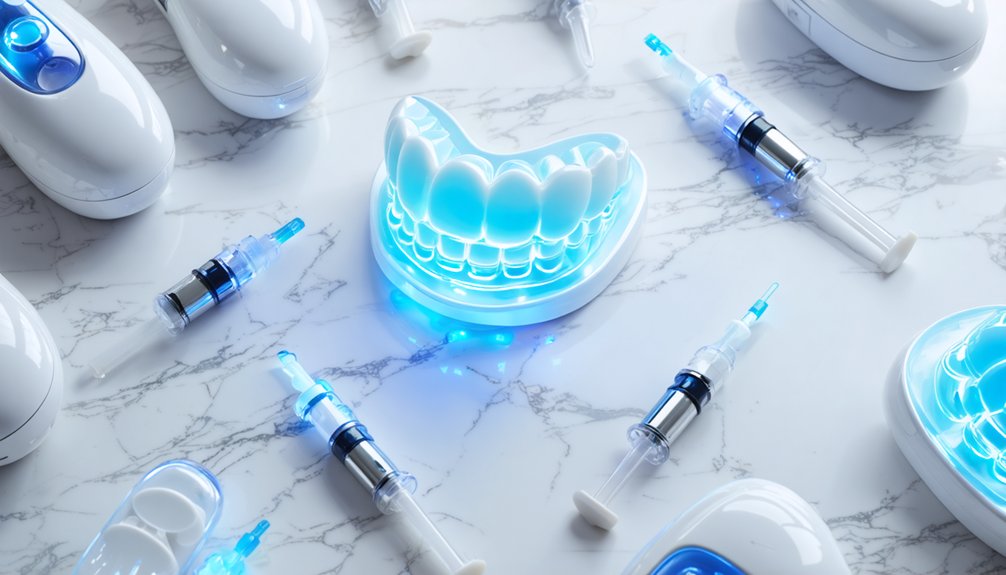
Treatment duration fundamentally separates blue light whitening technologies into three distinct performance categories, each delivering predictable outcomes through concentrated peroxide exposure rather than extended activation periods. Professional diode lasers complete whitening in 15–20 minutes using 25–40% hydrogen peroxide, while LED systems require 30–60 minutes at 20–35% concentration. At-home kits extend treatment across 2–4 weeks with 10–15% peroxide formulations.
Treatment intensity differences directly correlate with concentration rather than session length—45 minutes at 25% hydrogen peroxide produces identical results to 60 minutes at 40%. Your whitening outcomes comparison reveals that light activation primarily reduces chair time through heat acceleration without improving final shade achievement. Higher concentrations dramatically compress total treatment hours: 6% peroxide achieves in 7 hours what 10% requires 140 hours to accomplish.
Managing Tooth Sensitivity During LED Whitening Treatments
Tooth sensitivity affects approximately 67% of LED whitening users through a well-documented mechanism: peroxide molecules penetrate enamel micro-porosities, reaching dentin tubules where they trigger transient pulpal inflammation and direct nerve stimulation.
Managing pre-treatment sensitivity requires systematic preparation. You’ll apply potassium nitrate-based desensitizing toothpaste twice daily for 14 days before initiating whitening protocols. Select formulations with ≤10% hydrogen peroxide concentration to minimize neural activation while maintaining efficacy.
Addressing post-treatment pain relief demands immediate intervention. You’ll implement Pro-Argin technology dentifrice applications within one hour of treatment completion. Eliminate thermal extremes and acidic pH exposures for 48-72 hours post-session. For persistent intradental nerve responses exceeding 72 hours, you’ll discontinue treatment and secure professional evaluation to exclude underlying pathology including micro-fractures, compromised restorations, or irreversible pulpitis requiring clinical intervention.
Evaluating Cost vs. Results for Blue Light Whitening Devices
Beyond addressing discomfort protocols, your financial investment in LED whitening technology requires quantitative analysis of cost-efficacy ratios. Professional sessions ($300-800) deliver 8-shade improvements within 30 minutes, achieving ΔE 5.20 color stability lasting 12-24 months with minimal gel exposures.
At-home kits ($50-150) necessitate repeated applications over weeks, though systems like the $115 waterproof LED unit with 35% carbamide peroxide approach clinical outcomes. Longevity considerations favor professional violet LED treatments (405-410nm wavelength), maintaining ΔE 4.05 after 12 months versus strip results fading within months.
Custom trays ($200-600) maximize at-home durability, while maintenance expenses accumulate with basic strips ($20-40) requiring frequent repurchase. Your cost-per-shade metric determines ideal selection—professional treatments minimize long-term expenditure for sustained chromatic correction.
Tips for Maximizing Your Blue Light Teeth Whitening Results
While blue light devices offer chromatic enhancement potential, achieving maximum ΔE values requires systematic protocol adherence beyond mere device activation.
Proper pre-treatment oral hygiene establishes critical baseline conditions—thorough brushing removes pellicle layers that impede gel penetration. Apply protective barriers to prevent gingival inflammation. Personalized treatment plan considerations demand professional assessment of enamel thickness and intrinsic staining patterns before initiating protocols.
Strategic implementation protocols:
- Control sensitivity outcomes through graduated hydrogen peroxide concentrations (25-40%) matched to your enamel response patterns
- Eliminate chromogenic substances 48 hours post-treatment to safeguard your investment in whitening outcomes
- Document shade progression across sessions to quantify efficacy and adjust frequency parameters
- Prevent enamel demineralization by adhering to manufacturer-specified exposure intervals
- Achieve predictable results through disciplined spacing of treatment sessions based on individual physiological feedback
Frequently Asked Questions
Can Blue Light Teeth Whitening Devices Damage Tooth Enamel Over Time?
Like enamel temporarily softening after acidic foods, blue light whitening won’t damage your teeth long-term when used correctly. You’ll experience potential tooth sensitivity initially, but long term enamel effects remain negligible as microhardness recovers within seven days post-treatment.
Are Blue Light Whitening Results Permanent or Do Teeth Restain Quickly?
Blue light whitening results aren’t permanent; you’ll experience short-term effectiveness lasting 6-12 months. Maintenance requirements include avoiding staining agents, using touch-up treatments, and practicing consistent oral hygiene to prevent rapid restaining from dietary and lifestyle factors.
Can I Use Blue Light Whitening Devices With Dental Veneers or Crowns?
You’ll love whitening restorations that can’t actually whiten—veneer compatibility concerns and suitability for crowns reveal zero chromatic response to peroxide oxidation. Blue light devices won’t damage your restorations, but they’ll create mismatched shade differentials with adjacent natural dentition.
Do Blue Light Devices Work on Tetracycline or Medication-Caused Tooth Discoloration?
Blue light devices show limited effectiveness on tetracycline discoloration. While they address extrinsic teeth discoloration causes, they can’t penetrate deep dentin stains from medications. You’ll need professional-grade peroxide systems or veneers for meaningful results on medication-induced intrinsic staining.
How Do Blue Light Whitening Results Compare to Professional Dental Office Treatments?
Blue light whitening delivers inferior effectiveness compared to traditional whitening—achieving only 1.8 ΔE versus 3.3 for in-office peroxide treatments. Safety considerations for prolonged use include increased sensitivity rates and potential enamel compromise, requiring your careful monitoring.