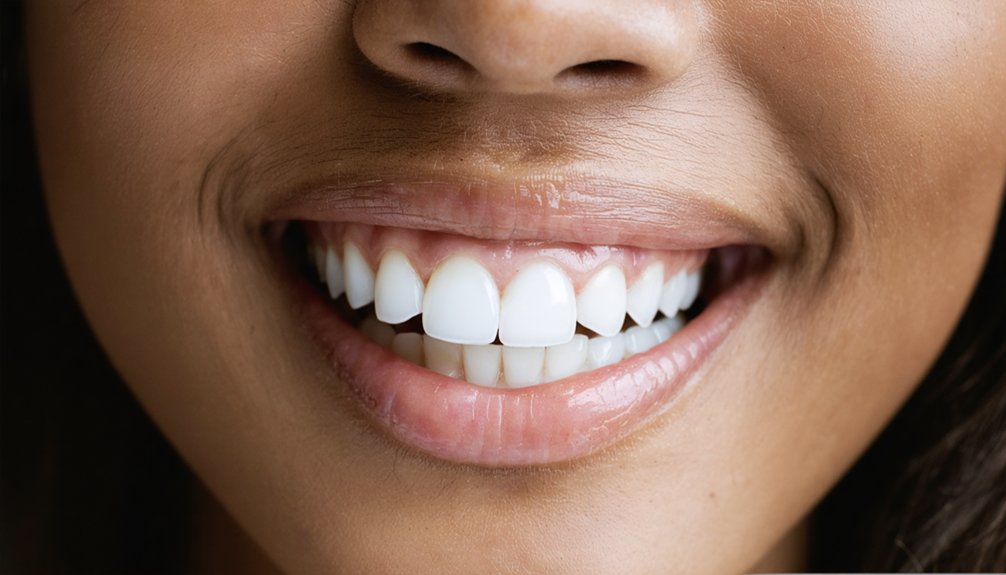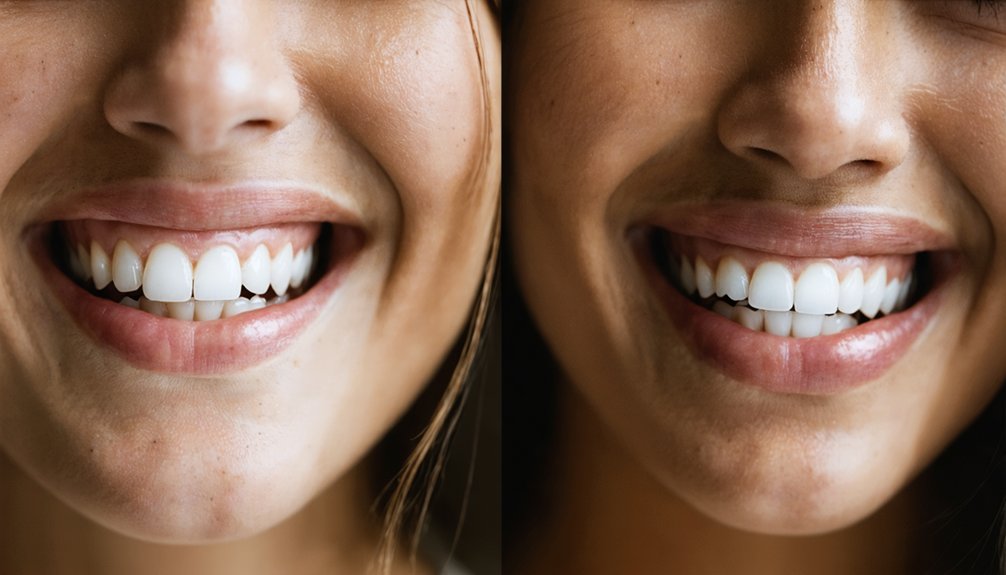
You’ll see transformations of 7-8 shades lighter with professional in-office whitening, often achieving dramatic results within 30-60 minutes of treatment. The most advanced systems can deliver changes of 10-15 shades in select cases, with ΔE values reaching 5.28 to 5.92 immediately after your session. At-home systems work more gradually, requiring about two weeks for visible improvements. Your results can last up to three years with proper maintenance, though individual outcomes depend on your age, enamel health, and lifestyle habits that we’ll explore further.
Key Takeaways
- Professional in-office treatments deliver dramatic results of 7-15 shades lighter within just 30-60 minutes of treatment.
- At-home whitening systems require two weeks for visible results but offer cost-effective maintenance and gradual improvement.
- Yellow staining responds excellently to bleaching agents, producing the most impressive before-and-after transformations.
- Professional treatments last up to three years with proper care, while over-the-counter options fade within three months.
- Younger patients aged 14-16 with healthy enamel achieve the most exceptional whitening results and dramatic transformations.
What to Expect From In-Office Whitening Results
In-office whitening delivers measurable color changes in a single session, with clinical studies documenting ΔE values of 5.28 to 5.92 immediately after treatment using 35-40% hydrogen peroxide formulations. You’ll typically see 7-8 shades lighter results, though some systems achieve 10-15 shades in select cases. The transformation occurs within 30-60 minutes, giving you immediate control over your smile’s appearance.
Your results depend on factors influencing whitening like initial tooth color, discoloration type, and age—teens aged 14-16 achieve ideal outcomes, while older adults may experience weaker transformations. Common whitening challenges include temporary dehydration effects and sensitivity in 30-78% of patients, though these resolve within days. Professional customization addresses these concerns through adjusted concentrations and supervised protocols, ensuring predictable outcomes based on your specific needs.
At-Home Whitening: A Gradual Path to Brighter Teeth
While professional treatments offer rapid transformations, at-home whitening systems provide a cost-effective alternative that works gradually over 1-2 weeks of consistent use. You’ll find carbamide peroxide gel-filled trays deliver the highest cost effectiveness of peroxide agents over 12 months, particularly at FDA-approved 10% concentrations. Strips and gels require two weeks for visible results, while whitening toothpastes work slower but maintain your improvements.
You can choose from several approaches: charcoal-based toothpastes show superior whitening efficiency, while the efficacy of herbal whitening options like Herbal Expert toothpaste ranks highest in comparative studies. Custom dentist-provided trays with controlled peroxide concentrations minimize sensitivity while maximizing outcomes. You’ll achieve moderate surface stain removal through daily application, though intrinsic discoloration requires professional intervention for ideal transformation.
How Long Your Whitening Results Will Last
Your investment in teeth whitening delivers results that typically last anywhere from a few months to three years, depending on the treatment method you choose and how diligently you maintain them. Professional in-office treatments provide the longest-lasting outcomes—up to three years with proper care—while dentist-prescribed take-home trays maintain brightness for approximately one year. Over-the-counter strips and kits fade within three months.
You’ll directly control longevity through diet impact and lifestyle habits. Limiting staining beverages like coffee and wine extends results by 6-12 months. Brushing twice daily with whitening toothpaste and maintaining professional cleanings every six months preserves your preferred shade. Avoiding tobacco and following maintenance protocols—applying whitening gel 1-2 days every 6-12 months—keeps your smile consistently bright.
Managing Sensitivity During and After Treatment
Achieving and maintaining your bright smile comes with one common challenge: tooth sensitivity. You’ll experience this when hydrogen peroxide penetrates your dentin and activates exposed dentinal tubules. For temporary sensitivity relief, apply desensitizing gel immediately after treatment and take ibuprofen as needed. Rinse with fluoride mouthwash to accelerate remineralization while avoiding extreme temperature foods and beverages. Switch to a soft-bristled toothbrush with non-abrasive toothpaste during recovery.
Long term sensitivity prevention requires strategic planning. Start using potassium nitrate toothpaste three weeks before whitening. Select lower peroxide concentrations (5-6%) and custom dental trays for controlled application. Space your treatments adequately, allowing complete remineralization between sessions. Consider gradual take-home kits instead of aggressive in-office procedures. Maintain consistent desensitizing toothpaste use and avoid acidic foods that compromise enamel strength.
Who Gets the Best Whitening Outcomes?
Though whitening treatments work for most patients, certain factors determine whether you’ll achieve dramatic transformation or modest improvement. Your age plays an indispensable role—patients aged 14 to 16 see exceptional results with fully erupted permanent teeth and minimal staining, while adults under 45 represent the majority of successful cases.
Your teeth enamel thickness directly impacts outcomes. Healthy, undamaged enamel allows superior peroxide penetration, achieving 90% success rates with professional treatments. Tooth discoloration causes matter greatly—yellow staining responds excellently to bleaching agents, whereas gray or intrinsic stains from medications prove resistant.
Your lifestyle habits control longevity. Non-smokers who avoid coffee, tea, and red wine maintain results up to three years. Higher peroxide concentrations deliver faster results, with professional treatments achieving substantial shade improvements.
Frequently Asked Questions
Can Teeth Whitening Damage Enamel or Weaken Tooth Structure Permanently?
Professional whitening won’t permanently damage your enamel when you follow proper protocols. The potential long-term effects remain minimal with supervised treatments, ensuring zero negative impact on oral health while you achieve dramatic whitening results safely and effectively.
How Much Does Professional Teeth Whitening Typically Cost Compared to At-Home Options?
You’ll pay roughly 3-5 times more for professional whitening. The average cost of professional whitening ranges $500-$1,200 per session, while the average cost of at-home whitening spans $20-$600, giving you budgetary control.
Will Whitening Work on Crowns, Veneers, or Other Dental Restorations?
No, whitening won’t work on crowns or veneers—they’re non-porous and resist bleaching agents. You’ll need proper dental restorations maintenance and should understand whitening impact on restorations before treating natural teeth to avoid mismatched shades.
What Foods and Drinks Should I Avoid After Whitening Treatments?
Your teeth are like freshly painted surfaces after whitening. You’ll want to avoid acidic foods and minimize staining beverages for 48 hours. Skip coffee, red wine, dark sodas, berries, and tomato-based sauces to protect your investment.
Can I Whiten My Teeth if I’m Pregnant or Breastfeeding?
You can safely whiten while breastfeeding since peroxide doesn’t enter breastmilk. However, postpone whitening during pregnancy due to heightened dental sensitivity and tooth sensitivity from hormonal changes. Consult your dentist to determine best timing for treatment.